



Markus Bursch
@markusbursch.bsky.social
Computational Chemist at FACCTs
Reposted by Markus Bursch

We are proud to be part of the Quantum Integrated Chemistry #QUICHE project, funded by ZIM and Innovate UK. Teaming up with Quantum Motion and Riverlane we strive to enable quantum-ready calculations within #ORCA
Learn more: www.faccts.de/quiche-proje...
#QuantumChem #QuantumComputing #Workflows
Learn more: www.faccts.de/quiche-proje...
#QuantumChem #QuantumComputing #Workflows

QUICHE Project - FACCTs
The QUICHE project is a UK–Germany Collaboration Bringing Chemistry Software into the Quantum Computing Era
www.faccts.de
February 4, 2026 at 12:40 PM
We are proud to be part of the Quantum Integrated Chemistry #QUICHE project, funded by ZIM and Innovate UK. Teaming up with Quantum Motion and Riverlane we strive to enable quantum-ready calculations within #ORCA
Learn more: www.faccts.de/quiche-proje...
#QuantumChem #QuantumComputing #Workflows
Learn more: www.faccts.de/quiche-proje...
#QuantumChem #QuantumComputing #Workflows
Reposted by Markus Bursch
Young, curious scientists are our future. That’s why we’re especially delighted to sponsor this year’s #JCF Frühjahrssymposium in our hometown of Cologne. We’re looking forward to meeting many of you there!
symposium.jcf.io
#FACCTs #FJS2026 #JungesChemieForum #GDCh #ORCAqc #OPI #ChemSky
symposium.jcf.io
#FACCTs #FJS2026 #JungesChemieForum #GDCh #ORCAqc #OPI #ChemSky

January 19, 2026 at 10:56 AM
Young, curious scientists are our future. That’s why we’re especially delighted to sponsor this year’s #JCF Frühjahrssymposium in our hometown of Cologne. We’re looking forward to meeting many of you there!
symposium.jcf.io
#FACCTs #FJS2026 #JungesChemieForum #GDCh #ORCAqc #OPI #ChemSky
symposium.jcf.io
#FACCTs #FJS2026 #JungesChemieForum #GDCh #ORCAqc #OPI #ChemSky
Reposted by Markus Bursch
We’re excited to sponsor this year’s #CCSC2026.
Meet us in Munich to learn more about the latest ORCA features and our ORCA Python Interface #OPI. We’re looking forward to seeing you there!
CCSC: ccsc2026.github.io
ORCA: www.faccts.de/orca/
OPI: github.com/faccts/opi
#FACCTs #ORCAqc #CompChem #ML
Meet us in Munich to learn more about the latest ORCA features and our ORCA Python Interface #OPI. We’re looking forward to seeing you there!
CCSC: ccsc2026.github.io
ORCA: www.faccts.de/orca/
OPI: github.com/faccts/opi
#FACCTs #ORCAqc #CompChem #ML

January 12, 2026 at 1:24 PM
We’re excited to sponsor this year’s #CCSC2026.
Meet us in Munich to learn more about the latest ORCA features and our ORCA Python Interface #OPI. We’re looking forward to seeing you there!
CCSC: ccsc2026.github.io
ORCA: www.faccts.de/orca/
OPI: github.com/faccts/opi
#FACCTs #ORCAqc #CompChem #ML
Meet us in Munich to learn more about the latest ORCA features and our ORCA Python Interface #OPI. We’re looking forward to seeing you there!
CCSC: ccsc2026.github.io
ORCA: www.faccts.de/orca/
OPI: github.com/faccts/opi
#FACCTs #ORCAqc #CompChem #ML
Reposted by Markus Bursch
What an incredible Christmas gift!
The #ORCA community has reached a major milestone: 100,000 registered users.
Thank you all for your trust and for being such an important part of ORCA’s journey. Your support is what makes this success possible.
#ORCAqc #FACCTs #MPIKOFO #CompChem #ChemSky
The #ORCA community has reached a major milestone: 100,000 registered users.
Thank you all for your trust and for being such an important part of ORCA’s journey. Your support is what makes this success possible.
#ORCAqc #FACCTs #MPIKOFO #CompChem #ChemSky

January 5, 2026 at 11:43 AM
Reposted by Markus Bursch

Dear ORCA community,
it took a while, but now the ORCA 6.0 article is out! It serves as generic reference for ORCA 6.x. However, if you are serious about supporting our efforts, please take note of the suggested citations at the end of each ORCA run.
wires.onlinelibrary.wiley.com/doi/10.1002/...
it took a while, but now the ORCA 6.0 article is out! It serves as generic reference for ORCA 6.x. However, if you are serious about supporting our efforts, please take note of the suggested citations at the end of each ORCA run.
wires.onlinelibrary.wiley.com/doi/10.1002/...
Software Update: The ORCA Program System—Version 6.0
This article describes the philosophy behind- and new features in the ORCA quantum chemistry program suite, version 6.0.
wires.onlinelibrary.wiley.com
April 28, 2025 at 9:01 AM
Dear ORCA community,
it took a while, but now the ORCA 6.0 article is out! It serves as generic reference for ORCA 6.x. However, if you are serious about supporting our efforts, please take note of the suggested citations at the end of each ORCA run.
wires.onlinelibrary.wiley.com/doi/10.1002/...
it took a while, but now the ORCA 6.0 article is out! It serves as generic reference for ORCA 6.x. However, if you are serious about supporting our efforts, please take note of the suggested citations at the end of each ORCA run.
wires.onlinelibrary.wiley.com/doi/10.1002/...
Reposted by Markus Bursch
The accessibility of state-of-the-art quantum chemistry is a core aspect of ORCA. We are therefore particularly proud that ORCA (@FACCTs & @orca-qc-official.bsky.social) is being used in such innovative projects as El Agente. Check it out!
#ORCAqc #CompChem #LLM #QuantumChem #ChemSky
#ORCAqc #CompChem #LLM #QuantumChem #ChemSky
👋 🤖 Meet El Agente–an autonomous AI for performing computational chemistry, made by the Matter Lab @uoft.bsky.social. This #LLM-powered multi-agent system making computational chemistry more accessible will soon be available worldwide. Sign up 4 the launch: acceleration.utoronto.ca/news/meet-el...
May 8, 2025 at 7:17 AM
The accessibility of state-of-the-art quantum chemistry is a core aspect of ORCA. We are therefore particularly proud that ORCA (@FACCTs & @orca-qc-official.bsky.social) is being used in such innovative projects as El Agente. Check it out!
#ORCAqc #CompChem #LLM #QuantumChem #ChemSky
#ORCAqc #CompChem #LLM #QuantumChem #ChemSky
Reposted by Markus Bursch
Reposting for other time zones. In my latest video I show how to parameterize bond length and angle force constants in a semiautomatic fashion using the #orca #compoundscripts module.
I uploaded the files from the video to:
github.com/niconeuman/p...
I uploaded the files from the video to:
github.com/niconeuman/p...
May 6, 2025 at 1:25 PM
Reposting for other time zones. In my latest video I show how to parameterize bond length and angle force constants in a semiautomatic fashion using the #orca #compoundscripts module.
I uploaded the files from the video to:
github.com/niconeuman/p...
I uploaded the files from the video to:
github.com/niconeuman/p...
Reposted by Markus Bursch
This paper is the start of something big - a new way to use Multipoles in electronic structure calculations. We are extremely excited and proud that this is out now.
pubs.acs.org/doi/10.1021/...
pubs.acs.org/doi/10.1021/...
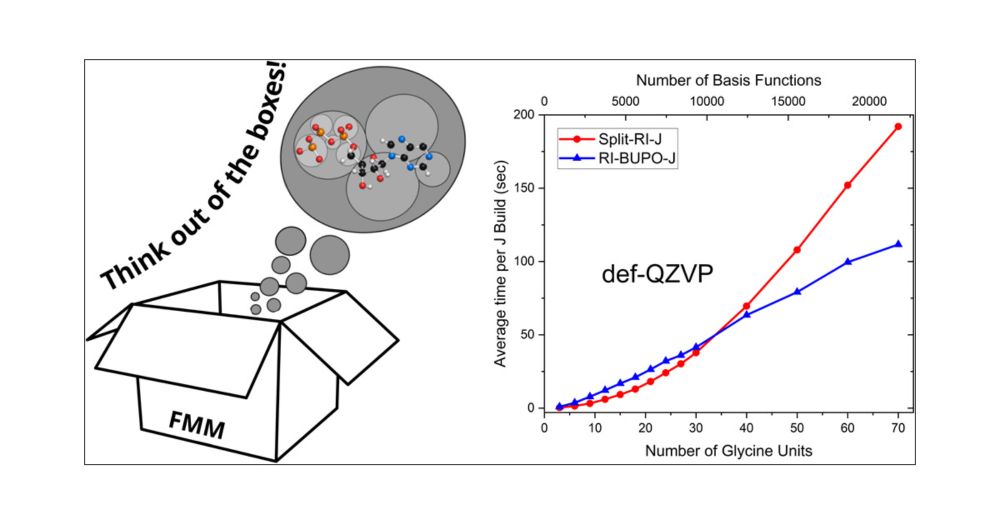
The “Bubblepole” (BUPO) Method for Linear-Scaling Coulomb Matrix Construction with or without Density Fitting
In this work, we describe the development of a new algorithm for the computation of Coulomb-type matrices using the well-known resolution of the identity (RI) or density fitting (DF) approximation. The method is linear-scaling with respect to system size and computationally highly efficient. For small molecules, it performs almost as well as the Split-RI-J algorithm (which might be the most efficient RI-J implementation to date), while outperforming it for larger systems with about 300 or more atoms. The method achieves linear scaling through multipole approximations and a hierarchical treatment of multipoles. However, unlike in the fast multipole method (FMM), the algorithm does not use a hierarchical boxing algorithm. Rather, close-lying objects like auxiliary basis shells and basis set shell pairs are grouped together in spheres that enclose the set of objects completely, which includes a new definition of the shell-pair extent that defines a real-space radius outside of which a given shell pair can be safely assumed to be negligible. We refer to these spheres as “bubbles” and therefore refer to the algorithm as the “Bubblepole” (BUPO) algorithm, with the acronym being RI-BUPO-J. The bubbles are constructed in a way to contain a nearly constant number of objects such that a very even workload arises. The hierarchical bubble structure adapts itself to the molecular topology and geometry. For any target object (shell pair or auxiliary shell), one might envision that the bubbles “carve” out what might be referred to as a “far-field surface”. Using the default settings determined in this work, we demonstrate that the algorithm reaches submicro-Eh and even nano-Eh accuracy in the total Coulomb energy for systems as large as 700 atoms and 7000 basis functions. The largest calculations performed (the crambin protein solvated by 500 explicit water molecules in a triple-ζ basis) featured more than 2000 atoms and more than 33,000 basis functions.
pubs.acs.org
March 3, 2025 at 2:52 PM
This paper is the start of something big - a new way to use Multipoles in electronic structure calculations. We are extremely excited and proud that this is out now.
pubs.acs.org/doi/10.1021/...
pubs.acs.org/doi/10.1021/...
Reposted by Markus Bursch

Quick follow up to the paper: here is GOAT doing a conformational search of a ligand on a protein pocket, including a few waters. The protein was frozen but does not need to be.
All done in ORCA6 using QM/MM for the PES.
Have fun with it! 😀 #compchemsky 🧪
onlinelibrary.wiley.com/doi/abs/10.1...
All done in ORCA6 using QM/MM for the PES.
Have fun with it! 😀 #compchemsky 🧪
onlinelibrary.wiley.com/doi/abs/10.1...
February 26, 2025 at 10:46 AM
Quick follow up to the paper: here is GOAT doing a conformational search of a ligand on a protein pocket, including a few waters. The protein was frozen but does not need to be.
All done in ORCA6 using QM/MM for the PES.
Have fun with it! 😀 #compchemsky 🧪
onlinelibrary.wiley.com/doi/abs/10.1...
All done in ORCA6 using QM/MM for the PES.
Have fun with it! 😀 #compchemsky 🧪
onlinelibrary.wiley.com/doi/abs/10.1...
Reposted by Markus Bursch

New CCH highlight: GOAT: A Global Optimization Algorithm for Molecules and Atomic Clusters
www.compchemhighlights.org/2025/02/goat... #compchem
www.compchemhighlights.org/2025/02/goat... #compchem

GOAT: A Global Optimization Algorithm for Molecules and Atomic Clusters
Bernardo de Souza (2025) Highlighted by Jan Jensen If you want to predict accurate reaction energies and barrier heights of typical organic ...
www.compchemhighlights.org
February 28, 2025 at 12:09 PM
New CCH highlight: GOAT: A Global Optimization Algorithm for Molecules and Atomic Clusters
www.compchemhighlights.org/2025/02/goat... #compchem
www.compchemhighlights.org/2025/02/goat... #compchem
Reposted by Markus Bursch
The ORCA team is looking for a postdoctoral fellow or Ph.D. student to work on XTB methodology jointly with the group of Prof. Stefan Grimme (University of Bonn).

February 26, 2025 at 9:27 AM
The ORCA team is looking for a postdoctoral fellow or Ph.D. student to work on XTB methodology jointly with the group of Prof. Stefan Grimme (University of Bonn).
Reposted by Markus Bursch
The paper on ORCA 6’s Global Optimization Algorithm GOAT is finally published at Angewandte Chemie! Feel free to try Bernardo's (@bernadsz.bsky.social) algorithm to generate conformer ensembles and much more.
doi.org/10.1002/anie...
Tutorial on GOAT: www.faccts.de/docs/orca/6....
#ORCAqc #ChemSky
doi.org/10.1002/anie...
Tutorial on GOAT: www.faccts.de/docs/orca/6....
#ORCAqc #ChemSky
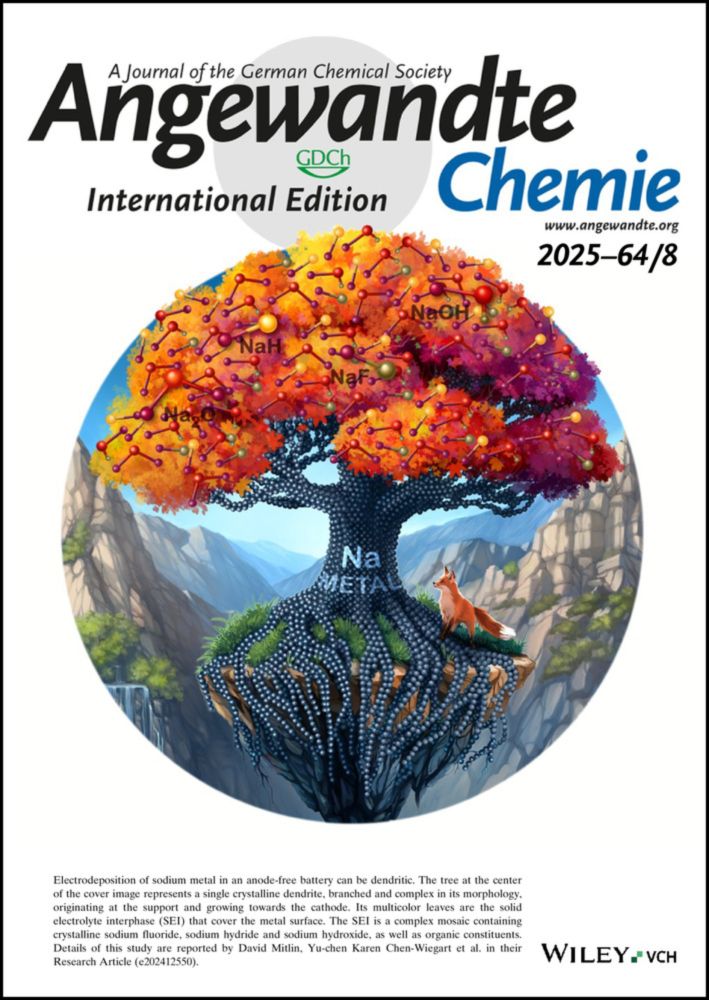
GOAT: A Global Optimization Algorithm for Molecules and Atomic Clusters
In this work, we propose a new Global Optimization Algorithm (GOAT) for molecules and clusters of atoms and show how it can find the global energy minima for both systems without resorting to molecul...
doi.org
February 19, 2025 at 9:24 AM
The paper on ORCA 6’s Global Optimization Algorithm GOAT is finally published at Angewandte Chemie! Feel free to try Bernardo's (@bernadsz.bsky.social) algorithm to generate conformer ensembles and much more.
doi.org/10.1002/anie...
Tutorial on GOAT: www.faccts.de/docs/orca/6....
#ORCAqc #ChemSky
doi.org/10.1002/anie...
Tutorial on GOAT: www.faccts.de/docs/orca/6....
#ORCAqc #ChemSky
Reposted by Markus Bursch
The quantum chemical prediction of EI-MS spectra is an important challenge. Check out @grimmelab.bsky.social's new preprint on their QCxMS2 program using ORCA's QM portfolio and NEB-TS infrastructure.
doi.org/10.26434/che...
#ORCAqc #ChemSky #CompChemSky #MassSpectrometry
doi.org/10.26434/che...
#ORCAqc #ChemSky #CompChemSky #MassSpectrometry
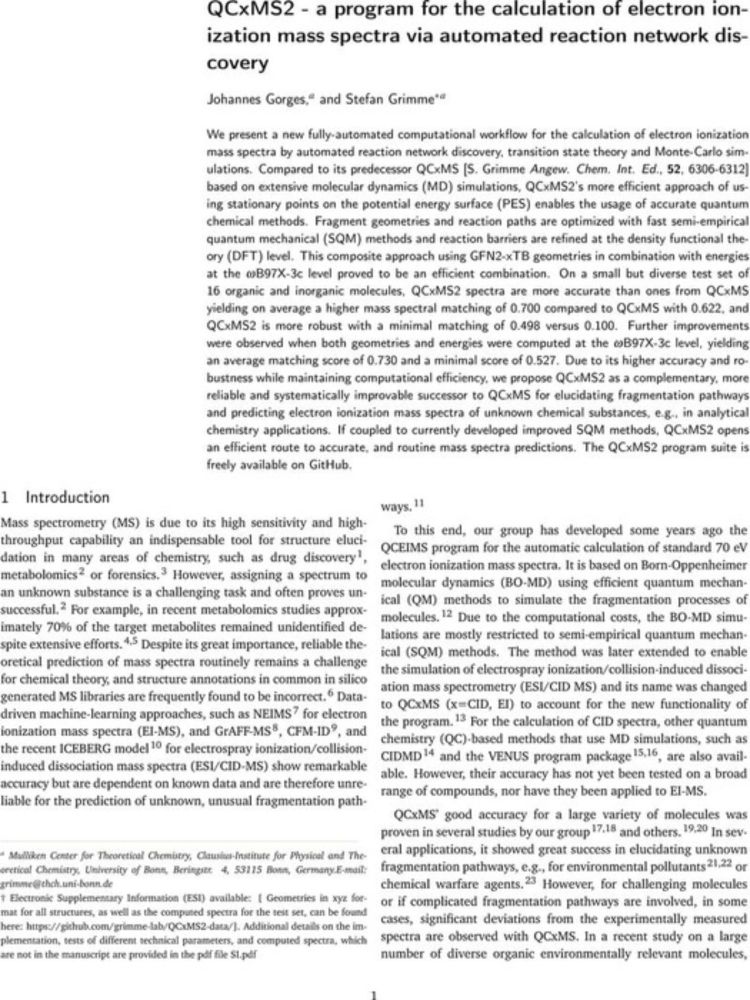
QCxMS2 - a program for the calculation of electron ion- ization mass spectra via automated reaction network dis- covery
We present a new fully-automated computational workflow for the calculation of electron ionization mass spectra by automated reaction network discovery, transition state theory and Monte-Carlo simulat...
doi.org
February 17, 2025 at 9:33 AM
The quantum chemical prediction of EI-MS spectra is an important challenge. Check out @grimmelab.bsky.social's new preprint on their QCxMS2 program using ORCA's QM portfolio and NEB-TS infrastructure.
doi.org/10.26434/che...
#ORCAqc #ChemSky #CompChemSky #MassSpectrometry
doi.org/10.26434/che...
#ORCAqc #ChemSky #CompChemSky #MassSpectrometry
Reposted by Markus Bursch
New video on how to calculate #Fluorescence spectra with #Orca using the ESD module! I follow the example for benzene from the manual.
#compchem #chemsky #science
youtu.be/zWzPkqN9SBo
#compchem #chemsky #science
youtu.be/zWzPkqN9SBo

Fluorescence Spectra with Orca
YouTube video by nicolas N
youtu.be
February 8, 2025 at 10:13 PM
New video on how to calculate #Fluorescence spectra with #Orca using the ESD module! I follow the example for benzene from the manual.
#compchem #chemsky #science
youtu.be/zWzPkqN9SBo
#compchem #chemsky #science
youtu.be/zWzPkqN9SBo
Reposted by Markus Bursch
All recordings of the ORCA workshop (@faccts-orca.bsky.social & @orca-qc-official.bsky.social) at the VWSCC 2025 (@vwscc.bsky.social) are now available on our YouTube Channel! Thank you to all participants who made it a great success.
www.youtube.com/playlist?lis...
#ORCAqc #ChemSky #VWSCC25
www.youtube.com/playlist?lis...
#ORCAqc #ChemSky #VWSCC25

VWSCC 2025 - YouTube
All recordings from the ORCA workshop at the Virtual Winter School on Computational Chemistry 2025.
www.youtube.com
February 7, 2025 at 12:45 PM
All recordings of the ORCA workshop (@faccts-orca.bsky.social & @orca-qc-official.bsky.social) at the VWSCC 2025 (@vwscc.bsky.social) are now available on our YouTube Channel! Thank you to all participants who made it a great success.
www.youtube.com/playlist?lis...
#ORCAqc #ChemSky #VWSCC25
www.youtube.com/playlist?lis...
#ORCAqc #ChemSky #VWSCC25
Reposted by Markus Bursch
Reposted by Markus Bursch
Also don't forget the xTB workshop by our friends and close collaborators at the @grimmelab.bsky.social. It will start today 10:00 CET!

January 31, 2025 at 8:50 AM
Also don't forget the xTB workshop by our friends and close collaborators at the @grimmelab.bsky.social. It will start today 10:00 CET!
Reposted by Markus Bursch
Join us at the free Virtual Winter School on Computational Chemistry and learn more about the features of ORCA 6! The ORCA workshop starts on Thursday, January 30th at 2 pm CET. The program and more information can be found here:
winterschool.cc/program/day-...
#ORCAqc #ORCA6 #VWSCC #ChemSky
winterschool.cc/program/day-...
#ORCAqc #ORCA6 #VWSCC #ChemSky
Virtual Winter School on Computational Chemistry - Workshop - ORCA 6
Online congress discussing state of the art computational chemistry
winterschool.cc
January 17, 2025 at 9:56 AM
Join us at the free Virtual Winter School on Computational Chemistry and learn more about the features of ORCA 6! The ORCA workshop starts on Thursday, January 30th at 2 pm CET. The program and more information can be found here:
winterschool.cc/program/day-...
#ORCAqc #ORCA6 #VWSCC #ChemSky
winterschool.cc/program/day-...
#ORCAqc #ORCA6 #VWSCC #ChemSky
Reposted by Markus Bursch

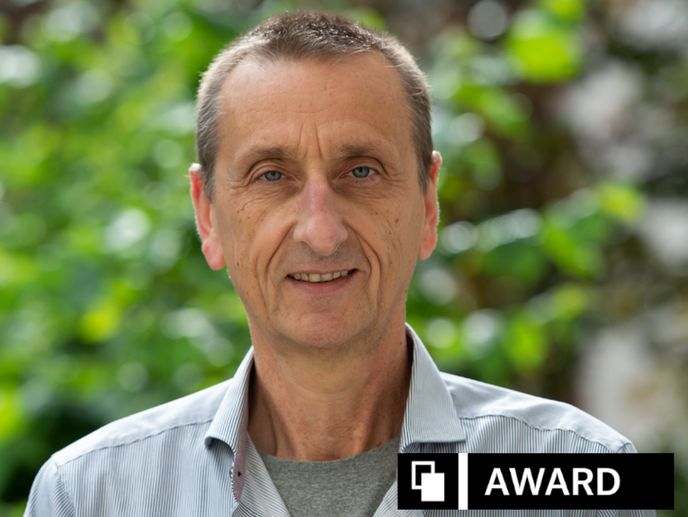
Stefan Grimme receives the 2025 Chemistry Europe Award!
Learn more at https://buff.ly/3BXDVhO.
#ChemistryAward #ChemistryEurope
Learn more at https://buff.ly/3BXDVhO.
#ChemistryAward #ChemistryEurope
January 16, 2025 at 7:38 AM
Stefan Grimme receives the 2025 Chemistry Europe Award!
Learn more at https://buff.ly/3BXDVhO.
#ChemistryAward #ChemistryEurope
Learn more at https://buff.ly/3BXDVhO.
#ChemistryAward #ChemistryEurope
Reposted by Markus Bursch

We're delighted to announce Stefan Grimme @grimmelab.bsky.social as the recipient of the 2025 Chemistry Europe Award! He'll be recognized "for his groundbreaking contributions that have had a profound impact on the scientific community” at #IUPAC2025.
www.chemistryviews.org/stefan-grimm...
#Chemsky
www.chemistryviews.org/stefan-grimm...
#Chemsky
January 16, 2025 at 9:18 AM
We're delighted to announce Stefan Grimme @grimmelab.bsky.social as the recipient of the 2025 Chemistry Europe Award! He'll be recognized "for his groundbreaking contributions that have had a profound impact on the scientific community” at #IUPAC2025.
www.chemistryviews.org/stefan-grimm...
#Chemsky
www.chemistryviews.org/stefan-grimm...
#Chemsky
Reposted by Markus Bursch
Missed the ORCA 6 Release Event? No problem, all talks are now available on our YouTube channel (youtube.com/@faccts_orca), the academic (MPI Kofo) ORCA channel (youtube.com/@orcaquantum...), and the ORCA forum (orcaforum.kofo.mpg.de/app.php/portal).
#ORCAqc #ORCA6 #CompChem #QuantumChem #ChemSky
#ORCAqc #ORCA6 #CompChem #QuantumChem #ChemSky

FACCTs
FACCTs is bringing the ORCA software to industry - promoting the next Quantum leaps in the Pharma, Materials and Chemical Industries.
youtube.com
September 5, 2024 at 10:56 AM
Missed the ORCA 6 Release Event? No problem, all talks are now available on our YouTube channel (youtube.com/@faccts_orca), the academic (MPI Kofo) ORCA channel (youtube.com/@orcaquantum...), and the ORCA forum (orcaforum.kofo.mpg.de/app.php/portal).
#ORCAqc #ORCA6 #CompChem #QuantumChem #ChemSky
#ORCAqc #ORCA6 #CompChem #QuantumChem #ChemSky
Reposted by Markus Bursch
Save the date! We (@faccts-orca.bsky.social)will visit the 18th German Conference on Cheminformatics (GCC 2024, @gdch.bsky.social) in Bad Soden am Taunus, Germany from November 3rd to 6th. Visit us to find out more about us and our tools.
#GCC2024 #ORCA6 #CompChem #ChemInformatics #ChemSky
#GCC2024 #ORCA6 #CompChem #ChemInformatics #ChemSky

September 9, 2024 at 8:45 AM
Save the date! We (@faccts-orca.bsky.social)will visit the 18th German Conference on Cheminformatics (GCC 2024, @gdch.bsky.social) in Bad Soden am Taunus, Germany from November 3rd to 6th. Visit us to find out more about us and our tools.
#GCC2024 #ORCA6 #CompChem #ChemInformatics #ChemSky
#GCC2024 #ORCA6 #CompChem #ChemInformatics #ChemSky
Reposted by Markus Bursch
ORCA offers a wide range of quantum chemical spectroscopy methods that can help solve complex chemical challenges. Learn more about them in our tutorials and our brand new online manual.
www.faccts.de/docs/orca/6....
www.faccts.de/docs/orca/6....
doi.org/10.1021/acs....
#ORCAqc #ChemSky
www.faccts.de/docs/orca/6....
www.faccts.de/docs/orca/6....
doi.org/10.1021/acs....
#ORCAqc #ChemSky

Solar Light CO2 Photoreduction Enhancement by Mononuclear Rhenium(I) Complexes: Characterization and Mechanistic Insights
The catalytic efficacy of a novel mononuclear rhenium(I) complex in CO2 reduction is remarkable, with a turnover number (TONCO) of 1517 in 3 h, significantly outperforming previous Re(I) catalysts. Th...
doi.org
September 16, 2024 at 8:55 AM
ORCA offers a wide range of quantum chemical spectroscopy methods that can help solve complex chemical challenges. Learn more about them in our tutorials and our brand new online manual.
www.faccts.de/docs/orca/6....
www.faccts.de/docs/orca/6....
doi.org/10.1021/acs....
#ORCAqc #ChemSky
www.faccts.de/docs/orca/6....
www.faccts.de/docs/orca/6....
doi.org/10.1021/acs....
#ORCAqc #ChemSky
Reposted by Markus Bursch
The first Quantum Mechanics in Pharma meeting starts today! Don't miss Christoph Riplinger’s (@faccts-orca.bsky.social) talk about "High-accuracy QM in life sciences: From drug properties to binding modes" at 15.40 (3:40 pm).
#ORCAqc #ORCA6 #CompChem #QuantumChem #PharmaChem #QMinPharma24 #ChemSky
#ORCAqc #ORCA6 #CompChem #QuantumChem #PharmaChem #QMinPharma24 #ChemSky

September 18, 2024 at 8:06 AM
The first Quantum Mechanics in Pharma meeting starts today! Don't miss Christoph Riplinger’s (@faccts-orca.bsky.social) talk about "High-accuracy QM in life sciences: From drug properties to binding modes" at 15.40 (3:40 pm).
#ORCAqc #ORCA6 #CompChem #QuantumChem #PharmaChem #QMinPharma24 #ChemSky
#ORCAqc #ORCA6 #CompChem #QuantumChem #PharmaChem #QMinPharma24 #ChemSky
Reposted by Markus Bursch
New video on using the GOAT method to find global minima with Orca and XTB, for a corrole dimer.
#compchem #chemsky
Pls help me share!
youtu.be/GvTNg2gKuZc
#compchem #chemsky
Pls help me share!
youtu.be/GvTNg2gKuZc
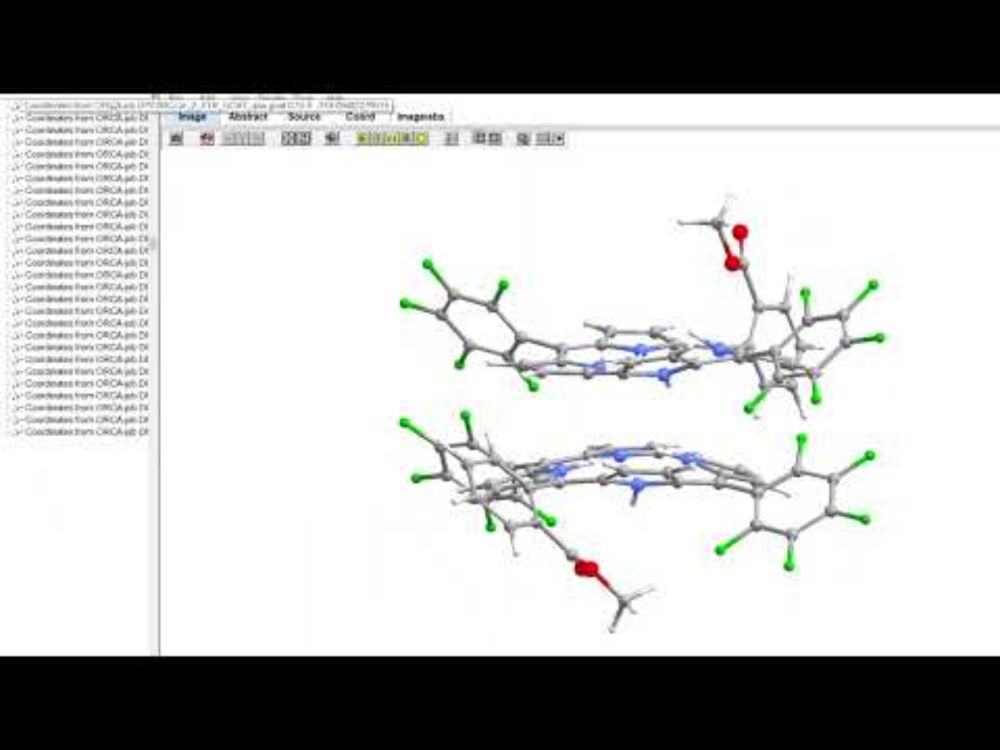
Global optimization using Orca6 and GOAT!
YouTube video by nicolas N
youtu.be
September 11, 2024 at 7:35 PM
New video on using the GOAT method to find global minima with Orca and XTB, for a corrole dimer.
#compchem #chemsky
Pls help me share!
youtu.be/GvTNg2gKuZc
#compchem #chemsky
Pls help me share!
youtu.be/GvTNg2gKuZc