




Melike
@mberksoz.bsky.social
Postdoctoral Researcher @Sabanci University - comp bio
https://mberksoz.github.io/
https://mberksoz.github.io/
Reposted by Melike

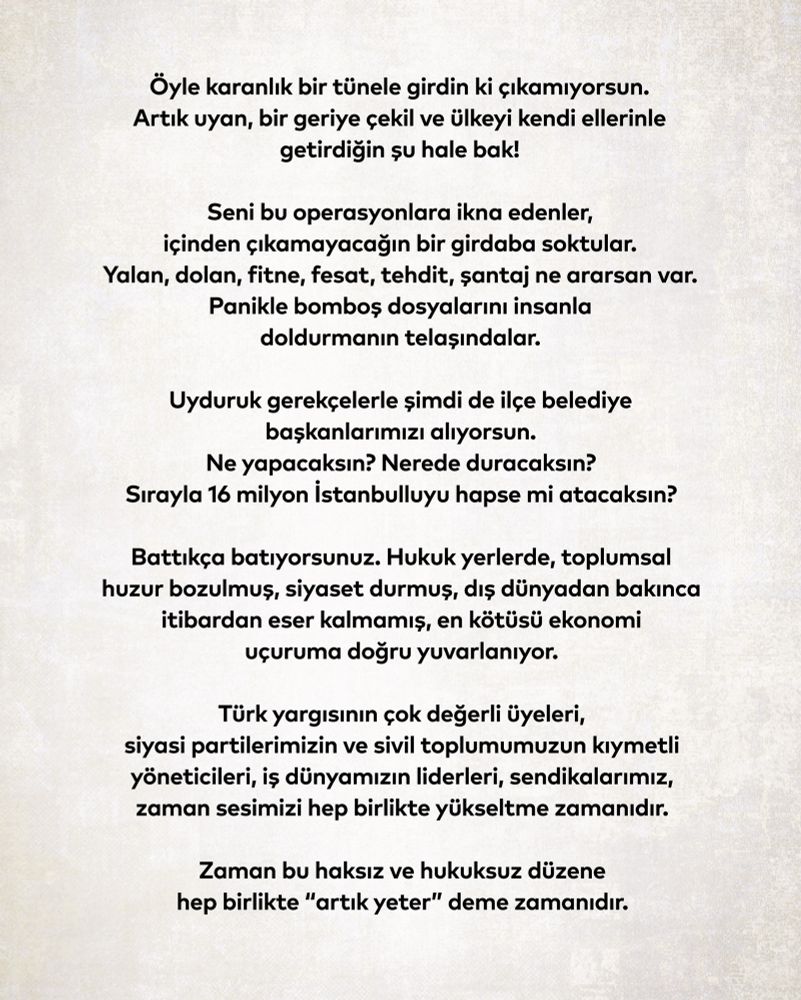
Öyle karanlık bir tünele girdin ki çıkamıyorsun. Artık uyan, bir geriye çekil ve ülkeyi kendi ellerinle getirdiğin şu hale bak!
May 31, 2025 at 11:24 AM
Öyle karanlık bir tünele girdin ki çıkamıyorsun. Artık uyan, bir geriye çekil ve ülkeyi kendi ellerinle getirdiğin şu hale bak!
Chatgpt 4.5 is horrible for any research query. It hallucinates like crazy, mostly pulls up wikipedia pages as primary resource.
March 7, 2025 at 9:12 PM
Chatgpt 4.5 is horrible for any research query. It hallucinates like crazy, mostly pulls up wikipedia pages as primary resource.
We developed a computationally efficient method to predict hot spots driving conformational changes in small molecule sensing proteins. It can easily be generalized to explore allosteric couplings in a wide range of proteins. Code available in the preprint, check it out ! #compchem #compbio
Can we determine the positions whose simulataneous perturbation would lead to maximum overlap between two conformers? We solve this problem and demonstrate its utility on sensor design -- by @mberksoz.bsky.social, @ara-17.bsky.social, Burak Kocuk and @cananatlgn.bsky.social
February 11, 2025 at 7:12 PM
Reposted by Melike
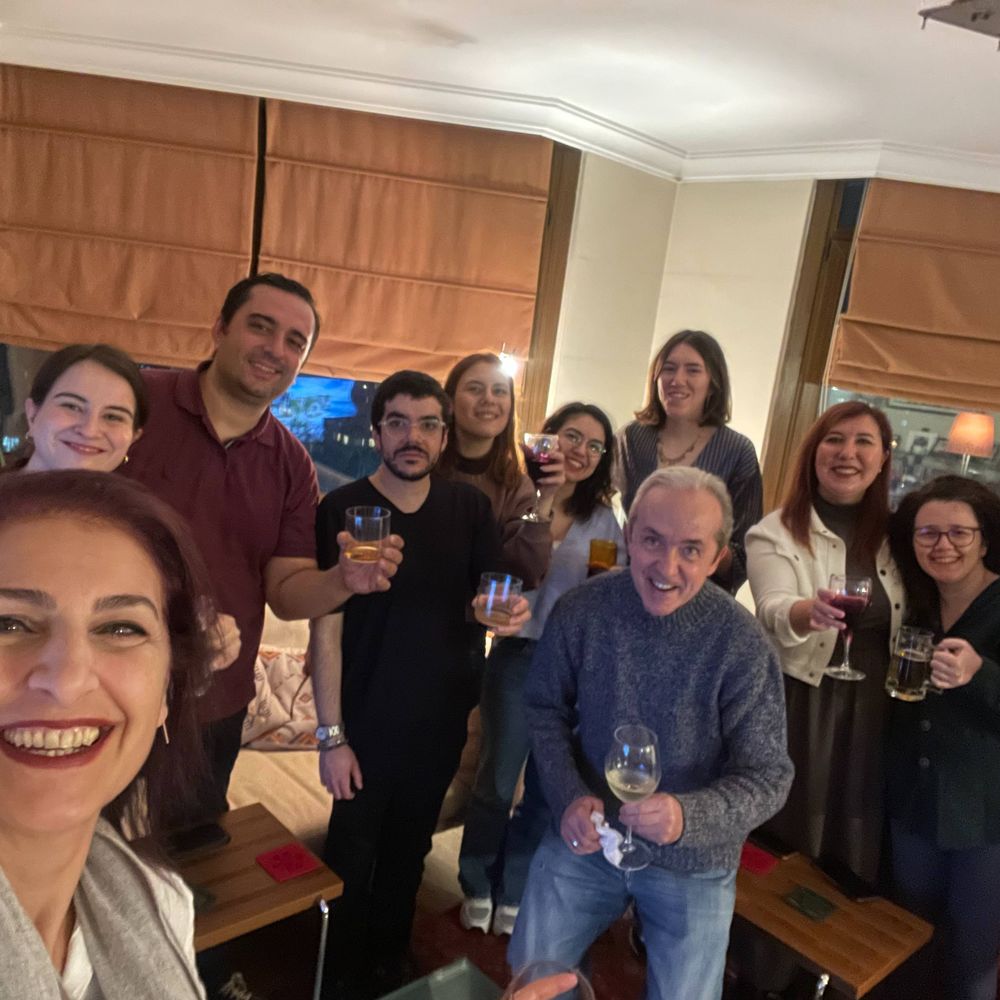
We have just moved here, and trying to get settled. Let's start with the good news of the day: Our manuscript on 'Ranking Single Fluorescent Protein-Based Calcium Biosensor Performance by Molecular Dynamics Simulations' was the #HighlightOfTheWeek by @JCIM_JCTC. x.com/JCIM_JCTC/st...
x.com
x.com
January 23, 2025 at 6:12 PM
We have just moved here, and trying to get settled. Let's start with the good news of the day: Our manuscript on 'Ranking Single Fluorescent Protein-Based Calcium Biosensor Performance by Molecular Dynamics Simulations' was the #HighlightOfTheWeek by @JCIM_JCTC. x.com/JCIM_JCTC/st...
Reposted by Melike

Summer seems still far away, but actually there's less than one month time to register! Take a look at this video to get into the summer school mood: www.youtube.com/watch?v=ad9E...
January 16, 2025 at 1:58 PM
Summer seems still far away, but actually there's less than one month time to register! Take a look at this video to get into the summer school mood: www.youtube.com/watch?v=ad9E...
This is peak documentary filmmaking.

January 16, 2025 at 7:49 PM
This is peak documentary filmmaking.
Reposted by Melike
Deep learning for proteins tutorial: github.com/Graylab/DL4P...
GitHub - Graylab/DL4Proteins-notebooks: Colab Notebooks covering deep learning tools for biomolecular structure prediction and design
Colab Notebooks covering deep learning tools for biomolecular structure prediction and design - Graylab/DL4Proteins-notebooks
github.com
December 28, 2024 at 3:15 AM
Deep learning for proteins tutorial: github.com/Graylab/DL4P...
Check out our latest paper in JCIM, where we dive into the mystery of fluorescent biosensors—how they work and why some outshine others—using classical and enhanced MD simulations. @cananatlgn.bsky.social #compchem
pubs.acs.org/doi/10.1021/...
pubs.acs.org/doi/10.1021/...

Ranking Single Fluorescent Protein-Based Calcium Biosensor Performance by Molecular Dynamics Simulations
Genetically encoded fluorescent biosensors (GEFBs) have become indispensable tools for visualizing biological processes in vivo. A typical GEFB is composed of a sensory domain (SD) that undergoes a conformational change upon ligand binding or enzymatic reaction; the SD is genetically fused with a fluorescent protein (FP). The changes in the SD allosterically modulate the chromophore environment whose spectral properties are changed. Single fluorescent (FP)-based biosensors, a subclass of GEFBs, offer a simple experimental setup; they are easy to produce in living cells, structurally stable, and simple to use due to their single-wavelength operation. However, they pose a significant challenge for structure optimization, especially concerning the length and residue content of linkers between the FP and SD, which affect how well the chromophore responds to conformational change in the SD. In this work, we use all-atom molecular dynamics simulations to analyze the dynamic properties of a series of calmodulin-based calcium biosensors, all with different FP–SD interaction interfaces and varying degrees of calcium binding-dependent fluorescence change. Our results indicate that biosensor performance can be predicted based on distribution of water molecules around the chromophore and shifts in hydrogen bond occupancies between the ligand-bound and ligand-free sensor structures.
pubs.acs.org
January 11, 2025 at 2:23 PM
Check out our latest paper in JCIM, where we dive into the mystery of fluorescent biosensors—how they work and why some outshine others—using classical and enhanced MD simulations. @cananatlgn.bsky.social #compchem
pubs.acs.org/doi/10.1021/...
pubs.acs.org/doi/10.1021/...