



Michael W. Reimann
@mwolfr.bsky.social
Neuroscientist and Data Scientist | Group Leader Connectomics
My talk at CNS*2025 seemed to be well-received, so we wrote it up as a paper. doi.org/10.1101/2025.... Might be worth your time if you are interested in the wiring structure of neuronal circuitry - it's only 12 pages without methods.

Neuron morphological physicality and variability define the non-random structure of connectivity
Connectivity in neuronal networks is characterized by high complexity that is required for the correct function of the circuitry. Our attempts to capture it has thus far been limited to the addition o...
doi.org
August 25, 2025 at 10:08 AM
My talk at CNS*2025 seemed to be well-received, so we wrote it up as a paper. doi.org/10.1101/2025.... Might be worth your time if you are interested in the wiring structure of neuronal circuitry - it's only 12 pages without methods.
Anyone at CNS*2025 in Florence? I hope to see you on Wednesday in our workshop: Bridging Complexity and Abstraction: Large-Scale Mechanistic Models of Brain Circuits from Biophysically Detailed to Simplified Representations.
July 7, 2025 at 9:00 AM
Anyone at CNS*2025 in Florence? I hope to see you on Wednesday in our workshop: Bridging Complexity and Abstraction: Large-Scale Mechanistic Models of Brain Circuits from Biophysically Detailed to Simplified Representations.
Just released a preprint for everyone interested in connectomics. Specifically, local connectivity at cellular resolution, but also long-range connectivity. www.biorxiv.org/content/10.1...
An algorithm to model the non-random connectome of cortical circuitry
Neuronal connectivity has been characterized at various scales and with respect to various structural aspects. In models of connectivity, it has so far remained difficult to match all of them at once,...
www.biorxiv.org
May 28, 2025 at 2:13 PM
Just released a preprint for everyone interested in connectomics. Specifically, local connectivity at cellular resolution, but also long-range connectivity. www.biorxiv.org/content/10.1...
Reposted by Michael W. Reimann

It's finally out!
Visual experience orthogonalizes visual cortical responses
Training in a visual task changes V1 tuning curves in odd ways. This effect is explained by a simple convex transformation. It orthogonalizes the population, making it easier to decode.
10.1016/j.celrep.2025.115235
Visual experience orthogonalizes visual cortical responses
Training in a visual task changes V1 tuning curves in odd ways. This effect is explained by a simple convex transformation. It orthogonalizes the population, making it easier to decode.
10.1016/j.celrep.2025.115235
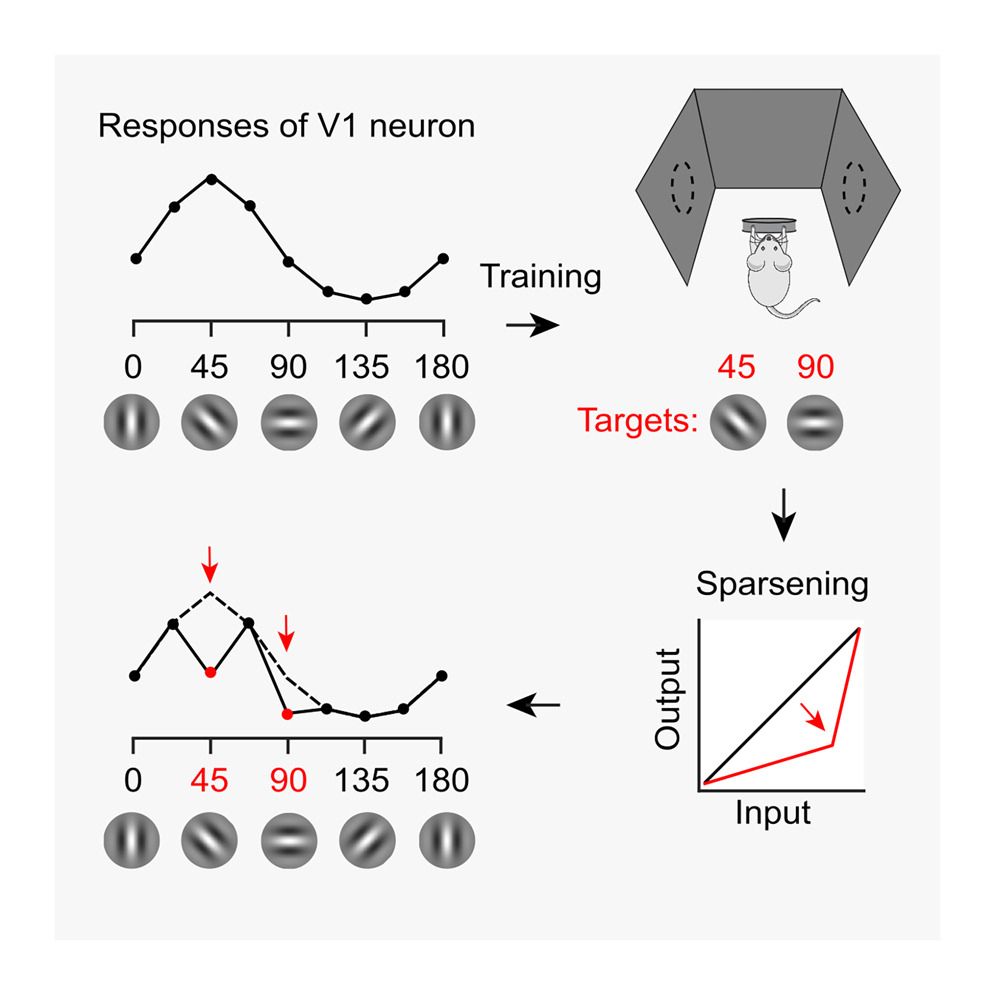
February 2, 2025 at 9:59 AM
It's finally out!
Visual experience orthogonalizes visual cortical responses
Training in a visual task changes V1 tuning curves in odd ways. This effect is explained by a simple convex transformation. It orthogonalizes the population, making it easier to decode.
10.1016/j.celrep.2025.115235
Visual experience orthogonalizes visual cortical responses
Training in a visual task changes V1 tuning curves in odd ways. This effect is explained by a simple convex transformation. It orthogonalizes the population, making it easier to decode.
10.1016/j.celrep.2025.115235
Reposted by Michael W. Reimann

Does the culture you grow up in shape the way you see the world? In a new Psych Review paper, @chazfirestone.bsky.social & I tackle this centuries-old question using the Müller-Lyer illusion as a case study. Come think through one of history's mysteries with us🧵(1/13):
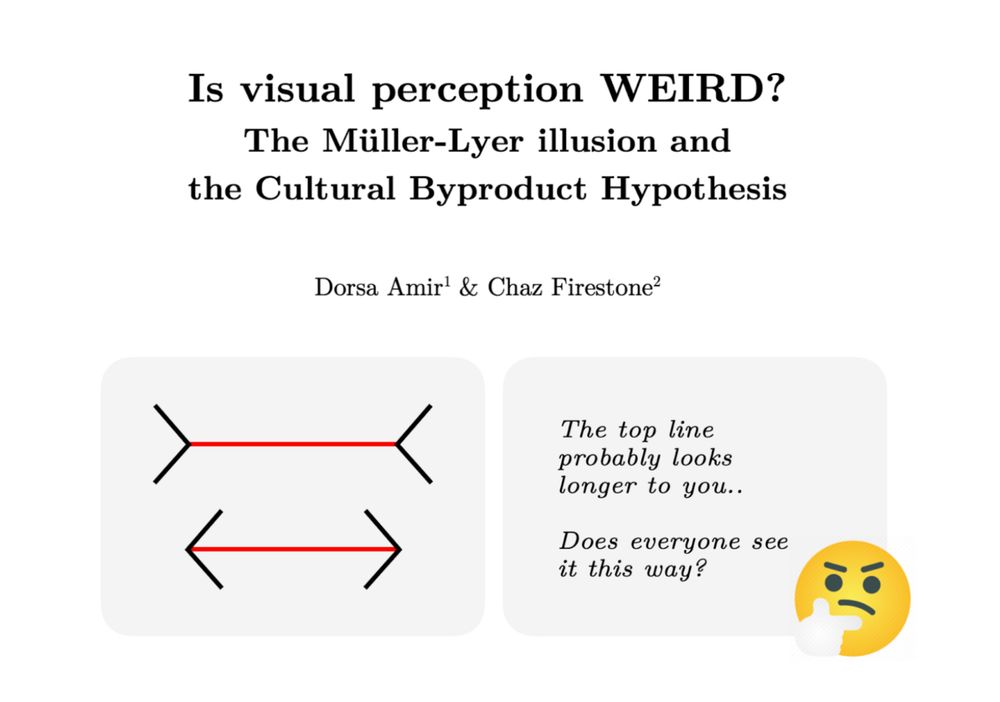
January 25, 2025 at 10:05 PM
Does the culture you grow up in shape the way you see the world? In a new Psych Review paper, @chazfirestone.bsky.social & I tackle this centuries-old question using the Müller-Lyer illusion as a case study. Come think through one of history's mysteries with us🧵(1/13):
Reposted by Michael W. Reimann

Leslie Ungerleider (1946 - 2020) was an extraordinary, pioneering neuroscientist. The latest issue of @jocn.bsky.social honors her legacy with articles authored by former colleagues & trainees that highlight critical aspects of her work and its influence https://buff.ly/4156UKw #cogsci #neuroscience

December 4, 2024 at 12:40 AM
Leslie Ungerleider (1946 - 2020) was an extraordinary, pioneering neuroscientist. The latest issue of @jocn.bsky.social honors her legacy with articles authored by former colleagues & trainees that highlight critical aspects of her work and its influence https://buff.ly/4156UKw #cogsci #neuroscience
Reposted by Michael W. Reimann

petition to change the word describing ChatGPT's mistakes from 'hallucinations' to 'confabulations'
A hallucination is a false subjective sensory experience. ChatGPT doesn't have experiences!
It's just making up plausible-sounding bs, covering knowledge gaps. That's confabulation
A hallucination is a false subjective sensory experience. ChatGPT doesn't have experiences!
It's just making up plausible-sounding bs, covering knowledge gaps. That's confabulation
December 11, 2024 at 9:47 AM
petition to change the word describing ChatGPT's mistakes from 'hallucinations' to 'confabulations'
A hallucination is a false subjective sensory experience. ChatGPT doesn't have experiences!
It's just making up plausible-sounding bs, covering knowledge gaps. That's confabulation
A hallucination is a false subjective sensory experience. ChatGPT doesn't have experiences!
It's just making up plausible-sounding bs, covering knowledge gaps. That's confabulation
Lots of neuroscience discoveries are based on spike sorting data, but we know it captures only parts of what's going on. Through modeling we predict which parts are captured and which are missed. 🧪
We hope the data set helps improve spike sorting even further!
www.biorxiv.org/content/10.1...
We hope the data set helps improve spike sorting even further!
www.biorxiv.org/content/10.1...

Spike sorting biases and information loss in a detailed cortical model
Sorting electrical signals (spikes) from extracellular recordings of large groups of connected neurons is essential to understanding brain function. Despite transformative advances in dense extracellu...
www.biorxiv.org
December 9, 2024 at 9:25 AM
Lots of neuroscience discoveries are based on spike sorting data, but we know it captures only parts of what's going on. Through modeling we predict which parts are captured and which are missed. 🧪
We hope the data set helps improve spike sorting even further!
www.biorxiv.org/content/10.1...
We hope the data set helps improve spike sorting even further!
www.biorxiv.org/content/10.1...
I am happy to announce that our latest work has been published in The MIT Press' Network Neuroscience (doi.org/10.1162/netn...). In this methods paper, we present a novel Python framework for rapid connectome manipulations of detailed, biologically realistic network models in SONATA format.

A connectome manipulation framework for the systematic and reproducible study of structure–function relationships through simulations
Abstract. Synaptic connectivity at the neuronal level is characterized by highly non-random features. Hypotheses about their role can be developed by correlating structural metrics to functional featu...
doi.org
December 3, 2024 at 2:42 PM
I am happy to announce that our latest work has been published in The MIT Press' Network Neuroscience (doi.org/10.1162/netn...). In this methods paper, we present a novel Python framework for rapid connectome manipulations of detailed, biologically realistic network models in SONATA format.
Reposted by Michael W. Reimann

Great blog by Bodo Stern (@hhmi.bsky.social) about the recent Clarivate decision on @elife.bsky.social’s impact factor. www.coalition-s.org/blog/how-the...

How the Web of Science takes a step back
<p>The Web of Science, a major commercial indexing service of scientific journals operated by Clarivate, recently decided to remove eLife from its Science Citation Index Expanded (SCIE). eLife will on...
www.coalition-s.org
November 30, 2024 at 7:39 AM
Great blog by Bodo Stern (@hhmi.bsky.social) about the recent Clarivate decision on @elife.bsky.social’s impact factor. www.coalition-s.org/blog/how-the...
We are happy to announce that our latest connectomics work has been published by Cerebral Cortex. We have analyzed one of our favorite open datasets: MICrONS cortical mm^3. In this EM dataset we found new rules for neuronal connectivity & describe them (doi.org/10.1093/cerc...) (1/3)

Specific inhibition and disinhibition in the higher-order structure of a cortical connectome
Abstract. Neurons are thought to act as parts of assemblies with strong internal excitatory connectivity. Conversely, inhibition is often reduced to blanke
doi.org
November 19, 2024 at 9:32 AM
We are happy to announce that our latest connectomics work has been published by Cerebral Cortex. We have analyzed one of our favorite open datasets: MICrONS cortical mm^3. In this EM dataset we found new rules for neuronal connectivity & describe them (doi.org/10.1093/cerc...) (1/3)