




Blair Shevlin
@bshev.bsky.social
Postdoc @ Icahn School of Medicine. Computational Psychiatry. Neuroeconomics. Decision-Making
Reposted by Blair Shevlin
Department of Psychological & Brain Sciences at Johns Hopkins is inviting applications for 3 open-rank tenured/tenure-track positions in (1) Behavioral Neuroscience, (2) Cognitive Neuroscience, and (3) Cognitive Psychology.
pbs.jhu.edu/about/jobs/
pbs.jhu.edu/about/jobs/

Jobs | Psychological & Brain Sciences
Tenured/Tenure-track position in Cognitive Psychology Open Date Dec 01, 2025 Salary Range or Pay Grade The expected academic base salary range for this position is $110,000- $144,500 (Assistant Profes...
pbs.jhu.edu
December 2, 2025 at 12:00 AM
Department of Psychological & Brain Sciences at Johns Hopkins is inviting applications for 3 open-rank tenured/tenure-track positions in (1) Behavioral Neuroscience, (2) Cognitive Neuroscience, and (3) Cognitive Psychology.
pbs.jhu.edu/about/jobs/
pbs.jhu.edu/about/jobs/
Reposted by Blair Shevlin

CogSci in Aarhus is hiring, open rank (assi, asso or full prof).
We want somebody working on and teaching computational modelling of cognitive processes and/or social processes. Students are amazing, work/life balance very satisfactory, and colleagues are nice!
international.au.dk/about/profil...
We want somebody working on and teaching computational modelling of cognitive processes and/or social processes. Students are amazing, work/life balance very satisfactory, and colleagues are nice!
international.au.dk/about/profil...

Assistant Professor, Associate Professor or Full Professor of Cognitive Science - Vacancy at Aarhus University
Vacancy at School of Communication and Culture - Linguistics, Cognitive Science and Semiotics, Dept. of, Aarhus University
international.au.dk
November 26, 2025 at 11:38 AM
CogSci in Aarhus is hiring, open rank (assi, asso or full prof).
We want somebody working on and teaching computational modelling of cognitive processes and/or social processes. Students are amazing, work/life balance very satisfactory, and colleagues are nice!
international.au.dk/about/profil...
We want somebody working on and teaching computational modelling of cognitive processes and/or social processes. Students are amazing, work/life balance very satisfactory, and colleagues are nice!
international.au.dk/about/profil...
Reposted by Blair Shevlin

1/3 How reward prediction errors shape memory: when people gamble and cues signal unexpectedly high reward probability, those incidental images are remembered better than ones on safe trials, linking RL computations to episodic encoding. #RewardSignals #neuroskyence www.nature.com/articles/s41...

Positive reward prediction errors during decision-making strengthen memory encoding - Nature Human Behaviour
Jang and colleagues show that positive reward prediction errors elicited during incidental encoding enhance the formation of episodic memories.
www.nature.com
November 30, 2025 at 11:12 AM
1/3 How reward prediction errors shape memory: when people gamble and cues signal unexpectedly high reward probability, those incidental images are remembered better than ones on safe trials, linking RL computations to episodic encoding. #RewardSignals #neuroskyence www.nature.com/articles/s41...
Reposted by Blair Shevlin


Reposted by Blair Shevlin

Out now in Translational Psychiatry! www.nature.com/articles/s41...
November 28, 2025 at 2:53 PM
Out now in Translational Psychiatry! www.nature.com/articles/s41...
Reposted by Blair Shevlin

New study out today in Nature Comms: www.nature.com/articles/s41..., in which we set out to test whether ultrasound could influence the reward-related learning computations of the nucleus accumbens, building on decades of work on dopaminergic prediction error and reinforcement learning. And it did.

Non-invasive ultrasonic neuromodulation of the human nucleus accumbens impacts reward sensitivity - Nature Communications
This study shows that non-invasive ultrasound to the human nucleus accumbens can modulate deep brain activity and enhance reward-guided learning, offering a potential alternative to invasive neuromodu...
www.nature.com
November 28, 2025 at 12:26 PM
New study out today in Nature Comms: www.nature.com/articles/s41..., in which we set out to test whether ultrasound could influence the reward-related learning computations of the nucleus accumbens, building on decades of work on dopaminergic prediction error and reinforcement learning. And it did.
Reposted by Blair Shevlin
Very happy that this is out www.nature.com/articles/s44.... Together with @stefankiebel.bsky.social we show that decision biases in context-dependent decision making, previously attributed to different forms of value normalization, are very well explained by habit-like action repetition.

Action repetition biases choice in context-dependent decision-making - Communications Psychology
This study shows that decision biases previously attributed to value normalization (e.g. relative value learning or range normalization) are better explained by action repetition. Repeating an action ...
www.nature.com
November 27, 2025 at 6:43 PM
Very happy that this is out www.nature.com/articles/s44.... Together with @stefankiebel.bsky.social we show that decision biases in context-dependent decision making, previously attributed to different forms of value normalization, are very well explained by habit-like action repetition.
Reposted by Blair Shevlin
Would happily go to the mat with anyone's uncle on behalf of any of these courses. I would probably volunteer to guest lecture a week in half of them.

ruin your thanksgiving by reading new york magazine's take on mathematics
![The Ten Most
Ridiculous-Sounding
Math Classes Currently
Offered at Liberal-Arts
Colleges
By Jessica Pressler, Janelle Zara, and Emily Watkins Rachel Stein andAviva Shen OCT. 19, 2010
Every year, liberal-arts majors anxiously scour their college's course listings looking for classes that will fulfill their math requirement but aren't so, you know, math-y. Here's what they're signed up for this year.
10. Topology: The Nature of Shape and Space: "In geometry we ask: How big is it? How long is it? But in topology we ask: Is it [Sarah Lawrence
9. The Mathematies of Chance: "Most topics are introduced ina case-study fashion, usually by reading an article in a current periodical such as the New York Times. [Bard]](https://cdn.bsky.app/img/feed_thumbnail/plain/did:plc:5itm7jsyrdqdxizkb4cufqxl/bafkreieq6gmwmropzlvjkaaxk6d2smd4tv4dy7qar66uoyv6mhs6naa3fu@jpeg)
![8. Mathematics in Many Cultures: "Mathematical ideas are found in many cultures, among both literate and non-literate peoples. This course examines both mathematics and the role it plays in the cultures. Examples chosen from the mathematical ideas of present-day peoples of Africa, Asia, Oceania and the Americas, as well as historic Egypt, Mesopotamia, Greece, Islam and China." [Pomona]
7. The Magic of Numbers: "This course will explore the beauty and mystery of mathematics through a study of the patterns and properties of the natural numbers 1, 2, [and] 3." [Harvard
6. Models of Life: In particular, we will ask such questions as: How do you model the growth of a population of animals? How can you model the growth of a tree? How do sunflowers and seashells grow?" [Kenyon]](https://cdn.bsky.app/img/feed_thumbnail/plain/did:plc:5itm7jsyrdqdxizkb4cufqxl/bafkreic3c4ox53ouwr3ij3wsmvetmuknu2u2jai7hlvuigco3ahppeoabi@jpeg)
![5. Mathematical Origamist's Toolkit: "Topics include modular origami and how this models the creation of polyhedra and coloring of graphs, comparison of origami-axiomatic constructions to straight-edge and compass constructions, the combinatorics of possible crease patterns, the mathematics of origami design (circle packing, optimization), matrix models for paperfolding, spherical geometry, Descartes' Theorem, and Gaussian curvature." [Hampshire]
4. Mathematics and Narrative: "Many literary works (Arcadia, Proof, and Uncle Petros and the Goldbach Conjecture) use mathematics as an integral part of their narrative. Movie and television narratives such as Good Will Hunting and Numb3rs are also mathematically based. Nonfiction works about mathematics and mathematical biographies like Chaos, Fermat's Enigma, and A Beautiful Mind provide further examples of the connection between mathematics and narrative." [Vassar]](https://cdn.bsky.app/img/feed_thumbnail/plain/did:plc:5itm7jsyrdqdxizkb4cufqxl/bafkreigyk5tqjszw3fodt7ivmszq7mozpta55o7c552oyzpbqyphl26x7m@jpeg)
![3. Borges and Mathematics: "Jorge Luis Borges was one of the most important writers of the 20th century. Many of his short stories and essays were concerned with philosophical, metaphysical, and mathematical questions. The thesis motivating this course is that if we know the mathematies that Borges referred to, then we will read him differently, and we will read him better." [Bennington 2. Mathematics and Science as Art in Contemporary Theatre: "Playwrights such as Tom Stoppard, Rinne Groff, Michael Frayn, and others have effectively explored mathematical and scientific themes for artistic purposes. Through readings and exercises, and by conducting labs and staging scenes, this class will gain some first-hand insight into the complementary ways in which science and art aim to seek out their respective truths." [Middlebury]
1. Meaning, Math, And Motion: "Quoting a charming articulation by Kinsman (a mathematician-turned-oceanographer, in the preface to Wind Waves): "To the beginner, science is a conversation that has been in progress for a very long time. Our collective work is to catch up on the conversation. [Evergreen]
This is why Asia is winning, by the way.](https://cdn.bsky.app/img/feed_thumbnail/plain/did:plc:5itm7jsyrdqdxizkb4cufqxl/bafkreihglx3kxej43i22j4vggyoutp2oyomivtmmvgp6uvslqemm4hhpci@jpeg)
November 27, 2025 at 3:49 PM
Would happily go to the mat with anyone's uncle on behalf of any of these courses. I would probably volunteer to guest lecture a week in half of them.
Reposted by Blair Shevlin

Nature research paper: Building compositional tasks with shared neural subspaces
go.nature.com/4ocRj3n
go.nature.com/4ocRj3n

Building compositional tasks with shared neural subspaces - Nature
The brain can flexibly perform multiple tasks by compositionally combining task-relevant neural representations.
go.nature.com
November 27, 2025 at 11:37 AM
Nature research paper: Building compositional tasks with shared neural subspaces
go.nature.com/4ocRj3n
go.nature.com/4ocRj3n
Reposted by Blair Shevlin

Y’all are reading this paper in the wrong way.
We love to trash dominant hypothesis, but we need to look for evidence against the manifold hypothesis elsewhere:
This elegant work doesn't show neural dynamics are high D, nor that we should stop using PCA
It’s quite the opposite!
(thread)
We love to trash dominant hypothesis, but we need to look for evidence against the manifold hypothesis elsewhere:
This elegant work doesn't show neural dynamics are high D, nor that we should stop using PCA
It’s quite the opposite!
(thread)

“Our findings challenge the conventional focus on low-dimensional coding subspaces as a sufficient framework for understanding neural computations, demonstrating that dimensions previously considered task-irrelevant and accounting for little variance can have a critical role in driving behavior.”

Neural dynamics outside task-coding dimensions drive decision trajectories through transient amplification
Most behaviors involve neural dynamics in high-dimensional activity spaces. A common approach is to extract dimensions that capture task-related variability, such as those separating stimuli or choice...
www.biorxiv.org
November 25, 2025 at 4:16 PM
Y’all are reading this paper in the wrong way.
We love to trash dominant hypothesis, but we need to look for evidence against the manifold hypothesis elsewhere:
This elegant work doesn't show neural dynamics are high D, nor that we should stop using PCA
It’s quite the opposite!
(thread)
We love to trash dominant hypothesis, but we need to look for evidence against the manifold hypothesis elsewhere:
This elegant work doesn't show neural dynamics are high D, nor that we should stop using PCA
It’s quite the opposite!
(thread)
Reposted by Blair Shevlin

‼️Now published in @imagingneurosci.bsky.social‼️
(with @judithschepers.bsky.social & @benediktehinger.bsky.social)
Do you have RTs in your 🧠📈-data? Fixation durations?
How do event-durations affect your data? And how to deal with this?
doi.org/10.1162/IMAG...
🧵 ⤵ 1 / 7
🧪 #EEG #fMRI #neuroimage
(with @judithschepers.bsky.social & @benediktehinger.bsky.social)
Do you have RTs in your 🧠📈-data? Fixation durations?
How do event-durations affect your data? And how to deal with this?
doi.org/10.1162/IMAG...
🧵 ⤵ 1 / 7
🧪 #EEG #fMRI #neuroimage

November 25, 2025 at 8:44 AM
‼️Now published in @imagingneurosci.bsky.social‼️
(with @judithschepers.bsky.social & @benediktehinger.bsky.social)
Do you have RTs in your 🧠📈-data? Fixation durations?
How do event-durations affect your data? And how to deal with this?
doi.org/10.1162/IMAG...
🧵 ⤵ 1 / 7
🧪 #EEG #fMRI #neuroimage
(with @judithschepers.bsky.social & @benediktehinger.bsky.social)
Do you have RTs in your 🧠📈-data? Fixation durations?
How do event-durations affect your data? And how to deal with this?
doi.org/10.1162/IMAG...
🧵 ⤵ 1 / 7
🧪 #EEG #fMRI #neuroimage
Reposted by Blair Shevlin

How do mood and psychotic disorders differentially affect effort-cost decision-making 💪💰 and how is that related to subjective value representation ⭐?
Learn more here 👇
Learn more here 👇

Understanding Effort-Cost Decision-Making Mechanisms in Mood and Psychotic Disorders: A Computational Modeling Approach Across Physical and Cognitive Effort Paradigms
Effort-cost decision-making (ECDM) is a core component of motivational deficits across diagnostic boundaries, yet mechanisms underlying ECDM deficits are not yet fully understood. Importantly,…
www.biologicalpsychiatrycnni.org
November 25, 2025 at 1:00 PM
How do mood and psychotic disorders differentially affect effort-cost decision-making 💪💰 and how is that related to subjective value representation ⭐?
Learn more here 👇
Learn more here 👇
Reposted by Blair Shevlin
In this systematic review, Kabotyanski and colleagues summarize how intracranial neural biomarkers relate to psychiatric symptoms and can guide the development of closed-loop neuromodulatory therapies, emphasizing the need to consider disorder-specific time constants for effective implementation.

Intracranial neural biomarkers of psychiatric symptoms and their utility for guiding neuromodulation therapy: a systematic review
The quest to develop and improve neuromodulatory therapies for treatment-resistant
psychiatric disorders has been fueled by the discovery of intracranial neural biomarkers
of symptom dimensions. These...
www.biologicalpsychiatryjournal.com
October 13, 2025 at 9:50 PM
In this systematic review, Kabotyanski and colleagues summarize how intracranial neural biomarkers relate to psychiatric symptoms and can guide the development of closed-loop neuromodulatory therapies, emphasizing the need to consider disorder-specific time constants for effective implementation.
Reposted by Blair Shevlin

In this study, Piray shows a problem of low statistical power in many studies that use Bayesian model selection with computational modelling in psychology and neuroscience.

Addressing low statistical power in computational modelling studies in psychology and neuroscience - Nature Human Behaviour
Piray shows a problem of low statistical power in many studies that use Bayesian model selection in the context of computational modelling in psychology and human neuroscience.
www.nature.com
November 17, 2025 at 8:33 PM
In this study, Piray shows a problem of low statistical power in many studies that use Bayesian model selection with computational modelling in psychology and neuroscience.
Reposted by Blair Shevlin

New paper in @cognitionjournal.bsky.social, where we show how attention impacts political choices. With an eye-tracking study, we find that people's votes aren't set in stone - they take longer to vote on divisive issues and can be swayed by gaze manipulations. authors.elsevier.com/sd/article/S...
ScienceDirect.com | Science, health and medical journals, full text articles and books.
authors.elsevier.com
November 21, 2025 at 6:21 PM
New paper in @cognitionjournal.bsky.social, where we show how attention impacts political choices. With an eye-tracking study, we find that people's votes aren't set in stone - they take longer to vote on divisive issues and can be swayed by gaze manipulations. authors.elsevier.com/sd/article/S...
Reposted by Blair Shevlin

📣🔥Thrilled to announce that 2026 Computational Psychiatry Conference will take place in New Haven, CT, btw July 14-16 -
www.cpconf.org
@robbrutledge.bsky.social @drrickadams.bsky.social @tobiasuhauser.bsky.social @docqhuys.bsky.social @clairegillan.bsky.social Sonia Bishop
More info to come soon!
www.cpconf.org
@robbrutledge.bsky.social @drrickadams.bsky.social @tobiasuhauser.bsky.social @docqhuys.bsky.social @clairegillan.bsky.social Sonia Bishop
More info to come soon!

November 21, 2025 at 7:27 PM
📣🔥Thrilled to announce that 2026 Computational Psychiatry Conference will take place in New Haven, CT, btw July 14-16 -
www.cpconf.org
@robbrutledge.bsky.social @drrickadams.bsky.social @tobiasuhauser.bsky.social @docqhuys.bsky.social @clairegillan.bsky.social Sonia Bishop
More info to come soon!
www.cpconf.org
@robbrutledge.bsky.social @drrickadams.bsky.social @tobiasuhauser.bsky.social @docqhuys.bsky.social @clairegillan.bsky.social Sonia Bishop
More info to come soon!
Reposted by Blair Shevlin

New pontification piece with @awestbrook.bsky.social and Jean Daunizeau, just out in TICS:
Why is cognitive effort experienced as costly?
(or why does it hurt to think)
never written a review paper before in my life, that was a new and unusual experience
Why is cognitive effort experienced as costly?
(or why does it hurt to think)
never written a review paper before in my life, that was a new and unusual experience

Why is cognitive effort experienced as costly?
A widespread observation is that people avoid mentally effortful courses of action,
and much recent work examining cognitive effort has explained subjective effort evaluation
– and, consequently, pref...
www.cell.com
November 19, 2025 at 2:48 PM
New pontification piece with @awestbrook.bsky.social and Jean Daunizeau, just out in TICS:
Why is cognitive effort experienced as costly?
(or why does it hurt to think)
never written a review paper before in my life, that was a new and unusual experience
Why is cognitive effort experienced as costly?
(or why does it hurt to think)
never written a review paper before in my life, that was a new and unusual experience
Reposted by Blair Shevlin

📢 New preprint! 📢
Very excited to be a part of the project led by
@saurabhbedi.bsky.social on how the brain learns from multimodal inputs (e.g. audiovisual):
Separable neurocomputational mechanisms underlying multisensory learning
biorxiv.org/content/10.1...
Very excited to be a part of the project led by
@saurabhbedi.bsky.social on how the brain learns from multimodal inputs (e.g. audiovisual):
Separable neurocomputational mechanisms underlying multisensory learning
biorxiv.org/content/10.1...

November 19, 2025 at 10:09 AM
📢 New preprint! 📢
Very excited to be a part of the project led by
@saurabhbedi.bsky.social on how the brain learns from multimodal inputs (e.g. audiovisual):
Separable neurocomputational mechanisms underlying multisensory learning
biorxiv.org/content/10.1...
Very excited to be a part of the project led by
@saurabhbedi.bsky.social on how the brain learns from multimodal inputs (e.g. audiovisual):
Separable neurocomputational mechanisms underlying multisensory learning
biorxiv.org/content/10.1...
Reposted by Blair Shevlin
I remember reading a paper on the causal confounds involved in analyzing only RTs from successful trials, but I can't find it again. Maybe, @dingdingpeng.the100.ci, you mentioned it at a certain point?
November 19, 2025 at 1:02 PM
I remember reading a paper on the causal confounds involved in analyzing only RTs from successful trials, but I can't find it again. Maybe, @dingdingpeng.the100.ci, you mentioned it at a certain point?
Reposted by Blair Shevlin

Oh tragic irony: online research made LLMs possible, LLMs kill online research

We can no longer trust that survey responses are coming from real people.”

A Researcher Made an AI That Completely Breaks the Online Surveys Scientists Rely On
We can no longer trust that survey responses are coming from real people.”
www.404media.co
November 18, 2025 at 1:43 AM
Oh tragic irony: online research made LLMs possible, LLMs kill online research
Reposted by Blair Shevlin

🧠Our new preprint is out on PsyArXiv!
We study how getting more feedback (seeing what you could have earned) and facing gains vs losses change the way people choose between risky and safe options.
🖇️Link: doi.org/10.31234/osf...
It's a thread🧶:
We study how getting more feedback (seeing what you could have earned) and facing gains vs losses change the way people choose between risky and safe options.
🖇️Link: doi.org/10.31234/osf...
It's a thread🧶:

November 16, 2025 at 12:09 PM
🧠Our new preprint is out on PsyArXiv!
We study how getting more feedback (seeing what you could have earned) and facing gains vs losses change the way people choose between risky and safe options.
🖇️Link: doi.org/10.31234/osf...
It's a thread🧶:
We study how getting more feedback (seeing what you could have earned) and facing gains vs losses change the way people choose between risky and safe options.
🖇️Link: doi.org/10.31234/osf...
It's a thread🧶:
Reposted by Blair Shevlin

New paper in CPS 🎉: We developed and validated a novel trial-by-trial belief update task, which allowed us to examine the association with depression quite precisely: dep symptoms were related to a slower update of established negative beliefs following pos info. journals.sagepub.com/doi/10.1177/...

Intraindividual Trajectories of Belief Updating in Relation to Depressive Symptoms: Reduced Integration of Positive Performance Feedback - Sebastian Meyerhöfer, Charlotte Ottenstein, Lukas Kirchner, L...
Previous research suggests that depression is related to difficulties with revising established negative expectations. However, it is not yet clear how precisel...
journals.sagepub.com
November 14, 2025 at 7:10 AM
New paper in CPS 🎉: We developed and validated a novel trial-by-trial belief update task, which allowed us to examine the association with depression quite precisely: dep symptoms were related to a slower update of established negative beliefs following pos info. journals.sagepub.com/doi/10.1177/...
Reposted by Blair Shevlin

How do we succeed at self-control? In a new paper in @pnas.org with James Wilson, David Kalkstein, and Melissa Ferguson, we use mouse-tracking of ~47,000 decisions of long-term over short-term to show that 'willpower' is too narrow a conception of self-control www.pnas.org/doi/abs/10.1...
PNAS
Proceedings of the National Academy of Sciences (PNAS), a peer reviewed journal of the National Academy of Sciences (NAS) - an authoritative source of high-impact, original research that broadly spans...
www.pnas.org
November 12, 2025 at 7:32 PM
How do we succeed at self-control? In a new paper in @pnas.org with James Wilson, David Kalkstein, and Melissa Ferguson, we use mouse-tracking of ~47,000 decisions of long-term over short-term to show that 'willpower' is too narrow a conception of self-control www.pnas.org/doi/abs/10.1...
Reposted by Blair Shevlin

Going to SfN this year? Come share your science journey with
@investnscience.bsky.social — from the questions that drive your work to the breakthroughs that inspire you. We are a group of scientists highlighting how science benefits everyone.
DM me to sign up or with any questions!
@investnscience.bsky.social — from the questions that drive your work to the breakthroughs that inspire you. We are a group of scientists highlighting how science benefits everyone.
DM me to sign up or with any questions!

Going to SfN? We want to connect with you!
Meet up with us to collaborate and share your science journey: from the questions that drive your work to the breakthroughs that inspire you.
Sign up here:
calendly.com/investnscien...
And share with your science friends!
Meet up with us to collaborate and share your science journey: from the questions that drive your work to the breakthroughs that inspire you.
Sign up here:
calendly.com/investnscien...
And share with your science friends!

November 12, 2025 at 7:44 PM
Going to SfN this year? Come share your science journey with
@investnscience.bsky.social — from the questions that drive your work to the breakthroughs that inspire you. We are a group of scientists highlighting how science benefits everyone.
DM me to sign up or with any questions!
@investnscience.bsky.social — from the questions that drive your work to the breakthroughs that inspire you. We are a group of scientists highlighting how science benefits everyone.
DM me to sign up or with any questions!
Reposted by Blair Shevlin

🧠 New paper on breathing and the brain, out now
@plos.org Computational Biology! 🫁
"The respiratory cycle modulates distinct dynamics of affective and perceptual decision-making"
doi.org/10.1371/jour...
We show how respiratory 'tidal computations' alter our decisons!
@plos.org Computational Biology! 🫁
"The respiratory cycle modulates distinct dynamics of affective and perceptual decision-making"
doi.org/10.1371/jour...
We show how respiratory 'tidal computations' alter our decisons!
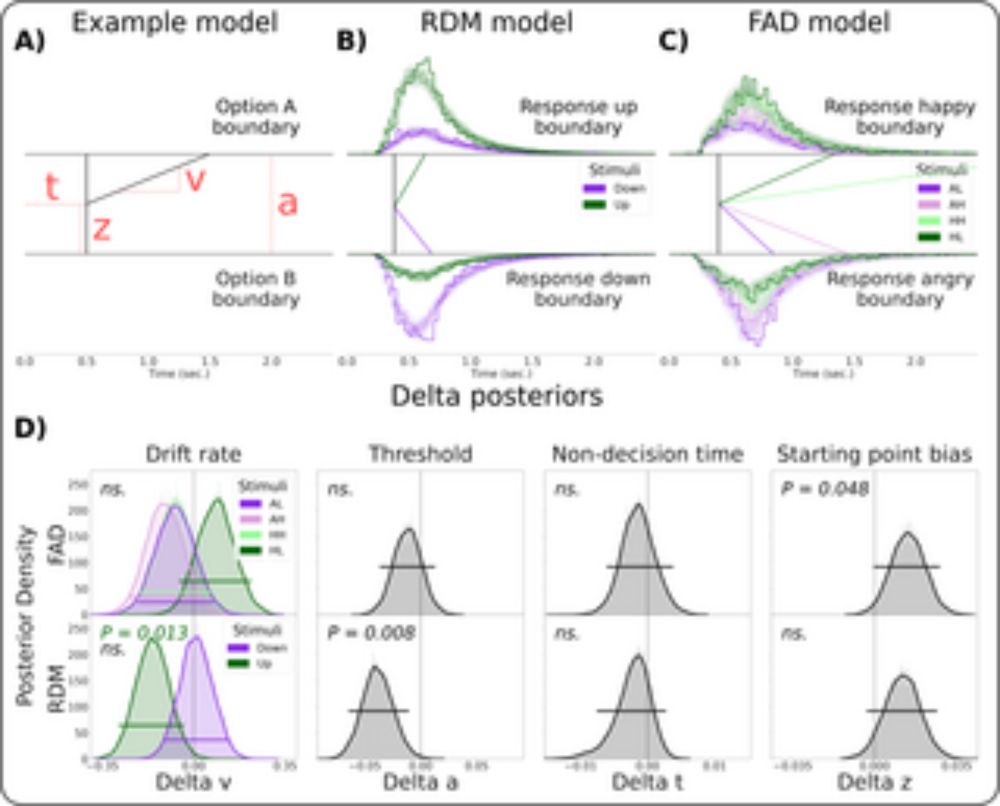
The respiratory cycle modulates distinct dynamics of affective and perceptual decision-making
Author summary Breathing is more than just a vital process for survival — it influences how we perceive and interact with the world around us. Recent research suggests that the rhythm of breathing, fr...
doi.org
August 1, 2025 at 10:35 AM
🧠 New paper on breathing and the brain, out now
@plos.org Computational Biology! 🫁
"The respiratory cycle modulates distinct dynamics of affective and perceptual decision-making"
doi.org/10.1371/jour...
We show how respiratory 'tidal computations' alter our decisons!
@plos.org Computational Biology! 🫁
"The respiratory cycle modulates distinct dynamics of affective and perceptual decision-making"
doi.org/10.1371/jour...
We show how respiratory 'tidal computations' alter our decisons!