



Joaquin Navajas
@joaconavajas.bsky.social
Associate Prof. at the Business School - Universidad Torcuato Di Tella (UTDT) - Buenos Aires, Argentina 🇦🇷
Director of the Neuro Lab (utdt.edu/neuro) & Director of the UTDT Bachelor Program in Behavioural Sciences (utdt.edu/comportamiento).
Director of the Neuro Lab (utdt.edu/neuro) & Director of the UTDT Bachelor Program in Behavioural Sciences (utdt.edu/comportamiento).
Reposted by Joaquin Navajas

✔️ If you’re interested in collaborating on this project we’re leading with @joaconavajas.bsky.social, @amit-goldenberg.bsky.social, and @canjantus.bsky.social at @harvard.edu and @utditella, please complete this form to sign up: forms.gle/WrRK614W9yzd.... 📝

Collaborate on a Multi-Country Study on Social Preferences for Political Extremes
The project
We are seeking collaborators interested in joining a global research project exploring the psychological and social factors that influence preferences for political extremes.
Recent resea...
forms.gle
December 18, 2024 at 3:02 PM
✔️ If you’re interested in collaborating on this project we’re leading with @joaconavajas.bsky.social, @amit-goldenberg.bsky.social, and @canjantus.bsky.social at @harvard.edu and @utditella, please complete this form to sign up: forms.gle/WrRK614W9yzd.... 📝
Reposted by Joaquin Navajas
🚨 Call for Collaborators 🚨 Join our multi-country study on social preferences for political extremes funded by @templetonfdn.bsky.social 🌍 We’re examining why people prefer extreme ingroups across multiple countries 🧠 Contribute to our project on political polarization! Details below👇

December 18, 2024 at 3:02 PM
🚨 Call for Collaborators 🚨 Join our multi-country study on social preferences for political extremes funded by @templetonfdn.bsky.social 🌍 We’re examining why people prefer extreme ingroups across multiple countries 🧠 Contribute to our project on political polarization! Details below👇
Reposted by Joaquin Navajas

New paper! Led by Elena Kozakevitch-Arbel, with Simone Shamay-Tsoory, we used multi-dimensional reinforcement learning approach to examine whether people are sensitive to different dimensions of social scenarios during empathic interactions www.nature.com/articles/s44... 🧵

Adaptive empathic response selection is sensitive to multiple dimensions of social interaction - Communications Psychology
When providing emotional support and deciding on an empathic reaction, responders were sensitive to changes in the person requiring empathy, the emotional state of that person, and the cause of their ...
www.nature.com
November 26, 2024 at 9:59 PM
New paper! Led by Elena Kozakevitch-Arbel, with Simone Shamay-Tsoory, we used multi-dimensional reinforcement learning approach to examine whether people are sensitive to different dimensions of social scenarios during empathic interactions www.nature.com/articles/s44... 🧵
Reposted by Joaquin Navajas

When we present our work on attraction to extremity, people often ask whether this is a new phenomenon. We found this great paper from 1968 showing that people assign more sincerity, competence, trustworthiness, and likability to extremes on their own side.
www.sciencedirect.com/science/arti...
www.sciencedirect.com/science/arti...
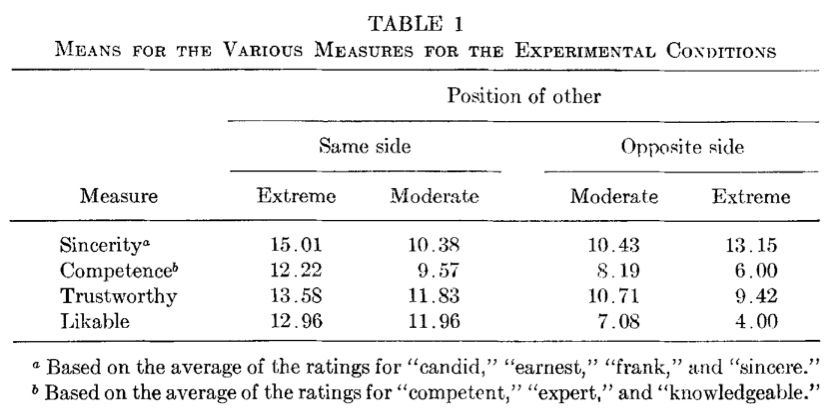
December 5, 2024 at 3:37 PM
When we present our work on attraction to extremity, people often ask whether this is a new phenomenon. We found this great paper from 1968 showing that people assign more sincerity, competence, trustworthiness, and likability to extremes on their own side.
www.sciencedirect.com/science/arti...
www.sciencedirect.com/science/arti...