



Share of deaths attributed to CVD in DK fell rapidly over a couple of years (WHO data does not differentiate between myocardial infarction and other IHD before ICD-9/10).
Changed attribution is clearly also important to e.g. the replacement CVD→dementia (as seen also in e.g. Sweden).
Changed attribution is clearly also important to e.g. the replacement CVD→dementia (as seen also in e.g. Sweden).

December 6, 2025 at 5:02 PM
Share of deaths attributed to CVD in DK fell rapidly over a couple of years (WHO data does not differentiate between myocardial infarction and other IHD before ICD-9/10).
Changed attribution is clearly also important to e.g. the replacement CVD→dementia (as seen also in e.g. Sweden).
Changed attribution is clearly also important to e.g. the replacement CVD→dementia (as seen also in e.g. Sweden).
80-talsvintrarna (de första jag, f. 1981, minns) hör till det förgångna: kontrasten mot åren kring 1990 gjorde uppvärmningen konkret för mig. En några år yngre person som växt upp i Sverige skulle kunna säga att det var lika slaskigt när jag var barn (motsäger förstås inte utvecklingen globalt).

December 1, 2025 at 7:53 PM
80-talsvintrarna (de första jag, f. 1981, minns) hör till det förgångna: kontrasten mot åren kring 1990 gjorde uppvärmningen konkret för mig. En några år yngre person som växt upp i Sverige skulle kunna säga att det var lika slaskigt när jag var barn (motsäger förstås inte utvecklingen globalt).
A(H3) har tagit över även i Sverige, och det är inte många fördubblingar kvar tills vi når normal toppnivå (kan nog bli till jul). Flest fall i Svealand och Norrland.
www.folkhalsomyndigheten.se/faktablad/fa...
www.folkhalsomyndigheten.se/faktablad/fa...
![A(H3) non-sentinel cases estimated as [total influenza A]×[subtyped A(H3)/total subtyped A] in Sweden per week seasons 2021–25 (starting at week 40), based on data from FluNet.](https://cdn.bsky.app/img/feed_thumbnail/plain/did:plc:xxppgquw2duy3v2qh6mg5oiv/bafkreib5nnjulo3ueharupscwhbm63vijejwbe3zpghv4mmxt7yimfciny@jpeg)
November 27, 2025 at 5:28 PM
A(H3) har tagit över även i Sverige, och det är inte många fördubblingar kvar tills vi når normal toppnivå (kan nog bli till jul). Flest fall i Svealand och Norrland.
www.folkhalsomyndigheten.se/faktablad/fa...
www.folkhalsomyndigheten.se/faktablad/fa...
Seems a bit improbable that such an early season would peak at a relatively low level.
Now, A(H3) may be taking over in Sweden too, We have also had more wintry weather for about a week now, but that can hardly have influenced reports for week 46.
Now, A(H3) may be taking over in Sweden too, We have also had more wintry weather for about a week now, but that can hardly have influenced reports for week 46.
![A(H1N1) non-sentinel cases estimated as [total influenza A]×[subtyped A(H1N1)/total subtyped A] in Sweden week seasons 2021–25 (starting at week 40), based on data from FluNet.](https://cdn.bsky.app/img/feed_thumbnail/plain/did:plc:xxppgquw2duy3v2qh6mg5oiv/bafkreiehtkrn3jfzsrwyj2biiegt3k7lr62npu5nqvcaqydhh27hacq4ba@jpeg)
![A(H3) non-sentinel cases estimated as [total influenza A]×[subtyped A(H3)/total subtyped A] in Sweden week seasons 2021–25 (starting at week 40), based on data from FluNet.](https://cdn.bsky.app/img/feed_thumbnail/plain/did:plc:xxppgquw2duy3v2qh6mg5oiv/bafkreihaagg5oo4775esgzeue676nncp5k5huraqyoyjfrzmtrdlseepau@jpeg)
November 20, 2025 at 5:29 PM
Seems a bit improbable that such an early season would peak at a relatively low level.
Now, A(H3) may be taking over in Sweden too, We have also had more wintry weather for about a week now, but that can hardly have influenced reports for week 46.
Now, A(H3) may be taking over in Sweden too, We have also had more wintry weather for about a week now, but that can hardly have influenced reports for week 46.
There may have been some A(H3) outbreak around week 42, but it has not really taken off. One may be concerned that both subtypes will increase exponentially the coming weeks.
![A(H1N1) non-sentinel cases estimated as [total influenza A]×[subtyped A(H1N1)/total subtyped A] in Sweden week seasons 2021–25 (starting at week 40), based on data from FluNet.](https://cdn.bsky.app/img/feed_thumbnail/plain/did:plc:xxppgquw2duy3v2qh6mg5oiv/bafkreidht2oehmxqehnseowkmlvobw4oji5bmkh3aklwmt5bs4s5euvnbq@jpeg)
![A(H3) non-sentinel cases estimated as [total influenza A]×[subtyped A(H3)/total subtyped A] in Sweden week seasons 2021–25 (starting at week 40), based on data from FluNet.](https://cdn.bsky.app/img/feed_thumbnail/plain/did:plc:xxppgquw2duy3v2qh6mg5oiv/bafkreifwepm7nitghjmobma7hk7bffotjcvomqn2k3s4ibijeexurtpc5a@jpeg)
November 9, 2025 at 3:20 PM
There may have been some A(H3) outbreak around week 42, but it has not really taken off. One may be concerned that both subtypes will increase exponentially the coming weeks.
314 A(H3N2) and 20 A(H1N1) week 44. Sweden is still different with 2 A(H3N2) and 19 A(H1N1) that week.

November 9, 2025 at 9:22 AM
314 A(H3N2) and 20 A(H1N1) week 44. Sweden is still different with 2 A(H3N2) and 19 A(H1N1) that week.
One can also note that all Swedish seasons since 2021/22, except for 2024/25, have had relatively early peaks (around New Year), and most have been mixed A(H3N2) and A(H1N1).

November 1, 2025 at 9:47 AM
One can also note that all Swedish seasons since 2021/22, except for 2024/25, have had relatively early peaks (around New Year), and most have been mixed A(H3N2) and A(H1N1).
Cases in Sweden did not increase last week, but still more cases than previous years. And 54/68 subtyped A since week 40 are A(H1N1).

October 31, 2025 at 7:35 PM
Cases in Sweden did not increase last week, but still more cases than previous years. And 54/68 subtyped A since week 40 are A(H1N1).
Nedgången i infektionsdödlighet bland ungdomar och yngre vuxna är mest tuberkulos, men bland små barn var det inte heller så vanligt.


October 30, 2025 at 8:26 PM
Nedgången i infektionsdödlighet bland ungdomar och yngre vuxna är mest tuberkulos, men bland små barn var det inte heller så vanligt.
The influenza season may be starting early in Sweden too.

October 23, 2025 at 9:06 PM
The influenza season may be starting early in Sweden too.
Genom postning av grafer baserade på internationell statistik (kanske bör utvecklas till blogginlägg, då det hänger ihop med mina tidigare inlägg).
Dessutom genom radering av tidigare version där ena grafen blev fel.
Dessutom genom radering av tidigare version där ena grafen blev fel.


October 20, 2025 at 5:54 PM
Genom postning av grafer baserade på internationell statistik (kanske bör utvecklas till blogginlägg, då det hänger ihop med mina tidigare inlägg).
Dessutom genom radering av tidigare version där ena grafen blev fel.
Dessutom genom radering av tidigare version där ena grafen blev fel.
Yes, almost all excess mortality in SE 2020–21 is captured by covid-19 as underlying cause, but if I start with 2022, coefficients for covid-19 increase to about 2.6 and 2.3 for women/men, which is, as noted, hard to interpret because of the collinearity with e.g. influenza.

October 15, 2025 at 9:43 AM
Yes, almost all excess mortality in SE 2020–21 is captured by covid-19 as underlying cause, but if I start with 2022, coefficients for covid-19 increase to about 2.6 and 2.3 for women/men, which is, as noted, hard to interpret because of the collinearity with e.g. influenza.
This is a modeling for Sweden, using monthly data (base.cov has ICD-10 U00–U49, exclusively covid-related as underlying cause of death, base.cov.flu also releases from hospital for confirmed flu, J10).
sdb.socialstyrelsen.se/if_dor_manad...
sdb.socialstyrelsen.se/if_par/val_e...
sdb.socialstyrelsen.se/if_dor_manad...
sdb.socialstyrelsen.se/if_par/val_e...

October 14, 2025 at 10:55 AM
This is a modeling for Sweden, using monthly data (base.cov has ICD-10 U00–U49, exclusively covid-related as underlying cause of death, base.cov.flu also releases from hospital for confirmed flu, J10).
sdb.socialstyrelsen.se/if_dor_manad...
sdb.socialstyrelsen.se/if_par/val_e...
sdb.socialstyrelsen.se/if_dor_manad...
sdb.socialstyrelsen.se/if_par/val_e...
Ja. Sedan är rubriken och delar av texten, om att »cancer seglat upp som den vanligaste dödsorsaken i flera regioner«, litet missvisande.

September 20, 2025 at 6:56 AM
Ja. Sedan är rubriken och delar av texten, om att »cancer seglat upp som den vanligaste dödsorsaken i flera regioner«, litet missvisande.

September 19, 2025 at 9:40 AM
Går att experimentera med TransformerLens själv, men det tar som vanligt tid om man inte har dyrt GPU-minne, då varje kombination av lager och position skall testas.

September 10, 2025 at 8:30 PM
Går att experimentera med TransformerLens själv, men det tar som vanligt tid om man inte har dyrt GPU-minne, då varje kombination av lager och position skall testas.
Sweden clearly has not seen increased cancer mortality after 2020.

July 31, 2025 at 9:48 AM
Sweden clearly has not seen increased cancer mortality after 2020.
Tokenization can be rather complex, however, so that one token may include several punctuation characters (this example is from gemma 3).
This can also make it a bit complicated to manipulate output by token logits, because it is not obvious which token will be used for a certain string.
This can also make it a bit complicated to manipulate output by token logits, because it is not obvious which token will be used for a certain string.

July 8, 2025 at 12:09 PM
Tokenization can be rather complex, however, so that one token may include several punctuation characters (this example is from gemma 3).
This can also make it a bit complicated to manipulate output by token logits, because it is not obvious which token will be used for a certain string.
This can also make it a bit complicated to manipulate output by token logits, because it is not obvious which token will be used for a certain string.
That seems to be period life expectancy, based on mortality rates for all ages during a given year. It started taking off in AU after 1970, much due to decreasing mortality from ischemic heart disease.

July 5, 2025 at 7:44 AM
That seems to be period life expectancy, based on mortality rates for all ages during a given year. It started taking off in AU after 1970, much due to decreasing mortality from ischemic heart disease.
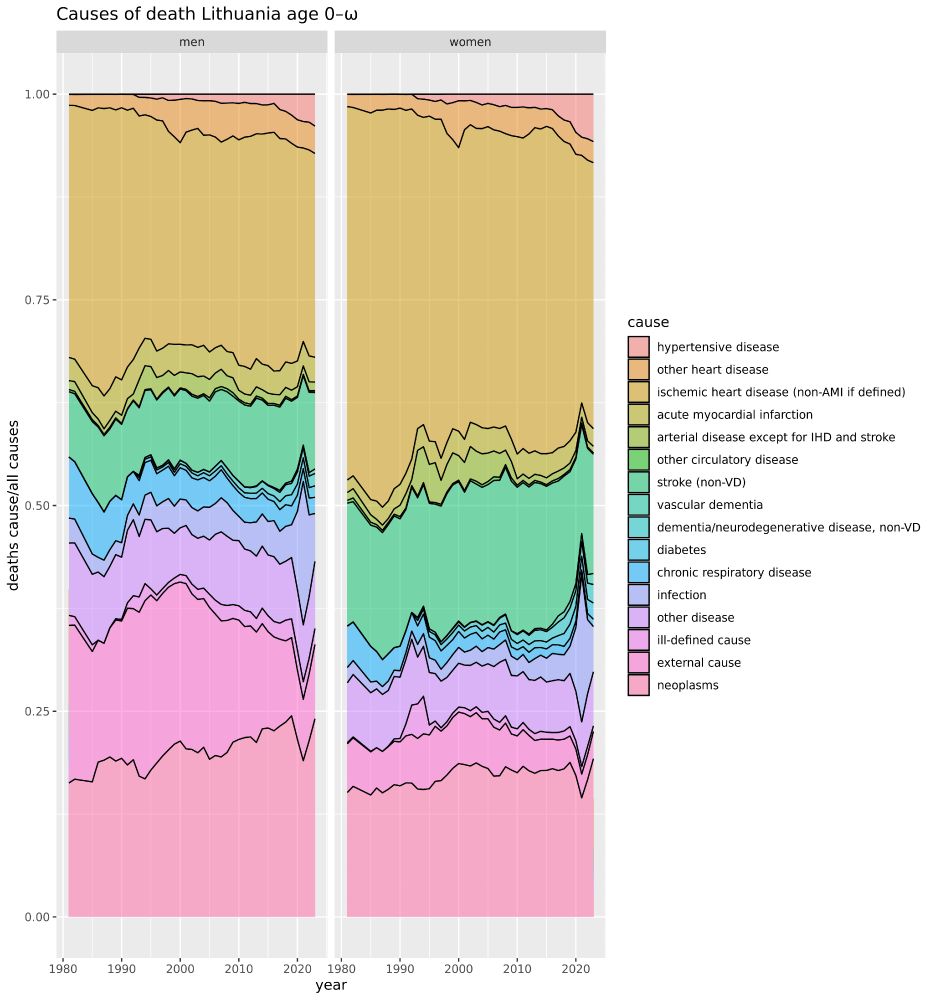
And that is a change typical of countries in Northern Europe and the Anglosphere, with historically high AMI burden. Other countries in e.g. Eastern Europe have had high proportion of IHD-ascribed deaths, but not that many of these have been AMI. doi.org/10.1093/ije/...
June 27, 2025 at 8:13 PM
And that is a change typical of countries in Northern Europe and the Anglosphere, with historically high AMI burden. Other countries in e.g. Eastern Europe have had high proportion of IHD-ascribed deaths, but not that many of these have been AMI. doi.org/10.1093/ije/...
If you look at the changing cause of death distribution e.g. in SE in recent decades, you see such declines in CVDs directly ascribed to arterial disease (myocardial infarction, other arterial disease, e.g. generalized atherosclerosis, stroke).
Probably both real changes and changed reporting.
Probably both real changes and changed reporting.

June 21, 2025 at 7:58 PM
If you look at the changing cause of death distribution e.g. in SE in recent decades, you see such declines in CVDs directly ascribed to arterial disease (myocardial infarction, other arterial disease, e.g. generalized atherosclerosis, stroke).
Probably both real changes and changed reporting.
Probably both real changes and changed reporting.
There has been a rather impressive decline in stomach cancer mortality, e.g. in Sweden.

June 4, 2025 at 5:34 PM
There has been a rather impressive decline in stomach cancer mortality, e.g. in Sweden.
Hard to discern anything like that after 2020 (plotting all K7 codes for the whole ICD-10 period here).

May 30, 2025 at 7:48 AM
Hard to discern anything like that after 2020 (plotting all K7 codes for the whole ICD-10 period here).
Demens och stroke bland >80 kan väl också vara undantag (även överrepresentationen relativt andelen män i de åldersgrupperna försvinner).


May 29, 2025 at 4:18 PM
Demens och stroke bland >80 kan väl också vara undantag (även överrepresentationen relativt andelen män i de åldersgrupperna försvinner).
Or even wider, as for Sweden (have taken mean rate over ages in wider groups, but that does not change the shape of the 0–44 group much).


May 25, 2025 at 8:30 AM
Or even wider, as for Sweden (have taken mean rate over ages in wider groups, but that does not change the shape of the 0–44 group much).