



Masahiro Kanai
@masakanai.bsky.social
Instructor in Medicine, MGH / HMS / Broad Institute
https://mkanai.github.io/
https://mkanai.github.io/
At the IL4R/IL21R locus, we identified two distinct causal variants within the same Finnish-enriched haplotype. Using our multiome and BBJ GWAS, we pinpointed the exact non-coding driver for IL21R expression in NK cells, distinct from the adjacent IL4R missense variant.

December 1, 2025 at 3:36 PM
At the IL4R/IL21R locus, we identified two distinct causal variants within the same Finnish-enriched haplotype. Using our multiome and BBJ GWAS, we pinpointed the exact non-coding driver for IL21R expression in NK cells, distinct from the adjacent IL4R missense variant.
The Finnish-enriched variants help us identify disease drivers 🇫🇮
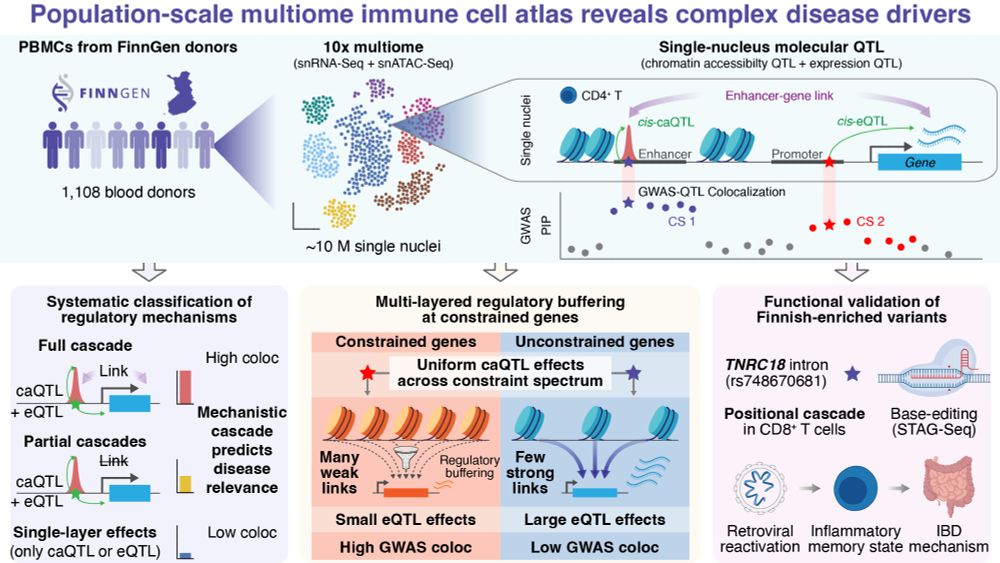
e.g., TNRC18 intron variant (114x enriched) is a risk factor for IBD but protective against autoimmune hypothyroidism.
e.g., TNRC18 intron variant (114x enriched) is a risk factor for IBD but protective against autoimmune hypothyroidism.

December 1, 2025 at 3:36 PM
The Finnish-enriched variants help us identify disease drivers 🇫🇮
e.g., TNRC18 intron variant (114x enriched) is a risk factor for IBD but protective against autoimmune hypothyroidism.
e.g., TNRC18 intron variant (114x enriched) is a risk factor for IBD but protective against autoimmune hypothyroidism.
Evolution tolerates chromatin variation but maintains essential gene expression levels via attenuated enhancer–gene links. This buffering makes caQTLs more detectable than eQTLs at disease loci targeting highly constrained genes 🧬🛡️

December 1, 2025 at 3:36 PM
Evolution tolerates chromatin variation but maintains essential gene expression levels via attenuated enhancer–gene links. This buffering makes caQTLs more detectable than eQTLs at disease loci targeting highly constrained genes 🧬🛡️
We found 1) constrained genes actually colocalize MORE with eQTLs but with smaller effects, and 2) "multi-layered regulatory buffering" where caQTLs occur with normal effect sizes, but transmission to gene expression is attenuated via systematically weaker enhancer–gene links

December 1, 2025 at 3:36 PM
We found 1) constrained genes actually colocalize MORE with eQTLs but with smaller effects, and 2) "multi-layered regulatory buffering" where caQTLs occur with normal effect sizes, but transmission to gene expression is attenuated via systematically weaker enhancer–gene links
Crucially, these regulatory mechanism predicts disease relevance 🧬🚨
Full cascade variants (caQTL + eQTL + Link) show 2x higher GWAS colocalization rates compared to those affecting chromatin alone, establishing a clear hierarchy for prioritizing causal variants.
Full cascade variants (caQTL + eQTL + Link) show 2x higher GWAS colocalization rates compared to those affecting chromatin alone, establishing a clear hierarchy for prioritizing causal variants.

December 1, 2025 at 3:36 PM
Crucially, these regulatory mechanism predicts disease relevance 🧬🚨
Full cascade variants (caQTL + eQTL + Link) show 2x higher GWAS colocalization rates compared to those affecting chromatin alone, establishing a clear hierarchy for prioritizing causal variants.
Full cascade variants (caQTL + eQTL + Link) show 2x higher GWAS colocalization rates compared to those affecting chromatin alone, establishing a clear hierarchy for prioritizing causal variants.
How do variants translate to function? We classified ~120K fine-mapped molQTLs into mechanistic categories, identifying ~3% to show a "Full Cascade" (Variant → Chromatin Δ → Expression Δ). The majority affect chromatin without detectable expression changes in baseline PBMCs.

December 1, 2025 at 3:36 PM
How do variants translate to function? We classified ~120K fine-mapped molQTLs into mechanistic categories, identifying ~3% to show a "Full Cascade" (Variant → Chromatin Δ → Expression Δ). The majority affect chromatin without detectable expression changes in baseline PBMCs.
To characterize cell-type specificity and regulatory mechanisms of molQTLs, we developed a new framework called CASCADE. We identified that while ~73% of eGenes are shared across lineages, individual regulatory variants often act in specific cell types.

December 1, 2025 at 3:36 PM
To characterize cell-type specificity and regulatory mechanisms of molQTLs, we developed a new framework called CASCADE. We identified that while ~73% of eGenes are shared across lineages, individual regulatory variants often act in specific cell types.
Leveraging this population-scale multiome, we identified 51,083 cis-eQTLs for 20,829 genes, 338,100 cis-caQTLs for 210,584 peaks, 119,094 fine-mapped variants, and 496,488 enhancer–gene links. This allows us to trace regulatory mechanisms across immune cell types 📊🩸


December 1, 2025 at 3:36 PM
Leveraging this population-scale multiome, we identified 51,083 cis-eQTLs for 20,829 genes, 338,100 cis-caQTLs for 210,584 peaks, 119,094 fine-mapped variants, and 496,488 enhancer–gene links. This allows us to trace regulatory mechanisms across immune cell types 📊🩸
Excited to share our new FinnGen single-nucleus multiome preprint! 🧬
We profiled ~10M PBMCs (snRNA-seq + snATAC-seq) from 1,108 Finnish donors to map how genetic variants drive complex disease through chromatin and gene regulation 🧵👇
🔗 Link: www.medrxiv.org/content/10.1...
We profiled ~10M PBMCs (snRNA-seq + snATAC-seq) from 1,108 Finnish donors to map how genetic variants drive complex disease through chromatin and gene regulation 🧵👇
🔗 Link: www.medrxiv.org/content/10.1...
December 1, 2025 at 3:36 PM
Excited to share our new FinnGen single-nucleus multiome preprint! 🧬
We profiled ~10M PBMCs (snRNA-seq + snATAC-seq) from 1,108 Finnish donors to map how genetic variants drive complex disease through chromatin and gene regulation 🧵👇
🔗 Link: www.medrxiv.org/content/10.1...
We profiled ~10M PBMCs (snRNA-seq + snATAC-seq) from 1,108 Finnish donors to map how genetic variants drive complex disease through chromatin and gene regulation 🧵👇
🔗 Link: www.medrxiv.org/content/10.1...