



Nicolas Martin
@nfmartin1980.bsky.social
Astronomer, CNRS/INSU researcher at Strasbourg Observatory. Local Group inhabitant.
Dernières préparations avant le spectacle de ce soir, organisé avec le @cnrs.fr et le Jardin des Sciences de l’ @unistra.fr au Planétarium de Strasbourg. “L’archéologie Galactique avec les courants stellaires.” Salle comble !

November 4, 2025 at 6:25 PM
Dernières préparations avant le spectacle de ce soir, organisé avec le @cnrs.fr et le Jardin des Sciences de l’ @unistra.fr au Planétarium de Strasbourg. “L’archéologie Galactique avec les courants stellaires.” Salle comble !
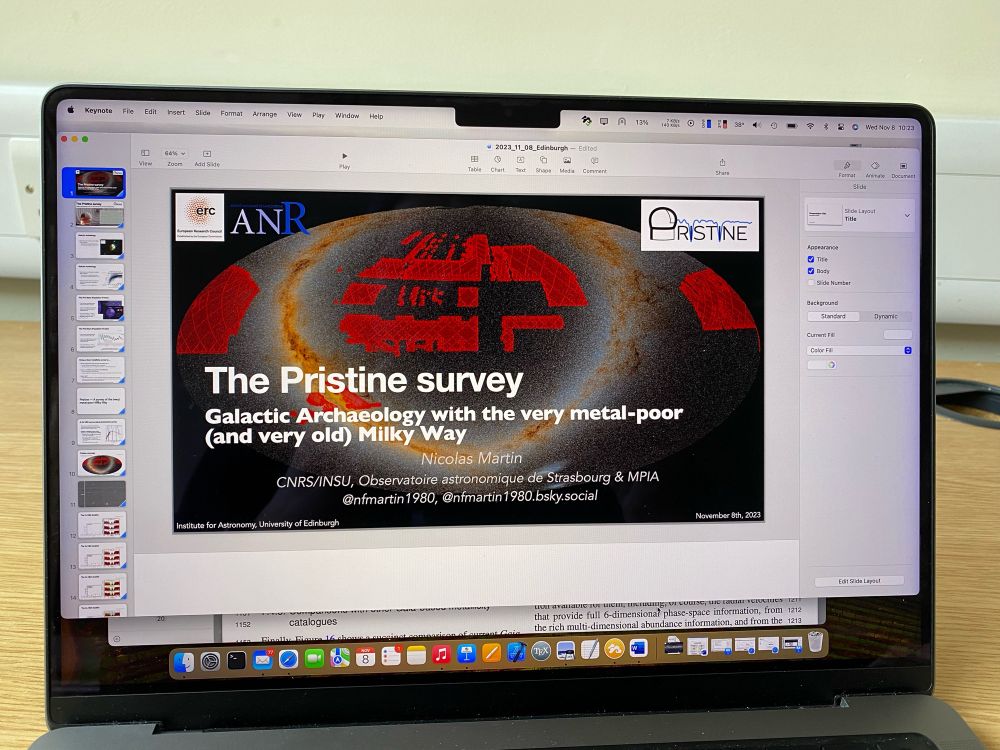
Very happy to be visiting the Royal Observatory of Edinburgh today and giving a talk about the low-metallicity Milky Way this afternoon. And Scottish weather didn’t disappoint this morning!
November 8, 2023 at 10:26 AM
Very happy to be visiting the Royal Observatory of Edinburgh today and giving a talk about the low-metallicity Milky Way this afternoon. And Scottish weather didn’t disappoint this morning!
Finally, we also have fun with the catalogue. 😁
Ever seen how the shape of the Milky Way changes with metallicity? Here it is!
The transition from the flat metal-rich disk to the rounder, spheroid-shaped meta-poor halo is just super obvious in these maps.
Ever seen how the shape of the Milky Way changes with metallicity? Here it is!
The transition from the flat metal-rich disk to the rounder, spheroid-shaped meta-poor halo is just super obvious in these maps.

August 4, 2023 at 10:56 AM
Finally, we also have fun with the catalogue. 😁
Ever seen how the shape of the Milky Way changes with metallicity? Here it is!
The transition from the flat metal-rich disk to the rounder, spheroid-shaped meta-poor halo is just super obvious in these maps.
Ever seen how the shape of the Milky Way changes with metallicity? Here it is!
The transition from the flat metal-rich disk to the rounder, spheroid-shaped meta-poor halo is just super obvious in these maps.
But that's not all! We use this opportunity to provide the community with the much higher signal-to-noise Pristine metallicities for all of those 219M stars that we already observed in Pristine survey. That's our first data release and includes 3M even higher quality [Fe/H]!

August 4, 2023 at 10:55 AM
But that's not all! We use this opportunity to provide the community with the much higher signal-to-noise Pristine metallicities for all of those 219M stars that we already observed in Pristine survey. That's our first data release and includes 3M even higher quality [Fe/H]!
Here, the comparison with literature high-resolution spectroscopic metallicities (Pristine is on the y axis). We get reliable metallicities down to at least [Fe/H]=-3.5. A difficult regime for most other efforts to get metallicities out of the Gaia data for so many stars.

August 4, 2023 at 10:54 AM
Here, the comparison with literature high-resolution spectroscopic metallicities (Pristine is on the y axis). We get reliable metallicities down to at least [Fe/H]=-3.5. A difficult regime for most other efforts to get metallicities out of the Gaia data for so many stars.
And that's what we did. That allows us to re-calibrate Pristine (at the 13 mmag level 🤯) and get 30+ million [Fe/H] values with our updated model to go from CaHK+broadband Gaia magnitude (G,BP,RP) to [Fe/H]. Look at how these stars arrange themselves nicely with [Fe/H]!

August 4, 2023 at 10:54 AM
And that's what we did. That allows us to re-calibrate Pristine (at the 13 mmag level 🤯) and get 30+ million [Fe/H] values with our updated model to go from CaHK+broadband Gaia magnitude (G,BP,RP) to [Fe/H]. Look at how these stars arrange themselves nicely with [Fe/H]!
These spectra are *very* low resolution (image from Gaia) and you can't really see and measure lines in them… but they can be used to reproduce the Pristine narrow-band filter. And so we can get Pristine-like observations for 219 million stars!! 🤩

August 4, 2023 at 10:53 AM
These spectra are *very* low resolution (image from Gaia) and you can't really see and measure lines in them… but they can be used to reproduce the Pristine narrow-band filter. And so we can get Pristine-like observations for 219 million stars!! 🤩
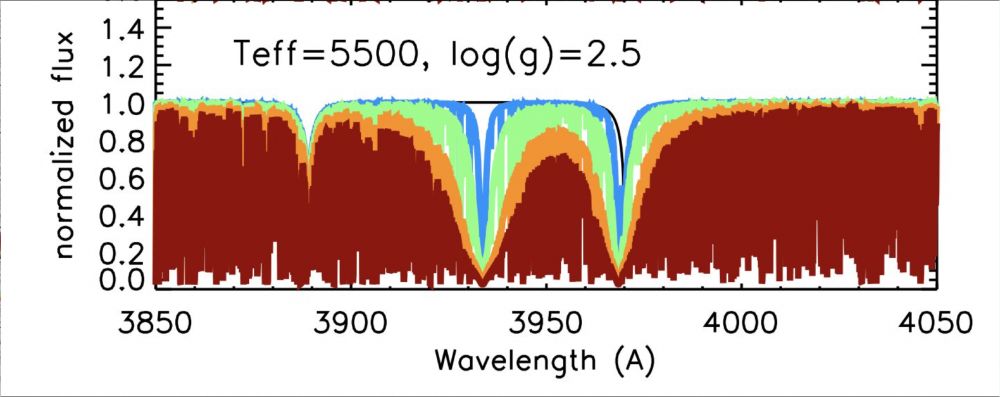
Why, I hear you ask? Because this CaHK wavelength region contains Calcium lines that are very sensitive to metallicity: if the star has lots of metals, the lines are deep, not much light makes it through the filter (red spectrum); if the star is metal-poor it looks bright (blue).
August 4, 2023 at 10:51 AM
Why, I hear you ask? Because this CaHK wavelength region contains Calcium lines that are very sensitive to metallicity: if the star has lots of metals, the lines are deep, not much light makes it through the filter (red spectrum); if the star is metal-poor it looks bright (blue).
But first, what is the Pristine survey? We've been surveying the Milky Way sky since 2015 with the wonderful CFHT (photo by JC Cuillandre) to obtain images of the sky with a special, narrow-band filter that only keeps the light from a very specific wavelength region.

August 4, 2023 at 10:51 AM
But first, what is the Pristine survey? We've been surveying the Milky Way sky since 2015 with the wonderful CFHT (photo by JC Cuillandre) to obtain images of the sky with a special, narrow-band filter that only keeps the light from a very specific wavelength region.
The 23rd paper of the main series of papers from the Pristine survey is out! It's been a lot of work by a lot of people since Gaia's Data Release 3 came out. It's also the first Data Release from the survey and we publish catalogues for ~30+ million stellar metallicities.

August 4, 2023 at 10:50 AM
The 23rd paper of the main series of papers from the Pristine survey is out! It's been a lot of work by a lot of people since Gaia's Data Release 3 came out. It's also the first Data Release from the survey and we publish catalogues for ~30+ million stellar metallicities.