




Opportunity & Inclusive Growth Institute
@oiginstitute.bsky.social
The Opportunity & Inclusive Growth Institute at the Minneapolis Fed supports research to expand economic opportunity and inclusive growth for all. Reposts ≠ endorsement.
#ASSA2026 attendees, join the Institute, LERA & @neaecon.bsky.social in celebrating the many contributions of Bill Spriggs to economics at two paper sessions plus luncheon plenary. Program committee Abigail Wozniak, Robynn Cox, Jesse Rothstein, and Omari Swinton. https://bit.ly/4pkJN7M

December 4, 2025 at 6:46 PM
#ASSA2026 attendees, join the Institute, LERA & @neaecon.bsky.social in celebrating the many contributions of Bill Spriggs to economics at two paper sessions plus luncheon plenary. Program committee Abigail Wozniak, Robynn Cox, Jesse Rothstein, and Omari Swinton. https://bit.ly/4pkJN7M
What factors have shaped Americans’ intergenerational mobility? A new Institute working paper from former visiting scholars @lalthoff.bsky.social and Hugo Reichardt with Harriet Brookes Gay studies the evolution of mobility in the U.S. from 1850 to 1950. https://bit.ly/4anugzC

December 1, 2025 at 3:26 PM
What factors have shaped Americans’ intergenerational mobility? A new Institute working paper from former visiting scholars @lalthoff.bsky.social and Hugo Reichardt with Harriet Brookes Gay studies the evolution of mobility in the U.S. from 1850 to 1950. https://bit.ly/4anugzC
Happy Thanksgiving from all of us at the Opportunity & Inclusive Growth Institute!

November 27, 2025 at 2:18 PM
Happy Thanksgiving from all of us at the Opportunity & Inclusive Growth Institute!
Long-term #unemployment can be a desperate situation. Benefits expire, savings deplete, and debts grow. Our data dive in the latest For All looks at the share of unemployed workers who eventually enter long-term unemployment: https://bit.ly/47vuClR

November 24, 2025 at 5:15 PM
Long-term #unemployment can be a desperate situation. Benefits expire, savings deplete, and debts grow. Our data dive in the latest For All looks at the share of unemployed workers who eventually enter long-term unemployment: https://bit.ly/47vuClR
Over nearly 4 decades, Bill Spriggs made significant contributions to labor economics, economic policy, & economics profession. At @assameeting.bsky.social, the Institute, LERA, and @neaecon.bsky.social are co-sponsoring sessions to honor and celebrate his many contributions. https://bit.ly/4pkJN7M
November 19, 2025 at 6:56 PM
Over nearly 4 decades, Bill Spriggs made significant contributions to labor economics, economic policy, & economics profession. At @assameeting.bsky.social, the Institute, LERA, and @neaecon.bsky.social are co-sponsoring sessions to honor and celebrate his many contributions. https://bit.ly/4pkJN7M
In 2010, there were 1.2 job postings requiring a college degree for every 1 posting that did not. By 2020, the ratio was 0.6. Our new article from senior writer @lisacamnermckay.bsky.social looks at how the labor market for college grads has changed: https://bit.ly/4mUUNaZ

November 18, 2025 at 5:12 PM
In 2010, there were 1.2 job postings requiring a college degree for every 1 posting that did not. By 2020, the ratio was 0.6. Our new article from senior writer @lisacamnermckay.bsky.social looks at how the labor market for college grads has changed: https://bit.ly/4mUUNaZ
It has been an active year in the U.S. economy. Watching for clues to the economy’s direction is important in many sectors and of course at the Fed. But the drivers of economic opportunity and inclusive growth often only come into view over time. https://bit.ly/475QG5i
November 17, 2025 at 3:54 PM
It has been an active year in the U.S. economy. Watching for clues to the economy’s direction is important in many sectors and of course at the Fed. But the drivers of economic opportunity and inclusive growth often only come into view over time. https://bit.ly/475QG5i
A mother's time and household income both shape children's skill outcomes. To evaluate cash assistance programs, then, we need to account for the children's future outcomes. This is @jmullins.bsky.social @umn-econ.bsky.social project in a new Institute Working Paper https://bit.ly/3WJHGhC

November 14, 2025 at 5:32 PM
A mother's time and household income both shape children's skill outcomes. To evaluate cash assistance programs, then, we need to account for the children's future outcomes. This is @jmullins.bsky.social @umn-econ.bsky.social project in a new Institute Working Paper https://bit.ly/3WJHGhC
What does wealth mobility look like over people’s lifetimes? Richard Audoly and his coauthors find that broadly speaking, there are four paths of wealth trajectory. Watch now: https://bit.ly/4gSFopm

November 13, 2025 at 6:04 PM
What does wealth mobility look like over people’s lifetimes? Richard Audoly and his coauthors find that broadly speaking, there are four paths of wealth trajectory. Watch now: https://bit.ly/4gSFopm
Tune in to the Institute Research Conference online here: https://bit.ly/4gSFopm

November 13, 2025 at 5:25 PM
Tune in to the Institute Research Conference online here: https://bit.ly/4gSFopm
Individuals' credit scores are quite stable, Nathan Hendren says. Differences in credit scores emerge early in life and persist over time. Watch live: https://bit.ly/3sRd0d9

November 13, 2025 at 4:46 PM
Individuals' credit scores are quite stable, Nathan Hendren says. Differences in credit scores emerge early in life and persist over time. Watch live: https://bit.ly/3sRd0d9
November 13, 2025 at 4:25 PM
Both money and time with parents matter for children's long-run skill development, with important implications for the optimal size and shape of government transfers. Read @jmullins.bsky.social @umn-econ.bsky.social new paper: https://bit.ly/3WJHGhC

November 7, 2025 at 9:05 PM
Both money and time with parents matter for children's long-run skill development, with important implications for the optimal size and shape of government transfers. Read @jmullins.bsky.social @umn-econ.bsky.social new paper: https://bit.ly/3WJHGhC
Historical trends show that long-term unemployment rises in recessions and falls in recoveries. However, recent data indicates an uptick in LTU, which could signal future challenges. What do labor market flows tell us about where LTU may be headed?
https://bit.ly/42DHhk3
https://bit.ly/42DHhk3

October 30, 2025 at 5:10 PM
Historical trends show that long-term unemployment rises in recessions and falls in recoveries. However, recent data indicates an uptick in LTU, which could signal future challenges. What do labor market flows tell us about where LTU may be headed?
https://bit.ly/42DHhk3
https://bit.ly/42DHhk3
It has been an active year in the U.S. economy. Watching for clues to the economy’s direction is important in many sectors and of course at the Fed. But the drivers of economic opportunity and inclusive growth often only come into view over time. https://bit.ly/475QG5i
October 16, 2025 at 8:09 PM
It has been an active year in the U.S. economy. Watching for clues to the economy’s direction is important in many sectors and of course at the Fed. But the drivers of economic opportunity and inclusive growth often only come into view over time. https://bit.ly/475QG5i
Rapid rise. Quick recovery. Long-term unemployment did not stay high for long after the COVID recession. But the baseline to which the labor market returned is itself the product of substantial long-run changes. From Abigail Wozniak & Andrew Goodman-Bacon in new For All: https://bit.ly/42DHhk3
October 15, 2025 at 3:10 PM
Rapid rise. Quick recovery. Long-term unemployment did not stay high for long after the COVID recession. But the baseline to which the labor market returned is itself the product of substantial long-run changes. From Abigail Wozniak & Andrew Goodman-Bacon in new For All: https://bit.ly/42DHhk3
We are one month away from the 2025 Institute Research Conference! Are you registered? Join us for presentations on wealth mobility, neighborhood migration, credit access, how workers keep up with inflation, and subjective uncertainty. More info here: https://bit.ly/4gSFopm

October 13, 2025 at 4:48 PM
We are one month away from the 2025 Institute Research Conference! Are you registered? Join us for presentations on wealth mobility, neighborhood migration, credit access, how workers keep up with inflation, and subjective uncertainty. More info here: https://bit.ly/4gSFopm
One way to think about income inequality is to compare a group’s share of earners to its share of earnings. For ex, men are 51% of earners in IDDA but receive 61% of income (gap of+10 ppts). Hispanic earners are 15.4% but earn 11.5% (gap of -3.9 ppts). https://bit.ly/46XR1Fu

October 7, 2025 at 6:05 PM
One way to think about income inequality is to compare a group’s share of earners to its share of earnings. For ex, men are 51% of earners in IDDA but receive 61% of income (gap of+10 ppts). Hispanic earners are 15.4% but earn 11.5% (gap of -3.9 ppts). https://bit.ly/46XR1Fu
Mark your calendars for the 2025 Institute Research Conference, a showcase of frontier-style research that the Institute engages with and supports.
Register now and we'll send you a calendar invite with the livestream link 👇
https://bit.ly/4gSFopm #EconSky
Register now and we'll send you a calendar invite with the livestream link 👇
https://bit.ly/4gSFopm #EconSky

October 6, 2025 at 3:49 PM
Mark your calendars for the 2025 Institute Research Conference, a showcase of frontier-style research that the Institute engages with and supports.
Register now and we'll send you a calendar invite with the livestream link 👇
https://bit.ly/4gSFopm #EconSky
Register now and we'll send you a calendar invite with the livestream link 👇
https://bit.ly/4gSFopm #EconSky
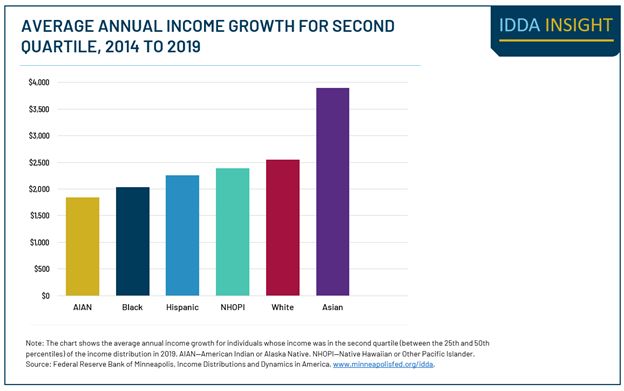
What does income growth look like for earners of different racial and ethnic groups? For earners with income in the second quartile of the distribution in 2014, average annual income growth was $3,892 a year for Asian earners and $1,843 for AIAN earners. https://www.minneapolisfed.org/idda
September 29, 2025 at 2:15 PM
What does income growth look like for earners of different racial and ethnic groups? For earners with income in the second quartile of the distribution in 2014, average annual income growth was $3,892 a year for Asian earners and $1,843 for AIAN earners. https://www.minneapolisfed.org/idda
In 2019, women's earnings at the median were 74% of men’s. This ratio was driven largely by White earners, who have the lowest W-to-M ratio of the racial and ethnic groups in IDDA. The earnings of Black women were closet to parity. For more, visit: https://www.minneapolisfed.org/idda

September 25, 2025 at 4:47 PM
In 2019, women's earnings at the median were 74% of men’s. This ratio was driven largely by White earners, who have the lowest W-to-M ratio of the racial and ethnic groups in IDDA. The earnings of Black women were closet to parity. For more, visit: https://www.minneapolisfed.org/idda
Rapid advances in #AI means machines may take over an expanding set of tasks. Who will gain and who will lose from this wave of automation? Visiting scholars @lukasfreund.bsky.social @bostoncollege.bsky.social & Lukas F. Mann answer this question in their new paper. bit.ly/46xUzAI

September 23, 2025 at 4:06 PM
Rapid advances in #AI means machines may take over an expanding set of tasks. Who will gain and who will lose from this wave of automation? Visiting scholars @lukasfreund.bsky.social @bostoncollege.bsky.social & Lukas F. Mann answer this question in their new paper. bit.ly/46xUzAI
For men and women, earnings growth was lowest at 50th percentile between 2005 and 2019. Women saw stronger earnings growth than men, but they continue to earn considerably less across the distribution. Discover more with IDDA: https://www.minneapolisfed.org/idda

September 22, 2025 at 2:30 PM
For men and women, earnings growth was lowest at 50th percentile between 2005 and 2019. Women saw stronger earnings growth than men, but they continue to earn considerably less across the distribution. Discover more with IDDA: https://www.minneapolisfed.org/idda
Who are the top 10 percent? It's no surprise older workers make up a bigger share of top earners than younger workers. But there are significant disparities between men and women in each age bucket: Men aged 45-54 are 32% while women that age are 14%. https://bit.ly/46XR1Fu

September 17, 2025 at 3:25 PM
Who are the top 10 percent? It's no surprise older workers make up a bigger share of top earners than younger workers. But there are significant disparities between men and women in each age bucket: Men aged 45-54 are 32% while women that age are 14%. https://bit.ly/46XR1Fu
As AI automates information-processing tasks, customer-facing and coordination tasks rise in significance. The latest Institute working paper shows this prompts some workers to move to lower-paying jobs, while other workers see their wages rise. https://bit.ly/46xUzAI

September 16, 2025 at 2:21 PM
As AI automates information-processing tasks, customer-facing and coordination tasks rise in significance. The latest Institute working paper shows this prompts some workers to move to lower-paying jobs, while other workers see their wages rise. https://bit.ly/46xUzAI