


Excited to share our latest work on plant immune receptor biochemistry! @kamounlab.bsky.social @hsuanpai.bsky.social @mpcontreras.bsky.social Jose Salguero Linares @danielluedke.bsky.social @adnroide.bsky.social @jiorgoskourelis.bsky.social
www.biorxiv.org/content/10.6...
www.biorxiv.org/content/10.6...

December 3, 2025 at 9:20 AM
Excited to share our latest work on plant immune receptor biochemistry! @kamounlab.bsky.social @hsuanpai.bsky.social @mpcontreras.bsky.social Jose Salguero Linares @danielluedke.bsky.social @adnroide.bsky.social @jiorgoskourelis.bsky.social
www.biorxiv.org/content/10.6...
www.biorxiv.org/content/10.6...

@charisramsing.bsky.social gave a great seminar on Clavibacter for UC Davis’ Plant Pathology Department today. New insights into tomato colonization and effector recognition. #MPMI

December 1, 2025 at 6:44 PM
@charisramsing.bsky.social gave a great seminar on Clavibacter for UC Davis’ Plant Pathology Department today. New insights into tomato colonization and effector recognition. #MPMI

🌱 RESEARCH 🌱
AGO1 is essential for Cu-deficiency responses but is sensitive to oxidative stress. FeSOD1 interacts with and protects AGO1 from superoxide radical-induced degradation, preserving miRNA-mediated gene silencing pathways - Tomassi et al.
🔗 doi.org/10.1093/jxb/...
#PlantScience 🧪
AGO1 is essential for Cu-deficiency responses but is sensitive to oxidative stress. FeSOD1 interacts with and protects AGO1 from superoxide radical-induced degradation, preserving miRNA-mediated gene silencing pathways - Tomassi et al.
🔗 doi.org/10.1093/jxb/...
#PlantScience 🧪

November 18, 2025 at 9:47 AM
🌱 RESEARCH 🌱
AGO1 is essential for Cu-deficiency responses but is sensitive to oxidative stress. FeSOD1 interacts with and protects AGO1 from superoxide radical-induced degradation, preserving miRNA-mediated gene silencing pathways - Tomassi et al.
🔗 doi.org/10.1093/jxb/...
#PlantScience 🧪
AGO1 is essential for Cu-deficiency responses but is sensitive to oxidative stress. FeSOD1 interacts with and protects AGO1 from superoxide radical-induced degradation, preserving miRNA-mediated gene silencing pathways - Tomassi et al.
🔗 doi.org/10.1093/jxb/...
#PlantScience 🧪
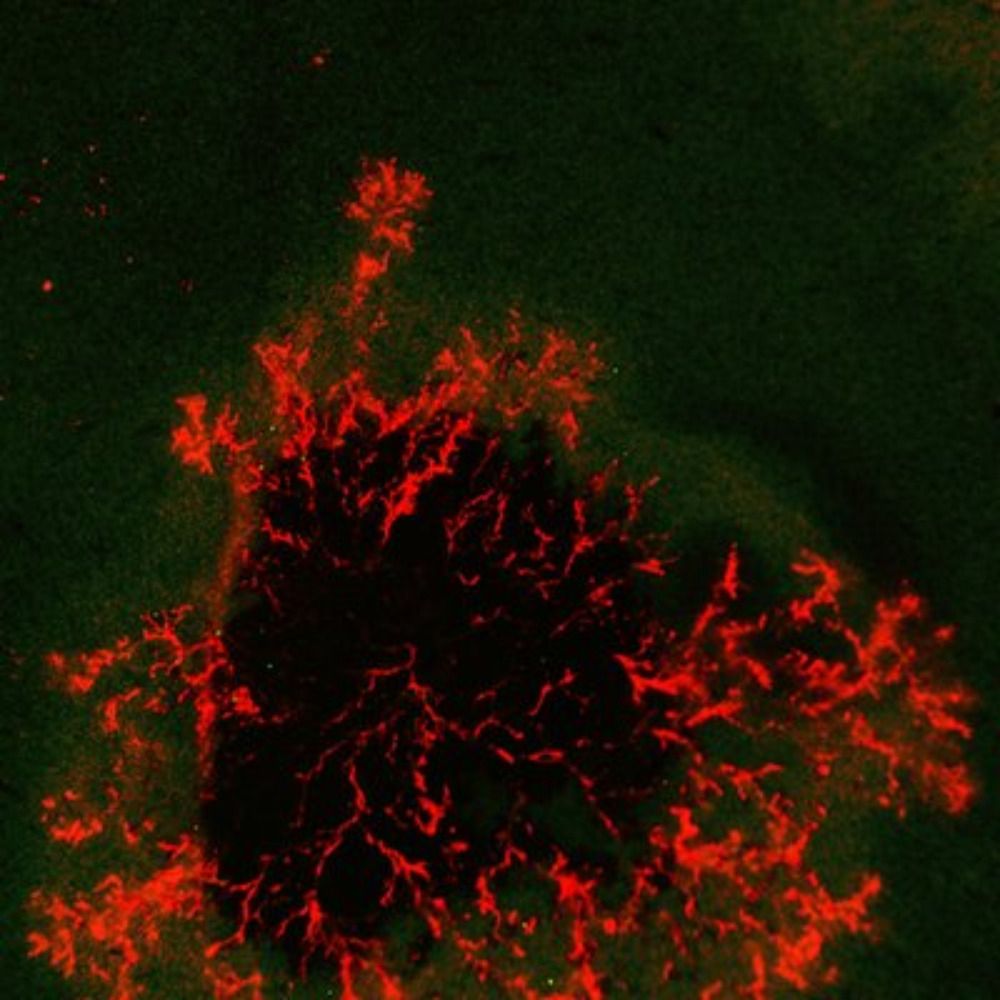
Plz RP. Come join us at @slcuplants.bsky.social @cam.ac.uk to study effector-targeted plant processes impacting plant cell biology and development.
www.cam.ac.uk/jobs/post-do...
www.schornacklab.net
www.cam.ac.uk/jobs/post-do...
www.schornacklab.net


November 6, 2025 at 6:51 PM
Plz RP. Come join us at @slcuplants.bsky.social @cam.ac.uk to study effector-targeted plant processes impacting plant cell biology and development.
www.cam.ac.uk/jobs/post-do...
www.schornacklab.net
www.cam.ac.uk/jobs/post-do...
www.schornacklab.net
Last week, our newest @biorxiv-plants.bsky.social preprint saw the light, led by @wolki95.bsky.social and co-directed by Kathrin Wippel (SILS, Amsterdam): A gnotobiotic system reveals multifunctional effector roles in plant-fungal pathogen dynamics www.biorxiv.org/content/10.1...

A gnotobiotic system reveals multifunctional effector roles in plant-fungal pathogen dynamics
Plants host diverse microbiota that influence physiological processes and can enhance resilience against invading pathogens that, in turn, evolved effector proteins to manipulate host microbiota in th...
www.biorxiv.org
April 4, 2025 at 1:59 PM
Last week, our newest @biorxiv-plants.bsky.social preprint saw the light, led by @wolki95.bsky.social and co-directed by Kathrin Wippel (SILS, Amsterdam): A gnotobiotic system reveals multifunctional effector roles in plant-fungal pathogen dynamics www.biorxiv.org/content/10.1...
Welcome @charisramsing.bsky.social
Charis Ramsing is a graduate student in my group working on identifying bacterial effector targets and an associated plant immune receptor using Clavibacter - an important xylem-colonizing plant pathogen.
Charis Ramsing is a graduate student in my group working on identifying bacterial effector targets and an associated plant immune receptor using Clavibacter - an important xylem-colonizing plant pathogen.
November 13, 2024 at 3:06 AM
Welcome @charisramsing.bsky.social
Charis Ramsing is a graduate student in my group working on identifying bacterial effector targets and an associated plant immune receptor using Clavibacter - an important xylem-colonizing plant pathogen.
Charis Ramsing is a graduate student in my group working on identifying bacterial effector targets and an associated plant immune receptor using Clavibacter - an important xylem-colonizing plant pathogen.

MolPhase: An Advanced Phase Separation Predictor and an Investigation of Phytobacterial Effector in Plant https://www.biorxiv.org/content/10.1101/2023.09.21.558813v1

MolPhase: An Advanced Phase Separation Predictor and an Investigation of Phytobacterial Effector in Plant https://www.biorxiv.org/content/10.1101/2023.09.21.558813v1
We introduce MolPhase (http://molphase.sbs.ntu.edu.sg/), an advanced protein phase separation (PS) p
www.biorxiv.org
September 22, 2023 at 1:47 AM
MolPhase: An Advanced Phase Separation Predictor and an Investigation of Phytobacterial Effector in Plant https://www.biorxiv.org/content/10.1101/2023.09.21.558813v1

🧪⚔️ When a fungal effector tries to coexist with plant apoplastic bacteria
My poster’s not up until Thursday, but you can already check it out on Zenodo 👀
📎 zenodo.org/records/1585...
🧾 Poster P-166, Thur 17th, 1:30 pm
#2025ISMPMI
My poster’s not up until Thursday, but you can already check it out on Zenodo 👀
📎 zenodo.org/records/1585...
🧾 Poster P-166, Thur 17th, 1:30 pm
#2025ISMPMI
The fungal effector AvrStb6 regulates the wheat pathobiome
Zymoseptoria tritici, the causal agent of the foliar disease Septoria tritici blotch (STB), is a major wheat pathogen in Europe. Although several wheat resistance (R) genes have been identified, Z. tr...
zenodo.org
July 14, 2025 at 2:39 PM
🧪⚔️ When a fungal effector tries to coexist with plant apoplastic bacteria
My poster’s not up until Thursday, but you can already check it out on Zenodo 👀
📎 zenodo.org/records/1585...
🧾 Poster P-166, Thur 17th, 1:30 pm
#2025ISMPMI
My poster’s not up until Thursday, but you can already check it out on Zenodo 👀
📎 zenodo.org/records/1585...
🧾 Poster P-166, Thur 17th, 1:30 pm
#2025ISMPMI

@teamthomma.bsky.social shares the story of how a Verticillium effector that impacts plant growth, actually targets other microbes, not the plant host itself.
Antimicrobial effectors have since been observed in many systems. Can we predict effectors with antimicrobial properties? Yes!
#2025ISMPMI
Antimicrobial effectors have since been observed in many systems. Can we predict effectors with antimicrobial properties? Yes!
#2025ISMPMI

July 17, 2025 at 4:31 PM
@teamthomma.bsky.social shares the story of how a Verticillium effector that impacts plant growth, actually targets other microbes, not the plant host itself.
Antimicrobial effectors have since been observed in many systems. Can we predict effectors with antimicrobial properties? Yes!
#2025ISMPMI
Antimicrobial effectors have since been observed in many systems. Can we predict effectors with antimicrobial properties? Yes!
#2025ISMPMI

#PlantScienceClassics #7: The ZigZag Model. 15 years ago @jonathandgjones.bsky.social & Jeff Dangl published their review integrating Pattern/PAMP-Triggered Immunity (PTI) & Effector-Triggered Immunity (ETI) into one unified model of ‘The plant immune system’. doi.org/10.1038/natu...

March 19, 2024 at 8:55 AM
#PlantScienceClassics #7: The ZigZag Model. 15 years ago @jonathandgjones.bsky.social & Jeff Dangl published their review integrating Pattern/PAMP-Triggered Immunity (PTI) & Effector-Triggered Immunity (ETI) into one unified model of ‘The plant immune system’. doi.org/10.1038/natu...

PLOS Biology: How Do Filamentous Pathogens Deliver Effector Proteins into Plant Cells? (An Unsolved Mystery) | t <a href="http://sco.lt/5AIZJB" class="hover:underline text-blue-600 dark:text-sky-400 no-card-link" target="_blank" rel="noopener" data-link="bsky">http://sco.lt/5AIZJB
PLOS Biology: How Do Filamentous Pathogens Deliver Effector Proteins into Plant Cells? (An Unsolved Mystery) | Plant Biology Teaching Resources (Higher Education)
By Benjamin Petre and Sophien Kamoun. They conclude, "The major challenge for the community is methodological. We therefore need to develop genetic, biochemical, and cell biological methods to manipulate, tag, detect, and observe effectors during infection."
sco.lt
February 26, 2014 at 7:19 AM
PLOS Biology: How Do Filamentous Pathogens Deliver Effector Proteins into Plant Cells? (An Unsolved Mystery) | t <a href="http://sco.lt/5AIZJB" class="hover:underline text-blue-600 dark:text-sky-400 no-card-link" target="_blank" rel="noopener" data-link="bsky">http://sco.lt/5AIZJB

Vacuolar sorting receptors coordinate lytic vacuolar and autophagic transport for plant effector-triggered immunity
www.nature.com/articles/s41...
www.nature.com/articles/s41...

Vacuolar sorting receptors coordinate lytic vacuolar and autophagic transport for plant effector-triggered immunity - Nature Plants
Vacuolar sorting receptors (VSRs) play crucial roles in plant stress responses. This study reveals that VSRs orchestrate the vacuolar sorting of immune-related proteins and autophagic degradation of b...
www.nature.com
August 26, 2025 at 3:11 PM
Vacuolar sorting receptors coordinate lytic vacuolar and autophagic transport for plant effector-triggered immunity
www.nature.com/articles/s41...
www.nature.com/articles/s41...

Herbivore insect small RNA effector suppress plant defense by cross-kingdom gene silencing https://www.biorxiv.org/content/10.1101/2023.11.18.567654v1

Herbivore insect small RNA effector suppress plant defense by cross-kingdom gene silencing https://www.biorxiv.org/content/10.1101/2023.11.18.567654v1
Herbivore insects deploy salivary effectors to manipulate the defense of their host plants, however,
www.biorxiv.org
November 19, 2023 at 4:20 AM
Herbivore insect small RNA effector suppress plant defense by cross-kingdom gene silencing https://www.biorxiv.org/content/10.1101/2023.11.18.567654v1

Haplotype-Phased Genome Assembly of Virulent Phytophthora ramorum Isolate ND886 Facilitated by Long-Read Sequencing Reveals Effector Polymorphisms and Copy Number Variation | Molecular Plant-Microbe Interactions...
November 17, 2024 at 1:24 AM
Haplotype-Phased Genome Assembly of Virulent Phytophthora ramorum Isolate ND886 Facilitated by Long-Read Sequencing Reveals Effector Polymorphisms and Copy Number Variation | Molecular Plant-Microbe Interactions...
📜 Facilitation of Symplastic Effector Protein Mobility by Paired Effectors Is Conserved in Different Classes of
Fungal Pathogens
🧑🔬 Nacera Talbi, Isabelle Fudal, Frank L. W. Takken, et al.
📔 Molecular Plant-Microbe Interactions
🔗 apsjournals.apsnet.org/doi/10.1094/...
#PlantScience #PlantImmunity
Fungal Pathogens
🧑🔬 Nacera Talbi, Isabelle Fudal, Frank L. W. Takken, et al.
📔 Molecular Plant-Microbe Interactions
🔗 apsjournals.apsnet.org/doi/10.1094/...
#PlantScience #PlantImmunity

Facilitation of Symplastic Effector Protein Mobility by Paired Effectors Is Conserved in Different Classes of Fungal Pathogens | Molecular Plant-Microbe Interactions®
It has been discovered that plant pathogens produce effectors that spread via plasmodesmata (PD) to allow modulation of host processes in distal uninfected cells. Fusarium oxysporum f. sp. lycopersici (Fol) facilitates effector translocation by expansion of the size-exclusion limit of PD using the Six5/Avr2 effector pair. How other fungal pathogens manipulate PD is unknown. We recently reported that many fungal pathogens belonging to different families carry effector pairs that resemble the SIX5/AVR2 gene pair from Fol. Here, we performed structural predictions of three of these effector pairs from Leptosphaeria maculans (Lm) and tested their ability to manipulate PD and to complement the virulence defect of a Fol SIX5 knockout mutant. We show that the AvrLm10A homologs are structurally related to FolSix5 and localize at PD when they are expressed with their paired effectors. Furthermore, these effectors were found to complement FolSix5 function in cell-to-cell mobility assays and in fungal virulence. We conclude that distantly related fungal species rely on structurally related paired effector proteins to manipulate PD and facilitate effector mobility. The wide distribution of these effector pairs implies Six5-mediated effector translocation to be a conserved propensity among fungal plant pathogens. Copyright © 2024 The Author(s). This is an open access article distributed under the CC BY-NC-ND 4.0 International license.
apsjournals.apsnet.org
April 9, 2024 at 6:01 AM
📜 Facilitation of Symplastic Effector Protein Mobility by Paired Effectors Is Conserved in Different Classes of
Fungal Pathogens
🧑🔬 Nacera Talbi, Isabelle Fudal, Frank L. W. Takken, et al.
📔 Molecular Plant-Microbe Interactions
🔗 apsjournals.apsnet.org/doi/10.1094/...
#PlantScience #PlantImmunity
Fungal Pathogens
🧑🔬 Nacera Talbi, Isabelle Fudal, Frank L. W. Takken, et al.
📔 Molecular Plant-Microbe Interactions
🔗 apsjournals.apsnet.org/doi/10.1094/...
#PlantScience #PlantImmunity
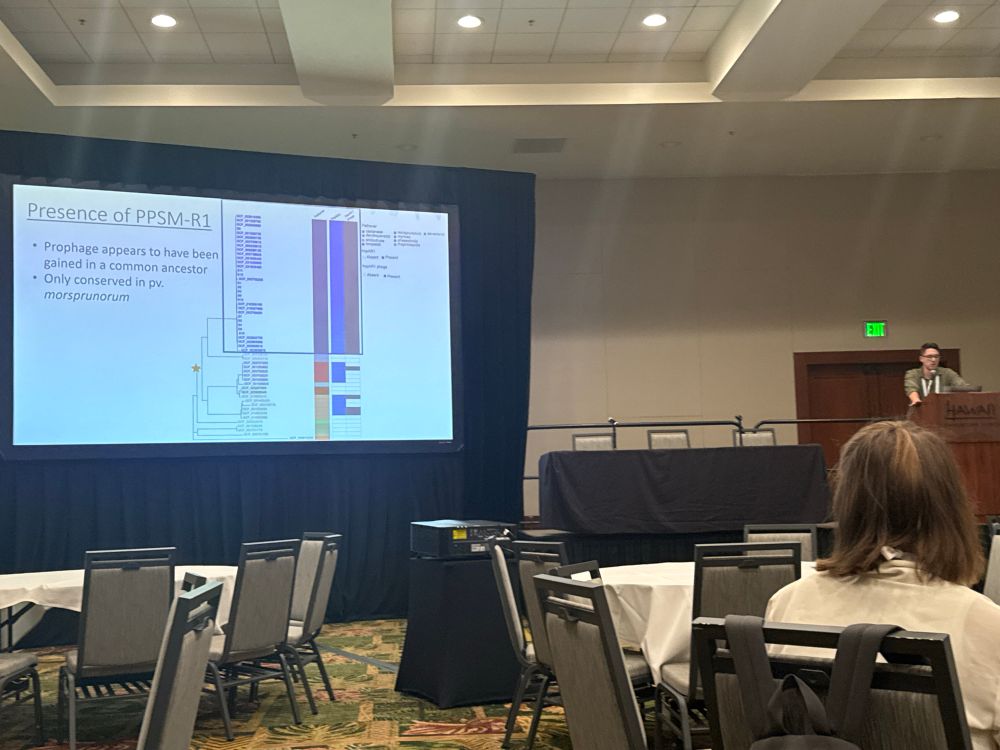
Daniel Maddock (@michhulin.bsky.social’s group) investigates prophage carrying a key effector protein that enables Pseudomonas bacteria to infect cherry trees.
Deleting the whole prophage reduces virulence of the bacterium on the plant (leaf and woody tissue) 🍒
#PlantHealth2025
Deleting the whole prophage reduces virulence of the bacterium on the plant (leaf and woody tissue) 🍒
#PlantHealth2025
August 5, 2025 at 12:22 AM
Daniel Maddock (@michhulin.bsky.social’s group) investigates prophage carrying a key effector protein that enables Pseudomonas bacteria to infect cherry trees.
Deleting the whole prophage reduces virulence of the bacterium on the plant (leaf and woody tissue) 🍒
#PlantHealth2025
Deleting the whole prophage reduces virulence of the bacterium on the plant (leaf and woody tissue) 🍒
#PlantHealth2025

Our new paper is out in New Phytologist! We describe how the Ralstonia solanacearum effector RipAV suppresses plant immunity by directly interfering with key defense regulators. 🧵👇
nph.onlinelibrary.wiley.com/doi/10.1111/...
nph.onlinelibrary.wiley.com/doi/10.1111/...

The Ralstonia solanacearum effector RipAV targets plant U‐box proteins and induces proteasomal‐dependent degradation of BIK1
Plants have developed a complex immune system to detect and respond to invading pathogens. A critical aspect of this defense relies on regulatory mechanisms that control the activation of immune res...
nph.onlinelibrary.wiley.com
September 2, 2025 at 7:58 AM
Our new paper is out in New Phytologist! We describe how the Ralstonia solanacearum effector RipAV suppresses plant immunity by directly interfering with key defense regulators. 🧵👇
nph.onlinelibrary.wiley.com/doi/10.1111/...
nph.onlinelibrary.wiley.com/doi/10.1111/...

NEW REVIEW OUT
Fungal pathogens (in fact, not only fungi and not only pathogens!) manipulate the microbiota of their plant hosts during infection.
We reviewed the processes involved, focusing on effector proteins with selective antimicrobial activities.
www.sciencedirect.com/science/arti...
Fungal pathogens (in fact, not only fungi and not only pathogens!) manipulate the microbiota of their plant hosts during infection.
We reviewed the processes involved, focusing on effector proteins with selective antimicrobial activities.
www.sciencedirect.com/science/arti...

September 5, 2024 at 8:42 AM
NEW REVIEW OUT
Fungal pathogens (in fact, not only fungi and not only pathogens!) manipulate the microbiota of their plant hosts during infection.
We reviewed the processes involved, focusing on effector proteins with selective antimicrobial activities.
www.sciencedirect.com/science/arti...
Fungal pathogens (in fact, not only fungi and not only pathogens!) manipulate the microbiota of their plant hosts during infection.
We reviewed the processes involved, focusing on effector proteins with selective antimicrobial activities.
www.sciencedirect.com/science/arti...

How do "virulence" effector proteins of a beneficial fungus interact with the network of their host plant A.thaliana. Using integrative network analysis, we show significant convergence on target-proteins shared with pathogens and exclusive targeting of host proteins in the signalling network.

Symbiont-host interactome mapping reveals effector-targeted modulation of hormone networks and activ...
Pathogens secrete effectors to promote disease, symbionts might use them to confer benefits. Here, the authors identify 106 candidate effectors from the symbiont Serendipita indica, characterise their...
www.nature.com
December 1, 2023 at 5:29 PM
How do "virulence" effector proteins of a beneficial fungus interact with the network of their host plant A.thaliana. Using integrative network analysis, we show significant convergence on target-proteins shared with pathogens and exclusive targeting of host proteins in the signalling network.

Phytoplasma Effector SAP54 Hijacks Plant Reproduction by Degrading MADS-box Proteins and Promotes Insect Colonization in a RAD23-Dependent Manner. journals.plos.org/plosbiology/...

Phytoplasma Effector SAP54 Hijacks Plant Reproduction by Degrading MADS-box Proteins and Promotes Insect Colonization in a RAD23-Dependent Manner
The phytoplasma bacterial plant parasite depends on leafhopper insects to spread and propagate itself. This study reveals how phytoplasma subverts plant development to turn flowers into leaves and thu...
journals.plos.org
March 13, 2025 at 12:36 AM
Phytoplasma Effector SAP54 Hijacks Plant Reproduction by Degrading MADS-box Proteins and Promotes Insect Colonization in a RAD23-Dependent Manner. journals.plos.org/plosbiology/...
Recent Progress in RXLR Effector Research — Molecular Plant-Microbe Interactions <a href="http://apsjournals.apsnet.org/doi/10.1094/MPMI-01-15-0022-CR?ai=3bds&ui=5nz&af=T" class="hover:underline text-blue-600 dark:text-sky-400 no-card-link" target="_blank" rel="noopener" data-link="bsky">http://apsjournals.apsnet.org/doi/10.1094/MPMI-01-15-0022-CR?ai=3bds&ui=5nz&af=T
November 18, 2024 at 3:42 AM
Recent Progress in RXLR Effector Research — Molecular Plant-Microbe Interactions <a href="http://apsjournals.apsnet.org/doi/10.1094/MPMI-01-15-0022-CR?ai=3bds&ui=5nz&af=T" class="hover:underline text-blue-600 dark:text-sky-400 no-card-link" target="_blank" rel="noopener" data-link="bsky">http://apsjournals.apsnet.org/doi/10.1094/MPMI-01-15-0022-CR?ai=3bds&ui=5nz&af=T

Protocol for probing candidate effector activity using the Prf-based plant cell death phenotype #protocol #starprotocols #cellpress

Protocol for probing candidate effector activity using the Prf-based plant cell death phenotype
Identification and functional characterization of candidate effector proteins of pathogens are essential for understanding plant-microbe interactions. Here, we present a protocol for probing candidate effector activity using the Prf-based plant cell death phenotype. We describe steps for co-infiltrating plant leaves with a Prf protein and the effector and visually assess the cell death phenotype as a readout for detecting effector activity. The protocol enables the screening of candidate effecto...
dlvr.it
May 3, 2025 at 7:27 PM
Protocol for probing candidate effector activity using the Prf-based plant cell death phenotype #protocol #starprotocols #cellpress

Root-knot nematodes exploit the catalase-like effector to manipulate plant reactive oxygen species levels by directly degrading H2O2 https://pubmed.ncbi.nlm.nih.gov/39254175/
September 11, 2024 at 6:35 PM
Root-knot nematodes exploit the catalase-like effector to manipulate plant reactive oxygen species levels by directly degrading H2O2 https://pubmed.ncbi.nlm.nih.gov/39254175/

We are excited to share our latest preprint from the Hogenhout lab (@matteogravino.bsky.social @saskiahogenhout.bsky.social
, @johninnescentre.bsky.social
) on plant-aphid interactions, showing that the aphid effector Mp10 balances suppression of DAMP responses and activation of ETI via EDS1.
, @johninnescentre.bsky.social
) on plant-aphid interactions, showing that the aphid effector Mp10 balances suppression of DAMP responses and activation of ETI via EDS1.

Aphid effector Mp10 balances immune suppression and defence activation through EDS1-dependent modulation of plant DAMP responses https://www.biorxiv.org/content/10.1101/2025.02.26.640334v1
March 1, 2025 at 10:08 AM
We are excited to share our latest preprint from the Hogenhout lab (@matteogravino.bsky.social @saskiahogenhout.bsky.social
, @johninnescentre.bsky.social
) on plant-aphid interactions, showing that the aphid effector Mp10 balances suppression of DAMP responses and activation of ETI via EDS1.
, @johninnescentre.bsky.social
) on plant-aphid interactions, showing that the aphid effector Mp10 balances suppression of DAMP responses and activation of ETI via EDS1.

🔥New and hot in #PlantSci! 🔥
By fusing roGFP2 to the type II peroxiredoxin (PRXIIB) endogenous H2O2 sensor, Hu et al. have developed an ultra-sensitive probe for H2O2 dynamics in diverse #plant #biological processes.
doi.org/10.1111/jipb...
#ROS #MPMI #PlantImmunity
By fusing roGFP2 to the type II peroxiredoxin (PRXIIB) endogenous H2O2 sensor, Hu et al. have developed an ultra-sensitive probe for H2O2 dynamics in diverse #plant #biological processes.
doi.org/10.1111/jipb...
#ROS #MPMI #PlantImmunity

June 19, 2025 at 1:38 PM
🔥New and hot in #PlantSci! 🔥
By fusing roGFP2 to the type II peroxiredoxin (PRXIIB) endogenous H2O2 sensor, Hu et al. have developed an ultra-sensitive probe for H2O2 dynamics in diverse #plant #biological processes.
doi.org/10.1111/jipb...
#ROS #MPMI #PlantImmunity
By fusing roGFP2 to the type II peroxiredoxin (PRXIIB) endogenous H2O2 sensor, Hu et al. have developed an ultra-sensitive probe for H2O2 dynamics in diverse #plant #biological processes.
doi.org/10.1111/jipb...
#ROS #MPMI #PlantImmunity