




Adrien Damseaux
@adriendams.bsky.social
Post-Doc at KIT; work on carbon cycle, permafrost, land use; like ecology, energy, transport, ethics; love cinema, music
🇧🇪
🇧🇪
Pinned
Adrien Damseaux
@adriendams.bsky.social
· Apr 14

Impact of snow thermal conductivity schemes on pan-Arctic permafrost dynamics in the Community Land Model version 5.0
Abstract. The precise magnitude and timing of permafrost-thaw-related emissions and their subsequent impact on the global climate system remain highly uncertain. This uncertainty stems from the comple...
doi.org
New paper 📝
After 4 years of work and 870 GB of modelling, remote-sensing, and observational data, I’m delighted to share our work on permafrost modelling ❄️
We focused on snow insulation, one of the key drivers of permafrost dynamics
After 4 years of work and 870 GB of modelling, remote-sensing, and observational data, I’m delighted to share our work on permafrost modelling ❄️
We focused on snow insulation, one of the key drivers of permafrost dynamics
Beautiful from the Guardian. Climate change is making food systems more fragile. Extreme weather, poor harvests, and rising prices threaten everyone's food security

How climate breakdown is putting the world’s food in peril - in maps and charts

How climate breakdown is putting the world’s food in peril - in maps and charts
From floods to droughts, erratic weather patterns are affecting food security, with crop yields projected to fall if changes are not made
www.theguardian.com
December 18, 2025 at 10:01 AM
Beautiful from the Guardian. Climate change is making food systems more fragile. Extreme weather, poor harvests, and rising prices threaten everyone's food security
Reposted by Adrien Damseaux

Delighted to see the UK rejoin Erasmus.
From my own experience, it’s about far more than studying abroad; it’s about confidence, connections, and horizons widened.
A real win for students and the future.
www.theguardian.com/world/2025/d...
From my own experience, it’s about far more than studying abroad; it’s about confidence, connections, and horizons widened.
A real win for students and the future.
www.theguardian.com/world/2025/d...

UK to rejoin EU’s Erasmus student exchange programme
Exclusive: British students will be able to participate in EU-wide scheme from January 2027, sources say
www.theguardian.com
December 17, 2025 at 9:28 AM
Delighted to see the UK rejoin Erasmus.
From my own experience, it’s about far more than studying abroad; it’s about confidence, connections, and horizons widened.
A real win for students and the future.
www.theguardian.com/world/2025/d...
From my own experience, it’s about far more than studying abroad; it’s about confidence, connections, and horizons widened.
A real win for students and the future.
www.theguardian.com/world/2025/d...
I hope this doesn't happen, but if it does, it will be a tragic day for climate research

Exclusive: The Trump administration is moving to dismantle the National Center for Atmospheric Research in Colorado, according to a senior White House official, taking aim at one of the world's leading climate research labs.

Trump moves to dismantle major US climate research center in Colorado
The Trump administration is breaking up the National Center for Atmospheric Research, taking aim at one of the world's leading climate research labs.
bit.ly
December 17, 2025 at 7:42 AM
I hope this doesn't happen, but if it does, it will be a tragic day for climate research
Reposted by Adrien Damseaux

Trump thinks immigrants will destroy Europe. The truth is the opposite.
This column is about the long arc of population change, the hybridity of European cultures, and the widely-misinterpreted results of demographic momentum.
Big issues we need to understand.
www.theguardian.com/commentisfre...
This column is about the long arc of population change, the hybridity of European cultures, and the widely-misinterpreted results of demographic momentum.
Big issues we need to understand.
www.theguardian.com/commentisfre...

The facts are stark: Europe must open the door to migrants, or face its own extinction | George Monbiot
These are the facts: plummeting birth rates mean that without attracting immigration, many countries are sliding towards collapse, says Guardian columnist George Monbiot
www.theguardian.com
December 12, 2025 at 6:47 AM
Trump thinks immigrants will destroy Europe. The truth is the opposite.
This column is about the long arc of population change, the hybridity of European cultures, and the widely-misinterpreted results of demographic momentum.
Big issues we need to understand.
www.theguardian.com/commentisfre...
This column is about the long arc of population change, the hybridity of European cultures, and the widely-misinterpreted results of demographic momentum.
Big issues we need to understand.
www.theguardian.com/commentisfre...
Reposted by Adrien Damseaux
Fewer than 60k people—0.001% of the world’s population—control 3x as much #wealth as the entire bottom half of humanity; the richest 10% own 75% of wealth and the bottom half just 2%. The top 10% of #income -earners earn more than the other 90% combined… (1/2) www.theguardian.com/inequality/2...

Just 0.001% hold three times the wealth of poorest half of humanity, report finds
Data from World Inequality Report also showed top 10% of income-earners earn more than the other 90%
www.theguardian.com
December 11, 2025 at 6:12 PM
Fewer than 60k people—0.001% of the world’s population—control 3x as much #wealth as the entire bottom half of humanity; the richest 10% own 75% of wealth and the bottom half just 2%. The top 10% of #income -earners earn more than the other 90% combined… (1/2) www.theguardian.com/inequality/2...
One Battle After Another as a musical/comedy (instead of drama) suggests they’re choosing genres with a dartboard

December 9, 2025 at 9:01 AM
One Battle After Another as a musical/comedy (instead of drama) suggests they’re choosing genres with a dartboard
Reposted by Adrien Damseaux

🌎 Livestock dominates global land, yet yields little food.
🐄 Regenerative grazing can't scale without a major cut to beef & dairy.
⚠️Regenerative grazing: short-lived soil gains, long-lived CH4.
🌳Removing livestock revives ecosystems.
FULL REPORT:
iffs.earth/living-repor...
🐄 Regenerative grazing can't scale without a major cut to beef & dairy.
⚠️Regenerative grazing: short-lived soil gains, long-lived CH4.
🌳Removing livestock revives ecosystems.
FULL REPORT:
iffs.earth/living-repor...

Living Report: Regenerative Agriculture vs. Rewilding
A comprehensive analysis of peer-reviewed evidence on regenerative grazing vs. rewilding through dietary shifts that reduce land use and restore soil, water, climate, and biodiversity
iffs.earth
November 8, 2025 at 2:37 PM
🌎 Livestock dominates global land, yet yields little food.
🐄 Regenerative grazing can't scale without a major cut to beef & dairy.
⚠️Regenerative grazing: short-lived soil gains, long-lived CH4.
🌳Removing livestock revives ecosystems.
FULL REPORT:
iffs.earth/living-repor...
🐄 Regenerative grazing can't scale without a major cut to beef & dairy.
⚠️Regenerative grazing: short-lived soil gains, long-lived CH4.
🌳Removing livestock revives ecosystems.
FULL REPORT:
iffs.earth/living-repor...
Reposted by Adrien Damseaux

This (1.48C) is a bit higher than our best estimate of human-induced warming to-date (~1.4C) in the recent Forster et al paper (essd.copernicus.org/...), despite 2025 being characterized by weak La Nina conditions (which would typically push down global temps.
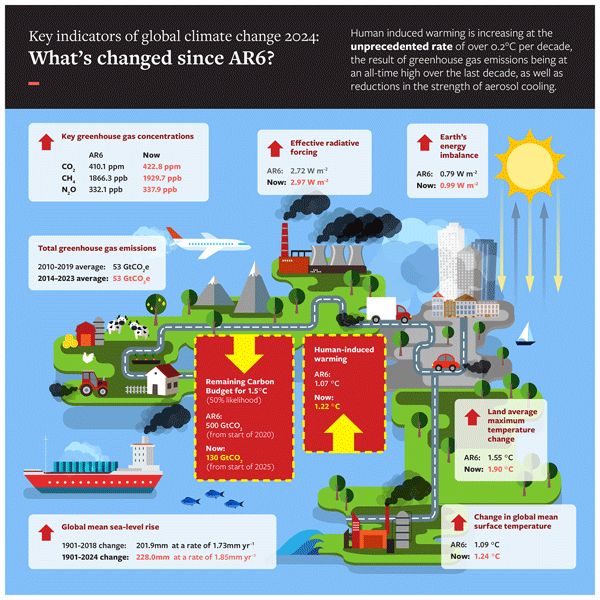
Indicators of Global Climate Change 2024: annual update of key indicators of the state of the climate system and human influence
Abstract. In a rapidly changing climate, evidence-based decision-making benefits from up-to-date and timely information. Here we compile monitoring datasets (published at https://doi.org/10.5281/zenodo.15639576; Smith et al., 2025a) to produce updated estimates for key indicators of the state of the climate system: net emissions of greenhouse gases and short-lived climate forcers, greenhouse gas concentrations, radiative forcing, the Earth's energy imbalance, surface temperature changes, warming attributed to human activities, the remaining carbon budget, and estimates of global temperature extremes. This year, we additionally include indicators for sea-level rise and land precipitation change. We follow methods as closely as possible to those used in the IPCC Sixth Assessment Report (AR6) Working Group One report. The indicators show that human activities are increasing the Earth's energy imbalance and driving faster sea-level rise compared to the AR6 assessment. For the 2015–2024 decade average, observed warming relative to 1850–1900 was 1.24 [1.11 to 1.35] °C, of which 1.22 [1.0 to 1.5] °C was human-induced. The 2024-observed best estimate of global surface temperature (1.52 °C) is well above the best estimate of human-caused warming (1.36 °C). However, the 2024 observed warming can still be regarded as a typical year, considering the human-induced warming level and the state of internal variability associated with the phase of El Niño and Atlantic variability. Human-induced warming has been increasing at a rate that is unprecedented in the instrumental record, reaching 0.27 [0.2–0.4] °C per decade over 2015–2024. This high rate of warming is caused by a combination of greenhouse gas emissions being at an all-time high of 53.6±5.2 Gt CO2e yr−1 over the last decade (2014–2023), as well as reductions in the strength of aerosol cooling. Despite this, there is evidence that the rate of increase in CO2 emissions over the last decade has slowed compared to the 2000s, and depending on societal choices, a continued series of these annual updates over the critical 2020s decade could track decreases or increases in the rate of the climatic changes presented here.
essd.copernicus.org
December 2, 2025 at 6:43 AM
This (1.48C) is a bit higher than our best estimate of human-induced warming to-date (~1.4C) in the recent Forster et al paper (essd.copernicus.org/...), despite 2025 being characterized by weak La Nina conditions (which would typically push down global temps.
Reposted by Adrien Damseaux
ICYM - Africa’s forests transformed from carbon sink to carbon source, study finds
- Alarming shift since 2010 means planet’s three main rainforest regions now contribute to #climatecrisis
www.theguardian.com/environment/...
- Alarming shift since 2010 means planet’s three main rainforest regions now contribute to #climatecrisis
www.theguardian.com/environment/...

Africa’s forests transformed from carbon sink to carbon source, study finds
Alarming shift since 2010 means planet’s three main rainforest regions now contribute to climate breakdown
www.theguardian.com
December 1, 2025 at 10:10 AM
ICYM - Africa’s forests transformed from carbon sink to carbon source, study finds
- Alarming shift since 2010 means planet’s three main rainforest regions now contribute to #climatecrisis
www.theguardian.com/environment/...
- Alarming shift since 2010 means planet’s three main rainforest regions now contribute to #climatecrisis
www.theguardian.com/environment/...
Reposted by Adrien Damseaux

In the last decades, the world has made fantastic progress against extreme poverty. In 1990, 2.3 billion people lived in extreme poverty. Since then, the number of extremely poor people has declined by 1.5 *billion* people. 🧵

November 17, 2025 at 11:24 AM
In the last decades, the world has made fantastic progress against extreme poverty. In 1990, 2.3 billion people lived in extreme poverty. Since then, the number of extremely poor people has declined by 1.5 *billion* people. 🧵
Reposted by Adrien Damseaux

www.lemonde.fr/le-monde-et-...
Un outil développé par @lemonde.fr, très bien conçu, pour mesurer la violence du changement climatique que nous vivons dès à présent dans nos lieux de vie.
Un outil développé par @lemonde.fr, très bien conçu, pour mesurer la violence du changement climatique que nous vivons dès à présent dans nos lieux de vie.

« Le Monde » lance La Météo du climat, pour connaître le temps qu’il fait et comprendre le temps qu’il fera
« Le Monde » lance, lundi, un nouveau service gratuit, interactif et géolocalisé, articulant prévisions météorologiques et données historiques climatiques. Une autre manière de mesurer les conséquence...
www.lemonde.fr
November 17, 2025 at 10:23 AM
www.lemonde.fr/le-monde-et-...
Un outil développé par @lemonde.fr, très bien conçu, pour mesurer la violence du changement climatique que nous vivons dès à présent dans nos lieux de vie.
Un outil développé par @lemonde.fr, très bien conçu, pour mesurer la violence du changement climatique que nous vivons dès à présent dans nos lieux de vie.
Reposted by Adrien Damseaux

![4-panel vertical comic. (1) 100 Years Ago [two people standing next to bicycle with small car nearby] PERSON 1: It’s too dangerous riding a bike with these cars around. I should get a car, too. (2) 50 Years Ago [two people between smaller car and bigger car] PERSON 2 with short hair: Small cars are less safe in collisions with larger vehicles, so I should get a bigger one. (3) Today [two people between big car and even bigger car] PERSON 1: Everyone has huge SUVs now. If I don’t get the biggest one, I’m putting my family at risk. (4) Soon [two people next to large armored car with spiked clubs attached] PERSON 2: If I don’t install more whirling spike clubs, I’ll be destroyed by all the other drivers who...](https://cdn.bsky.app/img/feed_thumbnail/plain/did:plc:cz73r7iyiqn26upot4jtjdhk/bafkreiby6can6k76yzfmv2czxs4pu2l7zie7bqbrpswi7h3ifmiadkuqvu@jpeg)
Reposted by Adrien Damseaux
🔴 Over 500 economists, including WIL co-director @thomaspiketty.bsky.social, call on world leaders to set up an International Panel on Inequality, as recommended by the Extraordinary Committee's report to the #G20, led by @josephestiglitz.bsky.social
🔗Letter www.equals.ink/p/sign-on-le...
🔗Letter www.equals.ink/p/sign-on-le...

November 14, 2025 at 1:53 PM
🔴 Over 500 economists, including WIL co-director @thomaspiketty.bsky.social, call on world leaders to set up an International Panel on Inequality, as recommended by the Extraordinary Committee's report to the #G20, led by @josephestiglitz.bsky.social
🔗Letter www.equals.ink/p/sign-on-le...
🔗Letter www.equals.ink/p/sign-on-le...
Reposted by Adrien Damseaux

Yes, here it is.

November 11, 2025 at 10:32 PM
Yes, here it is.
Reposted by Adrien Damseaux

On Monday 10th @14:00 BST |15:00 CET |07:00 MT, the International Land Model Forum and ISI-MIP are hosting a joint webinar. Topics will include:
The design of ISIMIP experiments,
Harmonization of forcing and land-use data,
Shared challenges e.g. generating sub-daily forcings for offline forcing.
The design of ISIMIP experiments,
Harmonization of forcing and land-use data,
Shared challenges e.g. generating sub-daily forcings for offline forcing.
November 6, 2025 at 4:17 PM
On Monday 10th @14:00 BST |15:00 CET |07:00 MT, the International Land Model Forum and ISI-MIP are hosting a joint webinar. Topics will include:
The design of ISIMIP experiments,
Harmonization of forcing and land-use data,
Shared challenges e.g. generating sub-daily forcings for offline forcing.
The design of ISIMIP experiments,
Harmonization of forcing and land-use data,
Shared challenges e.g. generating sub-daily forcings for offline forcing.
Reposted by Adrien Damseaux

Paris+🔟
Europe, incl. Belgium 🇧🇪, is warming faster than expected. Events once forecast for 2030–2040, like the 2021 floods and 40°C heat, are already here, notes Prof Xavier Fettweis (ULiège) | @universitedeliege.bsky.social | #ClimateImpacts
🔗 Full interview: www.climatecentre.be/post/the-par...
Europe, incl. Belgium 🇧🇪, is warming faster than expected. Events once forecast for 2030–2040, like the 2021 floods and 40°C heat, are already here, notes Prof Xavier Fettweis (ULiège) | @universitedeliege.bsky.social | #ClimateImpacts
🔗 Full interview: www.climatecentre.be/post/the-par...


November 6, 2025 at 8:15 AM
Paris+🔟
Europe, incl. Belgium 🇧🇪, is warming faster than expected. Events once forecast for 2030–2040, like the 2021 floods and 40°C heat, are already here, notes Prof Xavier Fettweis (ULiège) | @universitedeliege.bsky.social | #ClimateImpacts
🔗 Full interview: www.climatecentre.be/post/the-par...
Europe, incl. Belgium 🇧🇪, is warming faster than expected. Events once forecast for 2030–2040, like the 2021 floods and 40°C heat, are already here, notes Prof Xavier Fettweis (ULiège) | @universitedeliege.bsky.social | #ClimateImpacts
🔗 Full interview: www.climatecentre.be/post/the-par...
Reposted by Adrien Damseaux

Only 3% of international climate aid going to transitioning communities: ‘This is absurd’

Only 3% of international climate aid going to transitioning communities: ‘This is absurd’
New report on funding to slash carbon emissions finds startlingly low engagement with the people affected
Less than 3% of international aid to slash carbon emissions is supporting a “just transition” for workers and communities away from polluting industries, according to a new report.
Released one week before the start of major United Nations climate negotiations in Belém, Brazil, the analysis from the climate and development non-profit ActionAid warns that the world’s response to the climate crisis risks deepening inequality rather than addressing it. Continue reading...
www.theguardian.com
November 3, 2025 at 3:07 PM
Only 3% of international climate aid going to transitioning communities: ‘This is absurd’
Reposted by Adrien Damseaux
If climate policy had a “best buy,” it might be methane cuts
Global methane mitigation has a benefit–cost ratio >6:1, even before accounting for near-term climate feedbacks
A strong case: it’s among the most efficient levers in climate policy
www.science.org/doi/10.1126/...
Global methane mitigation has a benefit–cost ratio >6:1, even before accounting for near-term climate feedbacks
A strong case: it’s among the most efficient levers in climate policy
www.science.org/doi/10.1126/...

Global methane action pays for itself at least six times over
We provide a comprehensive assessment of the economic benefits and costs of global methane emissions abatement, anchored on the Global Methane Pledge. We use an integrated assessment model to estimate...
www.science.org
November 1, 2025 at 10:39 AM
If climate policy had a “best buy,” it might be methane cuts
Global methane mitigation has a benefit–cost ratio >6:1, even before accounting for near-term climate feedbacks
A strong case: it’s among the most efficient levers in climate policy
www.science.org/doi/10.1126/...
Global methane mitigation has a benefit–cost ratio >6:1, even before accounting for near-term climate feedbacks
A strong case: it’s among the most efficient levers in climate policy
www.science.org/doi/10.1126/...
Reposted by Adrien Damseaux
Tool reveals how your dinner affects risk of 30,875 species land-dwelling animals going extinct
"If everyone in the UK switched to a vegetarian diet overnight, we could halve our biodiversity impact."
phys.org/news/2025-10...
"If everyone in the UK switched to a vegetarian diet overnight, we could halve our biodiversity impact."
phys.org/news/2025-10...

Tool reveals how your dinner affects risk of 30,875 species land-dwelling animals going extinct
University of Cambridge researchers have developed a new way to measure the impact of our food production on other species' survival around the world.
phys.org
October 31, 2025 at 7:15 AM
Tool reveals how your dinner affects risk of 30,875 species land-dwelling animals going extinct
"If everyone in the UK switched to a vegetarian diet overnight, we could halve our biodiversity impact."
phys.org/news/2025-10...
"If everyone in the UK switched to a vegetarian diet overnight, we could halve our biodiversity impact."
phys.org/news/2025-10...
Reposted by Adrien Damseaux

Nature’s 2025 PhD survey asked doctoral candidates worldwide what advice they would give to someone considering a similar degree. Respondents gave advice on choosing supervisors, managing mental health, and surviving academic culture. #Academicsky 🧪

27 things we wish we’d known when we started our PhDs
Nature’s survey of PhD candidates reveals hard-won wisdom on choosing supervisors, managing mental health and surviving academic culture.
go.nature.com
October 27, 2025 at 1:48 AM
Nature’s 2025 PhD survey asked doctoral candidates worldwide what advice they would give to someone considering a similar degree. Respondents gave advice on choosing supervisors, managing mental health, and surviving academic culture. #Academicsky 🧪
Reposted by Adrien Damseaux

How can we explore the future of the world's forests? Understanding the demography of their trees is key. In We took the new gen of global demographic vegetation models and held their roots to the observations. Thanks @annemarie-es.bsky.social for leading! nph.onlinelibrary.wiley.com/doi/10.1111/...

October 27, 2025 at 7:12 AM
How can we explore the future of the world's forests? Understanding the demography of their trees is key. In We took the new gen of global demographic vegetation models and held their roots to the observations. Thanks @annemarie-es.bsky.social for leading! nph.onlinelibrary.wiley.com/doi/10.1111/...
Reposted by Adrien Damseaux

🍺🍷 What does climate change mean for your pint of beer or glass of wine?
Professor Paul Behrens from our Future of Food Programme shares five insights on how it’s transforming what we eat and why it matters this #WorldFoodDay.
🎥
Professor Paul Behrens from our Future of Food Programme shares five insights on how it’s transforming what we eat and why it matters this #WorldFoodDay.
🎥

Oxford professor: Five facts you need to know about climate change’s impact on food #worldfoodday
🍺 Beer prices could double🪳 Pests could wreak havoc on crops🌱 Switching to a plant-rich diet could save land almost the size of Scotland@OxMartinSchool's ...
youtube.com
October 16, 2025 at 11:31 AM
🍺🍷 What does climate change mean for your pint of beer or glass of wine?
Professor Paul Behrens from our Future of Food Programme shares five insights on how it’s transforming what we eat and why it matters this #WorldFoodDay.
🎥
Professor Paul Behrens from our Future of Food Programme shares five insights on how it’s transforming what we eat and why it matters this #WorldFoodDay.
🎥
Reposted by Adrien Damseaux

I'm excited to be speaking about Rafael Wildauer's and my new working paper (gala.gre.ac.uk/id/eprint/51...), which estimates the climate effect of wealth taxes at the #BlueEarthSummit today!
Study with us
gala.gre.ac.uk
October 15, 2025 at 7:23 AM
I'm excited to be speaking about Rafael Wildauer's and my new working paper (gala.gre.ac.uk/id/eprint/51...), which estimates the climate effect of wealth taxes at the #BlueEarthSummit today!
Reposted by Adrien Damseaux

This remains the funniest way to hear about an internet outage, though.

October 20, 2025 at 8:41 AM
This remains the funniest way to hear about an internet outage, though.
Un projet très prometteur à partager ! Le futur ourworldindata.org français ?
October 20, 2025 at 8:39 AM
Un projet très prometteur à partager ! Le futur ourworldindata.org français ?