




Anima Anandkumar
@anima-anandkumar.bsky.social
AI Pioneer, AI+Science, Professor at Caltech, Former Senior Director of AI at NVIDIA, Former Principal Scientist at AWS AI.
My 2025 research highlights in ai+science tensorlab.cms.caltech.edu/users/anima/...
Anima AI + Science Lab
As AI+Science went more mainstream in 2025, our team’s seminal contributions to the field are getting wide recognition. While language models have been used by “AI-scientists” to generate new ideas, they do not solve the main bottleneck in scientific discovery. The cost and time needed for physical experimentation is the main limiting factor for trying out many new ideas. AI with physical understanding aims to replace expensive physical experimentation with digital exploration. In 2020, we invented Neural Operators to learn multiscale physical phenomena that laid the foundations for such Physical AI. In 2025, we deepened these foundations and also pushed the frontier in a wide range of scientific applications.
tensorlab.cms.caltech.edu
January 2, 2026 at 8:41 PM
My 2025 research highlights in ai+science tensorlab.cms.caltech.edu/users/anima/...
An exciting collaboration with @francesarnold.bsky.social on AI+enzymes. This combines generative protein models with carefully tuned filters that resulted in functional and versatile enzymes beating natural and previously engineered enzymes.
Generated PLP-dependent Trp synthases are functional, stable, and exhibit usefully broad substrate scopes! fun collaboration with @anima-anandkumar.bsky.social @ramanathanlab.bsky.social Amin Takavoli. I love AI + #enzymes!
Finetune a codon-level language model with 30k tryptophan synthases, then generate diverse, functional, enzymes with broad substrate scopes.
Théophile Lambert @jsunn-y.bsky.social @francesarnold.bsky.social
www.biorxiv.org/content/10.1...
Théophile Lambert @jsunn-y.bsky.social @francesarnold.bsky.social
www.biorxiv.org/content/10.1...
December 16, 2025 at 3:23 AM
An exciting collaboration with @francesarnold.bsky.social on AI+enzymes. This combines generative protein models with carefully tuned filters that resulted in functional and versatile enzymes beating natural and previously engineered enzymes.
Reposted by Anima Anandkumar
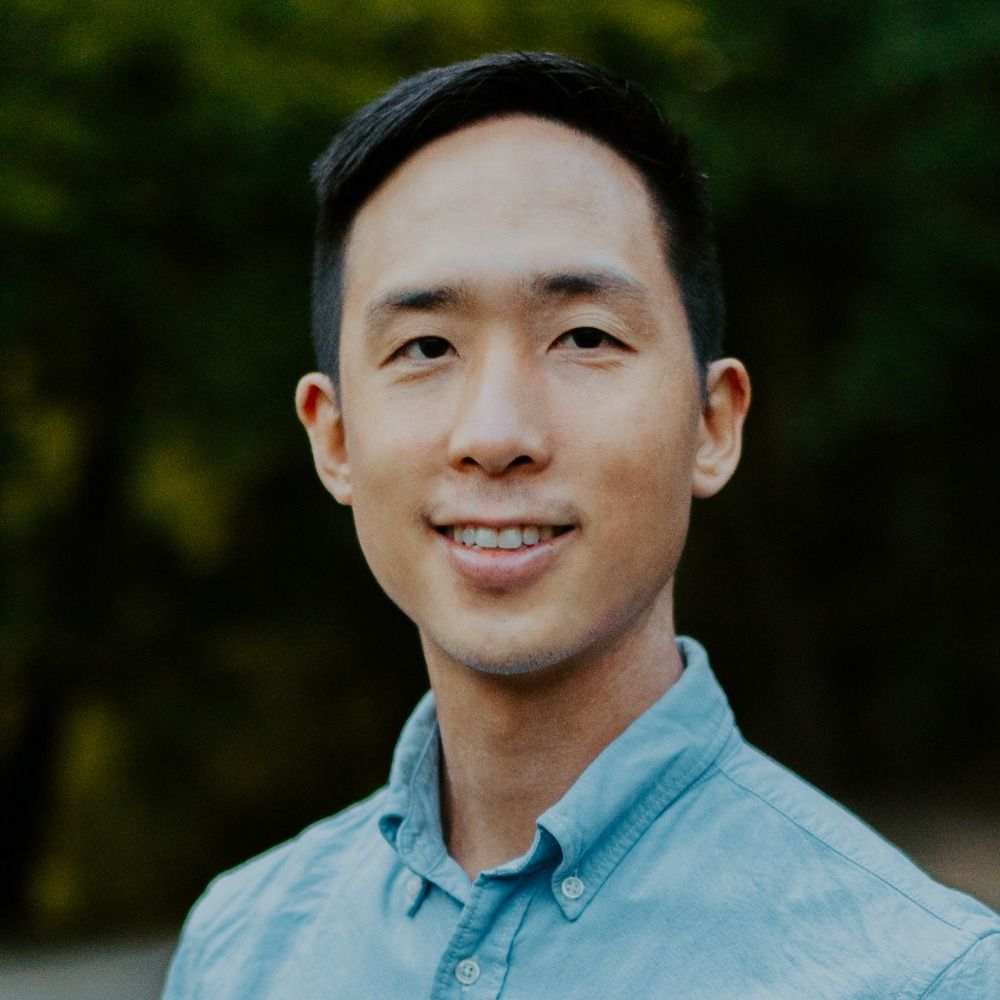
Finetune a codon-level language model with 30k tryptophan synthases, then generate diverse, functional, enzymes with broad substrate scopes.
Théophile Lambert @jsunn-y.bsky.social @francesarnold.bsky.social
www.biorxiv.org/content/10.1...
Théophile Lambert @jsunn-y.bsky.social @francesarnold.bsky.social
www.biorxiv.org/content/10.1...


December 16, 2025 at 12:25 AM
Finetune a codon-level language model with 30k tryptophan synthases, then generate diverse, functional, enzymes with broad substrate scopes.
Théophile Lambert @jsunn-y.bsky.social @francesarnold.bsky.social
www.biorxiv.org/content/10.1...
Théophile Lambert @jsunn-y.bsky.social @francesarnold.bsky.social
www.biorxiv.org/content/10.1...
Reposted by Anima Anandkumar
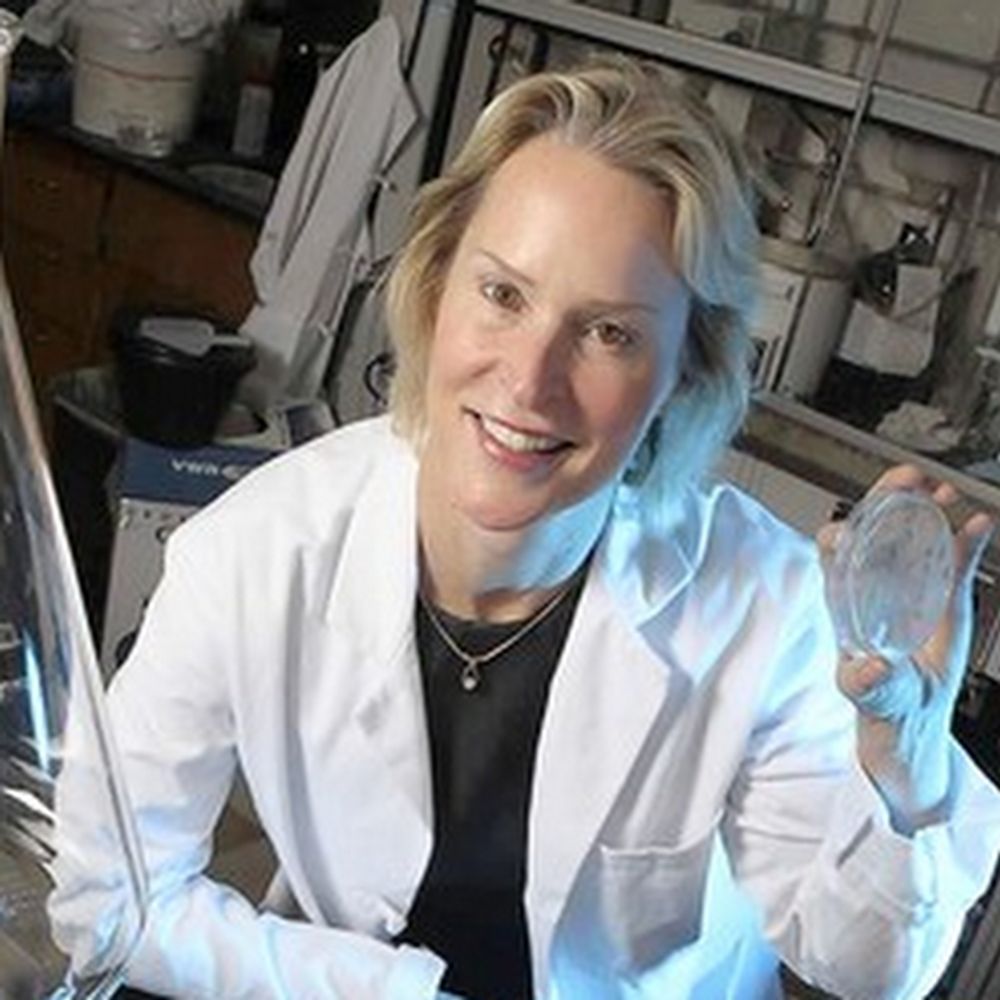
Generated PLP-dependent Trp synthases are functional, stable, and exhibit usefully broad substrate scopes! fun collaboration with @anima-anandkumar.bsky.social @ramanathanlab.bsky.social Amin Takavoli. I love AI + #enzymes!
Finetune a codon-level language model with 30k tryptophan synthases, then generate diverse, functional, enzymes with broad substrate scopes.
Théophile Lambert @jsunn-y.bsky.social @francesarnold.bsky.social
www.biorxiv.org/content/10.1...
Théophile Lambert @jsunn-y.bsky.social @francesarnold.bsky.social
www.biorxiv.org/content/10.1...
December 16, 2025 at 12:46 AM
Generated PLP-dependent Trp synthases are functional, stable, and exhibit usefully broad substrate scopes! fun collaboration with @anima-anandkumar.bsky.social @ramanathanlab.bsky.social Amin Takavoli. I love AI + #enzymes!
Reposted by Anima Anandkumar

Analyzing Political Text at Scale with Online Tensor LDA: @sarakangaslahti.bsky.social @harvard.edu | D Ebanks @iqss.bsky.social | @jeankossaifi.bsky.social NVIDIA |A Liu @hopkinsengineer.bsky.social @rmichaelalvarez.bsky.social @caltechlcssp.bsky.social @anima-anandkumar.bsky.social @caltech.edu

December 10, 2025 at 8:52 PM
Analyzing Political Text at Scale with Online Tensor LDA: @sarakangaslahti.bsky.social @harvard.edu | D Ebanks @iqss.bsky.social | @jeankossaifi.bsky.social NVIDIA |A Liu @hopkinsengineer.bsky.social @rmichaelalvarez.bsky.social @caltechlcssp.bsky.social @anima-anandkumar.bsky.social @caltech.edu
Join our happy hour meetup today at NeurIPS to chat about AI+Science and AI+Math with me and my team from @caltechedu at:
Achilles Coffee Roasters Gaslamp, San Diego.
4:45pm - 6:30pm
I will be announcing one more meetup later this week if you can't make it to this one. Stay tuned!
Achilles Coffee Roasters Gaslamp, San Diego.
4:45pm - 6:30pm
I will be announcing one more meetup later this week if you can't make it to this one. Stay tuned!

December 2, 2025 at 6:56 PM
Join our happy hour meetup today at NeurIPS to chat about AI+Science and AI+Math with me and my team from @caltechedu at:
Achilles Coffee Roasters Gaslamp, San Diego.
4:45pm - 6:30pm
I will be announcing one more meetup later this week if you can't make it to this one. Stay tuned!
Achilles Coffee Roasters Gaslamp, San Diego.
4:45pm - 6:30pm
I will be announcing one more meetup later this week if you can't make it to this one. Stay tuned!
Join livestream and listen to talks at @caltech.edu ai+science conference aiscienceconference.caltech.edu
AI+Science Conference
The California Institute of Technology and the University of Chicago are centers of gravity for the study, application, and use of AI and Machine Learning to enable scientific discovery across the physical and biological sciences, advancing core AI principles and training a new generation of interdisciplinary scientists. To both advance this scientific and technical pursuit and demonstrate the leadership of Caltech and UChicago in this space, we will host the The Caltech and University of Chicago Conference on AI+Science, Sponsored by the Margot and Tom Pritzker Foundation, at Caltech from November 10-11, 2025. This event will bring together an elite and diverse cohort of leading researchers in core AI and domain sciences to lead conversations and drive partnerships that will shape future inquiry, industry investment, and entrepreneurial opportunities.
aiscienceconference.caltech.edu
November 10, 2025 at 5:43 PM
Join livestream and listen to talks at @caltech.edu ai+science conference aiscienceconference.caltech.edu
Reposted by Anima Anandkumar
Join @aratip.bsky.social, Vivek Vishwanathan & @anima-anandkumar.bsky.social for UC Berkeley’s #TechPolicyWeek!
“Bigger, Better Ambitions for AI” — exploring how #AI can drive positive impact.
Oct 20 | 3–4:15pm | 2400 Ridge Rd
@BerkeleyISchool.bsky.social @GoldmanSchool.bsky.social
“Bigger, Better Ambitions for AI” — exploring how #AI can drive positive impact.
Oct 20 | 3–4:15pm | 2400 Ridge Rd
@BerkeleyISchool.bsky.social @GoldmanSchool.bsky.social

Bigger, Better Ambitions for AI
How can we advance efforts to harness AI to deliver positive impacts to people's lives?
www.eventbrite.com
October 11, 2025 at 10:50 PM
Join @aratip.bsky.social, Vivek Vishwanathan & @anima-anandkumar.bsky.social for UC Berkeley’s #TechPolicyWeek!
“Bigger, Better Ambitions for AI” — exploring how #AI can drive positive impact.
Oct 20 | 3–4:15pm | 2400 Ridge Rd
@BerkeleyISchool.bsky.social @GoldmanSchool.bsky.social
“Bigger, Better Ambitions for AI” — exploring how #AI can drive positive impact.
Oct 20 | 3–4:15pm | 2400 Ridge Rd
@BerkeleyISchool.bsky.social @GoldmanSchool.bsky.social
I am thrilled to see Omar Yaghi win the Nobel Prize in Chemistry today. I have had the privilege to interact with him and collaborate with him. This is a paper from a couple of years ago using generative models for MOFs with @ucberkeleyofficial.bsky.social group. pubs.acs.org/doi/10.1021/...

Shaping the Water-Harvesting Behavior of Metal–Organic Frameworks Aided by Fine-Tuned GPT Models
We construct a data set of metal–organic framework (MOF) linkers and employ a fine-tuned GPT assistant to propose MOF linker designs by mutating and modifying the existing linker structures. This strategy allows the GPT model to learn the intricate language of chemistry in molecular representations, thereby achieving an enhanced accuracy in generating linker structures compared with its base models. Aiming to highlight the significance of linker design strategies in advancing the discovery of water-harvesting MOFs, we conducted a systematic MOF variant expansion upon state-of-the-art MOF-303 utilizing a multidimensional approach that integrates linker extension with multivariate tuning strategies. We synthesized a series of isoreticular aluminum MOFs, termed Long-Arm MOFs (LAMOF-1 to LAMOF-10), featuring linkers that bear various combinations of heteroatoms in their five-membered ring moiety, replacing pyrazole with either thiophene, furan, or thiazole rings or a combination of two. Beyond their consistent and robust architecture, as demonstrated by permanent porosity and thermal stability, the LAMOF series offers a generalizable synthesis strategy. Importantly, these 10 LAMOFs establish new benchmarks for water uptake (up to 0.64 g g–1) and operational humidity ranges (between 13 and 53%), thereby expanding the diversity of water-harvesting MOFs.
pubs.acs.org
October 8, 2025 at 7:15 PM
I am thrilled to see Omar Yaghi win the Nobel Prize in Chemistry today. I have had the privilege to interact with him and collaborate with him. This is a paper from a couple of years ago using generative models for MOFs with @ucberkeleyofficial.bsky.social group. pubs.acs.org/doi/10.1021/...
Reposted by Anima Anandkumar
Our new paper on AI-generated TrpBs with @anima-anandkumar.bsky.social. GenSLM generated very useful promiscuous TrpB #enzymes, bypassing a lot of #directedevolution! great work by the whole team, especially Theophile Lambert. www.biorxiv.org/content/10.1...
www.biorxiv.org
September 4, 2025 at 2:58 PM
Our new paper on AI-generated TrpBs with @anima-anandkumar.bsky.social. GenSLM generated very useful promiscuous TrpB #enzymes, bypassing a lot of #directedevolution! great work by the whole team, especially Theophile Lambert. www.biorxiv.org/content/10.1...
Very pleased to see our AI model GenSLM designing novel and versatile enzymes in a challenging setting in
@francesarnold.bsky.social lab in the tryptophan synthase (TrpB) family. www.biorxiv.org/content/10.1...
AI can create novel enzymes outperformed both natural and laboratory-optimized TrpBs.
@francesarnold.bsky.social lab in the tryptophan synthase (TrpB) family. www.biorxiv.org/content/10.1...
AI can create novel enzymes outperformed both natural and laboratory-optimized TrpBs.
www.biorxiv.org
September 3, 2025 at 7:31 PM
Very pleased to see our AI model GenSLM designing novel and versatile enzymes in a challenging setting in
@francesarnold.bsky.social lab in the tryptophan synthase (TrpB) family. www.biorxiv.org/content/10.1...
AI can create novel enzymes outperformed both natural and laboratory-optimized TrpBs.
@francesarnold.bsky.social lab in the tryptophan synthase (TrpB) family. www.biorxiv.org/content/10.1...
AI can create novel enzymes outperformed both natural and laboratory-optimized TrpBs.
End-to-end learning can use both approximate and accurate training data, if the model can learn how to mix them correctly. It turns out that Neural Operators offer a perfect solution when such multi-fidelity and multi-resolution data is available, and can learn with high data efficiency.
September 2, 2025 at 12:41 AM
End-to-end learning can use both approximate and accurate training data, if the model can learn how to mix them correctly. It turns out that Neural Operators offer a perfect solution when such multi-fidelity and multi-resolution data is available, and can learn with high data efficiency.
Our latest paper surprisingly shows that it is not the case! End to end also requires less training data compared to methods that keep existing numerical solvers and augment with AI. Where do savings come from? The approach that augments AI relies only on fully accurate expensive training data.
September 2, 2025 at 12:40 AM
Our latest paper surprisingly shows that it is not the case! End to end also requires less training data compared to methods that keep existing numerical solvers and augment with AI. Where do savings come from? The approach that augments AI relies only on fully accurate expensive training data.
We have seen end-to-end approach win in areas like weather forecasting. It is significantly better for speed: 1000-million x faster than numerical simulations in many areas such as fluid dynamics, plasma physics etc. But a big argument against it is the need for expensive training data.
September 2, 2025 at 12:38 AM
We have seen end-to-end approach win in areas like weather forecasting. It is significantly better for speed: 1000-million x faster than numerical simulations in many areas such as fluid dynamics, plasma physics etc. But a big argument against it is the need for expensive training data.
Popular prescription is to augment AI into existing workflows rather than replace them, e.g., keep the approximate numerical solver for simulations, and use AI only to correct its errors in every time step. Other extreme is to completely discard the existing workflow and replace it fully with AI.
September 2, 2025 at 12:37 AM
Popular prescription is to augment AI into existing workflows rather than replace them, e.g., keep the approximate numerical solver for simulations, and use AI only to correct its errors in every time step. Other extreme is to completely discard the existing workflow and replace it fully with AI.
How do we build AI for science? Augment with AI or replace with AI? Augment with AI involves keeping existing numerical simulations. In our latest paper, we show end-to-end learning is faster significantly and also wins in data efficiency, which is counterintuitive. arxiv.org/pdf/2408.05177 #ai

September 2, 2025 at 12:37 AM
How do we build AI for science? Augment with AI or replace with AI? Augment with AI involves keeping existing numerical simulations. In our latest paper, we show end-to-end learning is faster significantly and also wins in data efficiency, which is counterintuitive. arxiv.org/pdf/2408.05177 #ai
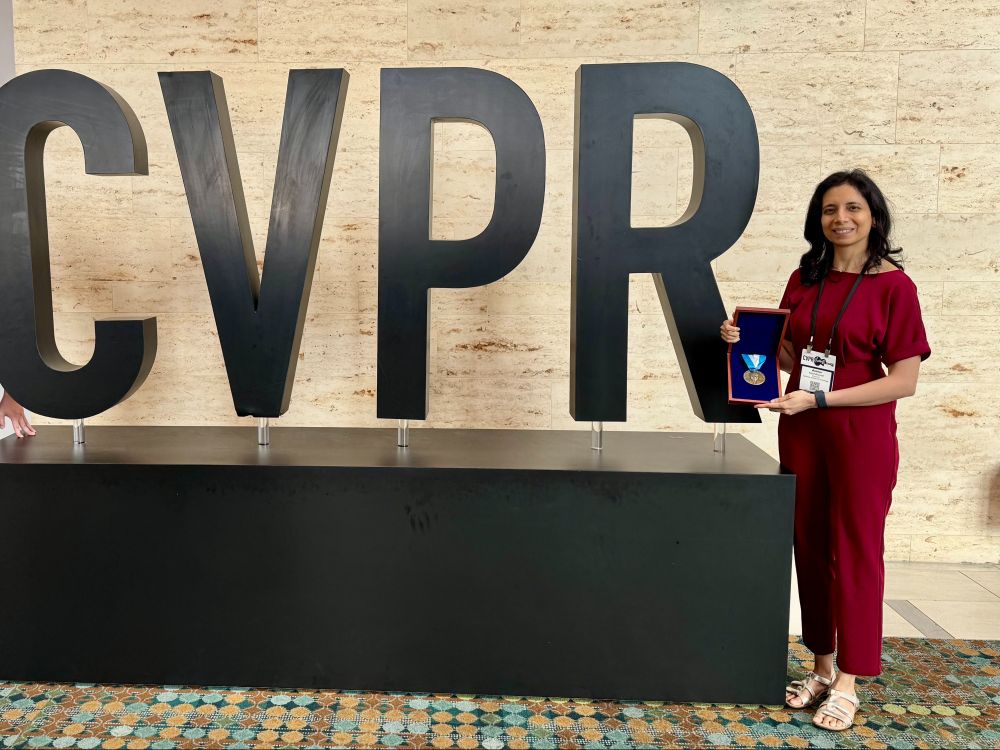
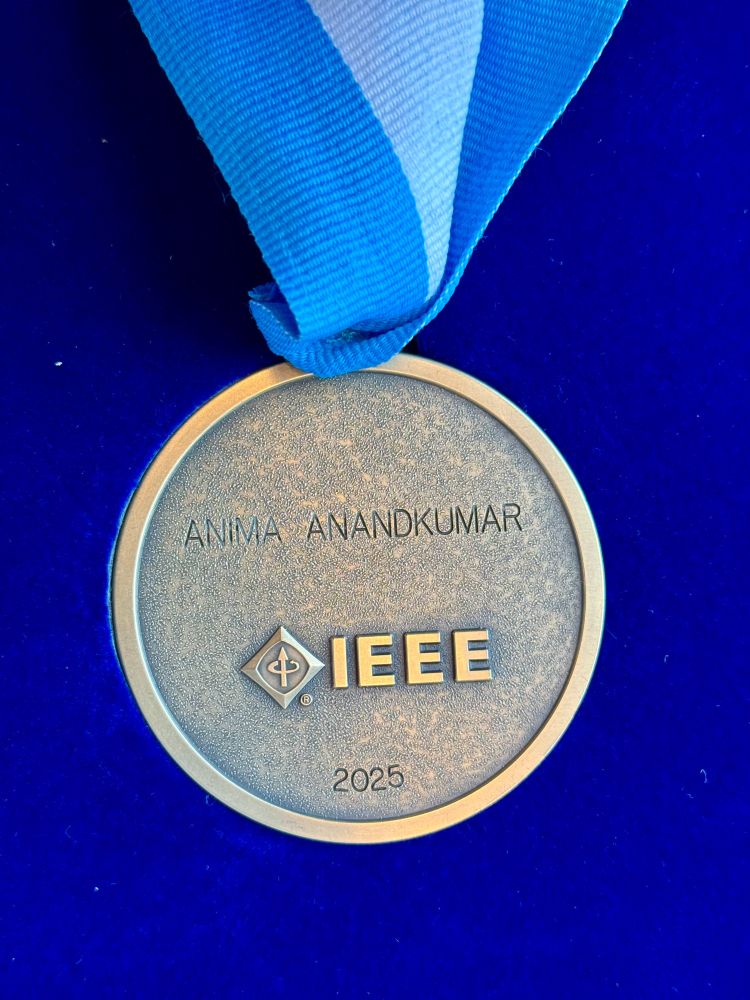
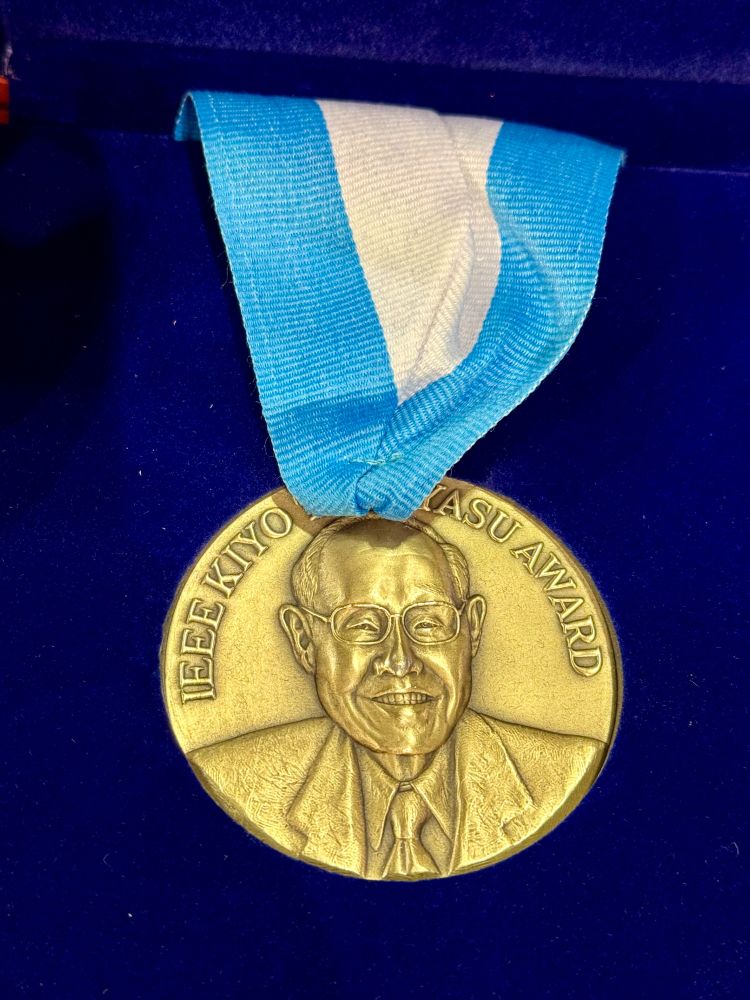
Thank you @cvprconference.bsky.social for hosting my
IEEE Kiyo Tomiyasu award for bringing AI to scientific domains with Neural Operators and physics-informed learning. The future of science is AI+Science!
corporate-awards.ieee.org/award/ieee-k...
IEEE Kiyo Tomiyasu award for bringing AI to scientific domains with Neural Operators and physics-informed learning. The future of science is AI+Science!
corporate-awards.ieee.org/award/ieee-k...
June 16, 2025 at 3:03 AM
Thank you @cvprconference.bsky.social for hosting my
IEEE Kiyo Tomiyasu award for bringing AI to scientific domains with Neural Operators and physics-informed learning. The future of science is AI+Science!
corporate-awards.ieee.org/award/ieee-k...
IEEE Kiyo Tomiyasu award for bringing AI to scientific domains with Neural Operators and physics-informed learning. The future of science is AI+Science!
corporate-awards.ieee.org/award/ieee-k...
Reposted by Anima Anandkumar
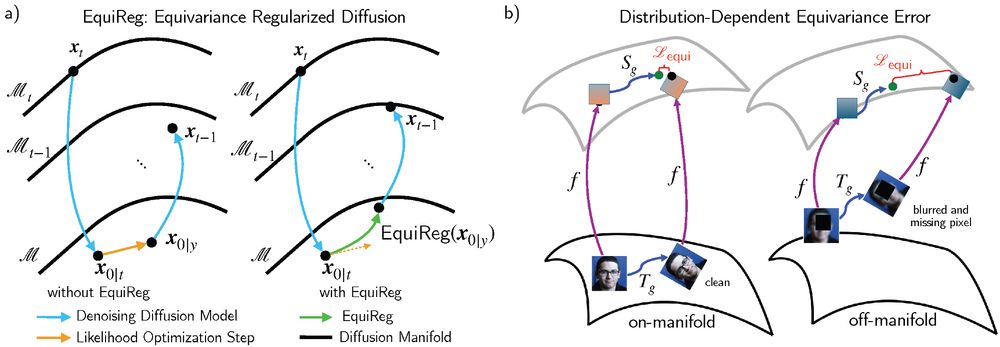
🚨We propose EquiReg, a generalized regularization framework that uses symmetry in generative diffusion models to improve solutions to inverse problems. arxiv.org/abs/2505.22973
@aditijc.bsky.social, Rayhan Zirvi, Abbas Mammadov, @jiacheny.bsky.social, Chuwei Wang, @anima-anandkumar.bsky.social 1/
@aditijc.bsky.social, Rayhan Zirvi, Abbas Mammadov, @jiacheny.bsky.social, Chuwei Wang, @anima-anandkumar.bsky.social 1/
June 12, 2025 at 3:47 PM
🚨We propose EquiReg, a generalized regularization framework that uses symmetry in generative diffusion models to improve solutions to inverse problems. arxiv.org/abs/2505.22973
@aditijc.bsky.social, Rayhan Zirvi, Abbas Mammadov, @jiacheny.bsky.social, Chuwei Wang, @anima-anandkumar.bsky.social 1/
@aditijc.bsky.social, Rayhan Zirvi, Abbas Mammadov, @jiacheny.bsky.social, Chuwei Wang, @anima-anandkumar.bsky.social 1/
Thank you @caltech.edu for including me in the history of AI. It starts with Carver Mead, John Hopfield and Richard Feynman teaching a course on physics of computation. Not many are aware that the main AI conference, NeurIPS, started at @caltech.edu
magazine.caltech.edu/post/ai-mach...
magazine.caltech.edu/post/ai-mach...
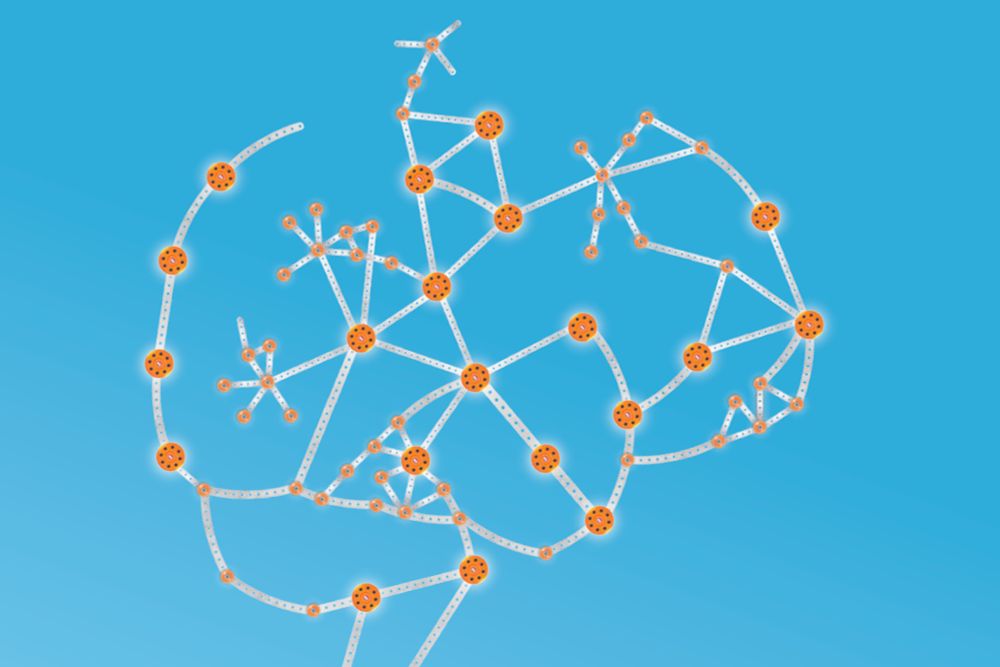
The Roots of Neural Network: How Caltech Research Paved the Way to Modern AI — Caltech Magazine
Tracing the roots of neural networks, the building blocks of modern AI, at Caltech. By Whitney Clavin
magazine.caltech.edu
June 10, 2025 at 5:34 PM
Thank you @caltech.edu for including me in the history of AI. It starts with Carver Mead, John Hopfield and Richard Feynman teaching a course on physics of computation. Not many are aware that the main AI conference, NeurIPS, started at @caltech.edu
magazine.caltech.edu/post/ai-mach...
magazine.caltech.edu/post/ai-mach...
Reposted by Anima Anandkumar
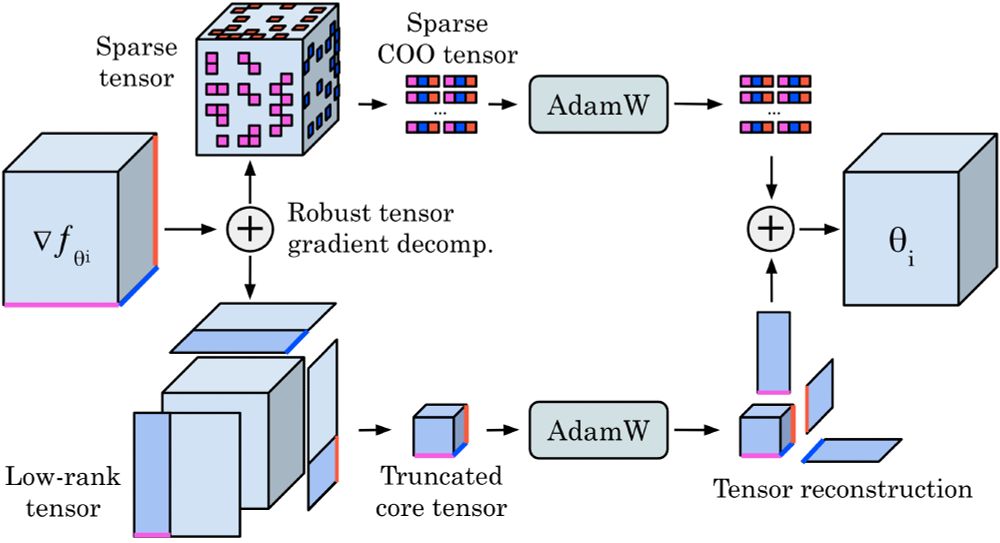
Check out our new preprint 𝐓𝐞𝐧𝐬𝐨𝐫𝐆𝐑𝐚𝐃.
We use a robust decomposition of the gradient tensors into low-rank + sparse parts to reduce optimizer memory for Neural Operators by up to 𝟕𝟓%, while matching the performance of Adam, even on turbulent Navier–Stokes (Re 10e5).
We use a robust decomposition of the gradient tensors into low-rank + sparse parts to reduce optimizer memory for Neural Operators by up to 𝟕𝟓%, while matching the performance of Adam, even on turbulent Navier–Stokes (Re 10e5).
June 3, 2025 at 3:17 AM
Check out our new preprint 𝐓𝐞𝐧𝐬𝐨𝐫𝐆𝐑𝐚𝐃.
We use a robust decomposition of the gradient tensors into low-rank + sparse parts to reduce optimizer memory for Neural Operators by up to 𝟕𝟓%, while matching the performance of Adam, even on turbulent Navier–Stokes (Re 10e5).
We use a robust decomposition of the gradient tensors into low-rank + sparse parts to reduce optimizer memory for Neural Operators by up to 𝟕𝟓%, while matching the performance of Adam, even on turbulent Navier–Stokes (Re 10e5).
Reposted by Anima Anandkumar
Thanks to my co-authors David Pitt, Robert Joseph George, Jiawwei Zhao, Cheng Luo, Yuandong Tian, Jean Kossaifi, @anima-anandkumar.bsky.social, and @caltech.edu for hosting me this spring!
Paper: arxiv.org/abs/2501.02379
Code: github.com/neuraloperat...
Paper: arxiv.org/abs/2501.02379
Code: github.com/neuraloperat...

TensorGRaD: Tensor Gradient Robust Decomposition for Memory-Efficient Neural Operator Training
Scientific problems require resolving multi-scale phenomena across different resolutions and learning solution operators in infinite-dimensional function spaces. Neural operators provide a powerful fr...
arxiv.org
June 3, 2025 at 3:17 AM
Thanks to my co-authors David Pitt, Robert Joseph George, Jiawwei Zhao, Cheng Luo, Yuandong Tian, Jean Kossaifi, @anima-anandkumar.bsky.social, and @caltech.edu for hosting me this spring!
Paper: arxiv.org/abs/2501.02379
Code: github.com/neuraloperat...
Paper: arxiv.org/abs/2501.02379
Code: github.com/neuraloperat...
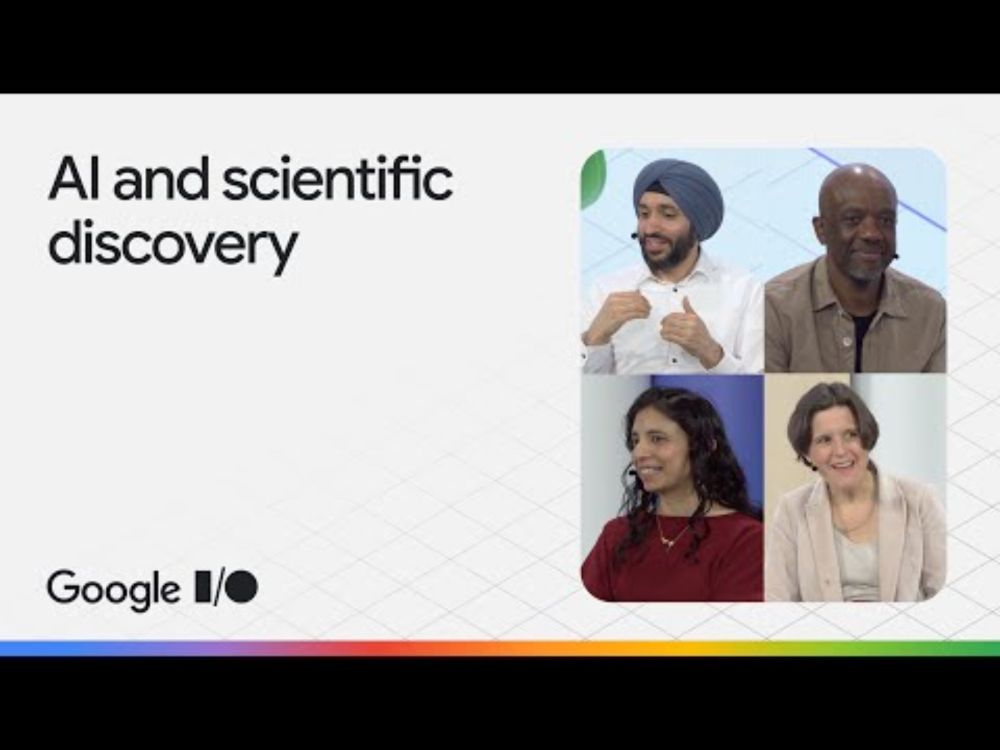
It was an honor to be part of Google IO Dialogues stage and talk about AI+Science.
AI needs to understand the physical world to make new scientific discoveries.
LLMs come up with new ideas, but bottleneck is testing in real world.
Physics-informed learning is needed
youtu.be/NYtQuneZMXc?...
AI needs to understand the physical world to make new scientific discoveries.
LLMs come up with new ideas, but bottleneck is testing in real world.
Physics-informed learning is needed
youtu.be/NYtQuneZMXc?...
Science in the age of AI
YouTube video by Google for Developers
youtu.be
June 1, 2025 at 6:21 PM
It was an honor to be part of Google IO Dialogues stage and talk about AI+Science.
AI needs to understand the physical world to make new scientific discoveries.
LLMs come up with new ideas, but bottleneck is testing in real world.
Physics-informed learning is needed
youtu.be/NYtQuneZMXc?...
AI needs to understand the physical world to make new scientific discoveries.
LLMs come up with new ideas, but bottleneck is testing in real world.
Physics-informed learning is needed
youtu.be/NYtQuneZMXc?...
In a recent interview I talk about what it takes for AI to make new scientific discoveries. tldr: it won’t be just LLMs. www.newindiaabroad.com/english/tech...
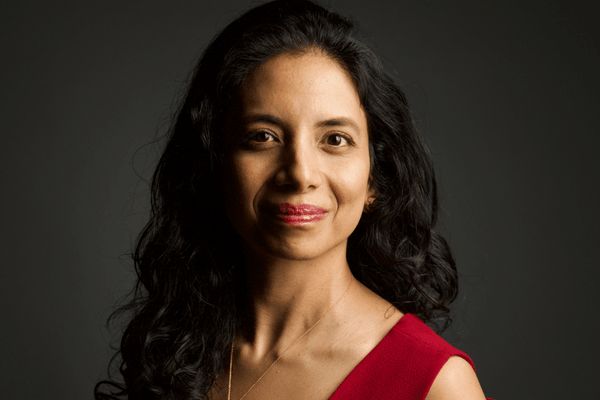
Indian American professor Anima Anandkumar on developing AI for new scientific discoveries
Learn how Indian American professor Anima Anandkumar is revolutionizing the world of artificial intelligence to drive new scientific discoveries. Explore her cutting-edge research and innovative appro...
www.newindiaabroad.com
May 25, 2025 at 11:26 PM
In a recent interview I talk about what it takes for AI to make new scientific discoveries. tldr: it won’t be just LLMs. www.newindiaabroad.com/english/tech...
Thank you EO for coming to @caltech.edu interviewing me on #ai I talk about the need to keep being curious and use AI as a tool, rather than being afraid of AI. I talk about AI for scientific modeling and discovery, and training the first high-resolution AI-based weather model. youtu.be/FIxLJVthW6I
Caltech AI Professor: The One Skill AI Can't Replace | Anima Anandkumar
YouTube video by EO
youtu.be
May 4, 2025 at 8:41 PM
Thank you EO for coming to @caltech.edu interviewing me on #ai I talk about the need to keep being curious and use AI as a tool, rather than being afraid of AI. I talk about AI for scientific modeling and discovery, and training the first high-resolution AI-based weather model. youtu.be/FIxLJVthW6I
Reposted by Anima Anandkumar
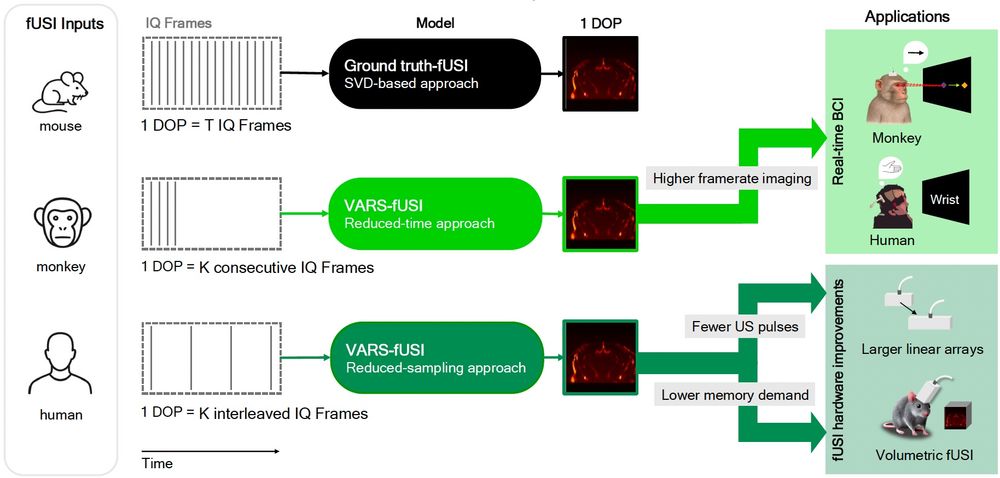
We have released VARS-fUSI: Variable sampling for fast and efficient functional ultrasound imaging (fUSI) using neural operators.
The first deep learning fUSI method to allow for different sampling durations and rates during training and inference. biorxiv.org/content/10.1... 1/
The first deep learning fUSI method to allow for different sampling durations and rates during training and inference. biorxiv.org/content/10.1... 1/
April 28, 2025 at 5:55 PM
We have released VARS-fUSI: Variable sampling for fast and efficient functional ultrasound imaging (fUSI) using neural operators.
The first deep learning fUSI method to allow for different sampling durations and rates during training and inference. biorxiv.org/content/10.1... 1/
The first deep learning fUSI method to allow for different sampling durations and rates during training and inference. biorxiv.org/content/10.1... 1/