


Christina Stier
@cstier.bsky.social
PostDoc Systems Neuroscience | Studying M/EEG's across the lifespan at IBB Münster | 🧠
Imaging Genetic Epilepsies at UniMedGöttingen & UKTübingen | 🧬⚡️
Imaging Genetic Epilepsies at UniMedGöttingen & UKTübingen | 🧬⚡️
Pinned
Christina Stier
@cstier.bsky.social
· Mar 4


Temporal autocorrelation is predictive of age — out now!
www.pnas.org/doi/10.1073/...
We used @camcan-2010.bsky.social #MEG data and massive time-series feature extraction (hctsa) to understand which aspects of neural activity predict a person's age. #PNAS #aging #MEG #Neuroscience #Neuroskyence
www.pnas.org/doi/10.1073/...
We used @camcan-2010.bsky.social #MEG data and massive time-series feature extraction (hctsa) to understand which aspects of neural activity predict a person's age. #PNAS #aging #MEG #Neuroscience #Neuroskyence
Reposted by Christina Stier

Conjunctive population coding integrates sensory evidence to guide adaptive human behavior. New work led by @jonasterlau.bsky.social in @pnas.org. We used human intracranial EEG to understand how coordinated population activity supports context-dependent behavior. www.pnas.org/doi/10.1073/.... (1/4)
PNAS
Proceedings of the National Academy of Sciences (PNAS), a peer reviewed journal of the National Academy of Sciences (NAS) - an authoritative source of high-impact, original research that broadly spans...
www.pnas.org
January 5, 2026 at 4:58 PM
Conjunctive population coding integrates sensory evidence to guide adaptive human behavior. New work led by @jonasterlau.bsky.social in @pnas.org. We used human intracranial EEG to understand how coordinated population activity supports context-dependent behavior. www.pnas.org/doi/10.1073/.... (1/4)
Reposted by Christina Stier
Ripple oscillations are central for memory and sleep.
But ripple detection in humans remains challenging. Here we introduce a simulation approach in @natcomms.nature.com as common ripple detectors mainly pick up 1/f noise and not genuine oscillations
👇
www.nature.com/articles/s41...
#neuroskyence
But ripple detection in humans remains challenging. Here we introduce a simulation approach in @natcomms.nature.com as common ripple detectors mainly pick up 1/f noise and not genuine oscillations
👇
www.nature.com/articles/s41...
#neuroskyence

Aperiodic 1/f noise drives ripple activity in humans - Nature Communications
How aperiodic 1/f noise drives ripple activity in human brain and impacts on ripple detections is not fully understood. Here authors show that ripple detections should be driven by the 1/f noise, whic...
www.nature.com
January 21, 2026 at 6:57 PM
Ripple oscillations are central for memory and sleep.
But ripple detection in humans remains challenging. Here we introduce a simulation approach in @natcomms.nature.com as common ripple detectors mainly pick up 1/f noise and not genuine oscillations
👇
www.nature.com/articles/s41...
#neuroskyence
But ripple detection in humans remains challenging. Here we introduce a simulation approach in @natcomms.nature.com as common ripple detectors mainly pick up 1/f noise and not genuine oscillations
👇
www.nature.com/articles/s41...
#neuroskyence
Reposted by Christina Stier

Female scientists have to wait longer for their articles to be reviewed than their male colleagues. An analysis of 36.5 million papers in the life sciences shows that for females it took 115 days to reach a decision, compared to 101 days for men journals.plos.org/plosbiology/... @plosbiology.org

January 22, 2026 at 8:43 AM
Female scientists have to wait longer for their articles to be reviewed than their male colleagues. An analysis of 36.5 million papers in the life sciences shows that for females it took 115 days to reach a decision, compared to 101 days for men journals.plos.org/plosbiology/... @plosbiology.org
Reposted by Christina Stier

Over the years, I have written a few Jupyter/Rmd/Matlab notebooks that attempt to teach some statistical concepts, particularly in neuroimaging. You can find them here: www.mrc-cbu.cam.ac.uk/people/rik.h..., though I will say a bit more about each one in a number of posts over next few days.
People
www.mrc-cbu.cam.ac.uk
January 19, 2026 at 5:46 PM
Over the years, I have written a few Jupyter/Rmd/Matlab notebooks that attempt to teach some statistical concepts, particularly in neuroimaging. You can find them here: www.mrc-cbu.cam.ac.uk/people/rik.h..., though I will say a bit more about each one in a number of posts over next few days.
Reposted by Christina Stier

🎉 The data of the Berlin Aging Study (BASE) are now accessible via the Research Data Center of the Leibniz Institute for Psychology (ZPID) @zpid.bsky.social.
This is a unique longitudinal data set with great potential – also for young scientists.
👉 www.mpib-berlin.mpg.de/base-data-av...
This is a unique longitudinal data set with great potential – also for young scientists.
👉 www.mpib-berlin.mpg.de/base-data-av...

Treasure trove of data on aging accessible
One of the most important gerontological data sets has been opened to the research community. The data of the Berlin Aging Study (BASE) are accessible via the Research Data Center of the Leibniz Insti...
www.mpib-berlin.mpg.de
January 13, 2026 at 11:56 AM
🎉 The data of the Berlin Aging Study (BASE) are now accessible via the Research Data Center of the Leibniz Institute for Psychology (ZPID) @zpid.bsky.social.
This is a unique longitudinal data set with great potential – also for young scientists.
👉 www.mpib-berlin.mpg.de/base-data-av...
This is a unique longitudinal data set with great potential – also for young scientists.
👉 www.mpib-berlin.mpg.de/base-data-av...
Reposted by Christina Stier
Aperiodic activity reflects pathological waveforms in epilepsy (and not necessarily hyper-excitability or altered E/I-balance). The 1/f slope goes up *or* down as function of waveforms during seizures. New work by Laura Heidiri and Frank van Schalkwijk from the lab: www.jneurosci.org/content/45/5...
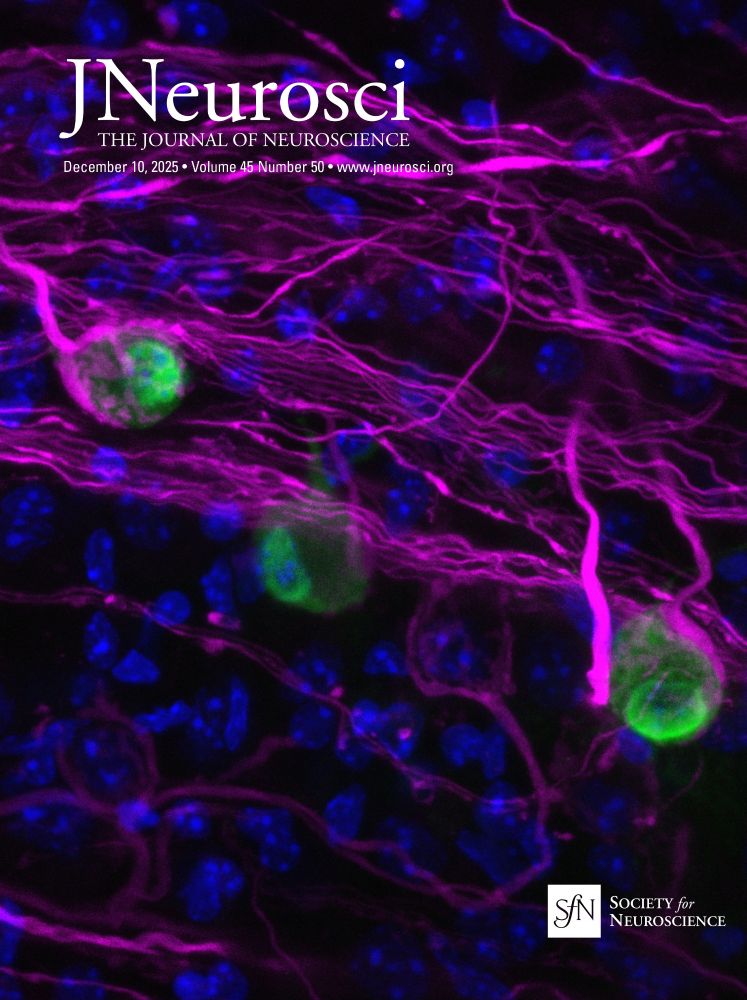
Aperiodic Activity Reflects Pathologic Waveform Shapes in Focal Epilepsy
Epilepsy constitutes a clinically manifest excitability disorder that is characterized by aberrant electrophysiological activity in the electroencephalogram (EEG). The correct identification of the se...
www.jneurosci.org
December 15, 2025 at 1:41 PM
Aperiodic activity reflects pathological waveforms in epilepsy (and not necessarily hyper-excitability or altered E/I-balance). The 1/f slope goes up *or* down as function of waveforms during seizures. New work by Laura Heidiri and Frank van Schalkwijk from the lab: www.jneurosci.org/content/45/5...
Reposted by Christina Stier
Thrilled to share our paper is out now in @ebiomedicine.bsky.social 🥳 The interoception accuracy part is still my favorite 🤩 Have a look: www.thelancet.com/journals/ebi...
December 13, 2025 at 8:58 PM
Thrilled to share our paper is out now in @ebiomedicine.bsky.social 🥳 The interoception accuracy part is still my favorite 🤩 Have a look: www.thelancet.com/journals/ebi...
Reposted by Christina Stier

A paper from my PhD lab is on Science! This is a really cool new way to utilize EM connectome datasets. Congrats to the team!
www.science.org/doi/10.1126/...
www.science.org/doi/10.1126/...

Spatial and morphological organization of mitochondria in neurons across a connectome
Neuronal function depends on mitochondria, but little is known about their organization across neurons. Using an electron microscopy Drosophila connectome, we uncovered quantitative rules governing th...
www.science.org
December 14, 2025 at 9:46 AM
A paper from my PhD lab is on Science! This is a really cool new way to utilize EM connectome datasets. Congrats to the team!
www.science.org/doi/10.1126/...
www.science.org/doi/10.1126/...
Reposted by Christina Stier

Out now in @ebiomedicine.bsky.social 🚨.
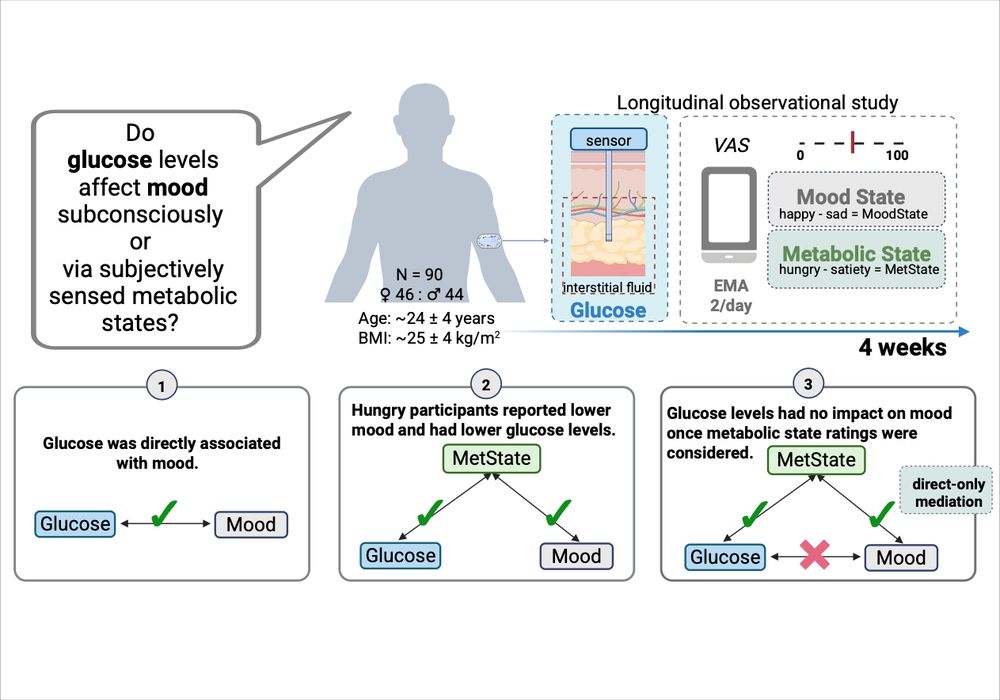
Hunger often affects our mood, but is this a conscious or a subconscious process? Using continuous glucose monitoring, we show that differences in mood are driven by hunger ratings, not just glucose. #neuroskyence 🩺
www.thelancet.com/journals/EBI...
Hunger often affects our mood, but is this a conscious or a subconscious process? Using continuous glucose monitoring, we show that differences in mood are driven by hunger ratings, not just glucose. #neuroskyence 🩺
www.thelancet.com/journals/EBI...
December 8, 2025 at 1:33 PM
Out now in @ebiomedicine.bsky.social 🚨.
Hunger often affects our mood, but is this a conscious or a subconscious process? Using continuous glucose monitoring, we show that differences in mood are driven by hunger ratings, not just glucose. #neuroskyence 🩺
www.thelancet.com/journals/EBI...
Hunger often affects our mood, but is this a conscious or a subconscious process? Using continuous glucose monitoring, we show that differences in mood are driven by hunger ratings, not just glucose. #neuroskyence 🩺
www.thelancet.com/journals/EBI...
Reposted by Christina Stier
A multilayer of time
Kenza Bennis investigated daily reconfigurations of EEG functional networks in older adults and highlighted their associations with the presence of AD biomarkers, and longitudinal cognitive trajectories over seven years!
A great collaborative work !
doi.org/10.1007/s113...
Kenza Bennis investigated daily reconfigurations of EEG functional networks in older adults and highlighted their associations with the presence of AD biomarkers, and longitudinal cognitive trajectories over seven years!
A great collaborative work !
doi.org/10.1007/s113...

Diurnal dynamics of multilayer brain networks predict cognitive trajectories in aging - GeroScience
Resting-state functional connectivity (rsFC) is a highly dynamic process that varies across different times of the day within each individual. Although this variability was long considered to be noise...
doi.org
December 5, 2025 at 7:34 AM
A multilayer of time
Kenza Bennis investigated daily reconfigurations of EEG functional networks in older adults and highlighted their associations with the presence of AD biomarkers, and longitudinal cognitive trajectories over seven years!
A great collaborative work !
doi.org/10.1007/s113...
Kenza Bennis investigated daily reconfigurations of EEG functional networks in older adults and highlighted their associations with the presence of AD biomarkers, and longitudinal cognitive trajectories over seven years!
A great collaborative work !
doi.org/10.1007/s113...
Reposted by Christina Stier

🔥 Open PhD position at the Institute of Medical Psychology and Systems Neuroscience @uni-muenster.de!
Join our team to investigate neural mechanisms of conscious and non-conscious processing of neutral and emotional stimuli using EEG, fMRI, or both simultaneously. tinyurl.com/phdmuenster
Join our team to investigate neural mechanisms of conscious and non-conscious processing of neutral and emotional stimuli using EEG, fMRI, or both simultaneously. tinyurl.com/phdmuenster

November 27, 2025 at 2:17 PM
🔥 Open PhD position at the Institute of Medical Psychology and Systems Neuroscience @uni-muenster.de!
Join our team to investigate neural mechanisms of conscious and non-conscious processing of neutral and emotional stimuli using EEG, fMRI, or both simultaneously. tinyurl.com/phdmuenster
Join our team to investigate neural mechanisms of conscious and non-conscious processing of neutral and emotional stimuli using EEG, fMRI, or both simultaneously. tinyurl.com/phdmuenster
Reposted by Christina Stier

New paper out! 🚀
Using a differentiable implementation of the reduced Wong–Wang model, we optimized whole-brain simulations for 1444 subjects.
onlinelibrary.wiley.com/doi/10.1002/...
Using a differentiable implementation of the reduced Wong–Wang model, we optimized whole-brain simulations for 1444 subjects.
onlinelibrary.wiley.com/doi/10.1002/...

November 17, 2025 at 8:59 AM
New paper out! 🚀
Using a differentiable implementation of the reduced Wong–Wang model, we optimized whole-brain simulations for 1444 subjects.
onlinelibrary.wiley.com/doi/10.1002/...
Using a differentiable implementation of the reduced Wong–Wang model, we optimized whole-brain simulations for 1444 subjects.
onlinelibrary.wiley.com/doi/10.1002/...
Reposted by Christina Stier
New position, new social media account. After 5 fantastic years in Tuebingen, I moved to @yale.edu and the @wutsaiyale.bsky.social this summer - which means that I’ll be recruiting PhD students and postdocs. Please help me to spread the word and see current opportunities below 👇
October 6, 2025 at 6:46 PM
New position, new social media account. After 5 fantastic years in Tuebingen, I moved to @yale.edu and the @wutsaiyale.bsky.social this summer - which means that I’ll be recruiting PhD students and postdocs. Please help me to spread the word and see current opportunities below 👇
Reposted by Christina Stier
New work from the lab published in @cp-neuron.bsky.social by @jonasterlau.bsky.social and Jan Martini. We describe that trial-by-trial variability indexes recurrent connectivity across the cortical hierarchy, which supports reliable and flexible coding www.cell.com/neuron/abstr... (1/4)

Structure in noise: Recurrent connectivity shapes neural variability to balance perceptual and cognitive demands in the human brain
Does neural variability reflect random noise or a feature that benefits adaptive behavior?
Using intracranial recordings in humans, Terlau et al. demonstrate that neural variability
results from the r...
www.cell.com
November 10, 2025 at 5:06 PM
New work from the lab published in @cp-neuron.bsky.social by @jonasterlau.bsky.social and Jan Martini. We describe that trial-by-trial variability indexes recurrent connectivity across the cortical hierarchy, which supports reliable and flexible coding www.cell.com/neuron/abstr... (1/4)
Reposted by Christina Stier

Exciting news from the chairs of Biomag 2026, Prof. Jiahong Gao and Prof. Huan Luo — the conference website is now live: biomag2026.scimeeting.cn The meetings take place in Beijing, 23–25 August 2026. Save the date and start thinking about ideas for posters and symposia! Please share with colleagues

BIOMAG 2025,在线会议,会议直播平台,网络会议直播,美迪康会务通,学术会议管理系统,会议活动管理,注册签到管理,会场幻灯片传输转播,PPT传输,会议网络直播,电子壁报管理系统,医学会,会员管理系统
biomag2026.scimeeting.cn
November 11, 2025 at 5:28 PM
Exciting news from the chairs of Biomag 2026, Prof. Jiahong Gao and Prof. Huan Luo — the conference website is now live: biomag2026.scimeeting.cn The meetings take place in Beijing, 23–25 August 2026. Save the date and start thinking about ideas for posters and symposia! Please share with colleagues
Reposted by Christina Stier

🧠 Why do some brains age faster than others?
🧬 Our new Nature Aging study of over 56,000 participants explores the genetics of the “brain age gap” — the difference between your brain’s biological and chronological age.
nature.com/articles/s43587-025-00962-7
Thread below 👇
🧬 Our new Nature Aging study of over 56,000 participants explores the genetics of the “brain age gap” — the difference between your brain’s biological and chronological age.
nature.com/articles/s43587-025-00962-7
Thread below 👇

Genome-wide analysis of brain age identifies 59 associated loci and unveils relationships with mental and physical health - Nature Aging
This genomic study of magnetic resonance imaging-based brain age in 56,348 people identifies 59 genetic loci, links brain aging to mental and physical health, and suggests high blood pressure and type 2 diabetes as causal factors of brain aging.
nature.com
October 7, 2025 at 9:38 AM
🧠 Why do some brains age faster than others?
🧬 Our new Nature Aging study of over 56,000 participants explores the genetics of the “brain age gap” — the difference between your brain’s biological and chronological age.
nature.com/articles/s43587-025-00962-7
Thread below 👇
🧬 Our new Nature Aging study of over 56,000 participants explores the genetics of the “brain age gap” — the difference between your brain’s biological and chronological age.
nature.com/articles/s43587-025-00962-7
Thread below 👇
Reposted by Christina Stier
👂🧠NCC in an auditory no-report fMRI study 🧠👂
now out in @currentbiology.bsky.social @cellpress.bsky.social !
www.cell.com/current-biol...
Using inattentional deafness, we show that awareness of task-irrelevant sounds mainly activates stimulus-specific sensory brain areas.
now out in @currentbiology.bsky.social @cellpress.bsky.social !
www.cell.com/current-biol...
Using inattentional deafness, we show that awareness of task-irrelevant sounds mainly activates stimulus-specific sensory brain areas.

Neural correlates of consciousness in an auditory no-report fMRI study
Dellert et al. use functional magnetic resonance imaging and inattentional deafness
to identify the neural basis of conscious auditory perception in humans. Their results
reveal a dominant role of sti...
www.cell.com
November 6, 2025 at 4:21 PM
👂🧠NCC in an auditory no-report fMRI study 🧠👂
now out in @currentbiology.bsky.social @cellpress.bsky.social !
www.cell.com/current-biol...
Using inattentional deafness, we show that awareness of task-irrelevant sounds mainly activates stimulus-specific sensory brain areas.
now out in @currentbiology.bsky.social @cellpress.bsky.social !
www.cell.com/current-biol...
Using inattentional deafness, we show that awareness of task-irrelevant sounds mainly activates stimulus-specific sensory brain areas.
Reposted by Christina Stier

Max Planck Institute seeks Postdoc in MEG & Cognition of Interaction to build dyadic OPM-MEG in Göttingen; deadline 23 Nov, 2025.
www.nature.com/naturecareer...
#Hiring #Postdoc #MEG #Cognition #Göttingen
@maxplanckpress.de
www.nature.com/naturecareer...
#Hiring #Postdoc #MEG #Cognition #Göttingen
@maxplanckpress.de

Postdoctoral Fellow (m/f/x) - MEG and Cognition of Interaction – - Göttingen (Stadt), Niedersachsen (DE) job with Max Planck Institute for Dynamics and Self-Organization | 12846778
Postdoc in dyadic OPM-MEG at MPI Göttingen: develop dual-MEG platform to study neural bases of human interaction. Apply by Nov 23, 2025.
www.nature.com
October 27, 2025 at 10:38 AM
Max Planck Institute seeks Postdoc in MEG & Cognition of Interaction to build dyadic OPM-MEG in Göttingen; deadline 23 Nov, 2025.
www.nature.com/naturecareer...
#Hiring #Postdoc #MEG #Cognition #Göttingen
@maxplanckpress.de
www.nature.com/naturecareer...
#Hiring #Postdoc #MEG #Cognition #Göttingen
@maxplanckpress.de
Reposted by Christina Stier

The official 2026 Psychology and Brain meeting website is now online!
Save the date: June 4 – 6, 2026 in Heidelberg, Germany
More information to follow shortly on the website. We already have some awesome keynotes lined up.
pug2026.org
@biodgps-dgpa.bsky.social @igor-dgps.bsky.social
Save the date: June 4 – 6, 2026 in Heidelberg, Germany
More information to follow shortly on the website. We already have some awesome keynotes lined up.
pug2026.org
@biodgps-dgpa.bsky.social @igor-dgps.bsky.social
PUG2026 – PUG 2026: June 4–6, 2026, Heidelberg, Germany
pug2026.org
October 16, 2025 at 10:03 AM
The official 2026 Psychology and Brain meeting website is now online!
Save the date: June 4 – 6, 2026 in Heidelberg, Germany
More information to follow shortly on the website. We already have some awesome keynotes lined up.
pug2026.org
@biodgps-dgpa.bsky.social @igor-dgps.bsky.social
Save the date: June 4 – 6, 2026 in Heidelberg, Germany
More information to follow shortly on the website. We already have some awesome keynotes lined up.
pug2026.org
@biodgps-dgpa.bsky.social @igor-dgps.bsky.social
Reposted by Christina Stier

Genetics of human handedness: microtubules and beyond. Check out this review by @ocklenburg.bsky.social published in @cp-trendsgenetics.bsky.social http://dlvr.it/TNjZCR #ASHG25

October 16, 2025 at 1:28 PM
Genetics of human handedness: microtubules and beyond. Check out this review by @ocklenburg.bsky.social published in @cp-trendsgenetics.bsky.social http://dlvr.it/TNjZCR #ASHG25
Reposted by Christina Stier

I'm thrilled to share that our new paper is now published in Psychophysiology (Open Access):
onlinelibrary.wiley.com/doi/10.1111/...
@zacndr.bsky.social @teamlabuda.bsky.social @fraferri.bsky.social @danlikesbrains.bsky.social
onlinelibrary.wiley.com/doi/10.1111/...
@zacndr.bsky.social @teamlabuda.bsky.social @fraferri.bsky.social @danlikesbrains.bsky.social
September 26, 2025 at 8:31 AM
I'm thrilled to share that our new paper is now published in Psychophysiology (Open Access):
onlinelibrary.wiley.com/doi/10.1111/...
@zacndr.bsky.social @teamlabuda.bsky.social @fraferri.bsky.social @danlikesbrains.bsky.social
onlinelibrary.wiley.com/doi/10.1111/...
@zacndr.bsky.social @teamlabuda.bsky.social @fraferri.bsky.social @danlikesbrains.bsky.social
Reposted by Christina Stier

Open postdoc position👈
We have an open position, starting early 2026, to work on an exciting project aiming at better understanding the role of thalamo-cortical brain oscillations in perception with a comparative, cross-species (animal-human) component based on electrophysiology (incl. scalp EEG).
We have an open position, starting early 2026, to work on an exciting project aiming at better understanding the role of thalamo-cortical brain oscillations in perception with a comparative, cross-species (animal-human) component based on electrophysiology (incl. scalp EEG).
September 27, 2025 at 11:21 AM
Open postdoc position👈
We have an open position, starting early 2026, to work on an exciting project aiming at better understanding the role of thalamo-cortical brain oscillations in perception with a comparative, cross-species (animal-human) component based on electrophysiology (incl. scalp EEG).
We have an open position, starting early 2026, to work on an exciting project aiming at better understanding the role of thalamo-cortical brain oscillations in perception with a comparative, cross-species (animal-human) component based on electrophysiology (incl. scalp EEG).
Reposted by Christina Stier

Quantifying rhythmic and arrhythmic brain activity is a hot 🥵 topic. But how independent are the two components from one another? 🤔 In my latest work with @smfleming.bsky.social & @matlandry.bsky.social, I explore the relationship between the two.
(1/4)
(1/4)

Quantifying Rhythmic and Arrhythmic Components of Brain Activity
Brain activity comprises both rhythmic (periodic) and arrhythmic (aperiodic) components. These signal elements vary across healthy aging, and disease, and may make distinct contributions to conscious ...
www.biorxiv.org
September 25, 2025 at 11:21 AM
Quantifying rhythmic and arrhythmic brain activity is a hot 🥵 topic. But how independent are the two components from one another? 🤔 In my latest work with @smfleming.bsky.social & @matlandry.bsky.social, I explore the relationship between the two.
(1/4)
(1/4)
Reposted by Christina Stier
🚀 Young Scientist Retreat 2025 – Hamburg 🌍
📅 October 21–24, 2025
👉 Register here: tinyurl.com/ycmyshra (Google Form)
If this does not work, feel free to write [email protected]
Let’s connect, learn & grow together in Hamburg! 🌟
ysr2025 #Biopsychology #YoungScientists
(more below)
📅 October 21–24, 2025
👉 Register here: tinyurl.com/ycmyshra (Google Form)
If this does not work, feel free to write [email protected]
Let’s connect, learn & grow together in Hamburg! 🌟
ysr2025 #Biopsychology #YoungScientists
(more below)

September 12, 2025 at 8:33 AM
🚀 Young Scientist Retreat 2025 – Hamburg 🌍
📅 October 21–24, 2025
👉 Register here: tinyurl.com/ycmyshra (Google Form)
If this does not work, feel free to write [email protected]
Let’s connect, learn & grow together in Hamburg! 🌟
ysr2025 #Biopsychology #YoungScientists
(more below)
📅 October 21–24, 2025
👉 Register here: tinyurl.com/ycmyshra (Google Form)
If this does not work, feel free to write [email protected]
Let’s connect, learn & grow together in Hamburg! 🌟
ysr2025 #Biopsychology #YoungScientists
(more below)
Reposted by Christina Stier
Presented my poster „Towards Personalized Neuroscience: Evaluating Individual-Level Information in Neural Mass Models“ at ICON2025! Grateful for the feedback and conversations about whole-brain modeling. Paper (hopefully) out soon!
#ICON2025 #CognitiveNeuroscience
#ICON2025 #CognitiveNeuroscience

September 24, 2025 at 1:18 PM
Presented my poster „Towards Personalized Neuroscience: Evaluating Individual-Level Information in Neural Mass Models“ at ICON2025! Grateful for the feedback and conversations about whole-brain modeling. Paper (hopefully) out soon!
#ICON2025 #CognitiveNeuroscience
#ICON2025 #CognitiveNeuroscience