




Richard Davy
@davyclimate.bsky.social
Climate scientist, Arctic, atmosphere, surface coupling
Living in Bergen, Norway
Nansen Center, Bjerknes Center
Publications: https://scholar.google.com/citations?user=v3d2ceIAAAAJ&hl=en
Living in Bergen, Norway
Nansen Center, Bjerknes Center
Publications: https://scholar.google.com/citations?user=v3d2ceIAAAAJ&hl=en
Reposted by Richard Davy

The tide seems to be finally turning on global coal, as both China and India are now adding enough clean energy to reduce their coal generation: www.carbonbrief.org/...

January 13, 2026 at 7:07 PM
The tide seems to be finally turning on global coal, as both China and India are now adding enough clean energy to reduce their coal generation: www.carbonbrief.org/...
I recently had a chat with Bob Grove for the climate hour about Arctic climate and tipping points, its out now online and on the air climategkc.org/climate-hour/
Climate Hour - Climate Council
The Best in Climate News, Technology and Practices From Experts in the Field The Climate Hour is available on…
climategkc.org
January 1, 2026 at 10:14 PM
I recently had a chat with Bob Grove for the climate hour about Arctic climate and tipping points, its out now online and on the air climategkc.org/climate-hour/
The map shows the spatial pattern of median conditions for the selected month, while the lower panel tracks how the season may evolve at your chosen location.
November 20, 2025 at 1:35 PM
The map shows the spatial pattern of median conditions for the selected month, while the lower panel tracks how the season may evolve at your chosen location.
You can:
• Jump between different ski resorts (like Myrkdalen in the screenshot)
• Switch to major Nordic cities
• Or just click anywhere on the map to get a local forecast time series for that spot
• Jump between different ski resorts (like Myrkdalen in the screenshot)
• Switch to major Nordic cities
• Or just click anywhere on the map to get a local forecast time series for that spot
November 20, 2025 at 1:35 PM
You can:
• Jump between different ski resorts (like Myrkdalen in the screenshot)
• Switch to major Nordic cities
• Or just click anywhere on the map to get a local forecast time series for that spot
• Jump between different ski resorts (like Myrkdalen in the screenshot)
• Switch to major Nordic cities
• Or just click anywhere on the map to get a local forecast time series for that spot
The tool uses ECMWF’s 51-member seasonal ensemble and summarises the range of possible conditions each month.
In the time series you see the 5th, 25th, 50th, 75th and 95th percentiles, so you get a sense of the spread.
In the time series you see the 5th, 25th, 50th, 75th and 95th percentiles, so you get a sense of the spread.
November 20, 2025 at 1:35 PM
The tool uses ECMWF’s 51-member seasonal ensemble and summarises the range of possible conditions each month.
In the time series you see the 5th, 25th, 50th, 75th and 95th percentiles, so you get a sense of the spread.
In the time series you see the 5th, 25th, 50th, 75th and 95th percentiles, so you get a sense of the spread.
Winter has arrived properly in Norway this week ❄️ After a few days of heavy snow it already feels like mid-season, so it’s time to look a bit further ahead.
I’ve built a small interactive tool to explore ECMWF seasonal snow forecasts for the Nordics:
climatecompass.shinyapps.io/Snow_Depth_F...
I’ve built a small interactive tool to explore ECMWF seasonal snow forecasts for the Nordics:
climatecompass.shinyapps.io/Snow_Depth_F...

November 20, 2025 at 1:35 PM
Winter has arrived properly in Norway this week ❄️ After a few days of heavy snow it already feels like mid-season, so it’s time to look a bit further ahead.
I’ve built a small interactive tool to explore ECMWF seasonal snow forecasts for the Nordics:
climatecompass.shinyapps.io/Snow_Depth_F...
I’ve built a small interactive tool to explore ECMWF seasonal snow forecasts for the Nordics:
climatecompass.shinyapps.io/Snow_Depth_F...

We are recruiting! (x2)
There are two permanent positions available in our climate dynamics and prediction group, so if either sounds interesting to you do apply, or share with your colleagues:
www.jobbnorge.no/en/available...
www.jobbnorge.no/en/available...
There are two permanent positions available in our climate dynamics and prediction group, so if either sounds interesting to you do apply, or share with your colleagues:
www.jobbnorge.no/en/available...
www.jobbnorge.no/en/available...

Permanent position as researcher in Climate Prediction (289560) | Nansen Environmental and Remote Sensing Center
Job title: Permanent position as researcher in Climate Prediction (289560), Employer: Nansen Environmental and Remote Sensing Center, Deadline: Sunday, December 7, 2025
www.jobbnorge.no
November 10, 2025 at 7:45 AM
We are recruiting! (x2)
There are two permanent positions available in our climate dynamics and prediction group, so if either sounds interesting to you do apply, or share with your colleagues:
www.jobbnorge.no/en/available...
www.jobbnorge.no/en/available...
There are two permanent positions available in our climate dynamics and prediction group, so if either sounds interesting to you do apply, or share with your colleagues:
www.jobbnorge.no/en/available...
www.jobbnorge.no/en/available...
Reposted by Richard Davy

Sarcasm aside, it's perhaps worth pointing out that the evidence suggests that weather disasters reduce economic growth for decades - the idea that there's rapid bounceback, or even extra growth stimulated by recovery, has proved wrong
www.newscientist.com/article/mg23...
www.newscientist.com/article/mg23...

We all get poorer every time a climate disaster strikes
Long-term economic effects of global warming could be far greater than thought, making many countries poorer and hurting even those of us spared direct impacts
www.newscientist.com
October 22, 2025 at 1:34 PM
Sarcasm aside, it's perhaps worth pointing out that the evidence suggests that weather disasters reduce economic growth for decades - the idea that there's rapid bounceback, or even extra growth stimulated by recovery, has proved wrong
www.newscientist.com/article/mg23...
www.newscientist.com/article/mg23...
Reposted by Richard Davy

Damn. This is amazing. £325 per week, paid monthly, for 3 years - and the result was a profit for the Irish economy:
www.citizensinformation.ie/en/employmen...
www.citizensinformation.ie/en/employmen...

October 6, 2025 at 10:03 PM
Damn. This is amazing. £325 per week, paid monthly, for 3 years - and the result was a profit for the Irish economy:
www.citizensinformation.ie/en/employmen...
www.citizensinformation.ie/en/employmen...
Reposted by Richard Davy

A reality check for me was working with students on an internal carbon accounting platform that Bon App our food provider uses. Beef was less than 5% of our purchases but around 50% of our food emissions even with international work to be plant forward.
apnews.com/article/plan...
apnews.com/article/plan...

A recipe for avoiding 15 million deaths a year and climate disaster is fixing food, scientists say
Scientists are presenting new evidence that the worst effects of climate change can’t be avoided without a major transformation of food systems.
apnews.com
October 6, 2025 at 10:24 PM
A reality check for me was working with students on an internal carbon accounting platform that Bon App our food provider uses. Beef was less than 5% of our purchases but around 50% of our food emissions even with international work to be plant forward.
apnews.com/article/plan...
apnews.com/article/plan...
The real headline is there in the article:
“The wealthiest are increasing their wealth faster than any other group.”
That’s the story. Not the meaningless number.
“The wealthiest are increasing their wealth faster than any other group.”
That’s the story. Not the meaningless number.
October 6, 2025 at 6:59 AM
The real headline is there in the article:
“The wealthiest are increasing their wealth faster than any other group.”
That’s the story. Not the meaningless number.
“The wealthiest are increasing their wealth faster than any other group.”
That’s the story. Not the meaningless number.
So when we say the richest 1% hold $52 trillion, we just check out. It sounds like monopoly money.
We’re not wired to understand exponential scales — and that’s exactly how the story slips past us.
We’re not wired to understand exponential scales — and that’s exactly how the story slips past us.
October 6, 2025 at 6:59 AM
So when we say the richest 1% hold $52 trillion, we just check out. It sounds like monopoly money.
We’re not wired to understand exponential scales — and that’s exactly how the story slips past us.
We’re not wired to understand exponential scales — and that’s exactly how the story slips past us.
Who has a sense of what $52 trillion means?
It’s too big, too abstract. Even billion vs. million is a scale most people can’t intuitively grasp — a billion seconds is 31 years; a million seconds is 12 days.
It’s too big, too abstract. Even billion vs. million is a scale most people can’t intuitively grasp — a billion seconds is 31 years; a million seconds is 12 days.
October 6, 2025 at 6:59 AM
Who has a sense of what $52 trillion means?
It’s too big, too abstract. Even billion vs. million is a scale most people can’t intuitively grasp — a billion seconds is 31 years; a million seconds is 12 days.
It’s too big, too abstract. Even billion vs. million is a scale most people can’t intuitively grasp — a billion seconds is 31 years; a million seconds is 12 days.
Growing wealth inequality is devastating for societies.
But with headlines like “the wealth of the top 1% reached $52 trillion”, the topic gets ignored — because those numbers mean absolutely nothing to anyone.
But with headlines like “the wealth of the top 1% reached $52 trillion”, the topic gets ignored — because those numbers mean absolutely nothing to anyone.

wealth of the top 1% reached a record $52 trillion (icymi friday) — www.cnbc.com/2025/10/03/t...

The wealth of the top 1% reaches a record $52 trillion
All wealth groups saw gains over the past year, according to recent Fed data. But the growth has been fastest for those at the very top.
www.cnbc.com
October 6, 2025 at 6:59 AM
Growing wealth inequality is devastating for societies.
But with headlines like “the wealth of the top 1% reached $52 trillion”, the topic gets ignored — because those numbers mean absolutely nothing to anyone.
But with headlines like “the wealth of the top 1% reached $52 trillion”, the topic gets ignored — because those numbers mean absolutely nothing to anyone.
Reposted by Richard Davy
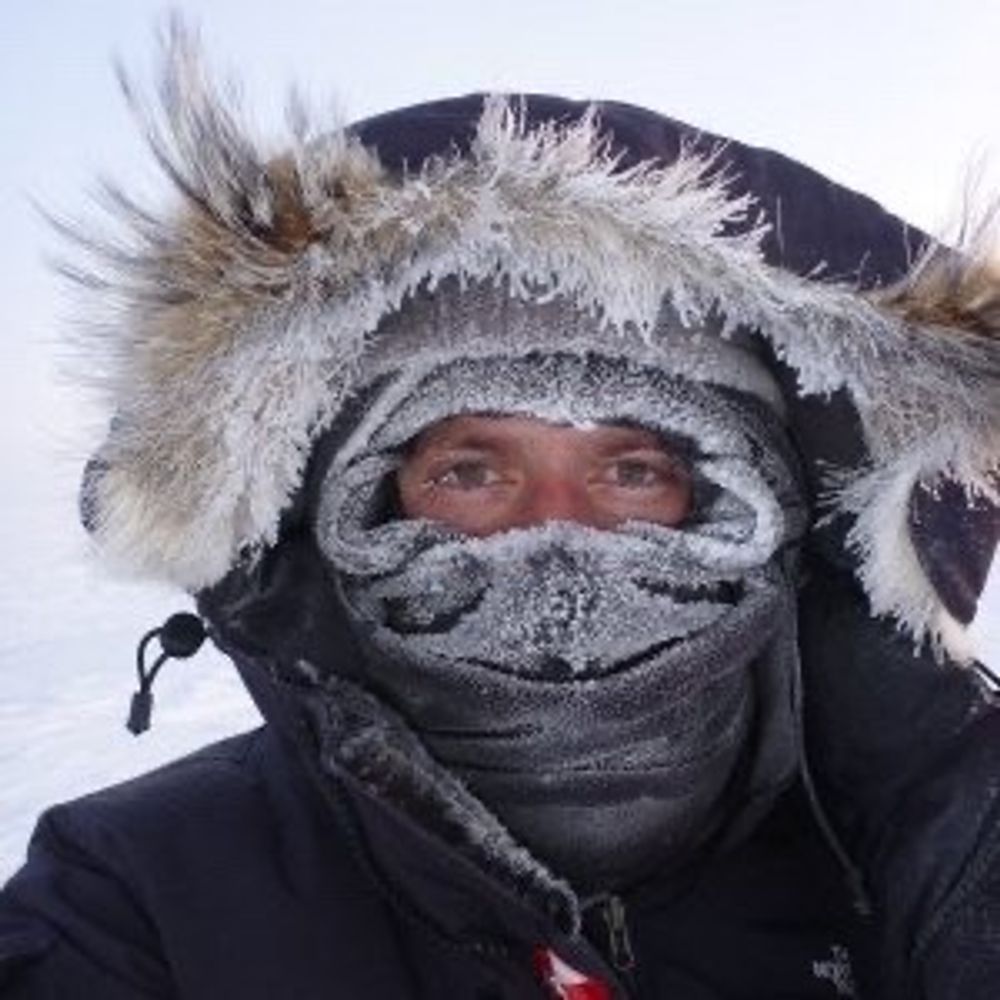
I am happy to announce that we received major funding from Schmidt Sciences under their VICC program to study rapid #Permafrost Thaw Carbon Trajectories (PeTCaT). The 5-year project led by my team @awi.de partners with an international team to quantify how rapid thaw contributes to climate change.

We're investing $45M over 5 years to launch the Virtual Institute for the Carbon Cycle (VICC).
Four global teams will combine AI, advanced observations & modeling to close major carbon cycle gaps, strengthening climate projections worldwide.
🔗 buff.ly/8WVpM9s
WIRED coverage: buff.ly/YsLAcRZ
Four global teams will combine AI, advanced observations & modeling to close major carbon cycle gaps, strengthening climate projections worldwide.
🔗 buff.ly/8WVpM9s
WIRED coverage: buff.ly/YsLAcRZ

Schmidt Sciences awards $45M to narrow carbon cycle knowledge gap - Schmidt Sciences
Globe-spanning interdisciplinary teams will dramatically improve climate modeling to drive better energy, environmental, economic decision making Contact: Carlie Wiener, [email protected]…
www.schmidtsciences.org
October 3, 2025 at 6:13 AM
I am happy to announce that we received major funding from Schmidt Sciences under their VICC program to study rapid #Permafrost Thaw Carbon Trajectories (PeTCaT). The 5-year project led by my team @awi.de partners with an international team to quantify how rapid thaw contributes to climate change.
Reposted by Richard Davy

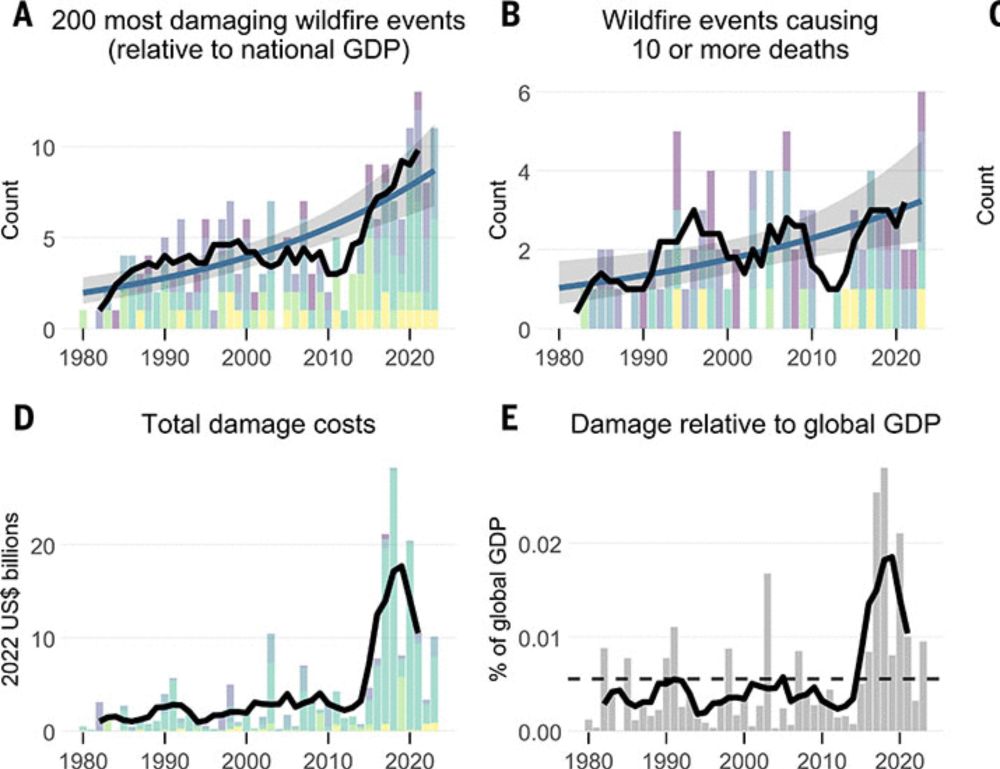
Published today: our new paper showing a 44-year trend of increasing global wildfire disasters (fatalities and economic losses) due to climate change-induced extreme weather. www.science.org/doi/10.1126/...
Climate-linked escalation of societally disastrous wildfires
Climate change and land mismanagement are creating increasingly fire-prone built and natural environments. However, despite worsening fire seasons, evidence is lacking globally for trends in socially ...
www.science.org
October 2, 2025 at 6:28 PM
Published today: our new paper showing a 44-year trend of increasing global wildfire disasters (fatalities and economic losses) due to climate change-induced extreme weather. www.science.org/doi/10.1126/...
Reposted by Richard Davy

By applying a tracking method to both climate models and satellite data, @davyclimate.bsky.social found that sea ice age is a more sensitive indicator of change than ice thickness or volume.
🧪🌊 Read the publication here: agupubs.onlinelibrary.wiley.com/doi/epdf/10....
🧪🌊 Read the publication here: agupubs.onlinelibrary.wiley.com/doi/epdf/10....

October 2, 2025 at 10:42 AM
By applying a tracking method to both climate models and satellite data, @davyclimate.bsky.social found that sea ice age is a more sensitive indicator of change than ice thickness or volume.
🧪🌊 Read the publication here: agupubs.onlinelibrary.wiley.com/doi/epdf/10....
🧪🌊 Read the publication here: agupubs.onlinelibrary.wiley.com/doi/epdf/10....
Reposted by Richard Davy

Are you interested in seasonal forecasts and how they have advanced over the past two decades?
Chris O’Reilly (Univ. of Reading) led a new paper on exactly this: rmets.onlinelibrary.wiley.com/doi/10.1002/...
Chris O’Reilly (Univ. of Reading) led a new paper on exactly this: rmets.onlinelibrary.wiley.com/doi/10.1002/...

Evaluating seasonal forecast improvements over the past two decades
We have analysed the performance of operational seasonal forecasting models since their inception. Clear improvements are measured through the different model eras, particularly in the Tropics. For t....
rmets.onlinelibrary.wiley.com
September 30, 2025 at 8:34 PM
Are you interested in seasonal forecasts and how they have advanced over the past two decades?
Chris O’Reilly (Univ. of Reading) led a new paper on exactly this: rmets.onlinelibrary.wiley.com/doi/10.1002/...
Chris O’Reilly (Univ. of Reading) led a new paper on exactly this: rmets.onlinelibrary.wiley.com/doi/10.1002/...
Reposted by Richard Davy

I may have found my defining quote.
Pair this with my pinned post and you will see what I mean!
Pair this with my pinned post and you will see what I mean!

September 29, 2025 at 12:22 PM
I may have found my defining quote.
Pair this with my pinned post and you will see what I mean!
Pair this with my pinned post and you will see what I mean!
Thanks to the fantastic team at NERSC, Jakob Dörr, and Philipp Griewank.
If you’re working on climate dynamics, prediction, or sea ice processes, I’d love to hear your thoughts on how sea ice age could play a role in your work.
#Arctic #SeaIce #ClimatePrediction #ClimateModels #ESA #SAGE
If you’re working on climate dynamics, prediction, or sea ice processes, I’d love to hear your thoughts on how sea ice age could play a role in your work.
#Arctic #SeaIce #ClimatePrediction #ClimateModels #ESA #SAGE
September 24, 2025 at 8:27 AM
Thanks to the fantastic team at NERSC, Jakob Dörr, and Philipp Griewank.
If you’re working on climate dynamics, prediction, or sea ice processes, I’d love to hear your thoughts on how sea ice age could play a role in your work.
#Arctic #SeaIce #ClimatePrediction #ClimateModels #ESA #SAGE
If you’re working on climate dynamics, prediction, or sea ice processes, I’d love to hear your thoughts on how sea ice age could play a role in your work.
#Arctic #SeaIce #ClimatePrediction #ClimateModels #ESA #SAGE
This work also launches us into our new ESA project, SAGE, where we’ll dig deeper into how sea ice age can reshape the way we evaluate and improve climate models. Stay tuned. 🌍❄️
September 24, 2025 at 8:27 AM
This work also launches us into our new ESA project, SAGE, where we’ll dig deeper into how sea ice age can reshape the way we evaluate and improve climate models. Stay tuned. 🌍❄️
Most exciting: sea ice age reveals low-frequency variability in the Arctic (see Fig. 5 in our paper). This opens a new window into decadal-scale fluctuations — crucial for improving #ClimatePrediction systems.
September 24, 2025 at 8:27 AM
Most exciting: sea ice age reveals low-frequency variability in the Arctic (see Fig. 5 in our paper). This opens a new window into decadal-scale fluctuations — crucial for improving #ClimatePrediction systems.
For the first time, we applied the same ice-tracking algorithm to both model output & satellite observations. This fair, like-for-like comparison reduces long-standing biases and shows that sea ice age captures dynamics thickness & volume alone cannot.
September 24, 2025 at 8:27 AM
For the first time, we applied the same ice-tracking algorithm to both model output & satellite observations. This fair, like-for-like comparison reduces long-standing biases and shows that sea ice age captures dynamics thickness & volume alone cannot.
Sea ice age is more than just a number — it integrates the dynamic + thermodynamic processes shaping Arctic sea ice. Unlike area or thickness, it can’t easily be tuned in models. Age emerges from the cumulative history of growth, melt & drift. A tough benchmark for climate models.
September 24, 2025 at 8:27 AM
Sea ice age is more than just a number — it integrates the dynamic + thermodynamic processes shaping Arctic sea ice. Unlike area or thickness, it can’t easily be tuned in models. Age emerges from the cumulative history of growth, melt & drift. A tough benchmark for climate models.