




Dhamma Sojourner
@dhammasojourner.bsky.social
Hi, and welcome. I use this profile strictly for peace and honoring the Buddhadhamma. I only follow people who do not share politics, nor will I share politics or negativity. I have another profile that serves that terrible purpose. May all beings be well.
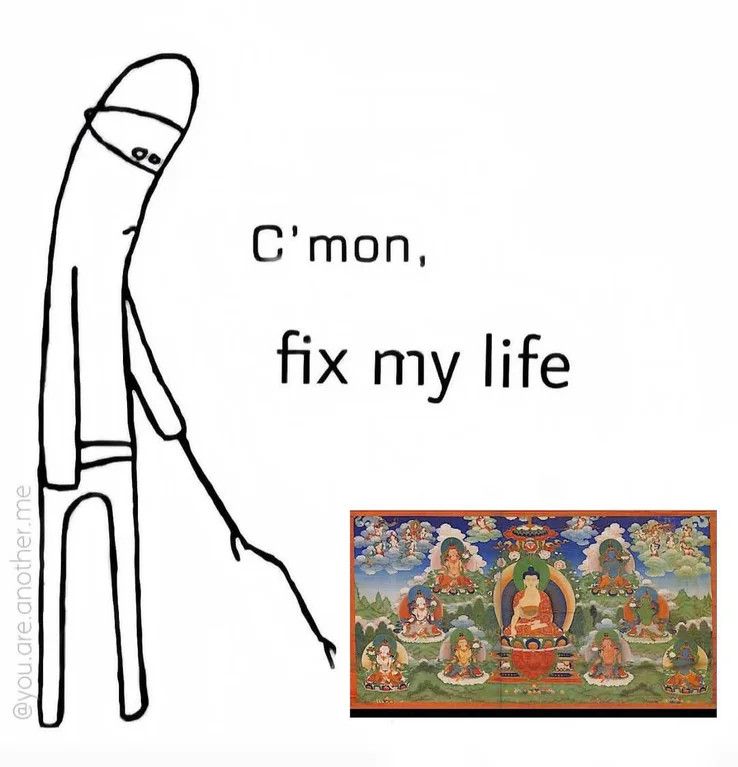
Hint: It's an inside job. Nobody or nothing is going to do it for you, so you have to do it yourself. There are, however, occasional signposts that help to point the way.
:)
:)
September 18, 2025 at 12:31 PM
Hint: It's an inside job. Nobody or nothing is going to do it for you, so you have to do it yourself. There are, however, occasional signposts that help to point the way.
:)
:)
I took this sunset photo while staying at the Montera Lighthouse Hostel, just north of Half Moon Bay, California, during December of 2013.

September 16, 2025 at 10:11 PM
I took this sunset photo while staying at the Montera Lighthouse Hostel, just north of Half Moon Bay, California, during December of 2013.
Artist - Tsherin Sherpa


September 16, 2025 at 1:12 AM
Artist - Tsherin Sherpa

... I responded, 'If your wife and children say, "Daddy has become nicer since he began to do zazen," then your practice is on the right track.'"
~~Roshi Kosho Uchiyama, 'Zen Teaching of Homeless Kodo'
~~Roshi Kosho Uchiyama, 'Zen Teaching of Homeless Kodo'
September 15, 2025 at 11:30 AM
... I responded, 'If your wife and children say, "Daddy has become nicer since he began to do zazen," then your practice is on the right track.'"
~~Roshi Kosho Uchiyama, 'Zen Teaching of Homeless Kodo'
~~Roshi Kosho Uchiyama, 'Zen Teaching of Homeless Kodo'
😀
"The other day, someone visited me and asked, 'I wish to practice zazen [meditation] under your guidance. But because I live far away, I can’t come to Antaiji very often. I’d like to practice zazen at home. What should I keep in mind to avoid doing zazen in a mistaken way?' ...
"The other day, someone visited me and asked, 'I wish to practice zazen [meditation] under your guidance. But because I live far away, I can’t come to Antaiji very often. I’d like to practice zazen at home. What should I keep in mind to avoid doing zazen in a mistaken way?' ...
September 15, 2025 at 11:30 AM
😀
"The other day, someone visited me and asked, 'I wish to practice zazen [meditation] under your guidance. But because I live far away, I can’t come to Antaiji very often. I’d like to practice zazen at home. What should I keep in mind to avoid doing zazen in a mistaken way?' ...
"The other day, someone visited me and asked, 'I wish to practice zazen [meditation] under your guidance. But because I live far away, I can’t come to Antaiji very often. I’d like to practice zazen at home. What should I keep in mind to avoid doing zazen in a mistaken way?' ...
Reposted by Dhamma Sojourner
Morning meditation — When you dream at night you see all sorts of different things.
https://wp.me/pFy3u-aJ6
https://wp.me/pFy3u-aJ6

Morning meditation — When you dream at night you see all sorts of different things.
‘When you dream at night you see all sorts of different things. Are those things seen with the eyes? You believe you have eyes in the dream, don’t you? You walk around and look all over, yet in reality your eyes are closed and you’re in bed.’ Tulku Urgyen Rinpoche
buddhismnow.com
September 15, 2025 at 10:27 AM
Morning meditation — When you dream at night you see all sorts of different things.
https://wp.me/pFy3u-aJ6
https://wp.me/pFy3u-aJ6
And which sutta would that be, Bhante?
September 15, 2025 at 1:32 AM
And which sutta would that be, Bhante?
If one does not know how to illuminate these with the Dhamma itself, then right at that point the path comes to a halt — no further wholesome actions, no further wholesome Dhamma can be cultivated.
— Sayadaw U Ottamathara
— Sayadaw U Ottamathara
September 15, 2025 at 1:25 AM
If one does not know how to illuminate these with the Dhamma itself, then right at that point the path comes to a halt — no further wholesome actions, no further wholesome Dhamma can be cultivated.
— Sayadaw U Ottamathara
— Sayadaw U Ottamathara
On the other hand, if one thinks, “I do not understand the Dhamma at all, my effort is useless,” and falls into discouragement, then again one cannot continue striving.
These are situations that anyone who practices the Dhamma may encounter: sometimes there is understanding, sometimes there is not.
These are situations that anyone who practices the Dhamma may encounter: sometimes there is understanding, sometimes there is not.
September 15, 2025 at 1:25 AM
On the other hand, if one thinks, “I do not understand the Dhamma at all, my effort is useless,” and falls into discouragement, then again one cannot continue striving.
These are situations that anyone who practices the Dhamma may encounter: sometimes there is understanding, sometimes there is not.
These are situations that anyone who practices the Dhamma may encounter: sometimes there is understanding, sometimes there is not.
If such mistakes are not corrected within oneself, the practice cannot progress. Thinking, “I have already understood the Dhamma,” while in fact that understanding is distorted — then one cannot continue.
September 15, 2025 at 1:25 AM
If such mistakes are not corrected within oneself, the practice cannot progress. Thinking, “I have already understood the Dhamma,” while in fact that understanding is distorted — then one cannot continue.
Sometimes there is not understanding, sometimes there is understanding — but even understanding, when clung to, becomes a misuse, a distortion.
September 15, 2025 at 1:25 AM
Sometimes there is not understanding, sometimes there is understanding — but even understanding, when clung to, becomes a misuse, a distortion.
There are right views, but there are also wrong views. Wrong view arises from delusion; but even when the view is right, if there is attachment to it, that is still greed.
Sometimes there is contempt, sometimes arrogance — both are unwholesome.
Sometimes there is contempt, sometimes arrogance — both are unwholesome.
September 15, 2025 at 1:25 AM
There are right views, but there are also wrong views. Wrong view arises from delusion; but even when the view is right, if there is attachment to it, that is still greed.
Sometimes there is contempt, sometimes arrogance — both are unwholesome.
Sometimes there is contempt, sometimes arrogance — both are unwholesome.
... — no longer deliberately trying to correct the faults of others. Rather, by correcting one’s own faults, one gains the strength and energy that can truly inspire and influence others so that their faults are also corrected.
September 15, 2025 at 1:25 AM
... — no longer deliberately trying to correct the faults of others. Rather, by correcting one’s own faults, one gains the strength and energy that can truly inspire and influence others so that their faults are also corrected.
This too is due to long-standing habits and conditioning.
If one truly knows how to look at one’s own faults, then one no longer spends time looking at the faults of others.
If one knows how to correct one’s own mistakes, then one will not set oneself up as a teacher over others...
If one truly knows how to look at one’s own faults, then one no longer spends time looking at the faults of others.
If one knows how to correct one’s own mistakes, then one will not set oneself up as a teacher over others...
September 15, 2025 at 1:25 AM
This too is due to long-standing habits and conditioning.
If one truly knows how to look at one’s own faults, then one no longer spends time looking at the faults of others.
If one knows how to correct one’s own mistakes, then one will not set oneself up as a teacher over others...
If one truly knows how to look at one’s own faults, then one no longer spends time looking at the faults of others.
If one knows how to correct one’s own mistakes, then one will not set oneself up as a teacher over others...
... Four Foundations of Mindfulness (Satipaṭṭhāna).
People easily fall into error because the external is easy to see and observe, while the internal — the inward (ajjhatta), the domain of the mind — is much harder to see and practice.
People easily fall into error because the external is easy to see and observe, while the internal — the inward (ajjhatta), the domain of the mind — is much harder to see and practice.
September 15, 2025 at 1:25 AM
... Four Foundations of Mindfulness (Satipaṭṭhāna).
People easily fall into error because the external is easy to see and observe, while the internal — the inward (ajjhatta), the domain of the mind — is much harder to see and practice.
People easily fall into error because the external is easy to see and observe, while the internal — the inward (ajjhatta), the domain of the mind — is much harder to see and practice.
When the Venerable Teachers give a Dhamma talk, in fact they are not merely speaking about the external surface. They are pointing to the ultimate reality (paramattha-sacca), and specifically guiding practitioners to contemplate Dhamma — that is, Dhamma-nupassanā within the....
September 15, 2025 at 1:25 AM
When the Venerable Teachers give a Dhamma talk, in fact they are not merely speaking about the external surface. They are pointing to the ultimate reality (paramattha-sacca), and specifically guiding practitioners to contemplate Dhamma — that is, Dhamma-nupassanā within the....
But the practice of observing the mind, observing reality as it truly is, is not well understood.
September 15, 2025 at 1:25 AM
But the practice of observing the mind, observing reality as it truly is, is not well understood.
Many people often think that when practicing meditation, one only needs to observe the outside, just looking at the surface.
For example: “Should I observe the in-and-out breath? Should I observe feelings?” – they only understand it that simply.
For example: “Should I observe the in-and-out breath? Should I observe feelings?” – they only understand it that simply.

September 15, 2025 at 1:25 AM
Many people often think that when practicing meditation, one only needs to observe the outside, just looking at the surface.
For example: “Should I observe the in-and-out breath? Should I observe feelings?” – they only understand it that simply.
For example: “Should I observe the in-and-out breath? Should I observe feelings?” – they only understand it that simply.
"It is natural for the immature to harm others. Getting angry with them is like resenting a fire for burning."
--Shantideva
--Shantideva
September 15, 2025 at 12:54 AM
"It is natural for the immature to harm others. Getting angry with them is like resenting a fire for burning."
--Shantideva
--Shantideva
...you make a mistake, you admit it. You don’t try to cover it up because, after all, you’re trying to change your actions from unskillful to skillful. And if you refuse to recognize your own mistakes, there’s no way you’re going to learn."
~ Thanissaro Bhikkhu "Prerequisites for the Practice"
~ Thanissaro Bhikkhu "Prerequisites for the Practice"

Prerequisites for the Practice (outdoors) | dhammatalks.org
www.dhammatalks.org
September 15, 2025 at 12:34 AM
...you make a mistake, you admit it. You don’t try to cover it up because, after all, you’re trying to change your actions from unskillful to skillful. And if you refuse to recognize your own mistakes, there’s no way you’re going to learn."
~ Thanissaro Bhikkhu "Prerequisites for the Practice"
~ Thanissaro Bhikkhu "Prerequisites for the Practice"
"Two more qualities the Buddha said he looked for in any student: One was that the student be observant; and the other was that the student be honest — “not deceitful,” as he said. In other words, when...
www.dhammatalks.org/audio/evenin...?
www.dhammatalks.org/audio/evenin...?
Prerequisites for the Practice (outdoors) | dhammatalks.org
www.dhammatalks.org
September 15, 2025 at 12:34 AM
"Two more qualities the Buddha said he looked for in any student: One was that the student be observant; and the other was that the student be honest — “not deceitful,” as he said. In other words, when...
www.dhammatalks.org/audio/evenin...?
www.dhammatalks.org/audio/evenin...?