




Digital Discovery
@digital-discovery.rsc.org
A new #GoldOA journal from @roysocchem.bsky.social, meeting the trend towards greater automation and data-driven scientific techniques head-on. Led by EiC Alan Aspuru-Guzik
🌐 Website: rsc.li/digitaldiscovery-journal Published by @rsc.org
🌐 Website: rsc.li/digitaldiscovery-journal Published by @rsc.org
✨ In a new #DigitalDiscovery advance article, Ping Yang and her team are improving the accuracy of solubility predictions with their new neural network-based model, HASolGNN!
📢 Read more HASolGNN here:
📢 Read more HASolGNN here:

Hierarchical attention graph learning with LLM enhancement for molecular solubility prediction
Solubility quantifies the concentration of a molecule that can dissolve in a given solvent. Accurate prediction of solubility is essential for optimizing drug efficacy, improving chemical and separation processes, and waste management, among many other industrial and research applications. Predicting solubility fro
doi.org
January 15, 2026 at 3:53 PM
✨ In a new #DigitalDiscovery advance article, Ping Yang and her team are improving the accuracy of solubility predictions with their new neural network-based model, HASolGNN!
📢 Read more HASolGNN here:
📢 Read more HASolGNN here:
✨ What if an AI agent could automate the structure generation and property analysis pipeline?
📢 Katerina Vriza and Uma Kornu introduce the newest multi-agent AI framework for autonomously preforming atomistic simulations in #DigitalDiscovery!
👉 Read it here!
📢 Katerina Vriza and Uma Kornu introduce the newest multi-agent AI framework for autonomously preforming atomistic simulations in #DigitalDiscovery!
👉 Read it here!

Multi-agentic AI framework for end-to-end atomistic simulations
One of the main bottlenecks for the wide adoption of atomistic simulation pipelines for computational materials design is the high complexity of the workflows which many times requires the use of a diverse set of specialized toolkits and libraries. Here, we introduce a multi-agent artificial intelligence (AI) frame
doi.org
January 13, 2026 at 5:12 PM
✨ What if an AI agent could automate the structure generation and property analysis pipeline?
📢 Katerina Vriza and Uma Kornu introduce the newest multi-agent AI framework for autonomously preforming atomistic simulations in #DigitalDiscovery!
👉 Read it here!
📢 Katerina Vriza and Uma Kornu introduce the newest multi-agent AI framework for autonomously preforming atomistic simulations in #DigitalDiscovery!
👉 Read it here!
We’re pleased to welcome Professor Jun Jiang to the Advisory Board of Digital Discovery.
A Professor at USTC, his work spans intelligent chemistry, AI-driven discovery, and automated robotic platforms.
Read more about Jun in our blog: https://bit.ly/4qEkiPg
A Professor at USTC, his work spans intelligent chemistry, AI-driven discovery, and automated robotic platforms.
Read more about Jun in our blog: https://bit.ly/4qEkiPg

January 12, 2026 at 4:00 PM
We’re pleased to welcome Professor Jun Jiang to the Advisory Board of Digital Discovery.
A Professor at USTC, his work spans intelligent chemistry, AI-driven discovery, and automated robotic platforms.
Read more about Jun in our blog: https://bit.ly/4qEkiPg
A Professor at USTC, his work spans intelligent chemistry, AI-driven discovery, and automated robotic platforms.
Read more about Jun in our blog: https://bit.ly/4qEkiPg
📢 #DigitalDiscovery's Editor in Chief Alán Aspuru-Guzik and his team are empowering experimentalists to integrate computer vision approaches within high-throughput materials research in their newest Tutorial Review!
✨ Read more here!
✨ Read more here!

Computer vision for high-throughput materials synthesis: a tutorial for experimentalists
Advances in high-throughput instrumentation and laboratory automation are revolutionizing materials synthesis by enabling the rapid generation of large libraries of novel materials. However, efficient characterization of these synthetic libraries remains a significant bottleneck in the discovery of new materials. T
doi.org
January 8, 2026 at 7:23 AM
📢 #DigitalDiscovery's Editor in Chief Alán Aspuru-Guzik and his team are empowering experimentalists to integrate computer vision approaches within high-throughput materials research in their newest Tutorial Review!
✨ Read more here!
✨ Read more here!
🖥️ From The University of Manchester, Artem Mishchenko and his team deliver the latest review in #DigitalDiscovery on how deep learning is transforming 2D material structure modelling!
✨ Read more about how AI is accelerating materials discovery here:
✨ Read more about how AI is accelerating materials discovery here:

Deep learning methods for 2D material electronic properties
This review explores the impact of deep learning (DL) techniques on understanding and predicting electronic structures in two-dimensional (2D) materials. We highlight unique computational challenges posed by 2D materials and discuss how DL approaches – such as physics-aware models, generative AI, and inverse design
doi.org
January 6, 2026 at 5:20 PM
🖥️ From The University of Manchester, Artem Mishchenko and his team deliver the latest review in #DigitalDiscovery on how deep learning is transforming 2D material structure modelling!
✨ Read more about how AI is accelerating materials discovery here:
✨ Read more about how AI is accelerating materials discovery here:
🧪 What if high-throughput computation could guide our hunt of chemical reactivities and synthetic strategies?
✨ New #DigitalDiscovery release features using enumerative combinatorics to map pathways between targets molecules and commercial catalogues!
👉 Read more here
✨ New #DigitalDiscovery release features using enumerative combinatorics to map pathways between targets molecules and commercial catalogues!
👉 Read more here

One step retrosynthesis of drugs from commercially available chemical building blocks and conceivable coupling reactions
In this report, the pharmaceuticals listed in DrugBank were structurally mapped to a commercial catalog of chemical feedstocks through reaction agnostic one step retrosynthetic decomposition. Enumerative combinatorics was utilized to retrosynthesize target molecules into commercially available building blocks, wher
doi.org
December 29, 2025 at 4:34 PM
🧪 What if high-throughput computation could guide our hunt of chemical reactivities and synthetic strategies?
✨ New #DigitalDiscovery release features using enumerative combinatorics to map pathways between targets molecules and commercial catalogues!
👉 Read more here
✨ New #DigitalDiscovery release features using enumerative combinatorics to map pathways between targets molecules and commercial catalogues!
👉 Read more here
✨ Tingzheng Hou and his team are working to bridge atomistic modeling with data-driven materials discovery in their new #DigitalDiscovery manuscript where they introduce their open-source python package, polymer electrolyte modeling and discovery (PEMD)!
👉 Read it here!
👉 Read it here!

PEMD: a high-throughput simulation and analysis framework for solid polymer electrolytes
Solid polymer electrolytes exhibit limitations in room-temperature ionic conductivity and electrochemical stability. While molecular simulations and electronic-structure theory are able to sample these key properties at the molecular scale, the field currently lacks integrated, automated tools for end-to-end assess
doi.org
December 23, 2025 at 2:16 PM
✨ Tingzheng Hou and his team are working to bridge atomistic modeling with data-driven materials discovery in their new #DigitalDiscovery manuscript where they introduce their open-source python package, polymer electrolyte modeling and discovery (PEMD)!
👉 Read it here!
👉 Read it here!
New neural network methods from Ankur Gupta and Wibe A. de Jong provide a rapid and cost-effective way to accelerate the discovery of new ligands for rare-earth element extraction!
👉 Read the full article here: doi.org/10.1039/D5DD...
#DigitalDiscovery #MachineLearning #NeuralNetworks
👉 Read the full article here: doi.org/10.1039/D5DD...
#DigitalDiscovery #MachineLearning #NeuralNetworks

Toward accelerating rare-earth metal extraction using equivariant neural networks
The separation of rare-earth metals, vital for numerous advanced technologies, is hampered by their similar chemical properties, making ligand discovery a significant challenge. Traditional experimental and quantum chemistry approaches for identifying effective ligands are often resource-intensive. We introduce a m
doi.org
December 18, 2025 at 5:17 PM
New neural network methods from Ankur Gupta and Wibe A. de Jong provide a rapid and cost-effective way to accelerate the discovery of new ligands for rare-earth element extraction!
👉 Read the full article here: doi.org/10.1039/D5DD...
#DigitalDiscovery #MachineLearning #NeuralNetworks
👉 Read the full article here: doi.org/10.1039/D5DD...
#DigitalDiscovery #MachineLearning #NeuralNetworks
#DigitalDiscovery and @pccp.rsc.org are proud to be sponsoring prizes at 2026's Chemical Compound Space Conference held in Munich from March 10th to 13th. Don't miss your chance to participate. Registration closes on the 15th of January!
Find out more here: ccsc2026.github.io/
Find out more here: ccsc2026.github.io/

December 18, 2025 at 10:47 AM
#DigitalDiscovery and @pccp.rsc.org are proud to be sponsoring prizes at 2026's Chemical Compound Space Conference held in Munich from March 10th to 13th. Don't miss your chance to participate. Registration closes on the 15th of January!
Find out more here: ccsc2026.github.io/
Find out more here: ccsc2026.github.io/
Reposted by Digital Discovery

Are you a UK or Ireland based chemistry undergraduate, postgraduate or recent graduate from a Black or minority ethnic background?
Apply by 5 February 2026 to our 2026–2027 Broadening Horizons cohort to explore career opportunities in the chemical sciences: rsc.li/broadening-horizons
#ChemSky
Apply by 5 February 2026 to our 2026–2027 Broadening Horizons cohort to explore career opportunities in the chemical sciences: rsc.li/broadening-horizons
#ChemSky

December 11, 2025 at 4:55 PM
Are you a UK or Ireland based chemistry undergraduate, postgraduate or recent graduate from a Black or minority ethnic background?
Apply by 5 February 2026 to our 2026–2027 Broadening Horizons cohort to explore career opportunities in the chemical sciences: rsc.li/broadening-horizons
#ChemSky
Apply by 5 February 2026 to our 2026–2027 Broadening Horizons cohort to explore career opportunities in the chemical sciences: rsc.li/broadening-horizons
#ChemSky
🖥️ Yuuya Nagata and his team combine automated synthesis and machine learning models in their new #DigitalDiscovery manuscript which works to transform chromatographic workflows through a new model relating retention time to molecular substructure!
👉 Read more here:
👉 Read more here:

Automated synthesis and fragment descriptor-based machine learning for retention time prediction in supercritical fluid chromatography
The integration of automated synthesis and machine learning (ML) is transforming analytical chemistry by enabling data-driven approaches to method development. Chromatographic column selection, a critical yet time-consuming step in separation science, stands to benefit substantially from such advances. Here,
doi.org
December 16, 2025 at 11:43 AM
🖥️ Yuuya Nagata and his team combine automated synthesis and machine learning models in their new #DigitalDiscovery manuscript which works to transform chromatographic workflows through a new model relating retention time to molecular substructure!
👉 Read more here:
👉 Read more here:
Reposted by Digital Discovery
Lots of exciting news this week! First, our PhD student Emma's RetroSynFormer work on multi-step retrosynthesis planning with a Decision Transformer was accepted in @digital-discovery.rsc.org! 🥳 #chemsky
Check out her amazing work here: doi.org/10.1039/D5DD...
Code: github.com/emmaryd/retr...
Check out her amazing work here: doi.org/10.1039/D5DD...
Code: github.com/emmaryd/retr...


December 8, 2025 at 1:57 PM
Lots of exciting news this week! First, our PhD student Emma's RetroSynFormer work on multi-step retrosynthesis planning with a Decision Transformer was accepted in @digital-discovery.rsc.org! 🥳 #chemsky
Check out her amazing work here: doi.org/10.1039/D5DD...
Code: github.com/emmaryd/retr...
Check out her amazing work here: doi.org/10.1039/D5DD...
Code: github.com/emmaryd/retr...
Reposted by Digital Discovery

Thrilled to share our latest work now published on @digital-discovery.rsc.org ! 🎉
👉 “Mol2Raman: a graph neural network model for predicting Raman spectra from SMILES representations”
pubs.rsc.org/en/content/a...
👉 “Mol2Raman: a graph neural network model for predicting Raman spectra from SMILES representations”
pubs.rsc.org/en/content/a...

Mol2Raman: a graph neural network model for predicting Raman spectra from SMILES representations
Raman spectroscopy is a powerful technique for probing molecular vibrations, yet the computational prediction of Raman spectra remains challenging due to the high cost of quantum chemical methods and ...
pubs.rsc.org
December 10, 2025 at 2:44 PM
Thrilled to share our latest work now published on @digital-discovery.rsc.org ! 🎉
👉 “Mol2Raman: a graph neural network model for predicting Raman spectra from SMILES representations”
pubs.rsc.org/en/content/a...
👉 “Mol2Raman: a graph neural network model for predicting Raman spectra from SMILES representations”
pubs.rsc.org/en/content/a...
🏅 Apolinario Tan (SISSA) - Stable and Systematically-Converged Linear Atomic Cluster Expansion Bases as Skeletons for Robust Interatomic Potentials
Congratulations to both for their excellent contributions to advancing uncertainty-aware atomistic modelling.
Congratulations to both for their excellent contributions to advancing uncertainty-aware atomistic modelling.

December 10, 2025 at 1:30 PM
🏅 Apolinario Tan (SISSA) - Stable and Systematically-Converged Linear Atomic Cluster Expansion Bases as Skeletons for Robust Interatomic Potentials
Congratulations to both for their excellent contributions to advancing uncertainty-aware atomistic modelling.
Congratulations to both for their excellent contributions to advancing uncertainty-aware atomistic modelling.
Digital Discovery & @pccp.rsc.org are pleased to announce the poster prize winners from the Uncertainty Quantification in Atomistic Modelling meeting!
🏅 Petra Navarcikova (TU Delft) - Uncertainty-Aware Protein Folding: From Classical Force Fields to Machine Learning Interatomic Potentials
🏅 Petra Navarcikova (TU Delft) - Uncertainty-Aware Protein Folding: From Classical Force Fields to Machine Learning Interatomic Potentials

December 10, 2025 at 1:30 PM
Digital Discovery & @pccp.rsc.org are pleased to announce the poster prize winners from the Uncertainty Quantification in Atomistic Modelling meeting!
🏅 Petra Navarcikova (TU Delft) - Uncertainty-Aware Protein Folding: From Classical Force Fields to Machine Learning Interatomic Potentials
🏅 Petra Navarcikova (TU Delft) - Uncertainty-Aware Protein Folding: From Classical Force Fields to Machine Learning Interatomic Potentials
What if molecular language models have been using the wrong assumptions?
This paper by Fabian P. Krüger ey al., outlines how MolEncoder uses higher masking ratios to boost accuracy while staying compute-efficient.
👉 doi.org/10.1039/D5DD...
This paper by Fabian P. Krüger ey al., outlines how MolEncoder uses higher masking ratios to boost accuracy while staying compute-efficient.
👉 doi.org/10.1039/D5DD...

December 10, 2025 at 11:20 AM
What if molecular language models have been using the wrong assumptions?
This paper by Fabian P. Krüger ey al., outlines how MolEncoder uses higher masking ratios to boost accuracy while staying compute-efficient.
👉 doi.org/10.1039/D5DD...
This paper by Fabian P. Krüger ey al., outlines how MolEncoder uses higher masking ratios to boost accuracy while staying compute-efficient.
👉 doi.org/10.1039/D5DD...
Our final #DigitalDiscovery newsletter of the year is now live on the blog!
Catch up on new article types, award winners, research highlights, Editorial Board developments, and upcoming themed collections.
Read the full update: blogs.rsc.org/dd/2025/12/0...
Catch up on new article types, award winners, research highlights, Editorial Board developments, and upcoming themed collections.
Read the full update: blogs.rsc.org/dd/2025/12/0...
blogs.rsc.org
December 8, 2025 at 11:09 AM
Our final #DigitalDiscovery newsletter of the year is now live on the blog!
Catch up on new article types, award winners, research highlights, Editorial Board developments, and upcoming themed collections.
Read the full update: blogs.rsc.org/dd/2025/12/0...
Catch up on new article types, award winners, research highlights, Editorial Board developments, and upcoming themed collections.
Read the full update: blogs.rsc.org/dd/2025/12/0...
Reposted by Digital Discovery
Professor Kenneth Lo (City University of Hong Kong) joins as the new External Organiser for #RSCPoster 2026!
His leadership will spark global collaboration, scientific discovery, and impactful conversations across the research community.
Stay tuned for updates — #ChemSky
His leadership will spark global collaboration, scientific discovery, and impactful conversations across the research community.
Stay tuned for updates — #ChemSky

December 3, 2025 at 3:10 PM
Professor Kenneth Lo (City University of Hong Kong) joins as the new External Organiser for #RSCPoster 2026!
His leadership will spark global collaboration, scientific discovery, and impactful conversations across the research community.
Stay tuned for updates — #ChemSky
His leadership will spark global collaboration, scientific discovery, and impactful conversations across the research community.
Stay tuned for updates — #ChemSky
What if TS geometries could be predicted 100× faster?
GoFlow uses E(3)-equivariant flow matching to generate transition states with higher accuracy and massively faster inference.
paper by Esther Heid et al.
👉 doi.org/10.1039/D5DD...
GoFlow uses E(3)-equivariant flow matching to generate transition states with higher accuracy and massively faster inference.
paper by Esther Heid et al.
👉 doi.org/10.1039/D5DD...

December 2, 2025 at 3:50 PM
What if TS geometries could be predicted 100× faster?
GoFlow uses E(3)-equivariant flow matching to generate transition states with higher accuracy and massively faster inference.
paper by Esther Heid et al.
👉 doi.org/10.1039/D5DD...
GoFlow uses E(3)-equivariant flow matching to generate transition states with higher accuracy and massively faster inference.
paper by Esther Heid et al.
👉 doi.org/10.1039/D5DD...
Can we decode 4D-STEM data without supervision?
An NMF-based framework uses IQA metrics + decision strategies to map orientations with more stable, interpretable clustering.
Paper by Arnaud Demortière, et al.
👉 https://bit.ly/49RzS4Q
An NMF-based framework uses IQA metrics + decision strategies to map orientations with more stable, interpretable clustering.
Paper by Arnaud Demortière, et al.
👉 https://bit.ly/49RzS4Q

November 25, 2025 at 4:35 PM
Can we decode 4D-STEM data without supervision?
An NMF-based framework uses IQA metrics + decision strategies to map orientations with more stable, interpretable clustering.
Paper by Arnaud Demortière, et al.
👉 https://bit.ly/49RzS4Q
An NMF-based framework uses IQA metrics + decision strategies to map orientations with more stable, interpretable clustering.
Paper by Arnaud Demortière, et al.
👉 https://bit.ly/49RzS4Q
Kicking off very soon in Lausanne, Switzerland:
Join us fo the Uncertainty quantification in atomistic modelling: From uncertainty-aware density functional theory to machine learning workshop with top minds!
📍 CECAM-HQ-EPFL
📅 Nov 25–28
🔗www.cecam.org/worksh...
Join us fo the Uncertainty quantification in atomistic modelling: From uncertainty-aware density functional theory to machine learning workshop with top minds!
📍 CECAM-HQ-EPFL
📅 Nov 25–28
🔗www.cecam.org/worksh...
November 18, 2025 at 2:08 PM
Kicking off very soon in Lausanne, Switzerland:
Join us fo the Uncertainty quantification in atomistic modelling: From uncertainty-aware density functional theory to machine learning workshop with top minds!
📍 CECAM-HQ-EPFL
📅 Nov 25–28
🔗www.cecam.org/worksh...
Join us fo the Uncertainty quantification in atomistic modelling: From uncertainty-aware density functional theory to machine learning workshop with top minds!
📍 CECAM-HQ-EPFL
📅 Nov 25–28
🔗www.cecam.org/worksh...
What if ML models could learn physics, not just patterns?
This study by Fleck, Niels, et al., from the University of Stuttgart outlines a neural net with built-in entropy scaling predicts shear viscosity across wide T–P ranges, learning its own reference functions.
👉 https://bit.ly/4r55ydu
This study by Fleck, Niels, et al., from the University of Stuttgart outlines a neural net with built-in entropy scaling predicts shear viscosity across wide T–P ranges, learning its own reference functions.
👉 https://bit.ly/4r55ydu

November 18, 2025 at 7:17 AM
What if ML models could learn physics, not just patterns?
This study by Fleck, Niels, et al., from the University of Stuttgart outlines a neural net with built-in entropy scaling predicts shear viscosity across wide T–P ranges, learning its own reference functions.
👉 https://bit.ly/4r55ydu
This study by Fleck, Niels, et al., from the University of Stuttgart outlines a neural net with built-in entropy scaling predicts shear viscosity across wide T–P ranges, learning its own reference functions.
👉 https://bit.ly/4r55ydu
Reposted by Digital Discovery
Our work exploring co-folding methods for PROTAC ternary structure prediction is now accepted in @digital-discovery.rsc.org!
Article: pubs.rsc.org/en/Content/A...
Website: protacfold.xyz
Great work led by 2 amazing students in our team, Nils and Francisco, together with @farzanejp.bsky.social! 🤩
Article: pubs.rsc.org/en/Content/A...
Website: protacfold.xyz
Great work led by 2 amazing students in our team, Nils and Francisco, together with @farzanejp.bsky.social! 🤩

November 10, 2025 at 10:23 AM
Our work exploring co-folding methods for PROTAC ternary structure prediction is now accepted in @digital-discovery.rsc.org!
Article: pubs.rsc.org/en/Content/A...
Website: protacfold.xyz
Great work led by 2 amazing students in our team, Nils and Francisco, together with @farzanejp.bsky.social! 🤩
Article: pubs.rsc.org/en/Content/A...
Website: protacfold.xyz
Great work led by 2 amazing students in our team, Nils and Francisco, together with @farzanejp.bsky.social! 🤩
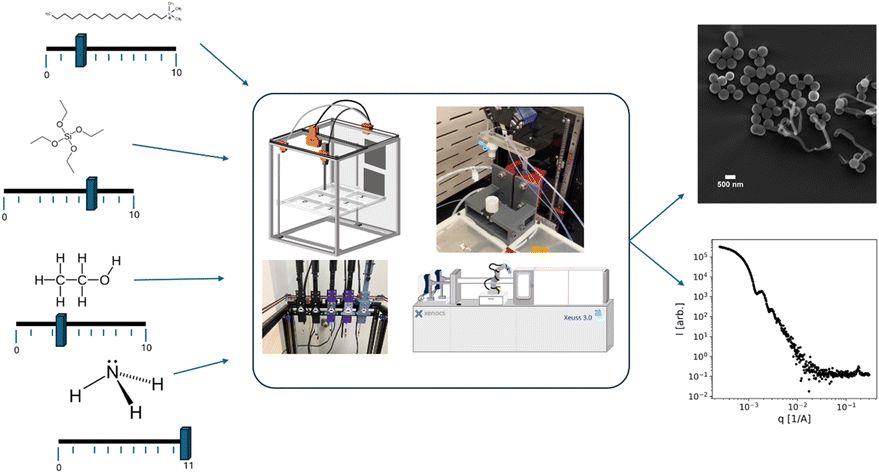
An automated sol–gel workflow for SiO₂ links precursor chemistry to nanostructure, accelerating discovery for separations, catalysis & drug delivery by Lilo D Pozzo from the University of Washington
👉 doi.org/10.1039/D5DD...
👉 doi.org/10.1039/D5DD...
November 5, 2025 at 10:09 AM
An automated sol–gel workflow for SiO₂ links precursor chemistry to nanostructure, accelerating discovery for separations, catalysis & drug delivery by Lilo D Pozzo from the University of Washington
👉 doi.org/10.1039/D5DD...
👉 doi.org/10.1039/D5DD...
New advance article!
📄 Beyond training data: how elemental features enhance ML-based formation energy predictions by Madhavi et al., @pennstateuniv.bsky.social
Element features boost GNNs trained on QM data enabling strong generalization.
👉 doi.org/10.1039/D5DD...
📄 Beyond training data: how elemental features enhance ML-based formation energy predictions by Madhavi et al., @pennstateuniv.bsky.social
Element features boost GNNs trained on QM data enabling strong generalization.
👉 doi.org/10.1039/D5DD...

October 28, 2025 at 3:08 PM
New advance article!
📄 Beyond training data: how elemental features enhance ML-based formation energy predictions by Madhavi et al., @pennstateuniv.bsky.social
Element features boost GNNs trained on QM data enabling strong generalization.
👉 doi.org/10.1039/D5DD...
📄 Beyond training data: how elemental features enhance ML-based formation energy predictions by Madhavi et al., @pennstateuniv.bsky.social
Element features boost GNNs trained on QM data enabling strong generalization.
👉 doi.org/10.1039/D5DD...