



Damian Koevoet
@dkoevoet.bsky.social
Postdoc | Visual Attention & Memory | Donders Institute, Radboud University (NL)
Pinned
Damian Koevoet
@dkoevoet.bsky.social
· May 13
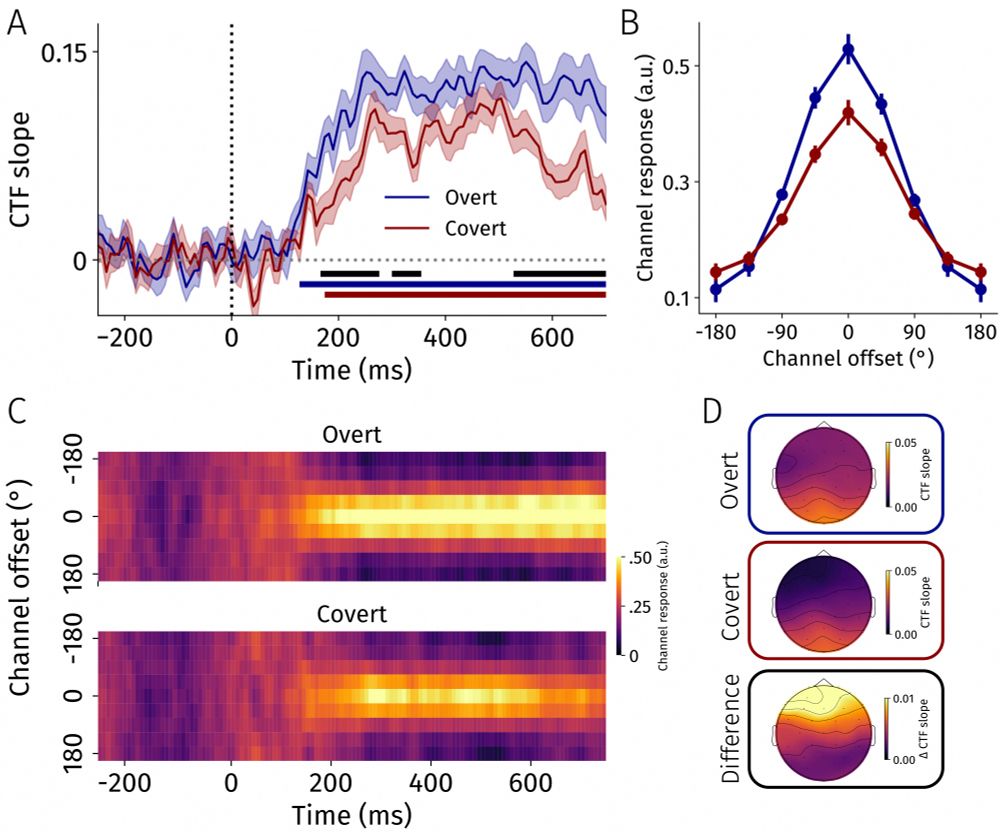
Preparing overt eye movements and directing covert attention are neurally coupled. Yet, this coupling breaks down at the single-cell level. What about populations of neurons?
We show: EEG decoding dissociates preparatory overt from covert attention at the population level:
doi.org/10.1101/2025...
We show: EEG decoding dissociates preparatory overt from covert attention at the population level:
doi.org/10.1101/2025...
Reposted by Damian Koevoet

My first TEDx talk just came out. It's always fun to talk about your own research area to the general audience, and its even more fun when you are lucky enough to be supported by such a platform. Happy to hear your thoughts :-)
youtu.be/UyUclyHx8d8?...
youtu.be/UyUclyHx8d8?...

How reality is simulated by your brain | Surgya Gayet | TEDxEindhoven
YouTube video by TEDx Talks
youtu.be
January 28, 2026 at 3:39 PM
My first TEDx talk just came out. It's always fun to talk about your own research area to the general audience, and its even more fun when you are lucky enough to be supported by such a platform. Happy to hear your thoughts :-)
youtu.be/UyUclyHx8d8?...
youtu.be/UyUclyHx8d8?...
Thanks to @ruthrosenholtz.bsky.social for the thought-provoking article. I'm looking forward to reading all the other commentaries and the full reply!
November 26, 2025 at 1:40 PM
Thanks to @ruthrosenholtz.bsky.social for the thought-provoking article. I'm looking forward to reading all the other commentaries and the full reply!
Our commentary @stigchel.bsky.social on Ruth Rosenholtz' Visual Attention in Crisis paper is now available:
doi.org/10.1017/S014...
We argue that effort must be considered when aiming to quantify capacity limits or a task's complexity.
doi.org/10.1017/S014...
We argue that effort must be considered when aiming to quantify capacity limits or a task's complexity.
November 26, 2025 at 1:40 PM
Our commentary @stigchel.bsky.social on Ruth Rosenholtz' Visual Attention in Crisis paper is now available:
doi.org/10.1017/S014...
We argue that effort must be considered when aiming to quantify capacity limits or a task's complexity.
doi.org/10.1017/S014...
We argue that effort must be considered when aiming to quantify capacity limits or a task's complexity.
Reposted by Damian Koevoet
Celebration time 🥳 @liangyouzhang.bsky.social publishes the 1st empirical paper of his PhD!
We show that numerosity adaptation (a seemingly high-level stim property) suppresses neural responses in early visual cortex; these adaptation FX increase as we progress thru the visual processing hierarchy.
We show that numerosity adaptation (a seemingly high-level stim property) suppresses neural responses in early visual cortex; these adaptation FX increase as we progress thru the visual processing hierarchy.

Numerosity adaptation suppresses monotonic neural responses to numerosity displays in the early visual cortex, with more suppression for higher numerosity adaptors. Therefore, numerosity adaptation effects begin in early sensory stages of processing.
www.nature.com/articles/s42...
www.nature.com/articles/s42...

Numerosity adaptation suppresses early visual responses - Communications Biology
Numerosity adaptation suppresses monotonic neural responses to numerosity displays in the early visual cortex, with more suppression for higher numerosity adaptors. Therefore, numerosity adaptation ef...
www.nature.com
November 24, 2025 at 8:26 PM
Celebration time 🥳 @liangyouzhang.bsky.social publishes the 1st empirical paper of his PhD!
We show that numerosity adaptation (a seemingly high-level stim property) suppresses neural responses in early visual cortex; these adaptation FX increase as we progress thru the visual processing hierarchy.
We show that numerosity adaptation (a seemingly high-level stim property) suppresses neural responses in early visual cortex; these adaptation FX increase as we progress thru the visual processing hierarchy.
November 24, 2025 at 6:39 PM
Reposted by Damian Koevoet

Planning on running a RIFT study? In a new manuscript, we put together the RIFT know-how accumulated over the years by multiple labs (@lindadrijvers.bsky.social, @schota.bsky.social, @eelkespaak.bsky.social, with Cecília Hustá and others).
Preprint: osf.io/preprints/ps...
Preprint: osf.io/preprints/ps...
OSF
osf.io
October 29, 2025 at 10:52 AM
Planning on running a RIFT study? In a new manuscript, we put together the RIFT know-how accumulated over the years by multiple labs (@lindadrijvers.bsky.social, @schota.bsky.social, @eelkespaak.bsky.social, with Cecília Hustá and others).
Preprint: osf.io/preprints/ps...
Preprint: osf.io/preprints/ps...
Big thanks to @henryjones.bsky.social for his help with the simulation analysis! And of course thanks to all other co-authors Vicky Voet, Ed Awh, @cstrauch.bsky.social @stigchel.bsky.social.
Also thanks to the anonymous reviewers for their valuable input.
Also thanks to the anonymous reviewers for their valuable input.
October 24, 2025 at 8:35 AM
Big thanks to @henryjones.bsky.social for his help with the simulation analysis! And of course thanks to all other co-authors Vicky Voet, Ed Awh, @cstrauch.bsky.social @stigchel.bsky.social.
Also thanks to the anonymous reviewers for their valuable input.
Also thanks to the anonymous reviewers for their valuable input.
Highlighting a supplementary analysis we added: Prior work showed that cross-decoding asymmetries can sometimes be driven by SNR differences between conditions instead of 'true' neurocognitive effects. We simulated EEG data and showed that SNR is unlikely to account for our cross-decoding results.

October 24, 2025 at 8:35 AM
Highlighting a supplementary analysis we added: Prior work showed that cross-decoding asymmetries can sometimes be driven by SNR differences between conditions instead of 'true' neurocognitive effects. We simulated EEG data and showed that SNR is unlikely to account for our cross-decoding results.
Filled with a bunch of extra analyses, this is now accepted in The Journal of Neuroscience @sfn.org! You can have a sneak peak here: www.biorxiv.org/content/10.1...
October 24, 2025 at 8:35 AM
Filled with a bunch of extra analyses, this is now accepted in The Journal of Neuroscience @sfn.org! You can have a sneak peak here: www.biorxiv.org/content/10.1...
Reposted by Damian Koevoet

🧠 Regularization, Action, and Attractors in the Dynamical “Bayesian” Brain
direct.mit.edu/jocn/article...
(still uncorrected proofs, but they should post the corrected one soon--also OA is forthcoming, for now PDF at brainandexperience.org/pdf/10.1162-...)
direct.mit.edu/jocn/article...
(still uncorrected proofs, but they should post the corrected one soon--also OA is forthcoming, for now PDF at brainandexperience.org/pdf/10.1162-...)

Regularization, Action, and Attractors in the Dynamical “Bayesian” Brain
Abstract. The idea that the brain is a probabilistic (Bayesian) inference machine, continuously trying to figure out the hidden causes of its inputs, has become very influential in cognitive (neuro)sc...
direct.mit.edu
October 22, 2025 at 8:59 AM
🧠 Regularization, Action, and Attractors in the Dynamical “Bayesian” Brain
direct.mit.edu/jocn/article...
(still uncorrected proofs, but they should post the corrected one soon--also OA is forthcoming, for now PDF at brainandexperience.org/pdf/10.1162-...)
direct.mit.edu/jocn/article...
(still uncorrected proofs, but they should post the corrected one soon--also OA is forthcoming, for now PDF at brainandexperience.org/pdf/10.1162-...)
Thanks Sebastiaan!!
October 17, 2025 at 1:41 PM
Thanks Sebastiaan!!
Thanks to everyone that contributed to project @henryjones.bsky.social, Stefan Van der Stigchel and Ed Awh. Also a special thanks to @dsuplica.bsky.social for helping out with the data from Exp. 3!
October 14, 2025 at 2:04 PM
Thanks to everyone that contributed to project @henryjones.bsky.social, Stefan Van der Stigchel and Ed Awh. Also a special thanks to @dsuplica.bsky.social for helping out with the data from Exp. 3!
In all experiments, we found a consistent pattern: pupil size tracked attentional breadth and WM load independently. This converges with recent EEG decoding work demonstrating a dissociation between spatial attention and working memory gating.
October 14, 2025 at 2:04 PM
In all experiments, we found a consistent pattern: pupil size tracked attentional breadth and WM load independently. This converges with recent EEG decoding work demonstrating a dissociation between spatial attention and working memory gating.
We analyzed pupil size - which reflects both spatial attention and WM load - data from three experiments wherein attentional breadth and working memory load were manipulated independently. For example, using dot cloud stimuli the spatial extent of stimuli were orthogonal to the number of clouds.

October 14, 2025 at 2:04 PM
We analyzed pupil size - which reflects both spatial attention and WM load - data from three experiments wherein attentional breadth and working memory load were manipulated independently. For example, using dot cloud stimuli the spatial extent of stimuli were orthogonal to the number of clouds.
Spatial attention and working memory are popularly thought to be tightly coupled. Yet, distinct neural activity tracks attentional breadth and WM load.
In a new paper @jocn.bsky.social, we show that pupil size independently tracks breadth and load.
doi.org/10.1162/JOCN...
In a new paper @jocn.bsky.social, we show that pupil size independently tracks breadth and load.
doi.org/10.1162/JOCN...

October 14, 2025 at 2:04 PM
Spatial attention and working memory are popularly thought to be tightly coupled. Yet, distinct neural activity tracks attentional breadth and WM load.
In a new paper @jocn.bsky.social, we show that pupil size independently tracks breadth and load.
doi.org/10.1162/JOCN...
In a new paper @jocn.bsky.social, we show that pupil size independently tracks breadth and load.
doi.org/10.1162/JOCN...
Reposted by Damian Koevoet

1/ Why are we so easily distracted? 🧠 In our new EEG preprint w/ Henry Jones, @monicarosenb.bsky.social and @edvogel.bsky.social we show that distractibility is associated w/ reduced neural connectivity — and can be predicted from EEG with ~80% accuracy using machine learning.

September 28, 2025 at 7:14 PM
1/ Why are we so easily distracted? 🧠 In our new EEG preprint w/ Henry Jones, @monicarosenb.bsky.social and @edvogel.bsky.social we show that distractibility is associated w/ reduced neural connectivity — and can be predicted from EEG with ~80% accuracy using machine learning.
Reposted by Damian Koevoet

Very excited to announce my first paper is out in @currentbiology.bsky.social! Using EEG, we identify an item-based measure of storage in working memory that generalizes across auditory and visual items.
authors.elsevier.com/a/1ljFF3QW8S...
#PsychSciSky #neuroskyence #workingmemory
authors.elsevier.com/a/1ljFF3QW8S...
#PsychSciSky #neuroskyence #workingmemory
authors.elsevier.com
September 4, 2025 at 4:34 PM
Very excited to announce my first paper is out in @currentbiology.bsky.social! Using EEG, we identify an item-based measure of storage in working memory that generalizes across auditory and visual items.
authors.elsevier.com/a/1ljFF3QW8S...
#PsychSciSky #neuroskyence #workingmemory
authors.elsevier.com/a/1ljFF3QW8S...
#PsychSciSky #neuroskyence #workingmemory
Reposted by Damian Koevoet

🧠 Excited to share that our new preprint is out!🧠
In this work, we investigate the dynamic competition between bottom-up saliency and top-down goals in the early visual cortex using rapid invisible frequency tagging (RIFT).
📄 Check it out on bioRxiv: www.biorxiv.org/cgi/content/...
In this work, we investigate the dynamic competition between bottom-up saliency and top-down goals in the early visual cortex using rapid invisible frequency tagging (RIFT).
📄 Check it out on bioRxiv: www.biorxiv.org/cgi/content/...

Dynamic competition between bottom-up saliency and top-down goals in early visual cortex
Task-irrelevant yet salient stimuli can elicit automatic, bottom-up attentional capture and compete with top-down, goal-directed processes for neural representation. However, the temporal dynamics und...
www.biorxiv.org
August 27, 2025 at 9:16 PM
🧠 Excited to share that our new preprint is out!🧠
In this work, we investigate the dynamic competition between bottom-up saliency and top-down goals in the early visual cortex using rapid invisible frequency tagging (RIFT).
📄 Check it out on bioRxiv: www.biorxiv.org/cgi/content/...
In this work, we investigate the dynamic competition between bottom-up saliency and top-down goals in the early visual cortex using rapid invisible frequency tagging (RIFT).
📄 Check it out on bioRxiv: www.biorxiv.org/cgi/content/...
Reposted by Damian Koevoet

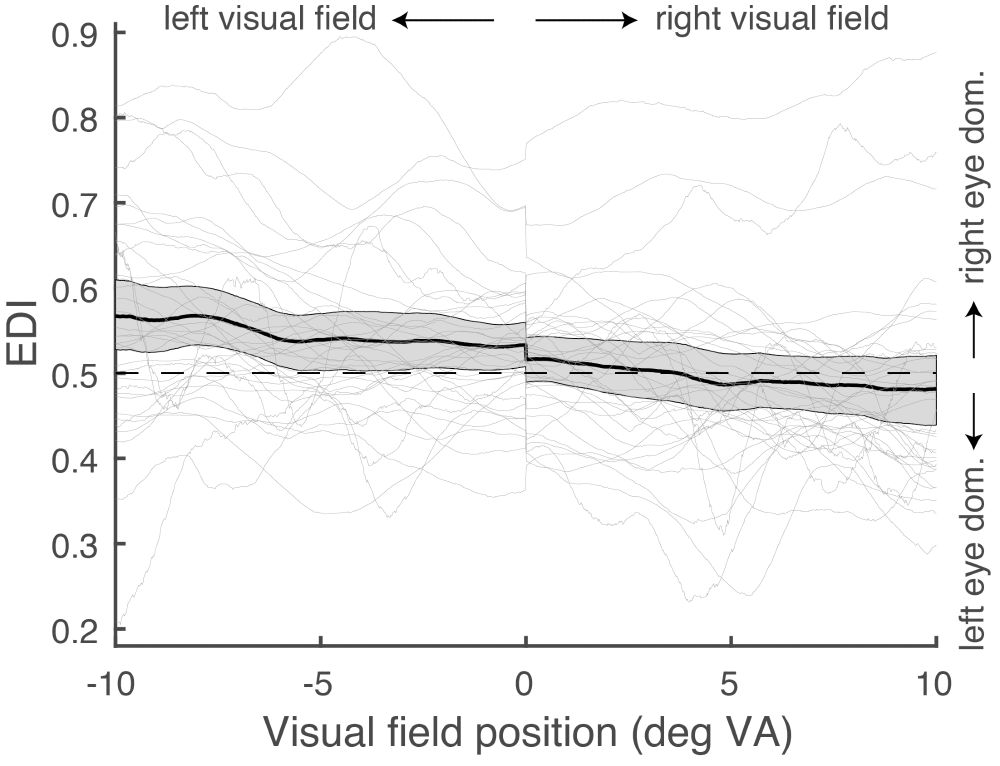
Surely you know about eye dominance. You probably don’t know it’s not a unitary phenomenon: in this paper I show that sensory eye dominance varies over the visual field. In the Discussion I propose an explanation for why this variation might exist. Curious? Read it here: doi.org/10.1167/jov....
July 2, 2025 at 7:46 AM
Surely you know about eye dominance. You probably don’t know it’s not a unitary phenomenon: in this paper I show that sensory eye dominance varies over the visual field. In the Discussion I propose an explanation for why this variation might exist. Curious? Read it here: doi.org/10.1167/jov....
Had a blast at last week's symposium! Inspiring to hear all the talks about EEG and attention.
I presented on the neural correlates of saccade preparation and covert spatial attention. Check out the preprint here: doi.org/10.1101/2025...
I presented on the neural correlates of saccade preparation and covert spatial attention. Check out the preprint here: doi.org/10.1101/2025...

June 30, 2025 at 9:49 AM
Had a blast at last week's symposium! Inspiring to hear all the talks about EEG and attention.
I presented on the neural correlates of saccade preparation and covert spatial attention. Check out the preprint here: doi.org/10.1101/2025...
I presented on the neural correlates of saccade preparation and covert spatial attention. Check out the preprint here: doi.org/10.1101/2025...
Reposted by Damian Koevoet
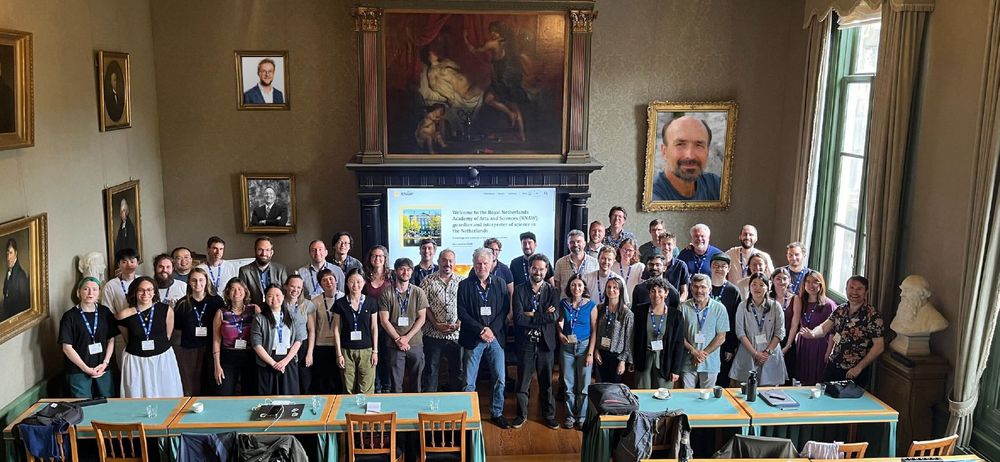
Last week's symposium titled "Advances in the Encephalographic Study of Attention" was a great success! Held in the KNAW building in Amsterdam and sponsored by the NWO, many of (Europe's) leading attention researchers assembled to discuss the latest advances in attention research using M/EEG.
June 30, 2025 at 7:13 AM
Last week's symposium titled "Advances in the Encephalographic Study of Attention" was a great success! Held in the KNAW building in Amsterdam and sponsored by the NWO, many of (Europe's) leading attention researchers assembled to discuss the latest advances in attention research using M/EEG.
Reposted by Damian Koevoet

In this new preprint, in review @elife.bsky.social, we show what processing steps make up the reaction time using single trial #EEG modelling in a contrast #decision task.
In this 🧵 I'm telling the story behind it as I think it is quite interesting and I can't write it like this in the paper...
In this 🧵 I'm telling the story behind it as I think it is quite interesting and I can't write it like this in the paper...

Decision-making components and times revealed by the single-trial electro-encephalogram https://www.biorxiv.org/content/10.1101/2025.06.25.661505v1
June 26, 2025 at 7:36 AM
In this new preprint, in review @elife.bsky.social, we show what processing steps make up the reaction time using single trial #EEG modelling in a contrast #decision task.
In this 🧵 I'm telling the story behind it as I think it is quite interesting and I can't write it like this in the paper...
In this 🧵 I'm telling the story behind it as I think it is quite interesting and I can't write it like this in the paper...
Reposted by Damian Koevoet

Thrilled to share that I successfully defended my PhD dissertation on Monday June 16th!
The dissertation is available here: doi.org/10.33540/2960
The dissertation is available here: doi.org/10.33540/2960


June 18, 2025 at 2:21 PM
Thrilled to share that I successfully defended my PhD dissertation on Monday June 16th!
The dissertation is available here: doi.org/10.33540/2960
The dissertation is available here: doi.org/10.33540/2960
Reposted by Damian Koevoet

New paper out at Journal of Memory and Language! We knew that individual differences in working memory predict source memory, but did it predict simple item recognition memory (that relied on less attention resources than source memory)? Our answer is: YES! (with @edvogel.bsky.social ) 1/5
June 18, 2025 at 3:56 PM
New paper out at Journal of Memory and Language! We knew that individual differences in working memory predict source memory, but did it predict simple item recognition memory (that relied on less attention resources than source memory)? Our answer is: YES! (with @edvogel.bsky.social ) 1/5