



Gökhan Aydogan
@drgokhanaydogan.bsky.social
Dad & Neuroeconomist - interested in human behavior, neuroeconomics🧠, neurogenomics🧬, good food🌯, music🎶, and astrophotography🔭
Pinned


🚨 Paper alert 👇
Does war trauma leave a lasting imprint on civilians’ brains🧠?
We analyzed ~40k MRIs in the #UKBiobank, including ~6k of people born during WWII. Those exposed to close bombings in-utero show differences in brain structure, even decades later.
www.biorxiv.org/content/10.1...
Does war trauma leave a lasting imprint on civilians’ brains🧠?
We analyzed ~40k MRIs in the #UKBiobank, including ~6k of people born during WWII. Those exposed to close bombings in-utero show differences in brain structure, even decades later.
www.biorxiv.org/content/10.1...
Reposted by Gökhan Aydogan

War Trauma Impairs Prenatal Brain Development: Evidence from Genetically-Informed Brain Imaging https://www.biorxiv.org/content/10.1101/2025.11.05.686844v1
November 7, 2025 at 5:15 AM
War Trauma Impairs Prenatal Brain Development: Evidence from Genetically-Informed Brain Imaging https://www.biorxiv.org/content/10.1101/2025.11.05.686844v1
🚨 Paper alert 👇
Does war trauma leave a lasting imprint on civilians’ brains🧠?
We analyzed ~40k MRIs in the #UKBiobank, including ~6k of people born during WWII. Those exposed to close bombings in-utero show differences in brain structure, even decades later.
www.biorxiv.org/content/10.1...
Does war trauma leave a lasting imprint on civilians’ brains🧠?
We analyzed ~40k MRIs in the #UKBiobank, including ~6k of people born during WWII. Those exposed to close bombings in-utero show differences in brain structure, even decades later.
www.biorxiv.org/content/10.1...
November 7, 2025 at 10:06 AM
🚨 Paper alert 👇
Does war trauma leave a lasting imprint on civilians’ brains🧠?
We analyzed ~40k MRIs in the #UKBiobank, including ~6k of people born during WWII. Those exposed to close bombings in-utero show differences in brain structure, even decades later.
www.biorxiv.org/content/10.1...
Does war trauma leave a lasting imprint on civilians’ brains🧠?
We analyzed ~40k MRIs in the #UKBiobank, including ~6k of people born during WWII. Those exposed to close bombings in-utero show differences in brain structure, even decades later.
www.biorxiv.org/content/10.1...
👇Check out our new pre-print 👇
War Trauma Impairs Prenatal Brain Development: Evidence from Genetically-Informed Brain Imaging https://www.biorxiv.org/content/10.1101/2025.11.05.686844v1
November 7, 2025 at 9:38 AM
👇Check out our new pre-print 👇
Reposted by Gökhan Aydogan

War Trauma Impairs Prenatal Brain Development: Evidence from Genetically-Informed Brain Imaging https://www.biorxiv.org/content/10.1101/2025.11.05.686844v1
November 7, 2025 at 5:15 AM
War Trauma Impairs Prenatal Brain Development: Evidence from Genetically-Informed Brain Imaging https://www.biorxiv.org/content/10.1101/2025.11.05.686844v1
1/ 🚨 New preprint: Acute stress doesn’t just change feelings—it warps how big payoffs look, pushing people to be more risk-seeking than usual.
👉 “Acute stress reduces risk-aversion by changing magnitude perception.” doi.org/10.1101/2025...
@gillesdehollander.bsky.social @saurabhbedi.bsky.social
👉 “Acute stress reduces risk-aversion by changing magnitude perception.” doi.org/10.1101/2025...
@gillesdehollander.bsky.social @saurabhbedi.bsky.social

Acute stress reduces risk-aversion by changing magnitude perception
Stress is thought to impair financial decision-making by influencing the willingness to take risks. This effect is commonly attributed to stress-related changes in affective evaluation of rewards and ...
doi.org
November 5, 2025 at 9:44 PM
1/ 🚨 New preprint: Acute stress doesn’t just change feelings—it warps how big payoffs look, pushing people to be more risk-seeking than usual.
👉 “Acute stress reduces risk-aversion by changing magnitude perception.” doi.org/10.1101/2025...
@gillesdehollander.bsky.social @saurabhbedi.bsky.social
👉 “Acute stress reduces risk-aversion by changing magnitude perception.” doi.org/10.1101/2025...
@gillesdehollander.bsky.social @saurabhbedi.bsky.social
Reposted by Gökhan Aydogan

📢 New preprint 📢
(with Daniil Luzyanin)
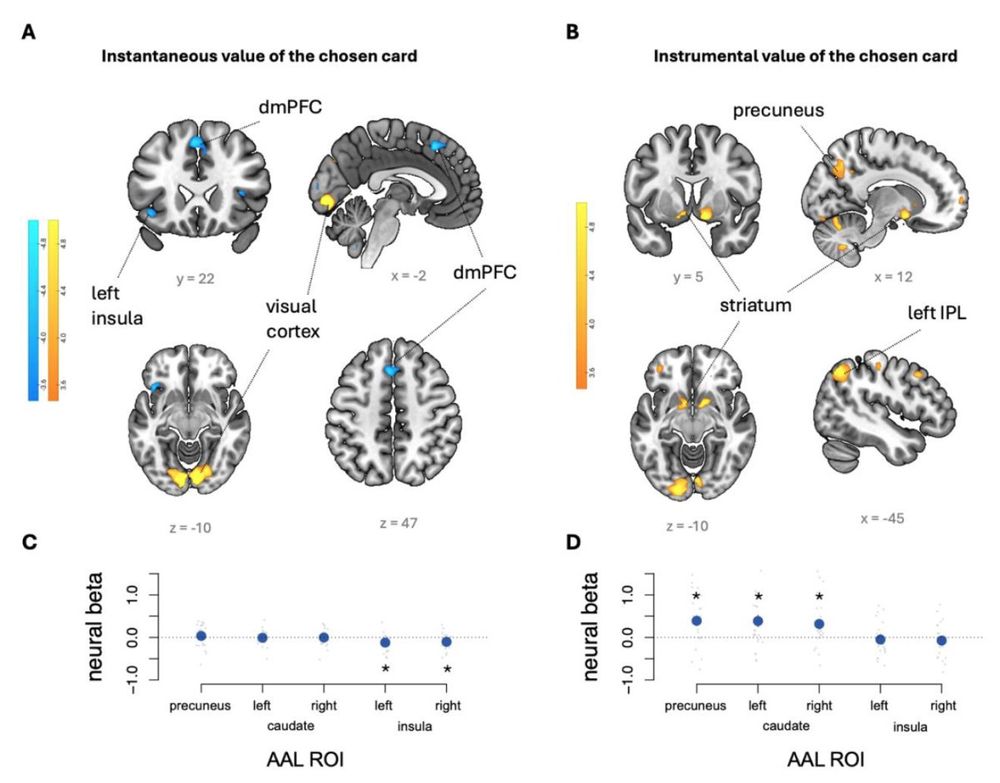
We use a new task to distinguish between the instantaneous and instrumental (goal-oriented) value of the same choice option in the brain using fMRI: biorxiv.org/content/10.1...
(with Daniil Luzyanin)
We use a new task to distinguish between the instantaneous and instrumental (goal-oriented) value of the same choice option in the brain using fMRI: biorxiv.org/content/10.1...
September 15, 2025 at 10:36 AM
📢 New preprint 📢
(with Daniil Luzyanin)
We use a new task to distinguish between the instantaneous and instrumental (goal-oriented) value of the same choice option in the brain using fMRI: biorxiv.org/content/10.1...
(with Daniil Luzyanin)
We use a new task to distinguish between the instantaneous and instrumental (goal-oriented) value of the same choice option in the brain using fMRI: biorxiv.org/content/10.1...
👉Great work by my colleagues at @econ.uzh.ch
📢 Preprint out! biorxiv.org/content/10.1... What gives rise to probability weighting, a cornerstone of Prospect Theory?
We show it comes from the natural boundedness of probabilities + cognitive noise. Adding boundaries adds multiple distortions, across risky choice & perception.
We show it comes from the natural boundedness of probabilities + cognitive noise. Adding boundaries adds multiple distortions, across risky choice & perception.

Probability weighting arises from boundary repulsions of cognitive noise
In both risky choice and perception, people overweight small and underweight large probabilities. While prospect theory models this with a probability weighting function, and Bayesian noisy coding mod...
biorxiv.org
October 3, 2025 at 8:58 AM
👉Great work by my colleagues at @econ.uzh.ch
Reposted by Gökhan Aydogan

📢 Preprint out! biorxiv.org/content/10.1... What gives rise to probability weighting, a cornerstone of Prospect Theory?
We show it comes from the natural boundedness of probabilities + cognitive noise. Adding boundaries adds multiple distortions, across risky choice & perception.
We show it comes from the natural boundedness of probabilities + cognitive noise. Adding boundaries adds multiple distortions, across risky choice & perception.
Probability weighting arises from boundary repulsions of cognitive noise
In both risky choice and perception, people overweight small and underweight large probabilities. While prospect theory models this with a probability weighting function, and Bayesian noisy coding mod...
biorxiv.org
September 16, 2025 at 9:14 AM
📢 Preprint out! biorxiv.org/content/10.1... What gives rise to probability weighting, a cornerstone of Prospect Theory?
We show it comes from the natural boundedness of probabilities + cognitive noise. Adding boundaries adds multiple distortions, across risky choice & perception.
We show it comes from the natural boundedness of probabilities + cognitive noise. Adding boundaries adds multiple distortions, across risky choice & perception.
🤔How do humans anticipate an opponent's moves in strategic games?
Excited to share our latest work on #mentalization in strategic games.
After years of work, we've empirically validated our new model, behaviorally (N~500) and neurally (N~100) 🧠 a 🧵 (1/5)
Excited to share our latest work on #mentalization in strategic games.
After years of work, we've empirically validated our new model, behaviorally (N~500) and neurally (N~100) 🧠 a 🧵 (1/5)

November 24, 2024 at 4:29 PM
🤔How do humans anticipate an opponent's moves in strategic games?
Excited to share our latest work on #mentalization in strategic games.
After years of work, we've empirically validated our new model, behaviorally (N~500) and neurally (N~100) 🧠 a 🧵 (1/5)
Excited to share our latest work on #mentalization in strategic games.
After years of work, we've empirically validated our new model, behaviorally (N~500) and neurally (N~100) 🧠 a 🧵 (1/5)