




Qinya Feng
@fqinya.bsky.social
PhD in political science from @uu-polisci.bsky.social. Political psychology, social science genetics. https://qinyafeng.github.io/
Liberal support can be selective when values clash: when elites frame liberal values as conflicting, citizens can trade off between these values.
In this case, gender equality > Iiberal immigration inclusion, producing policy preferences that appear illiberal and exclusive.
In this case, gender equality > Iiberal immigration inclusion, producing policy preferences that appear illiberal and exclusive.
Happy that my article just published in PSRM! In "Inclusion to Exclude“, I show that when politicians invoke women's rights to justify anti-immigration positions, it shifts citizens' policy preferences - but differently so depending on their prior views. doi.org/10.1017/psrm...
[Thread below]
[Thread below]

January 28, 2026 at 9:47 PM
Liberal support can be selective when values clash: when elites frame liberal values as conflicting, citizens can trade off between these values.
In this case, gender equality > Iiberal immigration inclusion, producing policy preferences that appear illiberal and exclusive.
In this case, gender equality > Iiberal immigration inclusion, producing policy preferences that appear illiberal and exclusive.
Reposted by Qinya Feng

An extraordinary paragraph. www.theatlantic.com/ideas/2026/0...

January 27, 2026 at 10:44 PM
An extraordinary paragraph. www.theatlantic.com/ideas/2026/0...
Reposted by Qinya Feng

New work by Stefania Paolini & Patrick Kotzur (@durhampsych.bsky.social) and international team proposes a rupture-habit model to make sense of emerging findings in everyday intergroup contact.
Paywall: doi.org/10.1038/s441...
Free Access Link: trebuchet.public.springernature.app/get_content/...
Paywall: doi.org/10.1038/s441...
Free Access Link: trebuchet.public.springernature.app/get_content/...

January 21, 2026 at 9:04 AM
New work by Stefania Paolini & Patrick Kotzur (@durhampsych.bsky.social) and international team proposes a rupture-habit model to make sense of emerging findings in everyday intergroup contact.
Paywall: doi.org/10.1038/s441...
Free Access Link: trebuchet.public.springernature.app/get_content/...
Paywall: doi.org/10.1038/s441...
Free Access Link: trebuchet.public.springernature.app/get_content/...
Reposted by Qinya Feng

For more context, see also the @nature.com News & Views article about this work, where I unpack what it means when genetic risk for psychiatric disorders overlaps with normal-range traits, including some positive associations with education-related outcomes: rdcu.be/eT4U7

December 10, 2025 at 5:42 PM
For more context, see also the @nature.com News & Views article about this work, where I unpack what it means when genetic risk for psychiatric disorders overlaps with normal-range traits, including some positive associations with education-related outcomes: rdcu.be/eT4U7
Genuinely generous and free research environment! Apply!!!

We're happy to announce at least three vacant PhD positions starting in fall 2026! Read more and apply here: www.uu.se/en/departmen...

December 8, 2025 at 3:04 PM
Genuinely generous and free research environment! Apply!!!
Stay tuned for years of exploration into how genes 🧬 and social environments jointly explain inequality and individual differences! With a UNIVERSE 🤯 of data and collaborations!!!

I feel incredibly lucky and honored to have been selected as one of the recipients of this very generous grant from the Knut and Alice Wallenberg Foundation. Looking forward to working hard over the coming years - lots of exciting research in social science genetics coming!

Another 27 promising researchers will now receive five-year basic research grants from Knut and Alice Wallenberg Foundation. This funding provides researchers in the beginning of their careers with the opportunity to contribute groundbreaking new knowledge
#research #science
tinyurl.com/yu4svfjh
#research #science
tinyurl.com/yu4svfjh
December 5, 2025 at 10:16 AM
Stay tuned for years of exploration into how genes 🧬 and social environments jointly explain inequality and individual differences! With a UNIVERSE 🤯 of data and collaborations!!!
Reposted by Qinya Feng

MASSIVE Japanese genetics of child health and development study: www.medrxiv.org/content/10.1...

Genome-wide association study on longitudinal and cross-sectional traits of child health and development in a Japanese population
Understanding the influence of both genetics and environment on human health, especially early in life, is essential for shaping long-term health. Here, we utilize a nationwide prospective birth cohor...
www.medrxiv.org
November 28, 2025 at 5:14 PM
MASSIVE Japanese genetics of child health and development study: www.medrxiv.org/content/10.1...
Maybe the 1st study to show gene(PGI)–environment interaction in political participation? Using unique Swedish data, Oskar finds that high-SES & politically active families and early life neighbourhoods can weaken genetic influences on voting.

Second thesis article now out in Political Behavior! Using PGIs for ~10 000 full-pair fraternal twins in STR, combined with rich, geo-coded register data, I highlight the compensatory interaction between genetics and family + neighbourhood factors, with regards to voting. 🗳️
doi.org/10.1007/s111...
doi.org/10.1007/s111...


November 14, 2025 at 2:23 PM
Maybe the 1st study to show gene(PGI)–environment interaction in political participation? Using unique Swedish data, Oskar finds that high-SES & politically active families and early life neighbourhoods can weaken genetic influences on voting.
Reposted by Qinya Feng
There’s a new kid in town!
Companies are now selling IVF and embryo selection based on genetic testing for traits related to health and even intelligence.
We outline methodological and ethical concerns, and warn against risks for social inequality.
With the fantastic @gaiaghirardi.bsky.social
Companies are now selling IVF and embryo selection based on genetic testing for traits related to health and even intelligence.
We outline methodological and ethical concerns, and warn against risks for social inequality.
With the fantastic @gaiaghirardi.bsky.social

Embryo selection based on polygenic prediction risks reinforcing social inequality
The rise of companies offering embryo selection based on genetic testing has triggered heated debate about ethical acceptability, as well as the accuracy and scientific validity of these techniques. W...
www.fertstert.org
November 13, 2025 at 8:09 AM
There’s a new kid in town!
Companies are now selling IVF and embryo selection based on genetic testing for traits related to health and even intelligence.
We outline methodological and ethical concerns, and warn against risks for social inequality.
With the fantastic @gaiaghirardi.bsky.social
Companies are now selling IVF and embryo selection based on genetic testing for traits related to health and even intelligence.
We outline methodological and ethical concerns, and warn against risks for social inequality.
With the fantastic @gaiaghirardi.bsky.social
Reposted by Qinya Feng

1/ 🚨New paper in Nature Genetics
Genetic factors are associated with the educational fields people study, from arts to engineering.
Article: www.nature.com/articles/s41...
FAQ: www.thehastingscenter.org/genomic-find...
Genetic factors are associated with the educational fields people study, from arts to engineering.
Article: www.nature.com/articles/s41...
FAQ: www.thehastingscenter.org/genomic-find...

Genetic associations with educational fields - Nature Genetics
Genome-wide analyses of 10 educational fields identify 17 associated loci. Analysis of genetic clustering across specializations identifies two key dimensions that show genetic overlap with personalit...
www.nature.com
November 4, 2025 at 10:23 AM
1/ 🚨New paper in Nature Genetics
Genetic factors are associated with the educational fields people study, from arts to engineering.
Article: www.nature.com/articles/s41...
FAQ: www.thehastingscenter.org/genomic-find...
Genetic factors are associated with the educational fields people study, from arts to engineering.
Article: www.nature.com/articles/s41...
FAQ: www.thehastingscenter.org/genomic-find...
Reposted by Qinya Feng

NEW -
Can Student Body Diversity Foster Inter-ethnic Trust, Tolerance, and National Identification Prioritization? The Role of Friendship in Kenya - https://cup.org/3LaSCCl
- Jaimie Bleck, Robert Dowd, @daniceguzman.bsky.social, John Mugo & Jackline Oluoch-Aridi
#OpenAccess
Can Student Body Diversity Foster Inter-ethnic Trust, Tolerance, and National Identification Prioritization? The Role of Friendship in Kenya - https://cup.org/3LaSCCl
- Jaimie Bleck, Robert Dowd, @daniceguzman.bsky.social, John Mugo & Jackline Oluoch-Aridi
#OpenAccess

October 30, 2025 at 12:50 PM
NEW -
Can Student Body Diversity Foster Inter-ethnic Trust, Tolerance, and National Identification Prioritization? The Role of Friendship in Kenya - https://cup.org/3LaSCCl
- Jaimie Bleck, Robert Dowd, @daniceguzman.bsky.social, John Mugo & Jackline Oluoch-Aridi
#OpenAccess
Can Student Body Diversity Foster Inter-ethnic Trust, Tolerance, and National Identification Prioritization? The Role of Friendship in Kenya - https://cup.org/3LaSCCl
- Jaimie Bleck, Robert Dowd, @daniceguzman.bsky.social, John Mugo & Jackline Oluoch-Aridi
#OpenAccess
Reposted by Qinya Feng

We built the openESM database:
▶️60 openly available experience sampling datasets (16K+ participants, 740K+ obs.) in one place
▶️Harmonized (meta-)data, fully open-source software
▶️Filter & search all data, simply download via R/Python
Find out more:
🌐 openesmdata.org
📝 doi.org/10.31234/osf...
▶️60 openly available experience sampling datasets (16K+ participants, 740K+ obs.) in one place
▶️Harmonized (meta-)data, fully open-source software
▶️Filter & search all data, simply download via R/Python
Find out more:
🌐 openesmdata.org
📝 doi.org/10.31234/osf...
October 22, 2025 at 7:34 PM
We built the openESM database:
▶️60 openly available experience sampling datasets (16K+ participants, 740K+ obs.) in one place
▶️Harmonized (meta-)data, fully open-source software
▶️Filter & search all data, simply download via R/Python
Find out more:
🌐 openesmdata.org
📝 doi.org/10.31234/osf...
▶️60 openly available experience sampling datasets (16K+ participants, 740K+ obs.) in one place
▶️Harmonized (meta-)data, fully open-source software
▶️Filter & search all data, simply download via R/Python
Find out more:
🌐 openesmdata.org
📝 doi.org/10.31234/osf...
After the 5th defence&party attended this year: what are the odds in life, how marvellous to see our explorations on digital transformation, Polish diaspora policy, Swedish twins and trust, climate change and fish, sex in willows, face the world alongside brilliant friends. No straight road behind🥂


September 20, 2025 at 9:06 AM
After the 5th defence&party attended this year: what are the odds in life, how marvellous to see our explorations on digital transformation, Polish diaspora policy, Swedish twins and trust, climate change and fish, sex in willows, face the world alongside brilliant friends. No straight road behind🥂
Reposted by Qinya Feng

💥🧠🧬Finally out!! Our new paper on the overlapping genetic basis of brain structures and psychiatric disorders has been published in Nature Mental Health. The full list of shared genetic loci is also available online. Thank you so much, Aaron and all co-authors.
www.nature.com/articles/s44...
www.nature.com/articles/s44...

The overlapping genetic architecture of psychiatric disorders and cortical brain structure - Nature Mental Health
This study highlights sex differences in major depressive disorder using resting-state functional magnetic resonance imaging. Findings suggest hormonal fluctuations influence onset, emphasizing the ne...
www.nature.com
August 11, 2025 at 6:54 PM
💥🧠🧬Finally out!! Our new paper on the overlapping genetic basis of brain structures and psychiatric disorders has been published in Nature Mental Health. The full list of shared genetic loci is also available online. Thank you so much, Aaron and all co-authors.
www.nature.com/articles/s44...
www.nature.com/articles/s44...
Reposted by Qinya Feng

NEW RELEASE
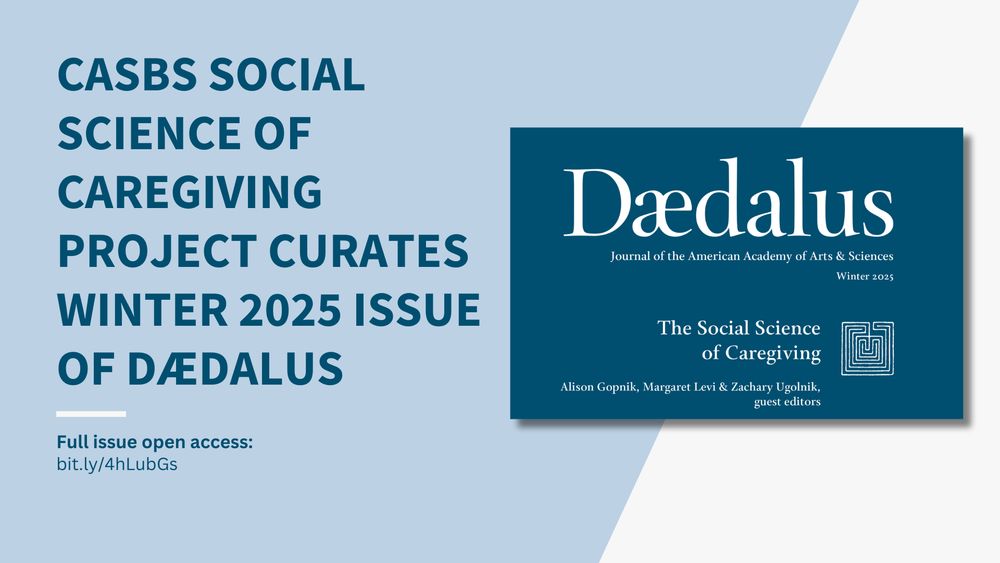
@alisongopnik.bsky.social, leader of CASBS's Social Science of Caregiving project, edits the new issue of Dædalus w/ @mlevi.bsky.social & Zachary Ugolnik
16 essays rethink the philosophical, psychological, biological, political & economic foundations of care
OPEN ACCESS bit.ly/3Qm49ha
@alisongopnik.bsky.social, leader of CASBS's Social Science of Caregiving project, edits the new issue of Dædalus w/ @mlevi.bsky.social & Zachary Ugolnik
16 essays rethink the philosophical, psychological, biological, political & economic foundations of care
OPEN ACCESS bit.ly/3Qm49ha
February 13, 2025 at 7:18 PM
NEW RELEASE
@alisongopnik.bsky.social, leader of CASBS's Social Science of Caregiving project, edits the new issue of Dædalus w/ @mlevi.bsky.social & Zachary Ugolnik
16 essays rethink the philosophical, psychological, biological, political & economic foundations of care
OPEN ACCESS bit.ly/3Qm49ha
@alisongopnik.bsky.social, leader of CASBS's Social Science of Caregiving project, edits the new issue of Dædalus w/ @mlevi.bsky.social & Zachary Ugolnik
16 essays rethink the philosophical, psychological, biological, political & economic foundations of care
OPEN ACCESS bit.ly/3Qm49ha
Reposted by Qinya Feng
In this study, @anatperry.bsky.social @desmond-ong.bsky.social et al show that human-attributed responses are rated as more empathic than AI-attributed ones, especially when conveying shared experience and care.
www.nature.com/articles/s41...
www.nature.com/articles/s41...

Comparing the value of perceived human versus AI-generated empathy - Nature Human Behaviour
AI mimics empathy well, but does its empathy feel different? The authors show human empathy has unique value: human-attributed responses are rated as more empathic than AI-attributed ones, especially ...
www.nature.com
July 1, 2025 at 7:07 PM
In this study, @anatperry.bsky.social @desmond-ong.bsky.social et al show that human-attributed responses are rated as more empathic than AI-attributed ones, especially when conveying shared experience and care.
www.nature.com/articles/s41...
www.nature.com/articles/s41...