


Jonathan Amos
@jcdamos.bsky.social
Journalist. Former BBC Science Correspondent. Way too interested in icebergs for my own good.
The landscape hidden beneath Antarctica's ice sheet has been mapped from space for the first time. Scientists used hi‑res satellite observations to track how the continent’s frozen surface bunches and dips as it moves over the rugged rock bed below. www.bbc.co.uk/news/article...

New map reveals landscape beneath Antarctica in unprecedented detail
Scientists believe the map could shed light on how Antarctica's vast ice sheet will respond to climate change.
www.bbc.co.uk
January 16, 2026 at 11:40 AM
The landscape hidden beneath Antarctica's ice sheet has been mapped from space for the first time. Scientists used hi‑res satellite observations to track how the continent’s frozen surface bunches and dips as it moves over the rugged rock bed below. www.bbc.co.uk/news/article...
Reposted by Jonathan Amos

A small silver lining: Yes, NASA and NOAA did not do briefings for their global temp data sets released today. And they certainly do not emphasize the human causes. But they *did* release them. The work is still happening.
data.giss.nasa.gov/gistemp/grap...
www.ncei.noaa.gov/access/monit...
data.giss.nasa.gov/gistemp/grap...
www.ncei.noaa.gov/access/monit...
January 14, 2026 at 5:52 PM
A small silver lining: Yes, NASA and NOAA did not do briefings for their global temp data sets released today. And they certainly do not emphasize the human causes. But they *did* release them. The work is still happening.
data.giss.nasa.gov/gistemp/grap...
www.ncei.noaa.gov/access/monit...
data.giss.nasa.gov/gistemp/grap...
www.ncei.noaa.gov/access/monit...
Reposted by Jonathan Amos
🌊❄️ When Antarctic glaciers collapse into the sea, they can trigger huge underwater tsunamis that mix the ocean, affecting ice loss, climate and ecosystems.
The project I lead on this is now in the field and featured on Sky News:
news.sky.com/story/underw...
#Antarctic #OceanMixing #ClimateScience
The project I lead on this is now in the field and featured on Sky News:
news.sky.com/story/underw...
#Antarctic #OceanMixing #ClimateScience
news.sky.com
January 14, 2026 at 9:54 AM
🌊❄️ When Antarctic glaciers collapse into the sea, they can trigger huge underwater tsunamis that mix the ocean, affecting ice loss, climate and ecosystems.
The project I lead on this is now in the field and featured on Sky News:
news.sky.com/story/underw...
#Antarctic #OceanMixing #ClimateScience
The project I lead on this is now in the field and featured on Sky News:
news.sky.com/story/underw...
#Antarctic #OceanMixing #ClimateScience
One big paddling pool becomes three. Today's view of iceberg A23a (left) and a view from the end of December (right). Notice how the raised rim effect, holding in surface meltwater, has re-established on all three main segments of the broken berg. A23a is turning to slush puppie.

January 13, 2026 at 10:40 PM
One big paddling pool becomes three. Today's view of iceberg A23a (left) and a view from the end of December (right). Notice how the raised rim effect, holding in surface meltwater, has re-established on all three main segments of the broken berg. A23a is turning to slush puppie.
💥 Boom! And it's just happened. The huge volumes of meltwater that had collected on the surface of iceberg A23a have triggered a massive and catastrophic hydrofracture event. Much of the berg has turned to mush. Three major segments remain, the largest about 500 sq km.

January 12, 2026 at 7:13 PM
💥 Boom! And it's just happened. The huge volumes of meltwater that had collected on the surface of iceberg A23a have triggered a massive and catastrophic hydrofracture event. Much of the berg has turned to mush. Three major segments remain, the largest about 500 sq km.
Want to see an iceberg turn to mush? What remains of iceberg A23a (<1,000 sq km) is about to experience death by hydrofracture. Look at all the meltwater sitting atop the berg. The whole thing could just fall apart any day now.

December 29, 2025 at 8:52 PM
Want to see an iceberg turn to mush? What remains of iceberg A23a (<1,000 sq km) is about to experience death by hydrofracture. Look at all the meltwater sitting atop the berg. The whole thing could just fall apart any day now.
Reposted by Jonathan Amos

I haven't heard about the disagreements. The ice was sitting on an ice plain - a very flat bed with low basal drag. These are present beneath the downstream parts of many Antarctic glaciers where the sediment they transport has built a depositional body known as a grounding zone wedge.
November 4, 2025 at 7:54 PM
I haven't heard about the disagreements. The ice was sitting on an ice plain - a very flat bed with low basal drag. These are present beneath the downstream parts of many Antarctic glaciers where the sediment they transport has built a depositional body known as a grounding zone wedge.
A fascinating paper in @NatureGeosci that has already sparked considerable debate in the ice community. It's the super-fast withdrawal of Hektoria Glacier on the eastern side of the Antarctic Peninsula in 2022/23. Words by me in @newscientist.com www.newscientist.com/article/2502...

Antarctic glacier's alarming retreat is the fastest ever seen
Hektoria glacier on the Antarctic Peninsula retreated 25 kilometres in just 15 months. Its rapid melt could have implications for other glaciers and the rate of sea level rise
www.newscientist.com
November 3, 2025 at 5:00 PM
A fascinating paper in @NatureGeosci that has already sparked considerable debate in the ice community. It's the super-fast withdrawal of Hektoria Glacier on the eastern side of the Antarctic Peninsula in 2022/23. Words by me in @newscientist.com www.newscientist.com/article/2502...
Reposted by Jonathan Amos

Speed reading "Science under Siege" - ahead of next week's recording of BBC Science in Action, where co-author @michaelemann.bsky.social joins a panel on the front line of the current assault on science, to answer what can be done.
An appropriate topic for the last edition of the 60yr old series.
An appropriate topic for the last edition of the 60yr old series.

October 25, 2025 at 4:35 PM
Speed reading "Science under Siege" - ahead of next week's recording of BBC Science in Action, where co-author @michaelemann.bsky.social joins a panel on the front line of the current assault on science, to answer what can be done.
An appropriate topic for the last edition of the 60yr old series.
An appropriate topic for the last edition of the 60yr old series.
Ooops! It's happened again. The remnants of iceberg A23a have been caught on another Taylor Column, this time above the NorthWest Georgia Rise to the north of South Georgia BOT. The fragments have spun around and around for more than a month now.
October 4, 2025 at 1:09 PM
Ooops! It's happened again. The remnants of iceberg A23a have been caught on another Taylor Column, this time above the NorthWest Georgia Rise to the north of South Georgia BOT. The fragments have spun around and around for more than a month now.
Fab first data from the UK-supplied Microwave Sounder on the new Metop weather satellite. MWS combines obs from the old MHS & AMSU instruments. MWS measures the temperature and water content sitting at different altitudes. Fundamental data needed by computer models' for medium range forecasts.

🌎 Fresh data just in from space: the first results from the Microwave Sounder and Radio Occultation Sounder onboard @eumetsat.int’s MetOp-SG-A1 satellite are here, after less than a month in orbit: esa.int/Applications...
📸Eumetsat
📸Eumetsat


September 2, 2025 at 2:27 PM
Fab first data from the UK-supplied Microwave Sounder on the new Metop weather satellite. MWS combines obs from the old MHS & AMSU instruments. MWS measures the temperature and water content sitting at different altitudes. Fundamental data needed by computer models' for medium range forecasts.
Really clear view today of Iceberg A23a's big fragmentation event. Going back through the data, I think it happened on the 25th/26th. Image from NASA/Terra/Modis. Each new fragment is probably big enough to get a US National Ice Center designation. Likely A23g, A23h and A23i.

August 30, 2025 at 1:40 PM
Really clear view today of Iceberg A23a's big fragmentation event. Going back through the data, I think it happened on the 25th/26th. Image from NASA/Terra/Modis. Each new fragment is probably big enough to get a US National Ice Center designation. Likely A23g, A23h and A23i.
🚨🚨🚨Boom! Iceberg A23a looks to have undergone a major fragmentation event in the past 24 hours. I count at least three "daughter" bergs (g, h and i ?). Further satellite imagery will confirm. The last intact measurement I made was ~2,250 sq km. @bas.ac.uk

August 29, 2025 at 10:15 AM
🚨🚨🚨Boom! Iceberg A23a looks to have undergone a major fragmentation event in the past 24 hours. I count at least three "daughter" bergs (g, h and i ?). Further satellite imagery will confirm. The last intact measurement I made was ~2,250 sq km. @bas.ac.uk
Iceberg A23a update. It's lost another couple of large chunks in the past few days. Are we getting close to a major fragmentation event? Likely so.

July 15, 2025 at 3:07 PM
Iceberg A23a update. It's lost another couple of large chunks in the past few days. Are we getting close to a major fragmentation event? Likely so.
In case you were wondering... Iceberg A23a seen cruising around South Georgia today by Meteosat 12. The old berg still has an area of 2,846 sq km.

July 7, 2025 at 3:43 PM
In case you were wondering... Iceberg A23a seen cruising around South Georgia today by Meteosat 12. The old berg still has an area of 2,846 sq km.
Sentinel-1 has finally got a clear view of iceberg A23a (13/6/25). The berg is much diminished as it skirts around South Georgia. And the US National Ice Center has updated its stats: A23a is now only the world's second biggest berg at 829.79 sqNM, or 2846,11 sqKM.

June 15, 2025 at 7:57 AM
Sentinel-1 has finally got a clear view of iceberg A23a (13/6/25). The berg is much diminished as it skirts around South Georgia. And the US National Ice Center has updated its stats: A23a is now only the world's second biggest berg at 829.79 sqNM, or 2846,11 sqKM.
The movement of iceberg A23a over the past seven days. It's moved about 80km to the southeast of the position where it grounded off the coast of South Georgia in early March. Zoomed in animation from Meteosat-12.
June 4, 2025 at 2:41 PM
The movement of iceberg A23a over the past seven days. It's moved about 80km to the southeast of the position where it grounded off the coast of South Georgia in early March. Zoomed in animation from Meteosat-12.
Somebody's got itchy feet! Iceberg A23a has moved in the past couple of days. It grounded close to South Georgia back at the beginning of March. But the erosion and melting since then has clearly allowed it to break free. Does it now reground or sweep off around the island?

June 1, 2025 at 6:17 PM
Somebody's got itchy feet! Iceberg A23a has moved in the past couple of days. It grounded close to South Georgia back at the beginning of March. But the erosion and melting since then has clearly allowed it to break free. Does it now reground or sweep off around the island?
Reposted by Jonathan Amos

Latest #CopernicusAtmosphere AOD forecast (from 30/05 00 UTC) shows smoke plume from devastating (&growing) Canadian #wildfires continuing across the Atlantic with hazy skies for Europe over next few days atmosphere.copernicus.eu/charts/packa... @copernicusecmwf.bsky.social @ecmwf.int
May 30, 2025 at 6:47 PM
Latest #CopernicusAtmosphere AOD forecast (from 30/05 00 UTC) shows smoke plume from devastating (&growing) Canadian #wildfires continuing across the Atlantic with hazy skies for Europe over next few days atmosphere.copernicus.eu/charts/packa... @copernicusecmwf.bsky.social @ecmwf.int
With days shortening at South Georgia (it's about 8 hours from sunrise to sunset), optical satellite coverage in the region is getting more restricted. Not so for Meteosat, which images the Europe/Africa hemisphere regardless of season. Hence we get a few views of iceberg A23a. Still grounded.

May 30, 2025 at 2:47 PM
With days shortening at South Georgia (it's about 8 hours from sunrise to sunset), optical satellite coverage in the region is getting more restricted. Not so for Meteosat, which images the Europe/Africa hemisphere regardless of season. Hence we get a few views of iceberg A23a. Still grounded.
Reposted by Jonathan Amos

I can't shake the feeling that these ideas are getting far more attention than their credibility and maturity warrant!
Cutting global greenhouse gas emissions as soon as possible is the key to tackling global warming.
www.thetimes.com/uk/science/a...
Cutting global greenhouse gas emissions as soon as possible is the key to tackling global warming.
www.thetimes.com/uk/science/a...

Hope to halt climate change by thickening Arctic sea ice
The government has outlined how it will spend £57 million on research on geo-engineering projects designed to cool the planet
www.thetimes.com
May 8, 2025 at 1:33 PM
I can't shake the feeling that these ideas are getting far more attention than their credibility and maturity warrant!
Cutting global greenhouse gas emissions as soon as possible is the key to tackling global warming.
www.thetimes.com/uk/science/a...
Cutting global greenhouse gas emissions as soon as possible is the key to tackling global warming.
www.thetimes.com/uk/science/a...
Reposted by Jonathan Amos

How little we’ve seen: A visual coverage estimate of the deep seafloor | Science Advances www.science.org/doi/10.1126/...

How little we’ve seen: A visual coverage estimate of the deep seafloor
In decades of deep-sea exploration, humans have observed only 0.001% of the deep seafloor, leaving 66% of planet Earth unseen.
www.science.org
May 8, 2025 at 12:50 AM
How little we’ve seen: A visual coverage estimate of the deep seafloor | Science Advances www.science.org/doi/10.1126/...
There was a spectacular view of iceberg A23a on 3 May. Clear skies over the berg and South Georgia. By my measurement, A23a is no longer the world's biggest iceberg. At ~2850 sq km, it's now bested by D15a - but only just. The US National Ice Center will be the final judge on the matter.

May 6, 2025 at 9:49 AM
There was a spectacular view of iceberg A23a on 3 May. Clear skies over the berg and South Georgia. By my measurement, A23a is no longer the world's biggest iceberg. At ~2850 sq km, it's now bested by D15a - but only just. The US National Ice Center will be the final judge on the matter.
Reposted by Jonathan Amos
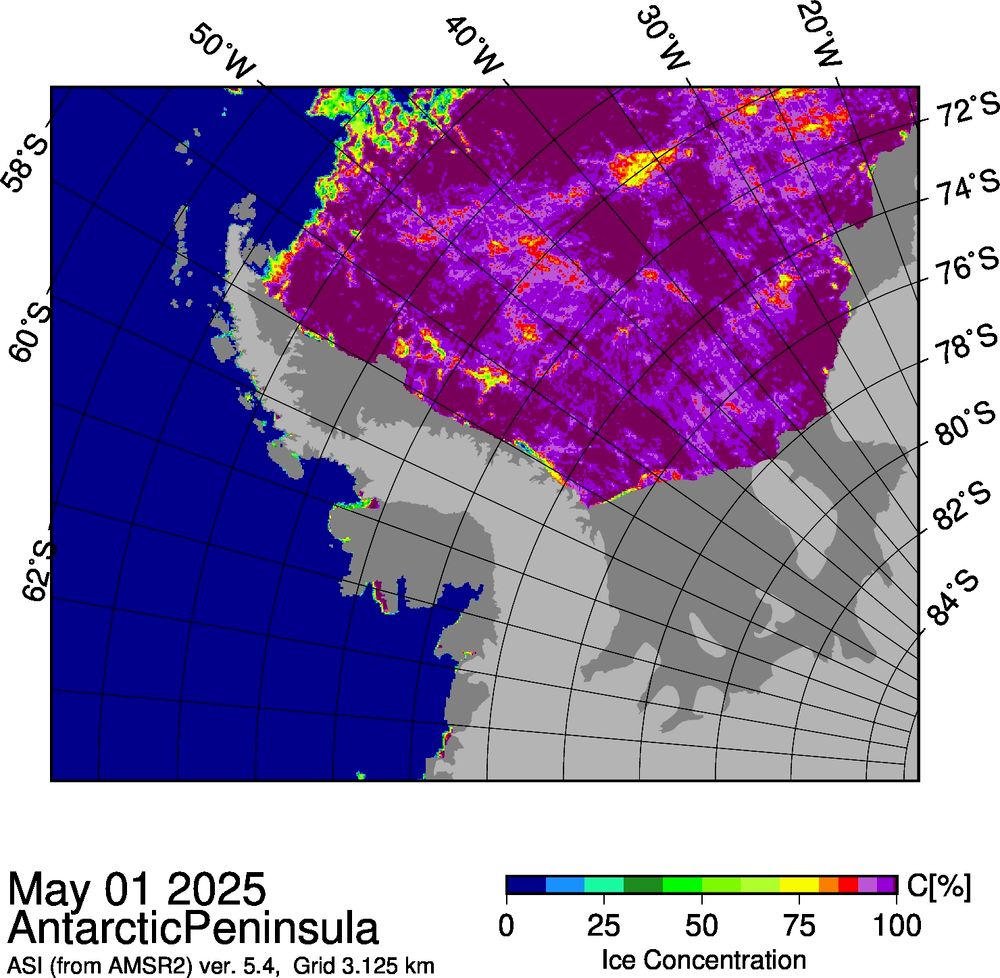
This is almost unbelievable. It's now May and there is still virtually no new sea ice forming in the Bellingshausen Sea (lower left region in image).
Image showing sea ice concentration derived from AMSR satellite data is by Institute of Environmental Physics, University of Bremen, Germany.
Image showing sea ice concentration derived from AMSR satellite data is by Institute of Environmental Physics, University of Bremen, Germany.
May 2, 2025 at 10:22 PM
This is almost unbelievable. It's now May and there is still virtually no new sea ice forming in the Bellingshausen Sea (lower left region in image).
Image showing sea ice concentration derived from AMSR satellite data is by Institute of Environmental Physics, University of Bremen, Germany.
Image showing sea ice concentration derived from AMSR satellite data is by Institute of Environmental Physics, University of Bremen, Germany.
Reposted by Jonathan Amos

The Penguin Book of Penguins!
Coming later this year: a beautifully illustrated book about the world’s most beloved bird, written by British Antarctic Survey’s Peter Fretwell @ptfretwell.bsky.social
What better day to reveal the cover the #WorldPenguinDay? ⬇️
Coming later this year: a beautifully illustrated book about the world’s most beloved bird, written by British Antarctic Survey’s Peter Fretwell @ptfretwell.bsky.social
What better day to reveal the cover the #WorldPenguinDay? ⬇️
April 25, 2025 at 2:13 PM
The Penguin Book of Penguins!
Coming later this year: a beautifully illustrated book about the world’s most beloved bird, written by British Antarctic Survey’s Peter Fretwell @ptfretwell.bsky.social
What better day to reveal the cover the #WorldPenguinDay? ⬇️
Coming later this year: a beautifully illustrated book about the world’s most beloved bird, written by British Antarctic Survey’s Peter Fretwell @ptfretwell.bsky.social
What better day to reveal the cover the #WorldPenguinDay? ⬇️