


Journal of Evolutionary Biology
@jevbio.bsky.social
#societyjournal (ESEB), covering #evolution across all organisms
#genetics #genomics #selection #lifehistory #evodevo #popgen #theory #speciation #morphometrics #phylogenetics #phylogeography
https://academic.oup.com/jeb
http://jevbio.net
#genetics #genomics #selection #lifehistory #evodevo #popgen #theory #speciation #morphometrics #phylogenetics #phylogeography
https://academic.oup.com/jeb
http://jevbio.net
During directional selection, advantageous trait values tend to become associated with earlier reproduction, accelerating the evolutionary response of the trait mean. This can lead to directional change even after selection has stopped:
Mitteroecker (2025)
doi.org/10.1093/jeb/...
Mitteroecker (2025)
doi.org/10.1093/jeb/...
Validate User
doi.org
January 22, 2026 at 10:48 AM
During directional selection, advantageous trait values tend to become associated with earlier reproduction, accelerating the evolutionary response of the trait mean. This can lead to directional change even after selection has stopped:
Mitteroecker (2025)
doi.org/10.1093/jeb/...
Mitteroecker (2025)
doi.org/10.1093/jeb/...
Comparative studies on genetic differentiation between two closely related species of #Drosophila; D. bipectinata and D. malerkotliana:
Singh et al. (2025)
doi.org/10.1093/jeb/...
Singh et al. (2025)
doi.org/10.1093/jeb/...
Validate User
doi.org
January 22, 2026 at 10:46 AM
Comparative studies on genetic differentiation between two closely related species of #Drosophila; D. bipectinata and D. malerkotliana:
Singh et al. (2025)
doi.org/10.1093/jeb/...
Singh et al. (2025)
doi.org/10.1093/jeb/...
Are Darwin's finches affected by climate change? Time-series analyses of beak and body traits, precipitation and temperature show finches are a resilient system, responding mainly to short-term weather variation rather than to long-term climate change:
Carrión et al. (2025)
doi.org/10.1093/jeb/...
Carrión et al. (2025)
doi.org/10.1093/jeb/...

Darwin’s finches and climate change: insights from a resilient system
Abstract. Climate change is known to influence biodiversity worldwide, with changes in organismal traits observed in many populations and species. Such eff
doi.org
January 22, 2026 at 10:39 AM
Are Darwin's finches affected by climate change? Time-series analyses of beak and body traits, precipitation and temperature show finches are a resilient system, responding mainly to short-term weather variation rather than to long-term climate change:
Carrión et al. (2025)
doi.org/10.1093/jeb/...
Carrión et al. (2025)
doi.org/10.1093/jeb/...
A formal theory of group-level adaptation for obligate eusociality:
doi.org/10.1093/jeb/...
@kztwyman.bsky.social & @andygardner.bsky.social (2025)
#OpenAccess
doi.org/10.1093/jeb/...
@kztwyman.bsky.social & @andygardner.bsky.social (2025)
#OpenAccess

A formal theory of group-level adaptation for obligate eusociality
Abstract. Darwin argued that natural selection leads organisms to appear as if they are striving to maximize their fitness. This idea is readily recognized
doi.org
January 22, 2026 at 10:37 AM
A formal theory of group-level adaptation for obligate eusociality:
doi.org/10.1093/jeb/...
@kztwyman.bsky.social & @andygardner.bsky.social (2025)
#OpenAccess
doi.org/10.1093/jeb/...
@kztwyman.bsky.social & @andygardner.bsky.social (2025)
#OpenAccess
Some Hawaiian cricket populations are losing the ability to sing. Males on Oahu invest more in sperm competition than males on Kauai by making more sperm and packing more proteins to increase sperm viability and slow female remating:
@jessiectanner.bsky.social et al. (2025)
doi.org/10.1093/jeb/...
@jessiectanner.bsky.social et al. (2025)
doi.org/10.1093/jeb/...

Ejaculate investment differs by population, but not wing morph or perceived sperm competition risk, in Pacific field crickets
Abstract. Conspicuous sexual signals are frequently under selection from conflicting sources, such as natural versus sexual selection and precopulatory ver
doi.org
January 22, 2026 at 10:34 AM
Some Hawaiian cricket populations are losing the ability to sing. Males on Oahu invest more in sperm competition than males on Kauai by making more sperm and packing more proteins to increase sperm viability and slow female remating:
@jessiectanner.bsky.social et al. (2025)
doi.org/10.1093/jeb/...
@jessiectanner.bsky.social et al. (2025)
doi.org/10.1093/jeb/...
Check out our latest Special Section guest edited by @mitopozzi.bsky.social and Sophie Breton:
Beyond ATP: New insight into mitochondrial function and evolution
🎨 Cover image - artwork by Iain G Johnston
academic.oup.com/jeb/pages/be...
Beyond ATP: New insight into mitochondrial function and evolution
🎨 Cover image - artwork by Iain G Johnston
academic.oup.com/jeb/pages/be...

January 22, 2026 at 10:06 AM
Check out our latest Special Section guest edited by @mitopozzi.bsky.social and Sophie Breton:
Beyond ATP: New insight into mitochondrial function and evolution
🎨 Cover image - artwork by Iain G Johnston
academic.oup.com/jeb/pages/be...
Beyond ATP: New insight into mitochondrial function and evolution
🎨 Cover image - artwork by Iain G Johnston
academic.oup.com/jeb/pages/be...
Wishing all of our followers a Happy New Year 2026! We kick off with the January Issue of JEB online now:
academic.oup.com/jeb/issue/39/1
📸 A sea otter (Enhydra lutris) in the water at the Toba Aquarium, Japan. Photo Credit Tomohiro Harano
academic.oup.com/jeb/issue/39/1
📸 A sea otter (Enhydra lutris) in the water at the Toba Aquarium, Japan. Photo Credit Tomohiro Harano

January 15, 2026 at 6:03 PM
Wishing all of our followers a Happy New Year 2026! We kick off with the January Issue of JEB online now:
academic.oup.com/jeb/issue/39/1
📸 A sea otter (Enhydra lutris) in the water at the Toba Aquarium, Japan. Photo Credit Tomohiro Harano
academic.oup.com/jeb/issue/39/1
📸 A sea otter (Enhydra lutris) in the water at the Toba Aquarium, Japan. Photo Credit Tomohiro Harano
Reposted by Journal of Evolutionary Biology

📢Out now in @jevbio.bsky.social, we tried to work out whether heat limits of survival or fertility are reflected in heat shock protein expression across Drosophila 🪰 species. The answer is, well, a bit. With the wonderful @chsmithson.bsky.social @ejduncan.bsky.social doi.org/10.1093/jeb/...

Expression of heat shock proteins and thermal sensitivity of male fertility across six Drosophila species
Abstract. Understanding the mechanisms that confer resilience to thermal stress is crucial in the context of climate change. Recently there has been increa
doi.org
January 13, 2026 at 11:29 AM
📢Out now in @jevbio.bsky.social, we tried to work out whether heat limits of survival or fertility are reflected in heat shock protein expression across Drosophila 🪰 species. The answer is, well, a bit. With the wonderful @chsmithson.bsky.social @ejduncan.bsky.social doi.org/10.1093/jeb/...
Just a week left to apply for a position in our Editorial Board!
Are you an evolutionary biologist? Would you like to support your society journal? We are looking for new editorial board members across the field of evolutionary biology:
🧬🌿🪰🐀🦀🔬🧫🦠🐟🐦🧑💻🪸🦎
Learn more and find out how to apply: jevbio.net/call-for-edi...
DEADLINE 19th January 2026 📣
🧬🌿🪰🐀🦀🔬🧫🦠🐟🐦🧑💻🪸🦎
Learn more and find out how to apply: jevbio.net/call-for-edi...
DEADLINE 19th January 2026 📣

January 12, 2026 at 10:09 PM
Just a week left to apply for a position in our Editorial Board!
@kztwyman.bsky.social & @andygardner.bsky.social mathematically connect the dynamics of natural selection to optimisation to provide formal justification for viewing obligately eusocial colonies as adaptive individuals in their own right—that is, superorganism:
doi.org/10.1093/jeb/...
doi.org/10.1093/jeb/...

December 16, 2025 at 12:43 PM
@kztwyman.bsky.social & @andygardner.bsky.social mathematically connect the dynamics of natural selection to optimisation to provide formal justification for viewing obligately eusocial colonies as adaptive individuals in their own right—that is, superorganism:
doi.org/10.1093/jeb/...
doi.org/10.1093/jeb/...
CALL OPEN NOW - Would you like to join the JEB Editorial Board?
📣 Deadline for applications - Monday 19th January 📣
We'd love to receive applications from across the field of evolutionary biology!
📣 Deadline for applications - Monday 19th January 📣
We'd love to receive applications from across the field of evolutionary biology!
Are you an evolutionary biologist? Would you like to support your society journal? We are looking for new editorial board members across the field of evolutionary biology:
🧬🌿🪰🐀🦀🔬🧫🦠🐟🐦🧑💻🪸🦎
Learn more and find out how to apply: jevbio.net/call-for-edi...
DEADLINE 19th January 2026 📣
🧬🌿🪰🐀🦀🔬🧫🦠🐟🐦🧑💻🪸🦎
Learn more and find out how to apply: jevbio.net/call-for-edi...
DEADLINE 19th January 2026 📣
December 16, 2025 at 12:39 PM
CALL OPEN NOW - Would you like to join the JEB Editorial Board?
📣 Deadline for applications - Monday 19th January 📣
We'd love to receive applications from across the field of evolutionary biology!
📣 Deadline for applications - Monday 19th January 📣
We'd love to receive applications from across the field of evolutionary biology!
Plant phenology is often involved in local adaptation. Genetic variation in phenology of Eurasian #Arabidopsis predicted continental patterns of natural #phenology. But locally, within regions, phenology of Arabidopsis individuals has low #heritability:
doi.org/10.1093/jeb/...
DeLeo et al.
doi.org/10.1093/jeb/...
DeLeo et al.
Validate User
doi.org
December 11, 2025 at 2:44 PM
Plant phenology is often involved in local adaptation. Genetic variation in phenology of Eurasian #Arabidopsis predicted continental patterns of natural #phenology. But locally, within regions, phenology of Arabidopsis individuals has low #heritability:
doi.org/10.1093/jeb/...
DeLeo et al.
doi.org/10.1093/jeb/...
DeLeo et al.
Carpenter #ants possess symbiotic #bacteria that are evolving in high-altitude forests! Our sequenced endosymbionts from CA’s Sierra Nevada Mts reveal their gene losses & adaptations to montane life. #Evolution #Genomics.
doi.org/10.1093/jeb/...
Maynard et al @uofcalifornia.bsky.social
doi.org/10.1093/jeb/...
Maynard et al @uofcalifornia.bsky.social

Hidden genetic diversity among Blochmanniella endosymbionts of closely related carpenter ant populations
Abstract. Carpenter ants (Family Formicidae; Genus Camponotus) are a globally distributed, arboreal clade. They harbor an intracellular obligate bacterial
doi.org
December 11, 2025 at 2:40 PM
Carpenter #ants possess symbiotic #bacteria that are evolving in high-altitude forests! Our sequenced endosymbionts from CA’s Sierra Nevada Mts reveal their gene losses & adaptations to montane life. #Evolution #Genomics.
doi.org/10.1093/jeb/...
Maynard et al @uofcalifornia.bsky.social
doi.org/10.1093/jeb/...
Maynard et al @uofcalifornia.bsky.social
Impact of genotype-dependent dispersal on mutation fixation in subdivided populations:
doi.org/10.1093/jeb/...
Marrec, 2025 @unibe.ch @unil.bsky.social
doi.org/10.1093/jeb/...
Marrec, 2025 @unibe.ch @unil.bsky.social

Impact of genotype-dependent dispersal on mutation fixation in subdivided populations
Abstract. In the wild, every population exhibits a certain degree of spatial structure. Some populations are subdivided into demes, between which individua
doi.org
December 11, 2025 at 2:37 PM
Impact of genotype-dependent dispersal on mutation fixation in subdivided populations:
doi.org/10.1093/jeb/...
Marrec, 2025 @unibe.ch @unil.bsky.social
doi.org/10.1093/jeb/...
Marrec, 2025 @unibe.ch @unil.bsky.social
A common garden study reveals how the waterway weed seep #monkeyflower (Erythranthe guttata) in New Zealand uses adaptive plasticity to increase seed output in high nutrient conditions:
doi.org/10.1093/jeb/...
Millar & Chapman
doi.org/10.1093/jeb/...
Millar & Chapman

Adaptive nutrient responses vary with growing environment but not altitudinal origin in an invasive plant
Abstract. Invasive plants often thrive in nutrient-rich environments because of their superior ability to capture and efficiently exploit nutrients. This f
doi.org
December 11, 2025 at 2:34 PM
A common garden study reveals how the waterway weed seep #monkeyflower (Erythranthe guttata) in New Zealand uses adaptive plasticity to increase seed output in high nutrient conditions:
doi.org/10.1093/jeb/...
Millar & Chapman
doi.org/10.1093/jeb/...
Millar & Chapman
NEW METHODS ARTICLE: Phylogenetic GLMMs open doors to study evolution of discrete traits. We show how binary models extend to ordinal & nominal traits, using bird data, and provide tutorials to make these methods accessible to evolutionary biologists:
doi.org/10.1093/jeb/...
Mizuno et al.
doi.org/10.1093/jeb/...
Mizuno et al.

Promoting the use of phylogenetic multinomial generalised mixed-effects model to understand the evolution of discrete traits
Abstract. Phylogenetic comparative methods (PCMs) are fundamental tools for understanding trait evolution across species. While linear models are widely us
doi.org
December 11, 2025 at 2:32 PM
NEW METHODS ARTICLE: Phylogenetic GLMMs open doors to study evolution of discrete traits. We show how binary models extend to ordinal & nominal traits, using bird data, and provide tutorials to make these methods accessible to evolutionary biologists:
doi.org/10.1093/jeb/...
Mizuno et al.
doi.org/10.1093/jeb/...
Mizuno et al.
Reposted by Journal of Evolutionary Biology

It’s time to publish responsibly! (And has been for a while, quite frankly...)
To help you do so, @nicolasgaltier.bsky.social and coauthors have put together a handy database of academia-friendly journals, DAFNEE. You can read about it in their article just out in @jevbio.bsky.social.
To help you do so, @nicolasgaltier.bsky.social and coauthors have put together a handy database of academia-friendly journals, DAFNEE. You can read about it in their article just out in @jevbio.bsky.social.
Delighted to publish Forum Article by @nicolasgaltier.bsky.social et al:
"Journals run by learned societies or universities have more ethical policies while being cheaper and similarly cited"
doi.org/10.1093/jeb/...
Thank you for choosing JEB - we encourage the support of #societyjournals
"Journals run by learned societies or universities have more ethical policies while being cheaper and similarly cited"
doi.org/10.1093/jeb/...
Thank you for choosing JEB - we encourage the support of #societyjournals

Time to publish responsibly: DAFNEE, a database of academia-friendly journals in ecology and evolutionary biology
Abstract. The current economics of scientific publishing reveal a profound imbalance: academia pays prices far exceeding the actual costs of publication. R
doi.org
December 9, 2025 at 10:56 AM
It’s time to publish responsibly! (And has been for a while, quite frankly...)
To help you do so, @nicolasgaltier.bsky.social and coauthors have put together a handy database of academia-friendly journals, DAFNEE. You can read about it in their article just out in @jevbio.bsky.social.
To help you do so, @nicolasgaltier.bsky.social and coauthors have put together a handy database of academia-friendly journals, DAFNEE. You can read about it in their article just out in @jevbio.bsky.social.
Delighted to publish Forum Article by @nicolasgaltier.bsky.social et al:
"Journals run by learned societies or universities have more ethical policies while being cheaper and similarly cited"
doi.org/10.1093/jeb/...
Thank you for choosing JEB - we encourage the support of #societyjournals
"Journals run by learned societies or universities have more ethical policies while being cheaper and similarly cited"
doi.org/10.1093/jeb/...
Thank you for choosing JEB - we encourage the support of #societyjournals
Time to publish responsibly: DAFNEE, a database of academia-friendly journals in ecology and evolutionary biology
Abstract. The current economics of scientific publishing reveal a profound imbalance: academia pays prices far exceeding the actual costs of publication. R
doi.org
December 9, 2025 at 10:16 AM
Delighted to publish Forum Article by @nicolasgaltier.bsky.social et al:
"Journals run by learned societies or universities have more ethical policies while being cheaper and similarly cited"
doi.org/10.1093/jeb/...
Thank you for choosing JEB - we encourage the support of #societyjournals
"Journals run by learned societies or universities have more ethical policies while being cheaper and similarly cited"
doi.org/10.1093/jeb/...
Thank you for choosing JEB - we encourage the support of #societyjournals
Reposted by Journal of Evolutionary Biology
Our paper in a great journal!
Eye size across avian lineages covaries with participation in a specialized foraging behaviour:
Ausprey et al. 2025
@thecowbirdlab.bsky.social
doi.org/10.1093/jeb/...
Ausprey et al. 2025
@thecowbirdlab.bsky.social
doi.org/10.1093/jeb/...

Eye size across avian lineages covaries with participation in a specialized foraging behaviour
Abstract. Foraging ecology and visual ability are often strongly related across animal lineages, as many organisms identify food sources by sight. Birds pa
doi.org
December 4, 2025 at 10:23 PM
Our paper in a great journal!
For cannibalistic #dragonfly larvae, chemical cues from conspecifics can signal either danger or dinner, shifting behavior from self-defense to foraging. This causes nonlinear, density-dependent effects on heterospecific prey:
Sysiak et al.: doi.org/10.1093/jeb/...
Sysiak et al.: doi.org/10.1093/jeb/...

The nonlinear effect of increasing cannibalistic predator density on heterospecific prey predation
Abstract. In cannibalistic interactions, the same chemical cue may signal either threat or hunting opportunity, depending on the receiver’s perspective. In
doi.org
December 4, 2025 at 3:45 PM
For cannibalistic #dragonfly larvae, chemical cues from conspecifics can signal either danger or dinner, shifting behavior from self-defense to foraging. This causes nonlinear, density-dependent effects on heterospecific prey:
Sysiak et al.: doi.org/10.1093/jeb/...
Sysiak et al.: doi.org/10.1093/jeb/...
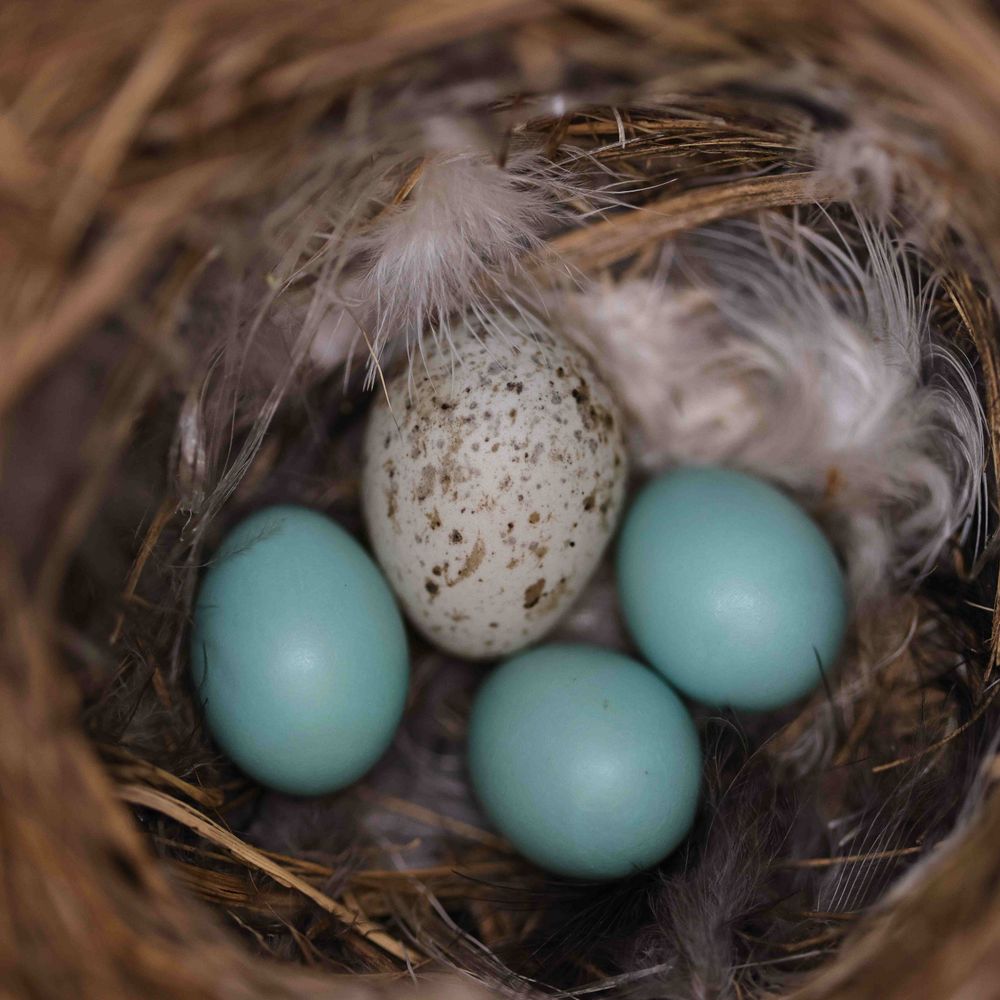
Separating the genetic and environmental drivers of body temperature during the development of endothermy in an altricial bird #sparrows
doi.org/10.1093/jeb/...
@lucywinder.bsky.social et al.
doi.org/10.1093/jeb/...
@lucywinder.bsky.social et al.

Separating the genetic and environmental drivers of body temperature during the development of endothermy in an altricial bird
Abstract. When altricial birds hatch, they are unable to regulate their own temperature, but by the time they fledge they are thermally independent. Early-
doi.org
December 4, 2025 at 3:44 PM
Separating the genetic and environmental drivers of body temperature during the development of endothermy in an altricial bird #sparrows
doi.org/10.1093/jeb/...
@lucywinder.bsky.social et al.
doi.org/10.1093/jeb/...
@lucywinder.bsky.social et al.
Eye size across avian lineages covaries with participation in a specialized foraging behaviour:
Ausprey et al. 2025
@thecowbirdlab.bsky.social
doi.org/10.1093/jeb/...
Ausprey et al. 2025
@thecowbirdlab.bsky.social
doi.org/10.1093/jeb/...
Eye size across avian lineages covaries with participation in a specialized foraging behaviour
Abstract. Foraging ecology and visual ability are often strongly related across animal lineages, as many organisms identify food sources by sight. Birds pa
doi.org
December 4, 2025 at 3:41 PM
Eye size across avian lineages covaries with participation in a specialized foraging behaviour:
Ausprey et al. 2025
@thecowbirdlab.bsky.social
doi.org/10.1093/jeb/...
Ausprey et al. 2025
@thecowbirdlab.bsky.social
doi.org/10.1093/jeb/...
How do short-lived plants colonize new habitats? In L. longirostris, adaptation during range expansion likely relied on standing variation, showing how existing diversity facilitates adaptation:
Mayol et al 2025
doi.org/10.1093/jeb/...
@creaf.cat
@inrae-france.bsky.social
@univbordeaux.bsky.social
Mayol et al 2025
doi.org/10.1093/jeb/...
@creaf.cat
@inrae-france.bsky.social
@univbordeaux.bsky.social

Genomic signatures of adaptation along an expansion route in the colonizing plant Leontodon longirostris (Asteraceae)
Abstract. Species’ range shifts are common in nature, often involving the colonization of new habitats. Identifying the evolutionary processes responsible
doi.org
December 4, 2025 at 3:39 PM
How do short-lived plants colonize new habitats? In L. longirostris, adaptation during range expansion likely relied on standing variation, showing how existing diversity facilitates adaptation:
Mayol et al 2025
doi.org/10.1093/jeb/...
@creaf.cat
@inrae-france.bsky.social
@univbordeaux.bsky.social
Mayol et al 2025
doi.org/10.1093/jeb/...
@creaf.cat
@inrae-france.bsky.social
@univbordeaux.bsky.social
Multigenerational exposure to high-fat and high-sugar diets exacerbates reproductive distress in an insect model
doi.org/10.1093/jeb/...
Merkel et al. 2025 @jellers.bsky.social
doi.org/10.1093/jeb/...
Merkel et al. 2025 @jellers.bsky.social

Multigenerational exposure to high-fat and high-sugar diets exacerbates reproductive distress in an insect model
Abstract. In several insect models, high-fat diets and high-sugar diets have detrimental effects, but it is largely unknown if multigenerational exposure c
doi.org
December 4, 2025 at 3:35 PM
Multigenerational exposure to high-fat and high-sugar diets exacerbates reproductive distress in an insect model
doi.org/10.1093/jeb/...
Merkel et al. 2025 @jellers.bsky.social
doi.org/10.1093/jeb/...
Merkel et al. 2025 @jellers.bsky.social
Are you an evolutionary biologist? Would you like to support your society journal? We are looking for new editorial board members across the field of evolutionary biology:
🧬🌿🪰🐀🦀🔬🧫🦠🐟🐦🧑💻🪸🦎
Learn more and find out how to apply: jevbio.net/call-for-edi...
DEADLINE 19th January 2026 📣
🧬🌿🪰🐀🦀🔬🧫🦠🐟🐦🧑💻🪸🦎
Learn more and find out how to apply: jevbio.net/call-for-edi...
DEADLINE 19th January 2026 📣
December 4, 2025 at 11:38 AM
Are you an evolutionary biologist? Would you like to support your society journal? We are looking for new editorial board members across the field of evolutionary biology:
🧬🌿🪰🐀🦀🔬🧫🦠🐟🐦🧑💻🪸🦎
Learn more and find out how to apply: jevbio.net/call-for-edi...
DEADLINE 19th January 2026 📣
🧬🌿🪰🐀🦀🔬🧫🦠🐟🐦🧑💻🪸🦎
Learn more and find out how to apply: jevbio.net/call-for-edi...
DEADLINE 19th January 2026 📣