



Max Wilkinson
@maxewilkinson.bsky.social
keen on reverse transcription | also keen on spliceosomes | cryoEM dabbler
Assistant Member @MSKCC
Formerly post-doc @MIT
Formerly-formerly PhD @MRC_LMB
Formerly formerly-formerly Otago Uni
Kiwi 🥝 🇳🇿
https://wilkinsonlab.bio/
Assistant Member @MSKCC
Formerly post-doc @MIT
Formerly-formerly PhD @MRC_LMB
Formerly formerly-formerly Otago Uni
Kiwi 🥝 🇳🇿
https://wilkinsonlab.bio/
Ohh lovely work (and lovely picture)
December 16, 2025 at 5:21 PM
Ohh lovely work (and lovely picture)
can someone run this on a nucleus tomogram please

IsoNet2 determines cellular structures at submolecular resolution without averaging https://www.biorxiv.org/content/10.64898/2025.12.09.693325v1
December 12, 2025 at 5:01 PM
can someone run this on a nucleus tomogram please
Reposted by Max Wilkinson

I am so excited to share our project with you! We find prokaryotic proteases activate toxic enzymes and pores as a modular strategy in phage defense. We studied four fascinating protease-toxin pairs that are abundant across bacterial genomes:
www.biorxiv.org/content/10.1...
www.biorxiv.org/content/10.1...

Proteolytic activation of diverse antiviral defense modules in prokaryotes
Linked protease–effector modules are widespread in prokaryotic antiviral defense, yet the mechanisms of most remain poorly understood. Here we show that four of the most prevalent modules—metallo-β-la...
www.biorxiv.org
November 15, 2025 at 11:49 PM
I am so excited to share our project with you! We find prokaryotic proteases activate toxic enzymes and pores as a modular strategy in phage defense. We studied four fascinating protease-toxin pairs that are abundant across bacterial genomes:
www.biorxiv.org/content/10.1...
www.biorxiv.org/content/10.1...
Reposted by Max Wilkinson
Oh, your favorite genetic locus only encodes one gene? That's boring.
Amazing work from Jess Warren (www.hhmi.org/scientists/j...) to figure this out and prove it was real, given the wacky and challenging insect system we've got here.
www.biorxiv.org/content/10.1...
Amazing work from Jess Warren (www.hhmi.org/scientists/j...) to figure this out and prove it was real, given the wacky and challenging insect system we've got here.
www.biorxiv.org/content/10.1...

November 14, 2025 at 8:07 PM
Oh, your favorite genetic locus only encodes one gene? That's boring.
Amazing work from Jess Warren (www.hhmi.org/scientists/j...) to figure this out and prove it was real, given the wacky and challenging insect system we've got here.
www.biorxiv.org/content/10.1...
Amazing work from Jess Warren (www.hhmi.org/scientists/j...) to figure this out and prove it was real, given the wacky and challenging insect system we've got here.
www.biorxiv.org/content/10.1...
please look here for more information about a postdoc position careers.mskcc.org/vacancies/93...

93229-Postdoctoral Researcher – Laboratory of Max Wilkinson | Memorial Sloan Kettering Cancer Center
careers.mskcc.org
October 31, 2025 at 7:12 PM
please look here for more information about a postdoc position careers.mskcc.org/vacancies/93...
The Wilkinson Lab is open for science! @mskcancercenter.bsky.social
🧬We'll be finding funky new RNA biology, mainly by looking at reverse transcriptases (i.e. the Best Enzymes In The World)🧬
annnd: I'm hiring - come join! Especially postdocs and PhD students - please get in touch (NYC is great)
🧬We'll be finding funky new RNA biology, mainly by looking at reverse transcriptases (i.e. the Best Enzymes In The World)🧬
annnd: I'm hiring - come join! Especially postdocs and PhD students - please get in touch (NYC is great)

Wilkinson Lab
We discover and study reverse transcriptases
wilkinsonlab.bio
October 31, 2025 at 7:00 PM
The Wilkinson Lab is open for science! @mskcancercenter.bsky.social
🧬We'll be finding funky new RNA biology, mainly by looking at reverse transcriptases (i.e. the Best Enzymes In The World)🧬
annnd: I'm hiring - come join! Especially postdocs and PhD students - please get in touch (NYC is great)
🧬We'll be finding funky new RNA biology, mainly by looking at reverse transcriptases (i.e. the Best Enzymes In The World)🧬
annnd: I'm hiring - come join! Especially postdocs and PhD students - please get in touch (NYC is great)
a highly attractive hypothesis for the origin of telomerase, but imo more evidence is needed to rule out convergent evolution
1- other RT phylogenies place TERT within eukaryotic retroelement clades
2- template jumping could plausibly evolve into repeat synthesis activity multiple independent times
1- other RT phylogenies place TERT within eukaryotic retroelement clades
2- template jumping could plausibly evolve into repeat synthesis activity multiple independent times
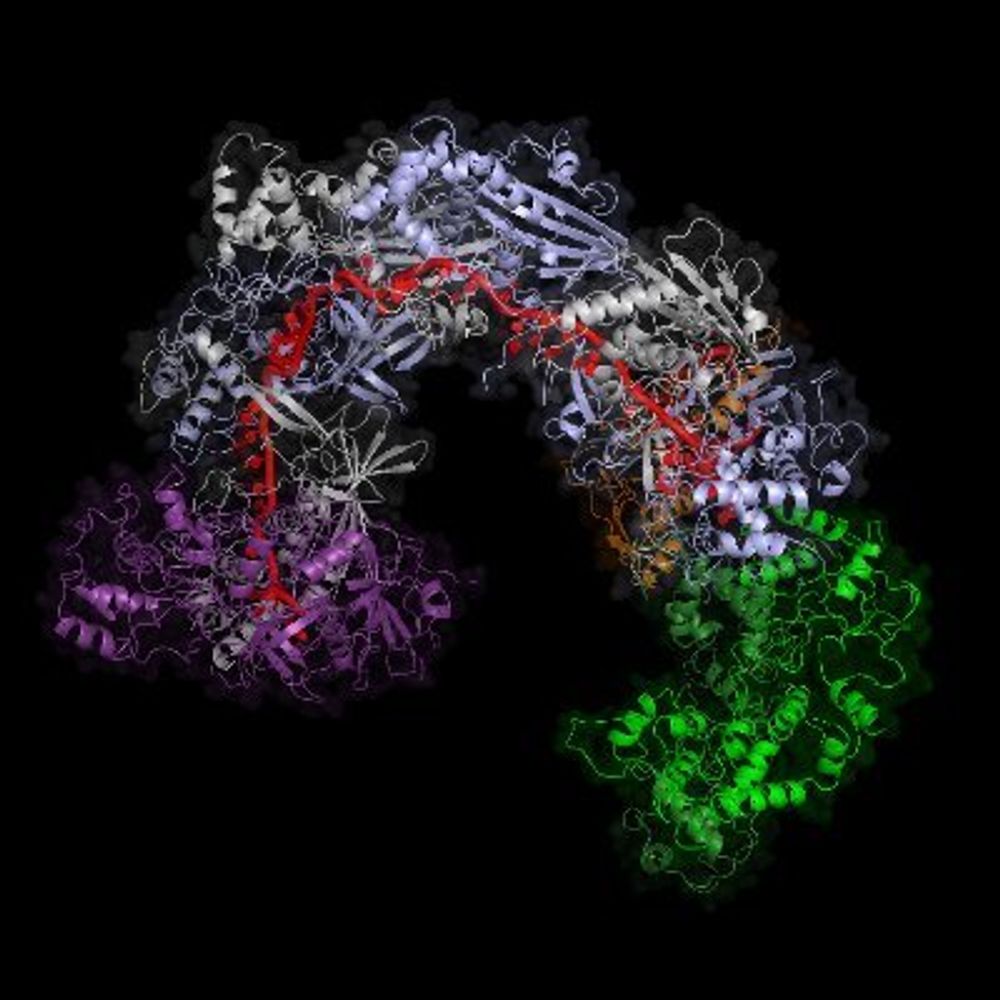
1/10 Genome maintenance by telomerase is a fundamental process in nearly all eukaryotes. But where does it come from?
Today, we report the discovery of telomerase homologs in a family of antiviral RTs, revealing an unexpected evolutionary origin in bacteria.
www.biorxiv.org/content/10.1...
Today, we report the discovery of telomerase homologs in a family of antiviral RTs, revealing an unexpected evolutionary origin in bacteria.
www.biorxiv.org/content/10.1...

Antiviral reverse transcriptases reveal the evolutionary origin of telomerase
Defense-associated reverse transcriptases (DRTs) employ diverse and distinctive mechanisms of cDNA synthesis to protect bacteria against viral infection. However, much of DRT family diversity remains ...
www.biorxiv.org
October 17, 2025 at 7:11 PM
a highly attractive hypothesis for the origin of telomerase, but imo more evidence is needed to rule out convergent evolution
1- other RT phylogenies place TERT within eukaryotic retroelement clades
2- template jumping could plausibly evolve into repeat synthesis activity multiple independent times
1- other RT phylogenies place TERT within eukaryotic retroelement clades
2- template jumping could plausibly evolve into repeat synthesis activity multiple independent times
there are a few solved phage tail structures, do any of them fit the density ok? I think most tailed phages have the same fold for the major tail protein. The pitch and twist also seem similar
October 5, 2025 at 5:31 PM
there are a few solved phage tail structures, do any of them fit the density ok? I think most tailed phages have the same fold for the major tail protein. The pitch and twist also seem similar
Is that a phage tail in Fig 4?? 👀

October 5, 2025 at 1:47 PM
Is that a phage tail in Fig 4?? 👀
Reposted by Max Wilkinson

Public access to the first fly connectome that spans the whole CNS - BANC!: codex.flywire.ai?dataset=banc
Different from prior connectomes - it is brain + cord (think spinal cord)
We use it to ‘embody’ the system and find it resembles ‘subsumption architecture’ doi.org/10.1101/2025...
Different from prior connectomes - it is brain + cord (think spinal cord)
We use it to ‘embody’ the system and find it resembles ‘subsumption architecture’ doi.org/10.1101/2025...
August 2, 2025 at 2:30 PM
Public access to the first fly connectome that spans the whole CNS - BANC!: codex.flywire.ai?dataset=banc
Different from prior connectomes - it is brain + cord (think spinal cord)
We use it to ‘embody’ the system and find it resembles ‘subsumption architecture’ doi.org/10.1101/2025...
Different from prior connectomes - it is brain + cord (think spinal cord)
We use it to ‘embody’ the system and find it resembles ‘subsumption architecture’ doi.org/10.1101/2025...
Really interesting q! It depends if insect rDNA::R2 inactivation is targeted, e.g. by piRNAs. If so, then maybe there's no problem because mammalian lineages lost R2 and so might have also lost specific defences. But if rDNA has inherent quality control / self-silencing, then this could happen.
July 3, 2025 at 3:49 PM
Really interesting q! It depends if insect rDNA::R2 inactivation is targeted, e.g. by piRNAs. If so, then maybe there's no problem because mammalian lineages lost R2 and so might have also lost specific defences. But if rDNA has inherent quality control / self-silencing, then this could happen.
Full story here!
We hope this expands the toolkit of retrotransposon-based gene editors. Also, check out related work from Kathy Collins lab, who also illuminated how R2 can be used for mammalian genome engineering, and @akankshathawani.bsky.social who also recently solved an R2Tg structure! (fin)
We hope this expands the toolkit of retrotransposon-based gene editors. Also, check out related work from Kathy Collins lab, who also illuminated how R2 can be used for mammalian genome engineering, and @akankshathawani.bsky.social who also recently solved an R2Tg structure! (fin)

Structure and biochemistry-guided engineering of an all-RNA system for DNA insertion with R2 retrotransposons - Nature Communications
R2 retrotransposons are natural RNA guided gene insertion systems. Here, Edmonds et al. characterize the structure and biochemistry of an avian R2 and engineer a compact, all-RNA system to integrate D...
doi.org
July 3, 2025 at 3:21 AM
Full story here!
We hope this expands the toolkit of retrotransposon-based gene editors. Also, check out related work from Kathy Collins lab, who also illuminated how R2 can be used for mammalian genome engineering, and @akankshathawani.bsky.social who also recently solved an R2Tg structure! (fin)
We hope this expands the toolkit of retrotransposon-based gene editors. Also, check out related work from Kathy Collins lab, who also illuminated how R2 can be used for mammalian genome engineering, and @akankshathawani.bsky.social who also recently solved an R2Tg structure! (fin)
This project was a huge team effort.
The hugest shoutout to @kedmonds.bsky.social for her HEROIC engineering and optimisation (+ birb drawing 🐦🥚)
Also to Hongyu Chen and Dangliang Liu for RNA chemistry, Feng Zhang for fearless leadership, and all the amazing authors who made this possible. (6/n)
The hugest shoutout to @kedmonds.bsky.social for her HEROIC engineering and optimisation (+ birb drawing 🐦🥚)
Also to Hongyu Chen and Dangliang Liu for RNA chemistry, Feng Zhang for fearless leadership, and all the amazing authors who made this possible. (6/n)

July 3, 2025 at 3:21 AM
This project was a huge team effort.
The hugest shoutout to @kedmonds.bsky.social for her HEROIC engineering and optimisation (+ birb drawing 🐦🥚)
Also to Hongyu Chen and Dangliang Liu for RNA chemistry, Feng Zhang for fearless leadership, and all the amazing authors who made this possible. (6/n)
The hugest shoutout to @kedmonds.bsky.social for her HEROIC engineering and optimisation (+ birb drawing 🐦🥚)
Also to Hongyu Chen and Dangliang Liu for RNA chemistry, Feng Zhang for fearless leadership, and all the amazing authors who made this possible. (6/n)
RNA stability may limit efficiency. With help from Xiao Wang and her lab, we added chemical modifications to protect donor RNA from exonucleases.
Combined with LNP delivery, this boosted integration efficiency to >80% in multiple human cell lines, all with an RNA system. Which is kinda nuts. (5/n)
Combined with LNP delivery, this boosted integration efficiency to >80% in multiple human cell lines, all with an RNA system. Which is kinda nuts. (5/n)

July 3, 2025 at 3:21 AM
RNA stability may limit efficiency. With help from Xiao Wang and her lab, we added chemical modifications to protect donor RNA from exonucleases.
Combined with LNP delivery, this boosted integration efficiency to >80% in multiple human cell lines, all with an RNA system. Which is kinda nuts. (5/n)
Combined with LNP delivery, this boosted integration efficiency to >80% in multiple human cell lines, all with an RNA system. Which is kinda nuts. (5/n)
The fabulous Grace then took over. She replaced parts of R2Tg RNA with custom sequences — “tricking” the retrotransposon into integrating cargo instead of itself.
She then defined the minimal R2 elements required for integration, leading to a compact, efficient “mini donor”. (4/n)
She then defined the minimal R2 elements required for integration, leading to a compact, efficient “mini donor”. (4/n)

July 3, 2025 at 3:21 AM
The fabulous Grace then took over. She replaced parts of R2Tg RNA with custom sequences — “tricking” the retrotransposon into integrating cargo instead of itself.
She then defined the minimal R2 elements required for integration, leading to a compact, efficient “mini donor”. (4/n)
She then defined the minimal R2 elements required for integration, leading to a compact, efficient “mini donor”. (4/n)
We found that the R2 retrotransposon from zebra finch (Taeniopygia guttata, “R2Tg”) looked really promising! I had fun playing around with its biochemistry, and solved the cryo-EM structure of it copying its own RNA. We found key features that differ from the more well-studied insect R2. (3/n)

July 3, 2025 at 3:21 AM
We found that the R2 retrotransposon from zebra finch (Taeniopygia guttata, “R2Tg”) looked really promising! I had fun playing around with its biochemistry, and solved the cryo-EM structure of it copying its own RNA. We found key features that differ from the more well-studied insect R2. (3/n)
R2 retrotransposons are neat! They're pretty widespread across the animal kingdom, and they propagate by copying themselves into ribosomal DNA, a highly repetitive region of the genome.
This natural system inspired our design: we thought the rDNA could be a good 'safe harbour' for transgenes. (2/n)
This natural system inspired our design: we thought the rDNA could be a good 'safe harbour' for transgenes. (2/n)

July 3, 2025 at 3:21 AM
R2 retrotransposons are neat! They're pretty widespread across the animal kingdom, and they propagate by copying themselves into ribosomal DNA, a highly repetitive region of the genome.
This natural system inspired our design: we thought the rDNA could be a good 'safe harbour' for transgenes. (2/n)
This natural system inspired our design: we thought the rDNA could be a good 'safe harbour' for transgenes. (2/n)
If you like transposons...
If you you love genome editing...
Or if you just like random bird animations,
we have the paper for you!
We (@kedmonds.bsky.social et al) are happy to share our work turning a songbird retrotransposon into a genome editing tool. 🐣 (1/n)
If you you love genome editing...
Or if you just like random bird animations,
we have the paper for you!
We (@kedmonds.bsky.social et al) are happy to share our work turning a songbird retrotransposon into a genome editing tool. 🐣 (1/n)
July 3, 2025 at 3:21 AM
If you like transposons...
If you you love genome editing...
Or if you just like random bird animations,
we have the paper for you!
We (@kedmonds.bsky.social et al) are happy to share our work turning a songbird retrotransposon into a genome editing tool. 🐣 (1/n)
If you you love genome editing...
Or if you just like random bird animations,
we have the paper for you!
We (@kedmonds.bsky.social et al) are happy to share our work turning a songbird retrotransposon into a genome editing tool. 🐣 (1/n)
Reposted by Max Wilkinson

Nice visit to the lovely Princeton campus. Could not be prouder of @automnenine.bsky.social. For those who are looking for a postdoc, there are exciting opportunities to join his lab!

May 5, 2025 at 5:28 PM
Nice visit to the lovely Princeton campus. Could not be prouder of @automnenine.bsky.social. For those who are looking for a postdoc, there are exciting opportunities to join his lab!
big fan of southern blots!! Do you have any ideas why the 3'UTR is not required?
April 9, 2025 at 7:27 PM
big fan of southern blots!! Do you have any ideas why the 3'UTR is not required?
Ridiculously good work by George on LINE-1 retrotransposition! Also the paper is an inspiring read - there's some really super biochem in it

Did you know that two jumping sequences (LINE-1 and Alu) make up nearly 30% of our genomes? Ever wonder how they jump into new genomic sites? We have some exciting discoveries to share new in @science.org on the structural mechanisms of LINE-1 retrotransposition (aka jumping 🧬➡️🧬) 🧪 #ScienceResearch
March 7, 2025 at 2:44 AM
Ridiculously good work by George on LINE-1 retrotransposition! Also the paper is an inspiring read - there's some really super biochem in it
absolute pleasure working on this with @guilhemfaure.bsky.social, Makoto Saito, other great colleagues, and our fearless leader Feng Zhang.
Lots more details here: www.science.org/doi/10.1126/...
(I'll try to make a fancier movie in time for the press version 🤞🤞)
(hashtag #TIGR #Tas)
Lots more details here: www.science.org/doi/10.1126/...
(I'll try to make a fancier movie in time for the press version 🤞🤞)
(hashtag #TIGR #Tas)

TIGR-Tas: A family of modular RNA-guided DNA-targeting systems in prokaryotes and their viruses
RNA-guided systems provide remarkable versatility, enabling diverse biological functions. Through iterative structural and sequence homology-based mining starting with a guide RNA-interaction domain o...
www.science.org
March 1, 2025 at 12:18 AM
absolute pleasure working on this with @guilhemfaure.bsky.social, Makoto Saito, other great colleagues, and our fearless leader Feng Zhang.
Lots more details here: www.science.org/doi/10.1126/...
(I'll try to make a fancier movie in time for the press version 🤞🤞)
(hashtag #TIGR #Tas)
Lots more details here: www.science.org/doi/10.1126/...
(I'll try to make a fancier movie in time for the press version 🤞🤞)
(hashtag #TIGR #Tas)
TIGR might have some advantages over CRISPR in genome editing (absolutely tiny, no PAM), but more importantly it's just some really neat, mysterious biology. Maybe TIGR is used by phages to fight other viruses? We don't know yet! Many many many questions left.

March 1, 2025 at 12:18 AM
TIGR might have some advantages over CRISPR in genome editing (absolutely tiny, no PAM), but more importantly it's just some really neat, mysterious biology. Maybe TIGR is used by phages to fight other viruses? We don't know yet! Many many many questions left.
we recently found some really neat RNA-guided DNA-cutting systems in phages. Despite remarkable similarities to CRISPR systems, including encoding guide RNAs in arrays, they appear entirely evolutionarily distinct (but definitely related to snoRNAs 🤓)
We decided to call them TIGR-Tas systems 🐯
We decided to call them TIGR-Tas systems 🐯
March 1, 2025 at 12:18 AM
we recently found some really neat RNA-guided DNA-cutting systems in phages. Despite remarkable similarities to CRISPR systems, including encoding guide RNAs in arrays, they appear entirely evolutionarily distinct (but definitely related to snoRNAs 🤓)
We decided to call them TIGR-Tas systems 🐯
We decided to call them TIGR-Tas systems 🐯