Niklaus E. Zimmermann
banner
nezimmermann.bsky.social
Niklaus E. Zimmermann
@nezimmermann.bsky.social

Scientist: #macroecology #biodiversity #biomes #plantscience #climatechange #plants #remotesensing #conservation #vegetation
⛰️🌳🌵🌴🔥💦🛰️
www.wsl.ch - tinyurl.com/3fb5n5dv - @wsl-dme

Environmental science 60%
Geography 16%
🌱 #Biodiversität in der #Schweiz: Der Zustand bleibt ungenügend. Trotz verlangsamtem Rückgang besteht grosser Handlungsbedarf. Unser neuer datenbasierter #Report zeigt #Fakten, Entwicklungen und Lösungsansätze 👉 biodiversitaet2026.ch #Wissenschaft #Forschung

Hey Marten, cool music! I like it😍
⏩️❓️‼️ If you have your biogeography research to be published, there is the perfect journal with an impact factor of 2.5 & being led & driven by a great society @biogeography.bsky.social🎉‼️⏪️

❤️FRONTIERS OF BIOGEOGRAPHY❤️

biogeography.pensoft.net

#tibs2026 #macroecology @tibsaarhus2026.bsky.social
Frontiers of Biogeography
 Launched to support biogeographic researchFrontiers of Biogeography (FoB) is the scientific journal of The International Biogeography Society (TIBS, biogeography.org), a not-for-profit orga...
biogeography.pensoft.net
Damiano Righetti from our DME lab just presented his cool research at #TIBS2026 on trophic species distribution modelling of tuna and its pray.
@wennading.bsky.social from the DME lab presented her great work at #TIBS2026 on the origin of mountain floras in response to biotic assembly, orogeny and climate change. If you are interested, her is the latest paper on the topic: www.science.org/doi/full/10....
Our DME member @dirknkarger.bsky.social gave a great talk on adapting land use to climate change and how this can mitigate global biodiversity decline.
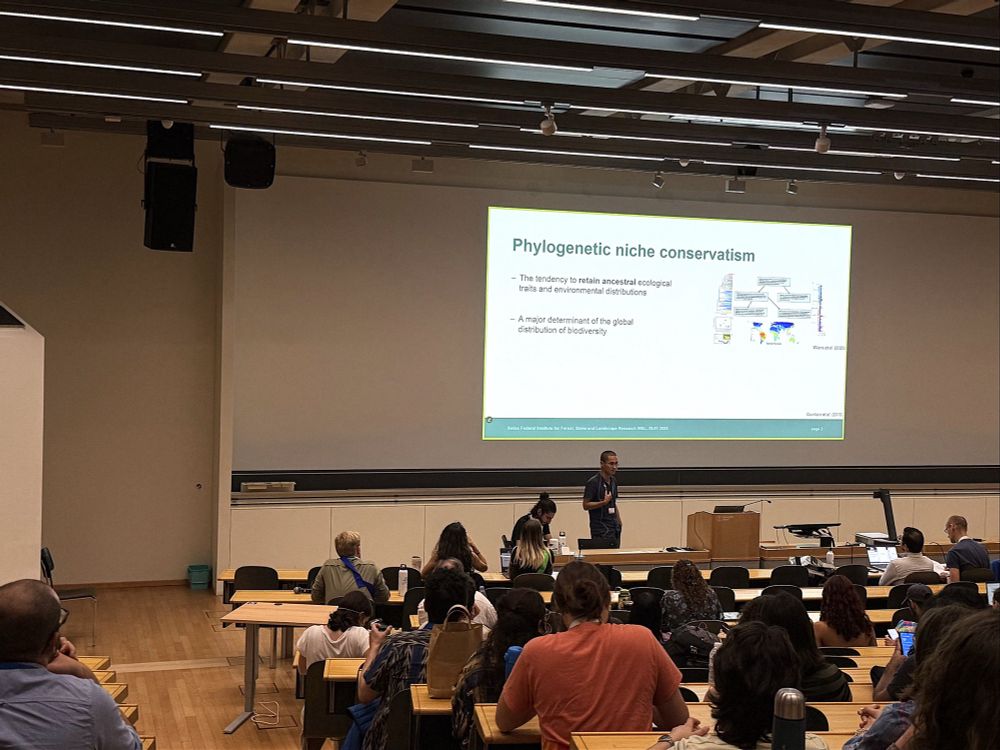
Interesting talk by @nezimmermann.bsky.social from our DME lab today at #TIBS2026 on a new conceptual framework on #BiomeBiogeography. This concept is at the core of our #biome project, in which several lab members are involved.
🗾The poster sessions at #TIBS2026 are a great opportunity to exchange results and ideas, and to meet new people. We enjoy the interaction and atmosphere. And we will leave with a rich set of new ideas and connections.🚀

#Biogeography #Macroecology #Biodiversity #CHELSA
@wslresearch.bsky.social
Elena Plekhanova from @wsl-dme.bsky.social just gave a very interesting talk on how to use #AI in combination with #RemoteSensing to map global #biomes.

#Macroecology #Biodiversity #Mapping
@wslresearch.bsky.social
Great talk by @vboussange.bsky.social from @wsl-dme.bsky.social on "Multiscale species richness modelling". Victor developed a cool method to map species richness in a way that allows spatial scaling and to retrieve scale-relevant information.
The @wsl-dme.bsky.social lab members arrived at #TIBS2026 in Aarhus. We are excited to enjoy great talks, posters, workshops, discussions with colleagues and friends, and we look forward to contribute as well, with 7 oral and 5 poster contributions.
#Biogeography #Macroecology #Biodiversity
How have mountain building and climate change shaped alpine biodiversity over millions of years? Check out our new study in Science Advances! www.science.org/doi/10.1126/...
The asynchronous rise of Northern Hemisphere alpine floras reveals general responses of biotic assembly to orogeny and climate change
The asynchronous rise of Northern Hemisphere alpine floras was shaped by general responses to orogeny and climate change.
www.science.org

Indeed, thanks Pep!?There are still items on my wish list😅

🌴Since my undergraduate time, I wanted to see the tropical alpine biome with its "giant rosette" species. On our #biome project fieldtrip in #Ecuador, I finally met #Espeletia picnophylla spp. angelensis, in El Angel. So happy! Magic!
🌿 While conducting #biome research in the #Maquipucuna Reserve in #Ecuador, our lodge unexpectedly became a perfect vantage point for observing mesmerizing #hummingbirds. ✨🐦
🌧️ If your team members are patiently waiting for 1h in the rain in a tropical #cloudforest, chatting, playing, laughing and happily continue fieldwork with rain-sensitive instruments as soon as the rain stops & finish the day with a “high five”: Now you know, you have a fantastic team! 🫶
Exploring the tropical cloud forests of #Guacamayos. 🔎 Foggy, rain-soaked and mild temperatures: #cloudforests are some of the most species- and endemism-rich biomes on Earth. Despite covering only 0.4% of global land, they host 3,700 #species of birds, mammals, amphibians and tree ferns. 🌧️🌳🌿
🚁🌳 We are collecting #biome data in #Ecuador using three types of #drones:

1️⃣ #LiDAR – to analyze vertical biomass distribution
2️⃣ Multispectral – to assess canopy leaf area
3️⃣ Photo – to capture leaf imagery
🌳 Towering trees (often >50 m), massive buttress roots and woody lianas are typical plant traits of tropical rainforests. 🌧
🌿Fieldwork in the #Yasuni National Park, #Ecuador.🦜
Our researchers are studying the structural and functional properties of #rainforests to better understand and define #biomes.🌳🔎
Where do species find suitable habitats in Switzerland? And how will habitat suitabilities change under future climate scenarios?
Here, we have modelled maps for more than 7500 swiss species:
doi.org/10.1038/s415...
SDMapCH: a Comprehensive database of >7,500 modelled species habitat suitability maps for Switzerland - Scientific Data
Scientific Data - SDMapCH: a Comprehensive database of >7,500 modelled species habitat suitability maps for Switzerland
doi.org

What a wonderful sunrise at Paso Papallacta (4063 m a.s.l.) before dropping down from the Andes into the Amazon rainforest. We are ready to start working. More soon!
A breathtaking sunrise with a view of the #Antisana volcano on the road from Quito to Yasuní National Park.☀️🌋
The BIOME team explored the high-altitude city of #Quito (2,850 m) before heading deep into the Amazon rainforest for fieldwork. 🌳🌿
🌎 Our BIOME project team has just begun a 3.5-week research expedition in Ecuador! 🇪🇨 They’ll be conducting fieldwork across diverse landscapes to study how biomes have evolved and how to define them. 🔎🌿🏔️ Stay tuned for field updates! ✨
👉BIOME project: shorturl.at/RLQPw
🔊 New paper: first integration of population genetics🧬 and dynamic species distribution modeling🌐 using #KISSMig to reconstruct postglacial dynamics of wild black pepper, endemic to India’s Western Ghats. #macroecology #popgen #phylogeography #biogeography

👉 onlinelibrary.wiley.com/doi/10.1111/...
This week, I presented my research on #BiomeConservatism at the @cpeg-cpb25.bsky.social in Zürich. 🌍 🌱 The analysis of 161 plant lineages across the globe provides clear evidence for biome conservatism and the mechanisms underlying current #biodiversity patterns and #biome dynamics. 💡
📱🌱 Plant identification apps are booming – but which one is the best? And how reliable are the results? 🤔 Our researchers collected over 5,000 photos of 560 Swiss plant species from 85 habitat types and tested the most popular apps.🔎 Here are the findings: shorturl.at/lD0Cl
At WSL @wslresearch.bsky.social we are hiring a "Postdoc in Regional Climate Downscaling" for a forest/climate project in Armenia funded by the Swiss Development Cooperation (DEZA).
📍 Switzerland | 🕐 1.5 yrs | 📅 Start: Spring 2025
Details: apply.refline.ch/273855/1727/...
Please share widely.
@clechartre.bsky.social reimplemented #BIOME4 into a modular, high-performance #Julia version, enabling 1 km vegetation modeling 🌱 and integration of #CHELSA climate datasets. 🌦️ We can now simulate biome patterns across complex terrains ⛰️ and define biome boundaries with greater accuracy. 🎯