



Political Analysis
@polanalysis.bsky.social
Official Journal of the Society for Political Methodology
https://www.cambridge.org/core/journals/political-analysis
https://www.cambridge.org/core/journals/political-analysis
Currently in FirstView: In “Stay Tuned: Improving Sentiment Analysis and Stance Detection Using Large Language Model,” Max Griswold, Michael Robbins, and @sociologian.bsky.social evaluate fine-tuning strategies to improve LLM performance using social media data surrounding the 2020 election.

January 13, 2026 at 5:50 PM
Currently in FirstView: In “Stay Tuned: Improving Sentiment Analysis and Stance Detection Using Large Language Model,” Max Griswold, Michael Robbins, and @sociologian.bsky.social evaluate fine-tuning strategies to improve LLM performance using social media data surrounding the 2020 election.
Currently in FirstView: In “Political DEBATE: Efficient Zero-Shot and Few-Shot Classifiers for Political Text,” Michael Burnham, Kayla Kahn, Ryan Yang Wang, and Rachel Peng introduce DEBATE, a new open source foundation model for classifying political documents.
January 6, 2026 at 5:35 PM
Currently in FirstView: In “Political DEBATE: Efficient Zero-Shot and Few-Shot Classifiers for Political Text,” Michael Burnham, Kayla Kahn, Ryan Yang Wang, and Rachel Peng introduce DEBATE, a new open source foundation model for classifying political documents.
Reposted by Political Analysis

NEW ISSUE from @polanalysis.bsky.social -
Political Analysis - Volume 34 - Issue 1 - January 2026 - https://cup.org/4aAPBWB
Political Analysis - Volume 34 - Issue 1 - January 2026 - https://cup.org/4aAPBWB

December 31, 2025 at 5:40 PM
NEW ISSUE from @polanalysis.bsky.social -
Political Analysis - Volume 34 - Issue 1 - January 2026 - https://cup.org/4aAPBWB
Political Analysis - Volume 34 - Issue 1 - January 2026 - https://cup.org/4aAPBWB
Currently in FirstView: In “Analyzing Political Text at Scale with Online Tensor LDA,” @sarakangaslahti.bsky.social, Danny Ebanks, @jeankossaifi.bsky.social, Anqi Liu, @rmichaelalvarez.bsky.social, and Anima Anandkumar introduce a topic modeling method that scales linearly to billions of documents.

December 23, 2025 at 5:35 PM
Currently in FirstView: In “Analyzing Political Text at Scale with Online Tensor LDA,” @sarakangaslahti.bsky.social, Danny Ebanks, @jeankossaifi.bsky.social, Anqi Liu, @rmichaelalvarez.bsky.social, and Anima Anandkumar introduce a topic modeling method that scales linearly to billions of documents.
Currently in FirstView: In “Measuring Politicians’ Public Personality Traits Using Computational Text Analysis: A Multimethod Feasibility Study for Agency and Communion,” @lukasbirkenmai1.bsky.social and Clemens Lechner introduce an approach to infer politicians’ personality traits from text data.

December 18, 2025 at 6:59 PM
Currently in FirstView: In “Measuring Politicians’ Public Personality Traits Using Computational Text Analysis: A Multimethod Feasibility Study for Agency and Communion,” @lukasbirkenmai1.bsky.social and Clemens Lechner introduce an approach to infer politicians’ personality traits from text data.
Currently in FirstView: In “Nationally Representative, Locally Misaligned: The Biases of Generative Artificial Intelligence in Neighborhood Perception,” Paige Bollen, @joehigton.bsky.social, and @msands.bsky.social test which populations Generative AI is most representative of.

December 11, 2025 at 6:05 PM
Currently in FirstView: In “Nationally Representative, Locally Misaligned: The Biases of Generative Artificial Intelligence in Neighborhood Perception,” Paige Bollen, @joehigton.bsky.social, and @msands.bsky.social test which populations Generative AI is most representative of.
Currently in FirstView: In “Survey Professionalism: New Evidence from Web Browsing Data,” Bernhard Clemm von Hohenberg, @tiagoventura.bsky.social, Tiago Ventura, @jonathannagler.bsky.social, @ericka.bric.digital, & Magdalena Wojcieszak provide evidence on survey professionalism across three samples.

December 4, 2025 at 6:05 PM
Currently in FirstView: In “Survey Professionalism: New Evidence from Web Browsing Data,” Bernhard Clemm von Hohenberg, @tiagoventura.bsky.social, Tiago Ventura, @jonathannagler.bsky.social, @ericka.bric.digital, & Magdalena Wojcieszak provide evidence on survey professionalism across three samples.
Currently in FirstView: In “Meaning Beyond Numbers: Introducing the Plot Staircase to Measure Graphical Preferences,” @talbotmandrews.bsky.social, Justin Curl, and Markus Prior examine how visual characteristics influence preferences. They find that people prefer increasing trends.

December 2, 2025 at 5:35 PM
Currently in FirstView: In “Meaning Beyond Numbers: Introducing the Plot Staircase to Measure Graphical Preferences,” @talbotmandrews.bsky.social, Justin Curl, and Markus Prior examine how visual characteristics influence preferences. They find that people prefer increasing trends.
Currently in FirstView: In “Codebook LLMs: Evaluating LLMs as Measurement Tools for Political Science Concepts,” @ahalterman.bsky.social and @katakeith.bsky.social show how “off-the-shelf” LLMs have limitations in faithfully following real-world codebook operationalizations.

November 27, 2025 at 6:05 PM
Currently in FirstView: In “Codebook LLMs: Evaluating LLMs as Measurement Tools for Political Science Concepts,” @ahalterman.bsky.social and @katakeith.bsky.social show how “off-the-shelf” LLMs have limitations in faithfully following real-world codebook operationalizations.
Currently in FirstView: In “A Statistical Model of Bipartite Networks: Application to Cosponsorship in the United States Senate,” @adelineylo.bsky.social, Santiago Olivella, and Kosuke Imai develop a statistical model of bipartite networks and offer an open-source software package for researchers.

November 20, 2025 at 6:05 PM
Currently in FirstView: In “A Statistical Model of Bipartite Networks: Application to Cosponsorship in the United States Senate,” @adelineylo.bsky.social, Santiago Olivella, and Kosuke Imai develop a statistical model of bipartite networks and offer an open-source software package for researchers.
Currently in FirstView: In “Generative AI and Topological Data Analysis of Longitudinal Panel Data,” Badredine Arfi constructs an approach to analysing longitudinal panel data which combines topological data analysis and generative AI applied to graph neural networks (GNNs).

November 18, 2025 at 6:11 PM
Currently in FirstView: In “Generative AI and Topological Data Analysis of Longitudinal Panel Data,” Badredine Arfi constructs an approach to analysing longitudinal panel data which combines topological data analysis and generative AI applied to graph neural networks (GNNs).
Currently in FirstView: In “Probabilistic Record Linkage Using Pretrained Text Embeddings,” @joeornstein.bsky.social introduces the R package fuzzylink and shows how to incorporate pretrained text embeddings into probabilistic record linkage procedure.
November 13, 2025 at 6:05 PM
Currently in FirstView: In “Probabilistic Record Linkage Using Pretrained Text Embeddings,” @joeornstein.bsky.social introduces the R package fuzzylink and shows how to incorporate pretrained text embeddings into probabilistic record linkage procedure.
Currently in FirstView: In “Decomposing Network Influence: Social Influence Regression,” Shahryar Minhas and Peter Hoff introduce the social influence regression (SIR) model. The SIR model is for relational data that incorporates exogenous covariates into the estimation of influence patterns.
November 11, 2025 at 5:35 PM
Currently in FirstView: In “Decomposing Network Influence: Social Influence Regression,” Shahryar Minhas and Peter Hoff introduce the social influence regression (SIR) model. The SIR model is for relational data that incorporates exogenous covariates into the estimation of influence patterns.
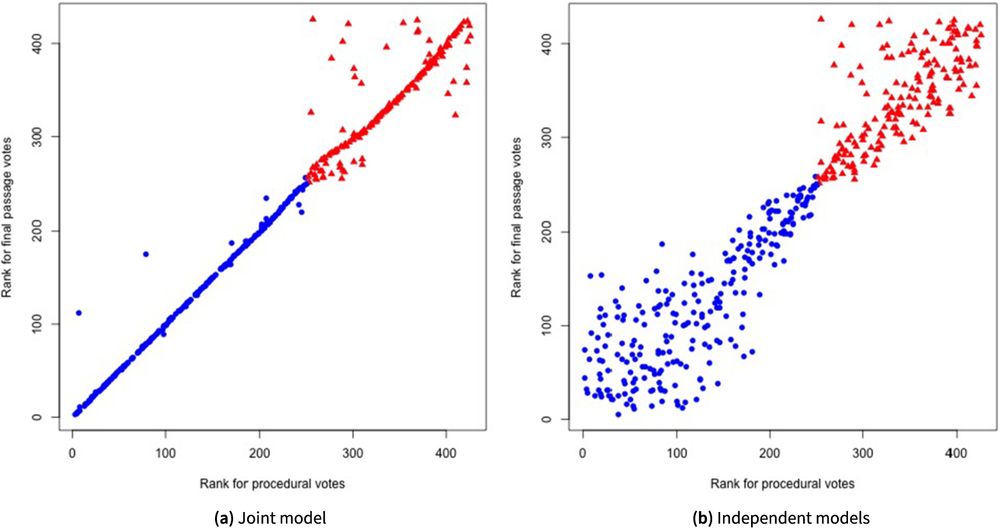
Currently in FirstView: In “Explaining Differences in Voting Patterns across Voting Domains Using Hierarchical Bayesian Models,” Erin Lipman, Scott Moser, and Abel Rodriguez extend spatial voting models with a hierarchical Bayesian approach that estimates legislators’ ideal points.
November 6, 2025 at 6:05 PM
Currently in FirstView: In “Explaining Differences in Voting Patterns across Voting Domains Using Hierarchical Bayesian Models,” Erin Lipman, Scott Moser, and Abel Rodriguez extend spatial voting models with a hierarchical Bayesian approach that estimates legislators’ ideal points.
Currently in FirstView: In “Measuring Media Criticism with ALC Word Embeddings,” @cbarrie.bsky.social, Neil Ketchley, @aasiegel.bsky.social, and Mossaab Bagdouri introduce a method for estimating media criticism using à la carte word embeddings which requires only minimal computational resources.

November 4, 2025 at 5:35 PM
Currently in FirstView: In “Measuring Media Criticism with ALC Word Embeddings,” @cbarrie.bsky.social, Neil Ketchley, @aasiegel.bsky.social, and Mossaab Bagdouri introduce a method for estimating media criticism using à la carte word embeddings which requires only minimal computational resources.
Currently in FirstView: In “An Expert-Sourced Measure of Judicial Ideology,” @kevinlcope.bsky.social develops a method for estimating the ideology of federal judges. He introduces the Jurist-Derived Judicial Ideology Score (JuDJIS) which is based on over 20,000 evaluations by a sample of jurists.

October 30, 2025 at 5:05 PM
Currently in FirstView: In “An Expert-Sourced Measure of Judicial Ideology,” @kevinlcope.bsky.social develops a method for estimating the ideology of federal judges. He introduces the Jurist-Derived Judicial Ideology Score (JuDJIS) which is based on over 20,000 evaluations by a sample of jurists.
Currently in FirstView: “Moral Foundation Measurements Fail to Converge on Multilingual Party Manifestos.” @marvins.bsky.social and @fhopp.bsky.social examine 810 party manifestos in 4 languages to study how different instruments lead to different results for extracting moral foundations.

October 28, 2025 at 4:35 PM
Currently in FirstView: “Moral Foundation Measurements Fail to Converge on Multilingual Party Manifestos.” @marvins.bsky.social and @fhopp.bsky.social examine 810 party manifestos in 4 languages to study how different instruments lead to different results for extracting moral foundations.
Currently in FirstView: In “Detecting Formatted Text: Data Collection Using Computer Vision,” Jonathan Colner describes a workflow process for structured text extraction using free software. This method is useful for poorly-formatted sources that require researchers to extract each item by hand.

October 21, 2025 at 4:35 PM
Currently in FirstView: In “Detecting Formatted Text: Data Collection Using Computer Vision,” Jonathan Colner describes a workflow process for structured text extraction using free software. This method is useful for poorly-formatted sources that require researchers to extract each item by hand.
Currently in FirstView: “Bin-Conditional Conformal Prediction of Fatalities from Armed Conflict” by David Randahl, Jonathan P. Williams, and Håvard Hegre. The authors discuss bin-conditional conformal prediction (BCCP) as an alternative to models that lack uncertainty estimates.

October 17, 2025 at 5:06 PM
Currently in FirstView: “Bin-Conditional Conformal Prediction of Fatalities from Armed Conflict” by David Randahl, Jonathan P. Williams, and Håvard Hegre. The authors discuss bin-conditional conformal prediction (BCCP) as an alternative to models that lack uncertainty estimates.
Currently in FirstView: In “Balancing Precision and Retention in Experimental Design,” @gustavodiaz.org and Erin Rossiter study how experimental design choices can increase precision when estimating treatment effects. Specifically, they examine block-randomized and pre-post designs.

October 14, 2025 at 4:35 PM
Currently in FirstView: In “Balancing Precision and Retention in Experimental Design,” @gustavodiaz.org and Erin Rossiter study how experimental design choices can increase precision when estimating treatment effects. Specifically, they examine block-randomized and pre-post designs.
Currently in FirstView: "Estimating the Local Average Treatment Effect Without the Exclusion Restriction." @zmarkovich.bsky.social introduces the Compliance Probability Weighting estimator, which enables inference about the LATE without relying on monotonicity or principal ignorability.

October 10, 2025 at 5:05 PM
Currently in FirstView: "Estimating the Local Average Treatment Effect Without the Exclusion Restriction." @zmarkovich.bsky.social introduces the Compliance Probability Weighting estimator, which enables inference about the LATE without relying on monotonicity or principal ignorability.
Currently in FirstView: In “Measuring the Quality of Answers in Political Q&As with Large Language Models,” @rmichaelalvarez.bsky.social and Jacob Morrier develop an approach for measuring the quality of answers in Q&A sessions using data from the Question Period in the Canadian House of Commons.

October 7, 2025 at 4:35 PM
Currently in FirstView: In “Measuring the Quality of Answers in Political Q&As with Large Language Models,” @rmichaelalvarez.bsky.social and Jacob Morrier develop an approach for measuring the quality of answers in Q&A sessions using data from the Question Period in the Canadian House of Commons.
Currently in FirstView: In “What to Observe When Assuming Selection on Observables,” Kevin M. Quinn, Guoer Liu, Lee Epstein, and Andrew Martin clarify how most estimators justified by a selection-on-observables assumption are special cases of a general weighting estimator.

October 3, 2025 at 5:05 PM
Currently in FirstView: In “What to Observe When Assuming Selection on Observables,” Kevin M. Quinn, Guoer Liu, Lee Epstein, and Andrew Martin clarify how most estimators justified by a selection-on-observables assumption are special cases of a general weighting estimator.
Currently in FirstView: In “Accessibility and Equity in the Research Process: Gender Bias in Elite Interview Recruitment,” Margaret A. T. Kenney and John Salchak study how researcher identity affects the research process. Specifically, they look at how this influences elite interview recruitment.

September 30, 2025 at 4:35 PM
Currently in FirstView: In “Accessibility and Equity in the Research Process: Gender Bias in Elite Interview Recruitment,” Margaret A. T. Kenney and John Salchak study how researcher identity affects the research process. Specifically, they look at how this influences elite interview recruitment.
The latest issue of PA is out now. We have a great collection of papers by @yamilrvelez.bsky.social, @sysilviakim.bsky.social, @mattblackwell.bsky.social, @sophieehill.bsky.social, @dwlee.bsky.social, @melissazrogers.bsky.social, @kaipingchen.bsky.social, @samuelbaltz.bsky.social (1/2)
September 29, 2025 at 3:45 PM
The latest issue of PA is out now. We have a great collection of papers by @yamilrvelez.bsky.social, @sysilviakim.bsky.social, @mattblackwell.bsky.social, @sophieehill.bsky.social, @dwlee.bsky.social, @melissazrogers.bsky.social, @kaipingchen.bsky.social, @samuelbaltz.bsky.social (1/2)