




Sen Pei
@senpei.bsky.social
Asst Prof @ColumbiaMSPH. A mix of Infectious Diseases, Environmental Health, Network Science & Complex Systems. Views are my own.
Website: https://senpei-cu.github.io/
Website: https://senpei-cu.github.io/
Welcome to join Columbia Mailman seminar series on infectious disease modeling featuring Prof. Virginia Pitzer from Yale on 2/10 Tue at 12 pm EST! Open to the public over Zoom. For more information and registration: events.columbia.edu/cal/event/ev...

February 3, 2026 at 6:31 PM
Welcome to join Columbia Mailman seminar series on infectious disease modeling featuring Prof. Virginia Pitzer from Yale on 2/10 Tue at 12 pm EST! Open to the public over Zoom. For more information and registration: events.columbia.edu/cal/event/ev...
Presymptomatic transmission is a key determinant of the controllability of respiratory viruses. This nice study used household data to quantify presymptomatic transmission of influenza and Omicron. Important findings with implications for modeling and control.
www.nature.com/articles/s44...
www.nature.com/articles/s44...

Frequent presymptomatic household transmission of influenza A but not influenza B virus - Nature Health
Based on two waves of data collection from 748 households in Hong Kong, this analysis sheds light on the number of transmission events that occurred before manifestation of symptoms in influenza A and...
www.nature.com
January 28, 2026 at 2:34 PM
Presymptomatic transmission is a key determinant of the controllability of respiratory viruses. This nice study used household data to quantify presymptomatic transmission of influenza and Omicron. Important findings with implications for modeling and control.
www.nature.com/articles/s44...
www.nature.com/articles/s44...
Reposted by Sen Pei

Dont miss the ESPIDAM summer program in June 2026 in Stockholm, covering many key concepts for ID modelling:
stochastic models, AI for ID control, nowcasting and forecasting, phylodynamics, data analysis, network models, within-host models, health economics www.statistics.su.se/english/divi...
stochastic models, AI for ID control, nowcasting and forecasting, phylodynamics, data analysis, network models, within-host models, health economics www.statistics.su.se/english/divi...
ESPIDAM, the European Summer Program in Infectious Disease Analysis and Modelling - Stockholms universitet
www.statistics.su.se
January 19, 2026 at 10:05 AM
Dont miss the ESPIDAM summer program in June 2026 in Stockholm, covering many key concepts for ID modelling:
stochastic models, AI for ID control, nowcasting and forecasting, phylodynamics, data analysis, network models, within-host models, health economics www.statistics.su.se/english/divi...
stochastic models, AI for ID control, nowcasting and forecasting, phylodynamics, data analysis, network models, within-host models, health economics www.statistics.su.se/english/divi...
Excited to share a new study published in PNAS! @pnas.org
We reconstructed the early, cryptic spatial spread of 2009 H1N1 influenza and SARS-CoV-2 across US metropolitan areas.
Link👉https://www.pnas.org/doi/10.1073/pnas.2518051123
#PandemicPreparedness #InfectiousDisease #HumanMobility
We reconstructed the early, cryptic spatial spread of 2009 H1N1 influenza and SARS-CoV-2 across US metropolitan areas.
Link👉https://www.pnas.org/doi/10.1073/pnas.2518051123
#PandemicPreparedness #InfectiousDisease #HumanMobility

January 6, 2026 at 7:41 PM
Excited to share a new study published in PNAS! @pnas.org
We reconstructed the early, cryptic spatial spread of 2009 H1N1 influenza and SARS-CoV-2 across US metropolitan areas.
Link👉https://www.pnas.org/doi/10.1073/pnas.2518051123
#PandemicPreparedness #InfectiousDisease #HumanMobility
We reconstructed the early, cryptic spatial spread of 2009 H1N1 influenza and SARS-CoV-2 across US metropolitan areas.
Link👉https://www.pnas.org/doi/10.1073/pnas.2518051123
#PandemicPreparedness #InfectiousDisease #HumanMobility
2025 was a challenging year for many of us. As the year comes to a close, let's pause to recognize and celebrate every accomplishment and milestone, big or small. Each step forward matters.
As we head into 2026, let’s keep climbing with aspiration, resilience, and strength!
As we head into 2026, let’s keep climbing with aspiration, resilience, and strength!

December 31, 2025 at 4:36 PM
2025 was a challenging year for many of us. As the year comes to a close, let's pause to recognize and celebrate every accomplishment and milestone, big or small. Each step forward matters.
As we head into 2026, let’s keep climbing with aspiration, resilience, and strength!
As we head into 2026, let’s keep climbing with aspiration, resilience, and strength!
Glad to share our latest study, led by Han Yong Wunrow
@hwunrow.bsky.social, on estimating time-varying reproduction numbers (Rt) using data assimilation methods, now published in the Journal of the Royal Society Interface!
Link: royalsocietypublishing.org/rsif/article...
@hwunrow.bsky.social, on estimating time-varying reproduction numbers (Rt) using data assimilation methods, now published in the Journal of the Royal Society Interface!
Link: royalsocietypublishing.org/rsif/article...

December 18, 2025 at 4:13 PM
Glad to share our latest study, led by Han Yong Wunrow
@hwunrow.bsky.social, on estimating time-varying reproduction numbers (Rt) using data assimilation methods, now published in the Journal of the Royal Society Interface!
Link: royalsocietypublishing.org/rsif/article...
@hwunrow.bsky.social, on estimating time-varying reproduction numbers (Rt) using data assimilation methods, now published in the Journal of the Royal Society Interface!
Link: royalsocietypublishing.org/rsif/article...
I am teaching Introduction to Network Science for a third year at Columbia Mailman! @cupublichealth.bsky.social Very grateful to have positive evaluations from students with diverse backgrounds. Welcome to join this small-size, engaged course if you are interested in networks and systems thinking!


December 11, 2025 at 6:21 PM
I am teaching Introduction to Network Science for a third year at Columbia Mailman! @cupublichealth.bsky.social Very grateful to have positive evaluations from students with diverse backgrounds. Welcome to join this small-size, engaged course if you are interested in networks and systems thinking!
Very interesting study on respiratory virus transmission in schools!
"Prolonged exposure in shared, poorly ventilated spaces, which potentially includes several infectious sources, drives respiratory virus transmission more than close contact."
www.nature.com/articles/s41...
"Prolonged exposure in shared, poorly ventilated spaces, which potentially includes several infectious sources, drives respiratory virus transmission more than close contact."
www.nature.com/articles/s41...
The relative contribution of close-proximity contacts, shared classroom exposure and indoor air quality to respiratory virus transmission in schools - Nature Communications
The relative importance of close-proximity interactions, shared space and air quality to the transmission of respiratory viruses is not well understood. Here, the authors investigate this question by ...
www.nature.com
December 10, 2025 at 3:50 PM
Very interesting study on respiratory virus transmission in schools!
"Prolonged exposure in shared, poorly ventilated spaces, which potentially includes several infectious sources, drives respiratory virus transmission more than close contact."
www.nature.com/articles/s41...
"Prolonged exposure in shared, poorly ventilated spaces, which potentially includes several infectious sources, drives respiratory virus transmission more than close contact."
www.nature.com/articles/s41...
Welcome to join Columbia Mailman @cupublichealth.bsky.social seminar series on infectious disease modeling featuring Prof. Mark Jit @markjit.bsky.social from NYU on 12/16 Tue at 12 pm EST! Open to the public over Zoom.
For more information and registration: 👉
events.columbia.edu/cal/event/ev...
For more information and registration: 👉
events.columbia.edu/cal/event/ev...

December 8, 2025 at 4:31 PM
Welcome to join Columbia Mailman @cupublichealth.bsky.social seminar series on infectious disease modeling featuring Prof. Mark Jit @markjit.bsky.social from NYU on 12/16 Tue at 12 pm EST! Open to the public over Zoom.
For more information and registration: 👉
events.columbia.edu/cal/event/ev...
For more information and registration: 👉
events.columbia.edu/cal/event/ev...
Grateful to @natcomms.nature.com for featuring our AMRO inference study as one of the Editors’ Highlights in #PublicHealth: www.nature.com/collections/...
November 30, 2025 at 4:15 AM
Grateful to @natcomms.nature.com for featuring our AMRO inference study as one of the Editors’ Highlights in #PublicHealth: www.nature.com/collections/...
Sunny and warm in San Diego. Preparing for #EPIDEMICS10 next week!


November 29, 2025 at 4:26 PM
Sunny and warm in San Diego. Preparing for #EPIDEMICS10 next week!
Sharing our new study on identifying asymptomatic carriers of antimicrobial-resistant organisms (AMROs) in hospitals, out in @natcomms.nature.com. We combine patient mobility, clinical cultures, EHR, and genomics to identify hidden AMRO carriers. #AMR #HAI #HospitalEpi
Link 👉 rdcu.be/eQKKF
1/
Link 👉 rdcu.be/eQKKF
1/

November 19, 2025 at 8:23 PM
Sharing our new study on identifying asymptomatic carriers of antimicrobial-resistant organisms (AMROs) in hospitals, out in @natcomms.nature.com. We combine patient mobility, clinical cultures, EHR, and genomics to identify hidden AMRO carriers. #AMR #HAI #HospitalEpi
Link 👉 rdcu.be/eQKKF
1/
Link 👉 rdcu.be/eQKKF
1/
A super interesting study on how ants alter their nest networks to prevent epidemics! Network topology metrics were used to measure the effect on disease transmission.
www.science.org/doi/full/10....
www.science.org/doi/full/10....

November 14, 2025 at 4:27 AM
A super interesting study on how ants alter their nest networks to prevent epidemics! Network topology metrics were used to measure the effect on disease transmission.
www.science.org/doi/full/10....
www.science.org/doi/full/10....
Excellent work on the ecology and spread of H5N1 in North America 👉
Our lab's paper describing the North American H5N1 epizootic is out now in Nature! So thrilled to have this out, and congratulations to @lambod50.bsky.social for all the fantastic work on this: www.nature.com/articles/s41...

Ecology and spread of the North American H5N1 epizootic - Nature
The panzootic of highly pathogenic H5N1 since 2021 was driven by around nine introductions into the Atlantic and Pacific flyways, followed by rapid dissemination through wild migratory birds, primaril...
www.nature.com
November 12, 2025 at 7:59 PM
Excellent work on the ecology and spread of H5N1 in North America 👉
Fantastic talk by Dr. Holden Thorp, Editor-in-Chief of Science, on the future of scientific research. Especially inspiring to hear how many scientific giants pushed forward even when others tried to stop them. In times of uncertainty and challenge, do the work.


November 11, 2025 at 6:29 PM
Fantastic talk by Dr. Holden Thorp, Editor-in-Chief of Science, on the future of scientific research. Especially inspiring to hear how many scientific giants pushed forward even when others tried to stop them. In times of uncertainty and challenge, do the work.
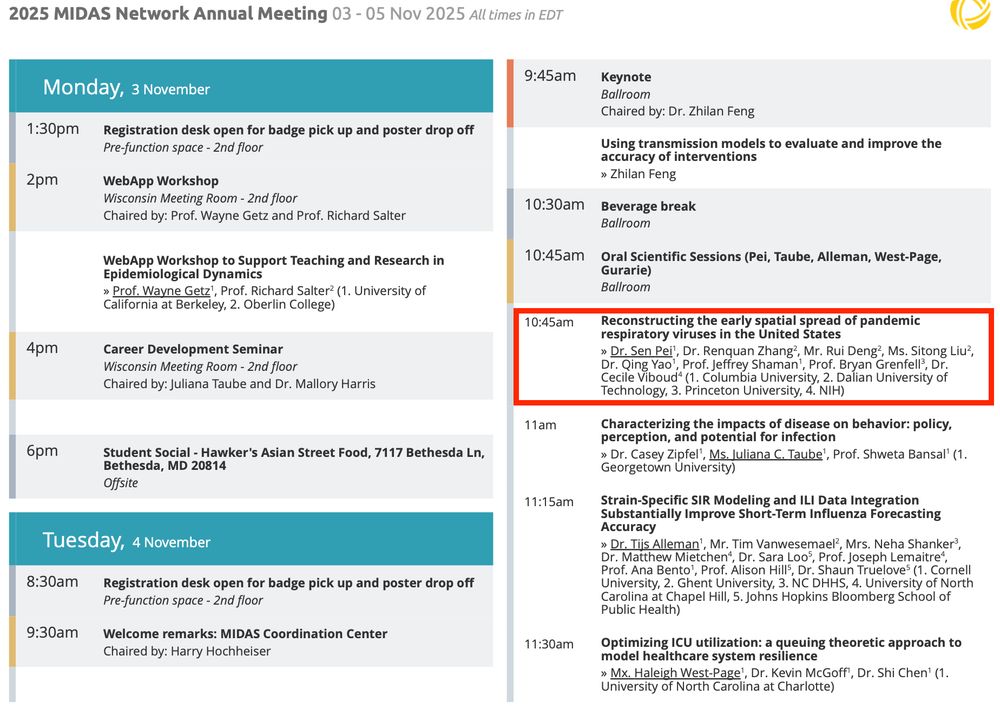
Our group is presenting at the MIDAS Network Annual Meeting! I will present on reconstructing the early spatial spread of pandemics in the US. Dr. Qing Yao will discuss the use of GNN to predict adaptive mobility for improving epidemic forecasts. Welcome to join us! @midas-network.bsky.social

November 4, 2025 at 12:54 PM
Our group is presenting at the MIDAS Network Annual Meeting! I will present on reconstructing the early spatial spread of pandemics in the US. Dr. Qing Yao will discuss the use of GNN to predict adaptive mobility for improving epidemic forecasts. Welcome to join us! @midas-network.bsky.social
Oof, this is a tough one...

October 27, 2025 at 1:40 PM
Oof, this is a tough one...
Fall is coming. Enjoy a warm and colorful afternoon in the woods. 🍁


October 7, 2025 at 7:47 PM
Fall is coming. Enjoy a warm and colorful afternoon in the woods. 🍁
Hurricanes don’t stop at the coast. Our recent study, published in Environ Res Lett, shows inland communities are less likely to evacuate, leaving them more vulnerable as storms like Helene bring historic flooding and loss of life.
Paper 👉 doi.org/10.1088/1748...
Paper 👉 doi.org/10.1088/1748...
Adaptive mobility responses during Hurricanes Helene and Milton in 2024 - IOPscience
Adaptive mobility responses during Hurricanes Helene and Milton in 2024, Yao, Qing, Lynch, Victoria D., Liu, Molei, Wu, Xiao, Parks, Robbie, Pei, Sen
doi.org
October 6, 2025 at 3:31 PM
Hurricanes don’t stop at the coast. Our recent study, published in Environ Res Lett, shows inland communities are less likely to evacuate, leaving them more vulnerable as storms like Helene bring historic flooding and loss of life.
Paper 👉 doi.org/10.1088/1748...
Paper 👉 doi.org/10.1088/1748...
🚨 JOB ALERT! Our group is recruiting a postdoc to develop novel methodologies for early outbreak detection and inference using AI/ML, modeling, and data science. This is a multi-year position providing stable research support. Welcome to apply and share with others!
👉 apply.interfolio.com/173722
👉 apply.interfolio.com/173722

September 12, 2025 at 2:35 PM
🚨 JOB ALERT! Our group is recruiting a postdoc to develop novel methodologies for early outbreak detection and inference using AI/ML, modeling, and data science. This is a multi-year position providing stable research support. Welcome to apply and share with others!
👉 apply.interfolio.com/173722
👉 apply.interfolio.com/173722
So proud to support Nidhi Ram’s presentation in the Science Research Fellows program! Nidhi is a freshman and an SFR fellow, a prestigious four-year designation for some of Columbia’s most promising science students. Truly impressed by the intellect, maturity and academic ability of all fellows.

July 30, 2025 at 4:13 PM
So proud to support Nidhi Ram’s presentation in the Science Research Fellows program! Nidhi is a freshman and an SFR fellow, a prestigious four-year designation for some of Columbia’s most promising science students. Truly impressed by the intellect, maturity and academic ability of all fellows.
Reposted by Sen Pei

A small team of us at Columbia (Sen Pei, Qing Yao, and me) collaborated with @washingtonpost.com to create a data-driven story about Hurricane Helene flooding and lack of evacuation added to the severe impacts:
www.washingtonpost.com/climate-envi...
www.washingtonpost.com/climate-envi...

July 22, 2025 at 1:22 PM
A small team of us at Columbia (Sen Pei, Qing Yao, and me) collaborated with @washingtonpost.com to create a data-driven story about Hurricane Helene flooding and lack of evacuation added to the severe impacts:
www.washingtonpost.com/climate-envi...
www.washingtonpost.com/climate-envi...
Are we prepared for intensifying and expanding disasters caused by climate change? How to plan for floods that we’ve never seen in our lives? Read this fantastic story in the Washington Post, including our mobility analysis during Hurricane Helene in 2024. 1/
www.washingtonpost.com/climate-envi...
www.washingtonpost.com/climate-envi...

A new era of floods has arrived. America isn’t prepared.
A Washington Post investigation reveals why so few people evacuated in the state hit hardest by last year’s deadliest disaster.
www.washingtonpost.com
July 22, 2025 at 3:28 PM
Are we prepared for intensifying and expanding disasters caused by climate change? How to plan for floods that we’ve never seen in our lives? Read this fantastic story in the Washington Post, including our mobility analysis during Hurricane Helene in 2024. 1/
www.washingtonpost.com/climate-envi...
www.washingtonpost.com/climate-envi...
First day at SMB 2025 @smbmathbiology.bsky.social in the beautiful city of Edmonton! Today, we have a minisymposium "Scenario Modeling to Inform Public Policymaking" (10:20 am and 4 pm) with excellent talks on bridging mathematical models and policymaking. Welcome to stop by and join the discussion!


July 14, 2025 at 2:01 PM
First day at SMB 2025 @smbmathbiology.bsky.social in the beautiful city of Edmonton! Today, we have a minisymposium "Scenario Modeling to Inform Public Policymaking" (10:20 am and 4 pm) with excellent talks on bridging mathematical models and policymaking. Welcome to stop by and join the discussion!