



Theo Schäfer
@theoschaefer.bsky.social
Cognitive Computational Neuroscientist @uni-hamburg.de | Prev: @mpicbs.bsky.social
Pinned
Theo Schäfer
@theoschaefer.bsky.social
· Dec 22
www.pnas.org
Happy to share this early Christmas present 🎄: our paper about geometry- and locomotion-dependence of 3D memory got published in PNAS! Joint work with co-first-author Volker Reisner (@reisnerv.bsky.social) as well as Leonard König, Misun Kim & Christian Doeller
www.pnas.org/doi/10.1073/
www.pnas.org/doi/10.1073/
Happy to share this early Christmas present 🎄: our paper about geometry- and locomotion-dependence of 3D memory got published in PNAS! Joint work with co-first-author Volker Reisner (@reisnerv.bsky.social) as well as Leonard König, Misun Kim & Christian Doeller
www.pnas.org/doi/10.1073/
www.pnas.org/doi/10.1073/
www.pnas.org
December 22, 2025 at 11:00 PM
Happy to share this early Christmas present 🎄: our paper about geometry- and locomotion-dependence of 3D memory got published in PNAS! Joint work with co-first-author Volker Reisner (@reisnerv.bsky.social) as well as Leonard König, Misun Kim & Christian Doeller
www.pnas.org/doi/10.1073/
www.pnas.org/doi/10.1073/
Reposted by Theo Schäfer
We’re very happy to share that our work on 3D spatial memory was published in PNAS just before the end of the year! 🎉
Link: www.pnas.org/doi/10.1073/...
(1/8)
Link: www.pnas.org/doi/10.1073/...
(1/8)
PNAS
Proceedings of the National Academy of Sciences (PNAS), a peer reviewed journal of the National Academy of Sciences (NAS) - an authoritative source of high-impact, original research that broadly spans...
www.pnas.org
December 22, 2025 at 10:43 PM
We’re very happy to share that our work on 3D spatial memory was published in PNAS just before the end of the year! 🎉
Link: www.pnas.org/doi/10.1073/...
(1/8)
Link: www.pnas.org/doi/10.1073/...
(1/8)
Reposted by Theo Schäfer

Is cognition a universal feature of the living world? How can we define it? Is a nervous system needed? If so, why? If not, why not? Check this fascinating @royalsocietypublishing.org Theme Issue led by @drmichaellevin.bsky.social & co. on Basal Cognition royalsocietypublishing.org/doi/pdf/10.1...

January 11, 2025 at 10:44 AM
Is cognition a universal feature of the living world? How can we define it? Is a nervous system needed? If so, why? If not, why not? Check this fascinating @royalsocietypublishing.org Theme Issue led by @drmichaellevin.bsky.social & co. on Basal Cognition royalsocietypublishing.org/doi/pdf/10.1...
Check out our new preprint on how environmental deformation and locomotion affect 3D maps! Co-led with @reisnerv.bsky.social, alongside Leonard König, Misun Kim, and Christian Doeller. Very proud of this work!
Curious about spatial memory in 3D? Our new preprint explores how environmental boundaries and the way we move affect our memory for locations in volumetric space!
Huge congrats to co-1st @theoschaefer.bsky.social w/ Leonard König, Misun Kim, Christian Doeller.
🔗 www.biorxiv.org/content/10.1...
Huge congrats to co-1st @theoschaefer.bsky.social w/ Leonard König, Misun Kim, Christian Doeller.
🔗 www.biorxiv.org/content/10.1...

Locomotion-dependent use of geometric and body cues in humans mapping 3D space
The ability to represent locations across multiple dimensions of space is a core function of cognitive maps. While the influence of boundary-dependent environmental geometry on spatial representations...
www.biorxiv.org
March 19, 2025 at 8:41 PM
Check out our new preprint on how environmental deformation and locomotion affect 3D maps! Co-led with @reisnerv.bsky.social, alongside Leonard König, Misun Kim, and Christian Doeller. Very proud of this work!
Reposted by Theo Schäfer

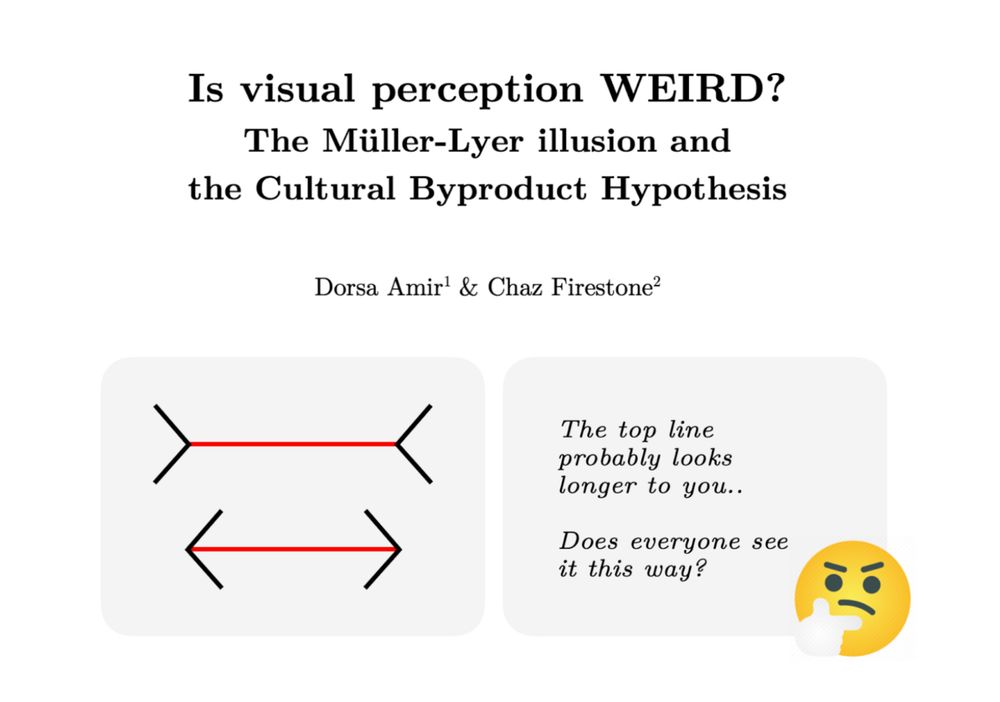
Does the culture you grow up in shape the way you see the world? In a new Psych Review paper, @chazfirestone.bsky.social & I tackle this centuries-old question using the Müller-Lyer illusion as a case study. Come think through one of history's mysteries with us🧵(1/13):
January 25, 2025 at 10:05 PM
Does the culture you grow up in shape the way you see the world? In a new Psych Review paper, @chazfirestone.bsky.social & I tackle this centuries-old question using the Müller-Lyer illusion as a case study. Come think through one of history's mysteries with us🧵(1/13):
Reposted by Theo Schäfer
It’s a Preprint! 👋
We show how we can dissociate perceptual from value-based mechanisms of generalisation + that stronger gen. in anxiety is associated with value rather than perception.
w/
@ondrejzika.bsky.social @nicoschuck.bsky.social @bernhardspitzer.bsky.social
osf.io/preprints/ps...
1/n
We show how we can dissociate perceptual from value-based mechanisms of generalisation + that stronger gen. in anxiety is associated with value rather than perception.
w/
@ondrejzika.bsky.social @nicoschuck.bsky.social @bernhardspitzer.bsky.social
osf.io/preprints/ps...
1/n
OSF
osf.io
January 17, 2025 at 7:11 AM
It’s a Preprint! 👋
We show how we can dissociate perceptual from value-based mechanisms of generalisation + that stronger gen. in anxiety is associated with value rather than perception.
w/
@ondrejzika.bsky.social @nicoschuck.bsky.social @bernhardspitzer.bsky.social
osf.io/preprints/ps...
1/n
We show how we can dissociate perceptual from value-based mechanisms of generalisation + that stronger gen. in anxiety is associated with value rather than perception.
w/
@ondrejzika.bsky.social @nicoschuck.bsky.social @bernhardspitzer.bsky.social
osf.io/preprints/ps...
1/n
Reposted by Theo Schäfer

SEEING THROUGH YOUR EYES 👁️:
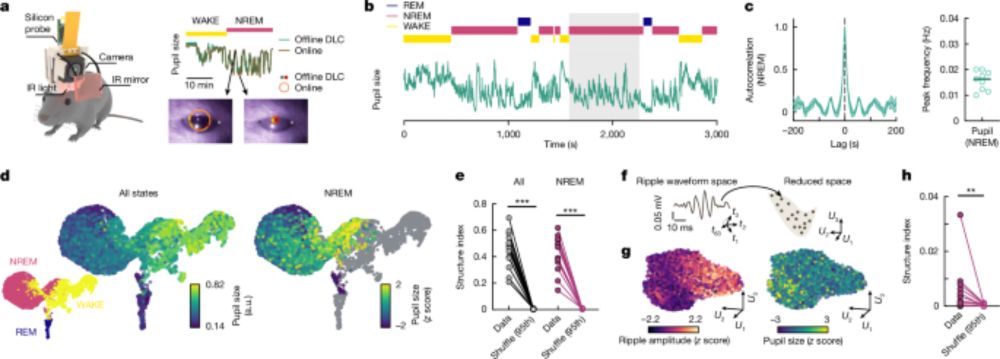
Excited to share our new paper (which is out now @nature.com !!) with Wenbo Tang, Antonio Fernandez-Ruiz✉️, and Azahara Oliva✉️: we discovered a novel sleep microstructure that promotes memory replay! #Neuroscience #hippocampus
nature.com/articles/s41... 🧵 1/12👇
Excited to share our new paper (which is out now @nature.com !!) with Wenbo Tang, Antonio Fernandez-Ruiz✉️, and Azahara Oliva✉️: we discovered a novel sleep microstructure that promotes memory replay! #Neuroscience #hippocampus
nature.com/articles/s41... 🧵 1/12👇
Sleep microstructure organizes memory replay - Nature
The temporal microstructure of the brain can multiplex distinct cognitive processes during sleep to support continuous learning.
nature.com
January 2, 2025 at 2:51 AM
SEEING THROUGH YOUR EYES 👁️:
Excited to share our new paper (which is out now @nature.com !!) with Wenbo Tang, Antonio Fernandez-Ruiz✉️, and Azahara Oliva✉️: we discovered a novel sleep microstructure that promotes memory replay! #Neuroscience #hippocampus
nature.com/articles/s41... 🧵 1/12👇
Excited to share our new paper (which is out now @nature.com !!) with Wenbo Tang, Antonio Fernandez-Ruiz✉️, and Azahara Oliva✉️: we discovered a novel sleep microstructure that promotes memory replay! #Neuroscience #hippocampus
nature.com/articles/s41... 🧵 1/12👇
Reposted by Theo Schäfer

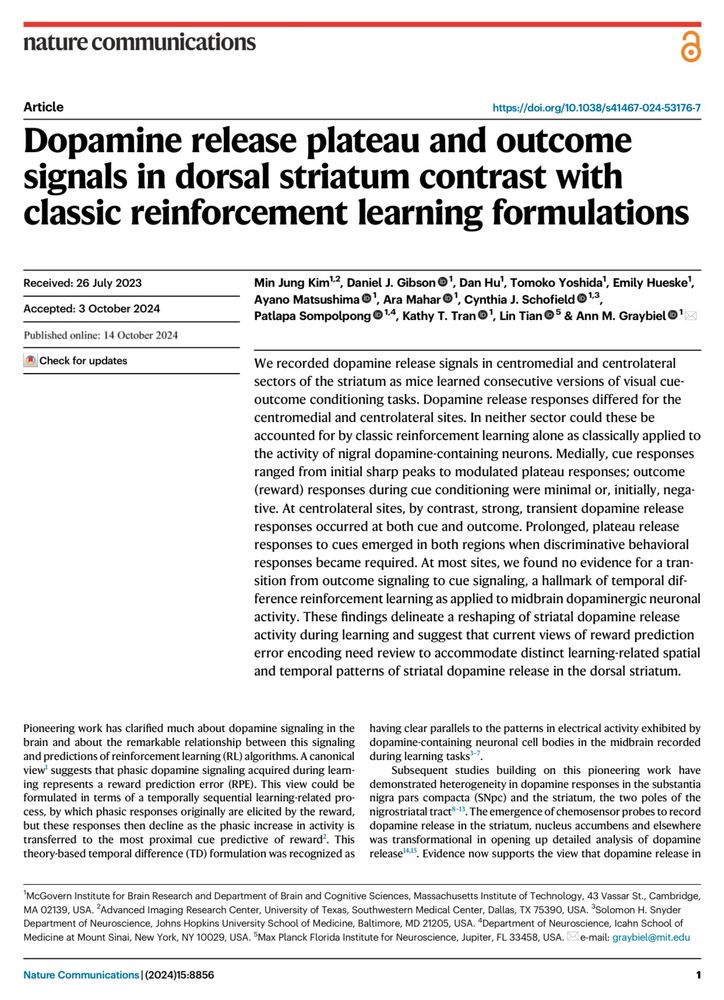
A detailed new look at dopamine signaling suggests neuroscientists’ model of reinforcement learning may need to be revised. #MIT
"Dopamine release plateau and outcome signals in dorsal striatum contrast with classic reinforcement learning formulations" #NatureCom
www.nature.com/articles/s41...
"Dopamine release plateau and outcome signals in dorsal striatum contrast with classic reinforcement learning formulations" #NatureCom
www.nature.com/articles/s41...
December 21, 2024 at 4:33 PM
A detailed new look at dopamine signaling suggests neuroscientists’ model of reinforcement learning may need to be revised. #MIT
"Dopamine release plateau and outcome signals in dorsal striatum contrast with classic reinforcement learning formulations" #NatureCom
www.nature.com/articles/s41...
"Dopamine release plateau and outcome signals in dorsal striatum contrast with classic reinforcement learning formulations" #NatureCom
www.nature.com/articles/s41...
Reposted by Theo Schäfer

Our work on inductive biases in reinforcement learning is out: tinyurl.com/yfc74e3u
By the fantastic
@noahedrich.bsky.social
Ppl learn faster from slowly changing features; we argue this reflects an inductive bias. Teamwork w @ericschulz.bsky.social & S HallMcMaster
#neuroskyence #compneuro
By the fantastic
@noahedrich.bsky.social
Ppl learn faster from slowly changing features; we argue this reflects an inductive bias. Teamwork w @ericschulz.bsky.social & S HallMcMaster
#neuroskyence #compneuro

An inductive bias for slowly changing features in human reinforcement learning
Author summary Learning experiments in the laboratory are often assumed to exist in a vacuum, where participants solve a given task independently of how they learn in more natural circumstances. But h...
journals.plos.org
November 27, 2024 at 8:34 AM
Our work on inductive biases in reinforcement learning is out: tinyurl.com/yfc74e3u
By the fantastic
@noahedrich.bsky.social
Ppl learn faster from slowly changing features; we argue this reflects an inductive bias. Teamwork w @ericschulz.bsky.social & S HallMcMaster
#neuroskyence #compneuro
By the fantastic
@noahedrich.bsky.social
Ppl learn faster from slowly changing features; we argue this reflects an inductive bias. Teamwork w @ericschulz.bsky.social & S HallMcMaster
#neuroskyence #compneuro
Reposted by Theo Schäfer
Happy to share our review on OFC/vmPFC representations in Trends in Neurosciences, written with @nirmoneta.bsky.social and Shany Grossman
www.cell.com/trends/neuro...
Very short thread below to summarize our review
#neuroscience #neuroskyence #compneurosky #PsychSciSky
www.cell.com/trends/neuro...
Very short thread below to summarize our review
#neuroscience #neuroskyence #compneurosky #PsychSciSky
ScienceDirect.com | Science, health and medical journals, full text articles and books.
kwnsfk27.r.eu-west-1.awstrack.me
November 15, 2024 at 11:33 AM
Happy to share our review on OFC/vmPFC representations in Trends in Neurosciences, written with @nirmoneta.bsky.social and Shany Grossman
www.cell.com/trends/neuro...
Very short thread below to summarize our review
#neuroscience #neuroskyence #compneurosky #PsychSciSky
www.cell.com/trends/neuro...
Very short thread below to summarize our review
#neuroscience #neuroskyence #compneurosky #PsychSciSky
One of my PhD projects is online!
We show that category prototypes correspond to interpolated states in a cognitive map that guide cortical pattern completion during category-based decisions.
w/ Mirko Thalmann, Eric Schulz, Christian Doeller, Stephanie Theves
www.biorxiv.org/content/10.1...
We show that category prototypes correspond to interpolated states in a cognitive map that guide cortical pattern completion during category-based decisions.
w/ Mirko Thalmann, Eric Schulz, Christian Doeller, Stephanie Theves
www.biorxiv.org/content/10.1...

The hippocampus supports interpolation into new states during category abstraction
bioRxiv - the preprint server for biology, operated by Cold Spring Harbor Laboratory, a research and educational institution
www.biorxiv.org
May 15, 2024 at 12:48 PM
One of my PhD projects is online!
We show that category prototypes correspond to interpolated states in a cognitive map that guide cortical pattern completion during category-based decisions.
w/ Mirko Thalmann, Eric Schulz, Christian Doeller, Stephanie Theves
www.biorxiv.org/content/10.1...
We show that category prototypes correspond to interpolated states in a cognitive map that guide cortical pattern completion during category-based decisions.
w/ Mirko Thalmann, Eric Schulz, Christian Doeller, Stephanie Theves
www.biorxiv.org/content/10.1...