



Thomas Nortmann
@thonor.bsky.social
Computational neuroscience. PhD student with Friedemann Zenke at FMI, Basel. B.Sc. and M.Sc. Cognitive Science at university Osnabrück
Reposted by Thomas Nortmann

Our work with @georgkeller.bsky.social on testing predictive processing (PP) models in cortex is out on biorvix now! www.biorxiv.org/content/10.6... A short thread on our findings and thoughts on where we should move on from PP below.
A functional influence based circuit motif that constrains the set of plausible algorithms of cortical function
There are several plausible algorithms for cortical function that are specific enough to make testable predictions of the interactions between functionally identified cell types. Many of these algorithms are based on some variant of predictive processing. Here we set out to experimentally distinguish between two such predictive processing variants. A central point of variability between them lies in the proposed vertical communication between layer 2/3 and layer 5, which stems from the diverging assumptions about the computational role of layer 5. One assumes a hierarchically organized architecture and proposes that, within a given node of the network, layer 5 conveys unexplained bottom-up input to prediction error neurons of layer 2/3. The other proposes a non-hierarchical architecture in which internal representation neurons of layer 5 provide predictions for the local prediction error neurons of layer 2/3. We show that the functional influence of layer 2/3 cell types on layer 5 is incompatible with the hierarchical variant, while the functional influence of layer 5 cell types on prediction error neurons of layer 2/3 is incompatible with the non-hierarchical variant. Given these data, we can constrain the space of plausible algorithms of cortical function. We propose a model for cortical function based on a combination of a joint embedding predictive architecture (JEPA) and predictive processing that makes experimentally testable predictions. ### Competing Interest Statement The authors have declared no competing interest. Swiss National Science Foundation, https://ror.org/00yjd3n13 Novartis Foundation, https://ror.org/04f9t1x17 European Research Council, https://ror.org/0472cxd90, 865617
www.biorxiv.org
January 30, 2026 at 2:37 PM
Our work with @georgkeller.bsky.social on testing predictive processing (PP) models in cortex is out on biorvix now! www.biorxiv.org/content/10.6... A short thread on our findings and thoughts on where we should move on from PP below.
Reposted by Thomas Nortmann

1/6 New preprint 🚀 How does the cortex learn to represent things and how they move without reconstructing sensory stimuli? We developed a circuit-centric recurrent predictive learning (RPL) model based on JEPAs.
🔗 doi.org/10.1101/2025...
Led by @atenagm.bsky.social @mshalvagal.bsky.social
🔗 doi.org/10.1101/2025...
Led by @atenagm.bsky.social @mshalvagal.bsky.social

November 27, 2025 at 8:24 AM
1/6 New preprint 🚀 How does the cortex learn to represent things and how they move without reconstructing sensory stimuli? We developed a circuit-centric recurrent predictive learning (RPL) model based on JEPAs.
🔗 doi.org/10.1101/2025...
Led by @atenagm.bsky.social @mshalvagal.bsky.social
🔗 doi.org/10.1101/2025...
Led by @atenagm.bsky.social @mshalvagal.bsky.social
🚨 Out in Patterns!
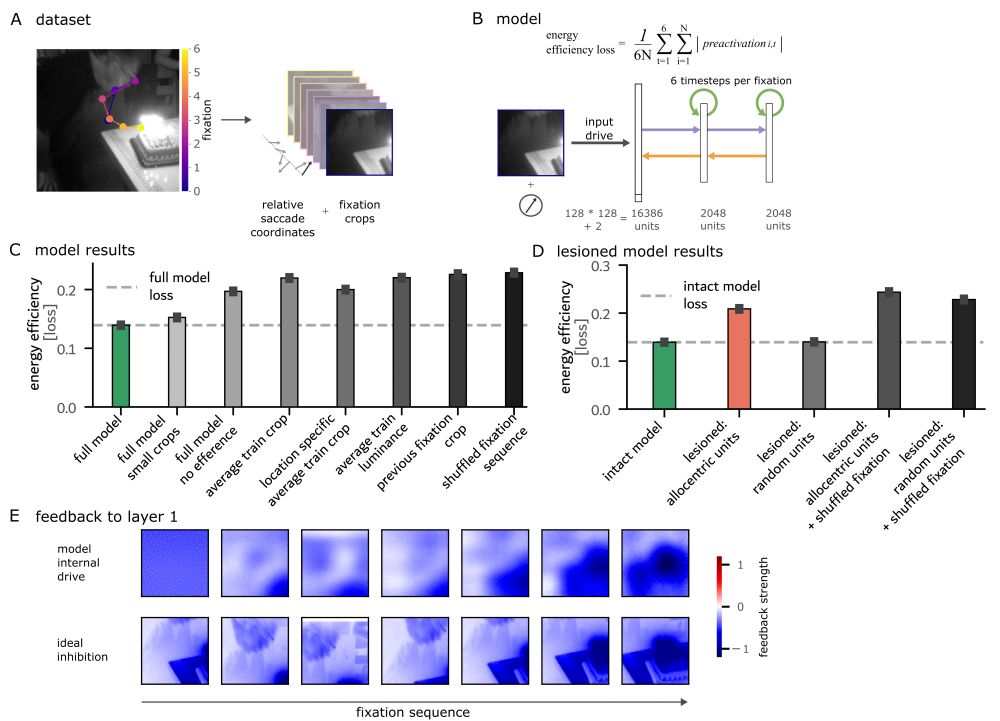
We asked ourselves, if complex neural dynamics like predictive remapping and allocentric coding can emerge from simple physical principles, in this case Energy Efficiency. Turns out they can!
More information in the 🧵 below.
I am super excited to see this one out in the wild.
We asked ourselves, if complex neural dynamics like predictive remapping and allocentric coding can emerge from simple physical principles, in this case Energy Efficiency. Turns out they can!
More information in the 🧵 below.
I am super excited to see this one out in the wild.

November 20, 2025 at 7:47 PM
🚨 Out in Patterns!
We asked ourselves, if complex neural dynamics like predictive remapping and allocentric coding can emerge from simple physical principles, in this case Energy Efficiency. Turns out they can!
More information in the 🧵 below.
I am super excited to see this one out in the wild.
We asked ourselves, if complex neural dynamics like predictive remapping and allocentric coding can emerge from simple physical principles, in this case Energy Efficiency. Turns out they can!
More information in the 🧵 below.
I am super excited to see this one out in the wild.
Reposted by Thomas Nortmann

Introducing CorText: a framework that fuses brain data directly into a large language model, allowing for interactive neural readout using natural language.
tl;dr: you can now chat with a brain scan 🧠💬
1/n
tl;dr: you can now chat with a brain scan 🧠💬
1/n

November 3, 2025 at 3:17 PM
Introducing CorText: a framework that fuses brain data directly into a large language model, allowing for interactive neural readout using natural language.
tl;dr: you can now chat with a brain scan 🧠💬
1/n
tl;dr: you can now chat with a brain scan 🧠💬
1/n
Reposted by Thomas Nortmann

Another Friday feat: Philip Sulewski's (@psulewski.bsky.social) and @thonor.bsky.social's
modelling work. Predictive remapping and allocentric coding as consequences of energy efficiency in RNN models of active vision
Time: Friday, August 15, 2:00 – 5:00 pm,
Location: Poster C112, de Brug & E‑Hall
modelling work. Predictive remapping and allocentric coding as consequences of energy efficiency in RNN models of active vision
Time: Friday, August 15, 2:00 – 5:00 pm,
Location: Poster C112, de Brug & E‑Hall
August 8, 2025 at 2:21 PM
Another Friday feat: Philip Sulewski's (@psulewski.bsky.social) and @thonor.bsky.social's
modelling work. Predictive remapping and allocentric coding as consequences of energy efficiency in RNN models of active vision
Time: Friday, August 15, 2:00 – 5:00 pm,
Location: Poster C112, de Brug & E‑Hall
modelling work. Predictive remapping and allocentric coding as consequences of energy efficiency in RNN models of active vision
Time: Friday, August 15, 2:00 – 5:00 pm,
Location: Poster C112, de Brug & E‑Hall
Reposted by Thomas Nortmann

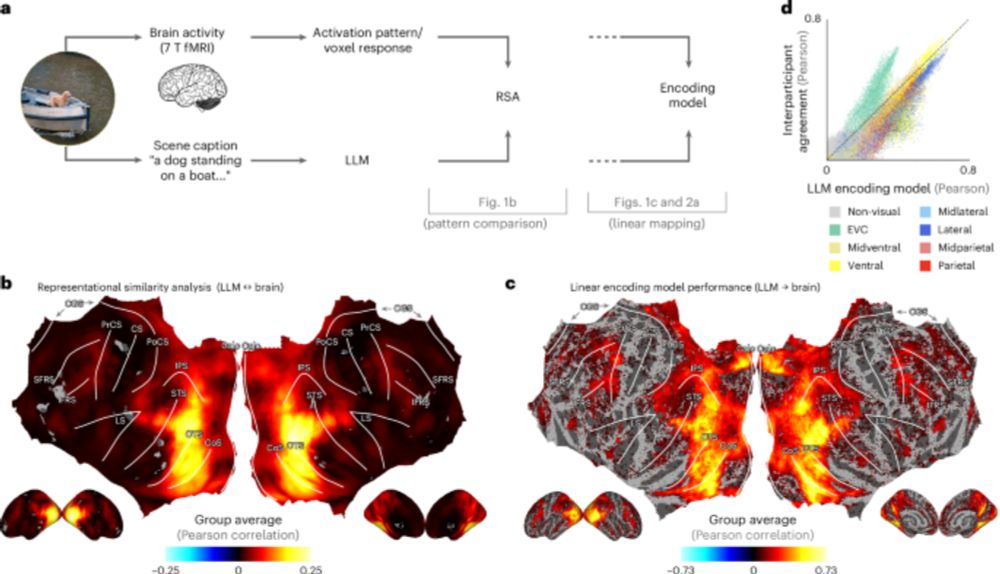
🚨 Finally out in Nature Machine Intelligence!!
"Visual representations in the human brain are aligned with large language models"
🔗 www.nature.com/articles/s42...
"Visual representations in the human brain are aligned with large language models"
🔗 www.nature.com/articles/s42...
High-level visual representations in the human brain are aligned with large language models - Nature Machine Intelligence
Doerig, Kietzmann and colleagues show that the brain’s response to visual scenes can be modelled using language-based AI representations. By linking brain activity to caption-based embeddings from lar...
www.nature.com
August 7, 2025 at 1:06 PM
🚨 Finally out in Nature Machine Intelligence!!
"Visual representations in the human brain are aligned with large language models"
🔗 www.nature.com/articles/s42...
"Visual representations in the human brain are aligned with large language models"
🔗 www.nature.com/articles/s42...
My first ever preprint is now out. We show the emergence of complex computations given only the rather simple underlying goal of energy efficiency.
Can seemingly complex multi-area computations in the brain emerge from the need for energy efficient computation? In our new preprint on predictive remapping in active vision, we report on such a case.
Let us take you for a spin. 1/6 www.biorxiv.org/content/10.1...
Let us take you for a spin. 1/6 www.biorxiv.org/content/10.1...
June 5, 2025 at 1:41 PM
My first ever preprint is now out. We show the emergence of complex computations given only the rather simple underlying goal of energy efficiency.