



Varun Warrier
@vw1234.bsky.social
Interested in genetics, development, and brain. Associate prof of neurodev. research at Cambridge.
Reposted by Varun Warrier

How do GWAS and rare variant burden tests rank gene signals?
In new work @nature.com with @hakha.bsky.social, @jkpritch.bsky.social, and our wonderful coauthors we find that the key factors are what we call Specificity, Length, and Luck!
🧬🧪🧵
www.nature.com/articles/s41...
In new work @nature.com with @hakha.bsky.social, @jkpritch.bsky.social, and our wonderful coauthors we find that the key factors are what we call Specificity, Length, and Luck!
🧬🧪🧵
www.nature.com/articles/s41...

Specificity, length and luck drive gene rankings in association studies - Nature
Genetic association tests prioritize candidate genes based on different criteria.
www.nature.com
November 7, 2025 at 12:05 AM
How do GWAS and rare variant burden tests rank gene signals?
In new work @nature.com with @hakha.bsky.social, @jkpritch.bsky.social, and our wonderful coauthors we find that the key factors are what we call Specificity, Length, and Luck!
🧬🧪🧵
www.nature.com/articles/s41...
In new work @nature.com with @hakha.bsky.social, @jkpritch.bsky.social, and our wonderful coauthors we find that the key factors are what we call Specificity, Length, and Luck!
🧬🧪🧵
www.nature.com/articles/s41...
Reposted by Varun Warrier

Excited to share our latest work on the factors that determine what genes we find (and don't find!) in GWAS and burden tests.
We describe a critical concept that we call *specificity*.
Led by Jeff Spence and Hakhamanesh Mostafavi:
We describe a critical concept that we call *specificity*.
Led by Jeff Spence and Hakhamanesh Mostafavi:
How do GWAS and rare variant burden tests rank gene signals?
In new work @nature.com with @hakha.bsky.social, @jkpritch.bsky.social, and our wonderful coauthors we find that the key factors are what we call Specificity, Length, and Luck!
🧬🧪🧵
www.nature.com/articles/s41...
In new work @nature.com with @hakha.bsky.social, @jkpritch.bsky.social, and our wonderful coauthors we find that the key factors are what we call Specificity, Length, and Luck!
🧬🧪🧵
www.nature.com/articles/s41...
Specificity, length and luck drive gene rankings in association studies - Nature
Genetic association tests prioritize candidate genes based on different criteria.
www.nature.com
November 7, 2025 at 4:08 AM
Excited to share our latest work on the factors that determine what genes we find (and don't find!) in GWAS and burden tests.
We describe a critical concept that we call *specificity*.
Led by Jeff Spence and Hakhamanesh Mostafavi:
We describe a critical concept that we call *specificity*.
Led by Jeff Spence and Hakhamanesh Mostafavi:
It is now clear that more people are being diagnosed as autistic in their teens and as adults than in childhood. A prevailing theory is that those diagnosed later have "milder" form of autism, and later diagnosis entirely due to social factors.
October 1, 2025 at 4:05 PM
It is now clear that more people are being diagnosed as autistic in their teens and as adults than in childhood. A prevailing theory is that those diagnosed later have "milder" form of autism, and later diagnosis entirely due to social factors.
Reposted by Varun Warrier

🧬💥 Do the genetics that make you develop a disease also help you survive it? Not much.
Our new study in Nature Genetics including 9 disease and 7 biobanks shows:
• Susceptibility variants ≠ survival
• PRSs for onset weak at predicting progression
• Lifespan PRS predicts survival better
Our new study in Nature Genetics including 9 disease and 7 biobanks shows:
• Susceptibility variants ≠ survival
• PRSs for onset weak at predicting progression
• Lifespan PRS predicts survival better


September 30, 2025 at 12:50 PM
🧬💥 Do the genetics that make you develop a disease also help you survive it? Not much.
Our new study in Nature Genetics including 9 disease and 7 biobanks shows:
• Susceptibility variants ≠ survival
• PRSs for onset weak at predicting progression
• Lifespan PRS predicts survival better
Our new study in Nature Genetics including 9 disease and 7 biobanks shows:
• Susceptibility variants ≠ survival
• PRSs for onset weak at predicting progression
• Lifespan PRS predicts survival better
Reposted by Varun Warrier

We are delighted to announce the launch of a new Master's Programme in Brain Health and Disease within the Department of Clinical Neurosciences at the University of Cambridge.
Applications are now open!
@camneurodept.bsky.social
www.clinical-neuroscience.cam.ac.uk/education/ta...
Applications are now open!
@camneurodept.bsky.social
www.clinical-neuroscience.cam.ac.uk/education/ta...
Taught MPhil in Brain Health and Disease | Clinical Neurosciences
Our one-year Master’s programme in Brain Health and Disease: Clinical Neurosciences offers an exceptional opportunity for students to engage with the forefront of clinical neuroscience through a dynam...
www.clinical-neuroscience.cam.ac.uk
September 25, 2025 at 2:33 PM
We are delighted to announce the launch of a new Master's Programme in Brain Health and Disease within the Department of Clinical Neurosciences at the University of Cambridge.
Applications are now open!
@camneurodept.bsky.social
www.clinical-neuroscience.cam.ac.uk/education/ta...
Applications are now open!
@camneurodept.bsky.social
www.clinical-neuroscience.cam.ac.uk/education/ta...
We have an opening for a research assistant/associate to study the genetics of neurodevelopmental traits in the general population, and explore their overlap with neurodevelopmental diagnoses. Funds available until Jan 2027.
lnkd.in/eHEcccwC
Please circulate widely.
lnkd.in/eHEcccwC
Please circulate widely.
LinkedIn
This link will take you to a page that’s not on LinkedIn
lnkd.in
September 23, 2025 at 8:10 AM
We have an opening for a research assistant/associate to study the genetics of neurodevelopmental traits in the general population, and explore their overlap with neurodevelopmental diagnoses. Funds available until Jan 2027.
lnkd.in/eHEcccwC
Please circulate widely.
lnkd.in/eHEcccwC
Please circulate widely.
Reposted by Varun Warrier

We are excited to share GPN-Star, a cost-effective, biologically grounded genomic language modeling framework that achieves state-of-the-art performance across a wide range of variant effect prediction tasks relevant to human genetics.
www.biorxiv.org/content/10.1...
(1/n)
www.biorxiv.org/content/10.1...
(1/n)

September 22, 2025 at 5:29 AM
We are excited to share GPN-Star, a cost-effective, biologically grounded genomic language modeling framework that achieves state-of-the-art performance across a wide range of variant effect prediction tasks relevant to human genetics.
www.biorxiv.org/content/10.1...
(1/n)
www.biorxiv.org/content/10.1...
(1/n)
Reposted by Varun Warrier


Very nice method that exploits collider bias to identify independent contributors to outcomes.

Causal Pivot is an idea that comes from differential diagnosis in medical practice www.sciencedirect.com/science/arti... Chad Shaw and I drew DAGs for molecular diagnosis and gene discovery. He saw an opportunity to exploit collider bias in an interesting way.

The Causal Pivot: A structural approach to genetic heterogeneity and variant discovery in complex diseases
We present the Causal Pivot (CP) as a structural causal model (SCM) for analyzing genetic heterogeneity in complex diseases. The CP leverages an estab…
www.sciencedirect.com
August 23, 2025 at 8:12 AM
Very nice method that exploits collider bias to identify independent contributors to outcomes.
Reposted by Varun Warrier

Latest processing of UK Biobank brain imaging data - now with 82,000 usable first-scan datasets. Correlating brain IDPs with 13,000 non-imaging variables gives a rich manhattan-stye plot. 324,000 Bonferroni-significant associations.

August 22, 2025 at 11:35 AM
Latest processing of UK Biobank brain imaging data - now with 82,000 usable first-scan datasets. Correlating brain IDPs with 13,000 non-imaging variables gives a rich manhattan-stye plot. 324,000 Bonferroni-significant associations.
Reposted by Varun Warrier
Isn't genetics cool???
Within only 145 nucleotides(!) of a non-coding RNA (RNU4-2) - different variants in distinct regions / structures cause three distinct disorders!!! (all discovered within the last 18 months)
🤯🤓🧬❤️
Within only 145 nucleotides(!) of a non-coding RNA (RNU4-2) - different variants in distinct regions / structures cause three distinct disorders!!! (all discovered within the last 18 months)
🤯🤓🧬❤️

August 18, 2025 at 2:03 PM
Isn't genetics cool???
Within only 145 nucleotides(!) of a non-coding RNA (RNU4-2) - different variants in distinct regions / structures cause three distinct disorders!!! (all discovered within the last 18 months)
🤯🤓🧬❤️
Within only 145 nucleotides(!) of a non-coding RNA (RNU4-2) - different variants in distinct regions / structures cause three distinct disorders!!! (all discovered within the last 18 months)
🤯🤓🧬❤️
Reposted by Varun Warrier

Excited to share this preprint from first author Jon Rosen, a postdoctoral fellow in the @klmohlke.bsky.social lab and my lab. We examine eQTL study sample size and how this affects signal discovery and rates of colocalization with GWAS.
www.biorxiv.org/content/10.1...
www.biorxiv.org/content/10.1...

Higher eQTL power reveals signals that boost GWAS colocalization
Expression quantitative trait locus (eQTL) studies in human cohorts typically detect at least one regulatory signal per gene, and have been proposed as a way to explain mechanisms of genetic liability...
www.biorxiv.org
August 18, 2025 at 12:18 PM
Excited to share this preprint from first author Jon Rosen, a postdoctoral fellow in the @klmohlke.bsky.social lab and my lab. We examine eQTL study sample size and how this affects signal discovery and rates of colocalization with GWAS.
www.biorxiv.org/content/10.1...
www.biorxiv.org/content/10.1...
Reposted by Varun Warrier

Interested in Network hubs, cortical hierarchies, and gradients? Ever wonder where they come from? Check our latest review, where we cover different approaches to mapping hubs, models for their evolution, and mechanisms for how they develop:
osf.io/preprints/os...
osf.io/preprints/os...

August 17, 2025 at 4:27 AM
Interested in Network hubs, cortical hierarchies, and gradients? Ever wonder where they come from? Check our latest review, where we cover different approaches to mapping hubs, models for their evolution, and mechanisms for how they develop:
osf.io/preprints/os...
osf.io/preprints/os...
Reposted by Varun Warrier

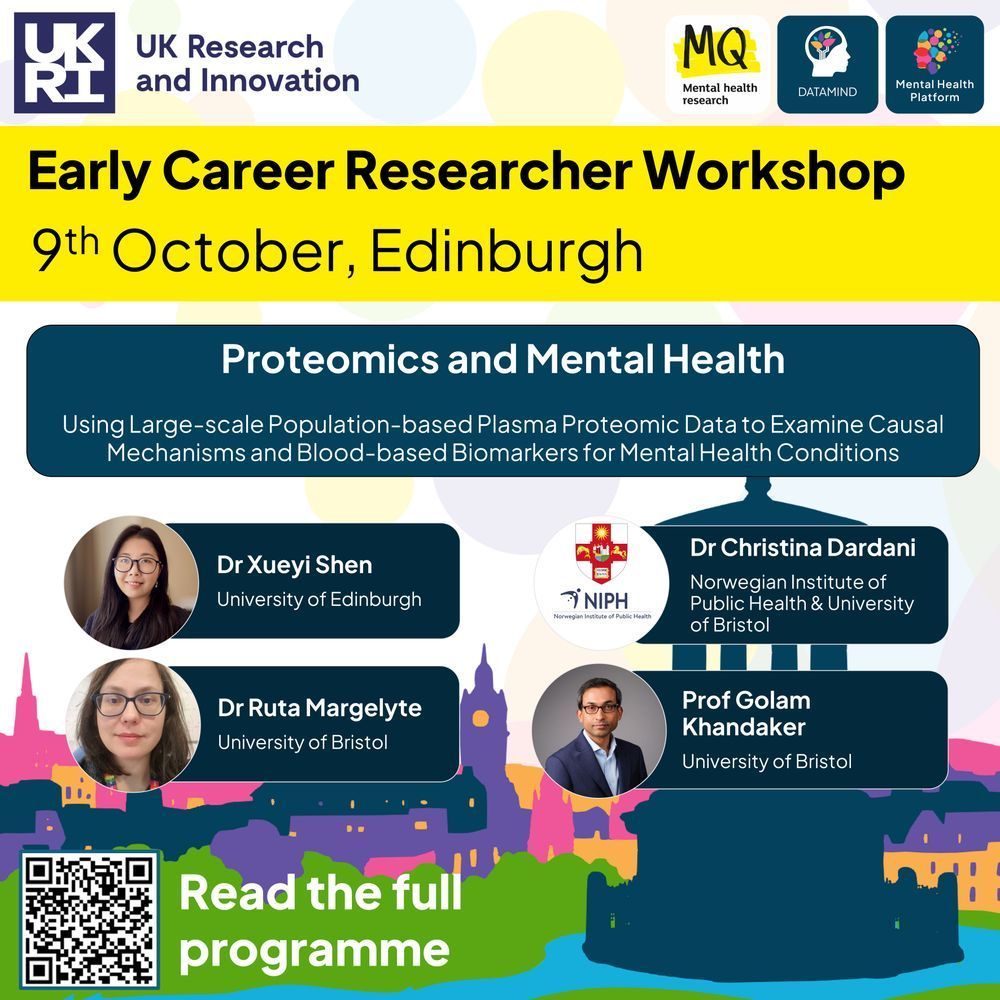
ECR Workshop: Proteomics & Mental Health 🧠
9 Oct | Edinburgh | £25
Hosted by @mqmentalhealth.bsky.social & @datamind.bsky.social in partnership with MHP.
Meet the Speakers! Programme & bios online – register: rebrand.ly/ecr-workshop
9 Oct | Edinburgh | £25
Hosted by @mqmentalhealth.bsky.social & @datamind.bsky.social in partnership with MHP.
Meet the Speakers! Programme & bios online – register: rebrand.ly/ecr-workshop
August 12, 2025 at 10:00 AM
ECR Workshop: Proteomics & Mental Health 🧠
9 Oct | Edinburgh | £25
Hosted by @mqmentalhealth.bsky.social & @datamind.bsky.social in partnership with MHP.
Meet the Speakers! Programme & bios online – register: rebrand.ly/ecr-workshop
9 Oct | Edinburgh | £25
Hosted by @mqmentalhealth.bsky.social & @datamind.bsky.social in partnership with MHP.
Meet the Speakers! Programme & bios online – register: rebrand.ly/ecr-workshop
Reposted by Varun Warrier
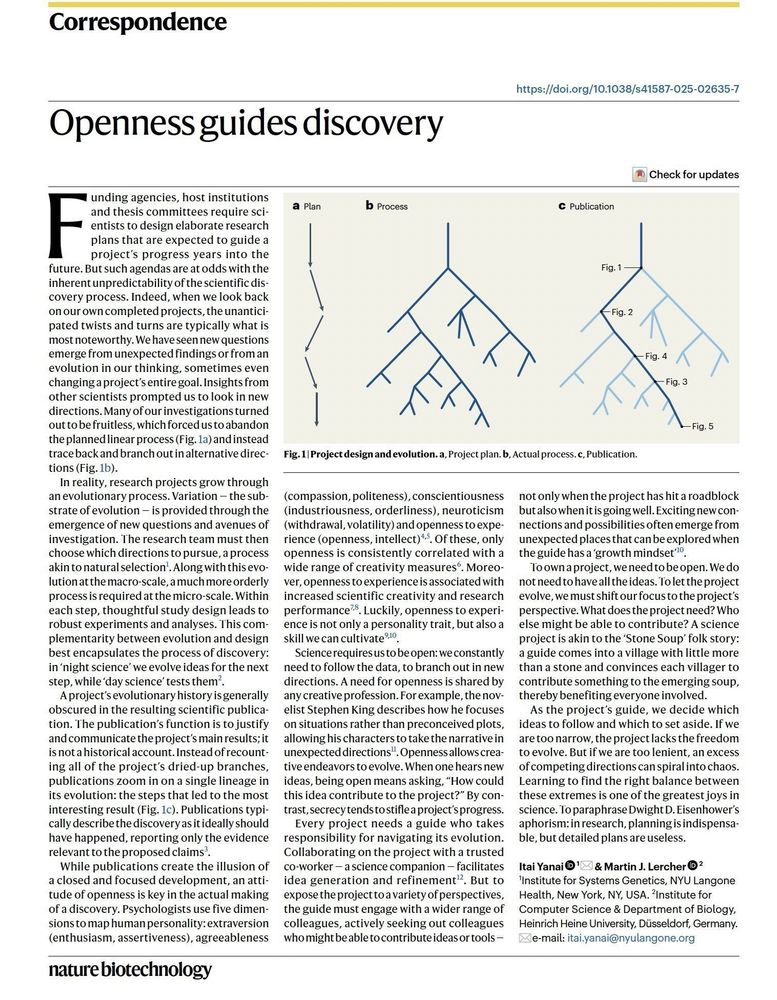
Science doesn’t need to be pretty and go according to plan; it just needs to lead to a discovery. If doesn’t have to be done alone or together with someone else; there just needs to be a discovery. It doesn’t need to happen fast or slow; just as long as there’s a discovery, then everybody is happy.
August 9, 2025 at 2:13 AM
Science doesn’t need to be pretty and go according to plan; it just needs to lead to a discovery. If doesn’t have to be done alone or together with someone else; there just needs to be a discovery. It doesn’t need to happen fast or slow; just as long as there’s a discovery, then everybody is happy.
Reposted by Varun Warrier

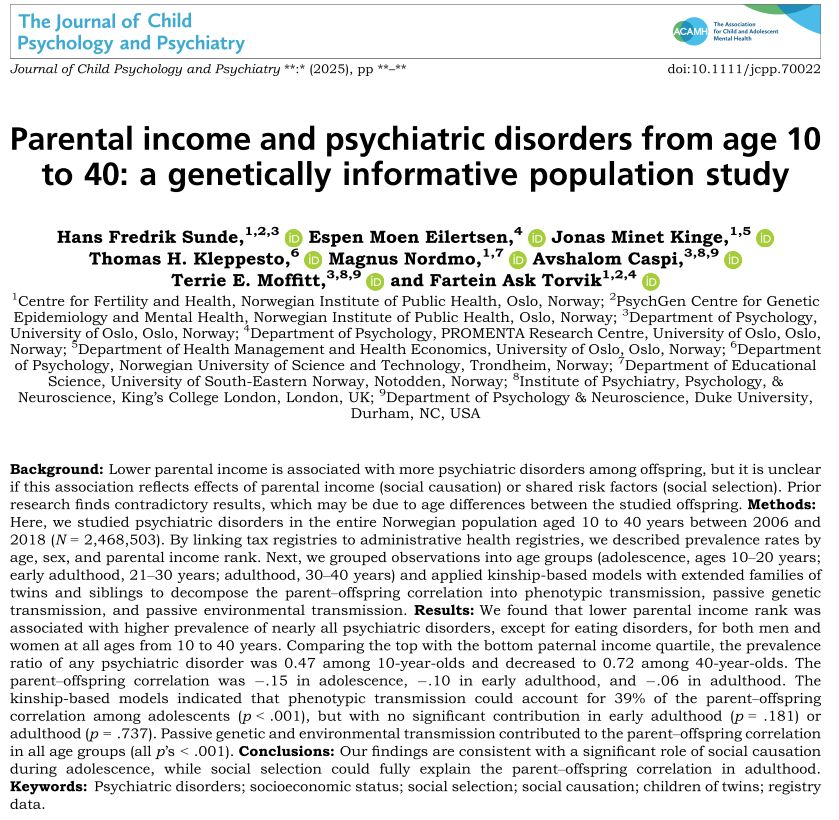
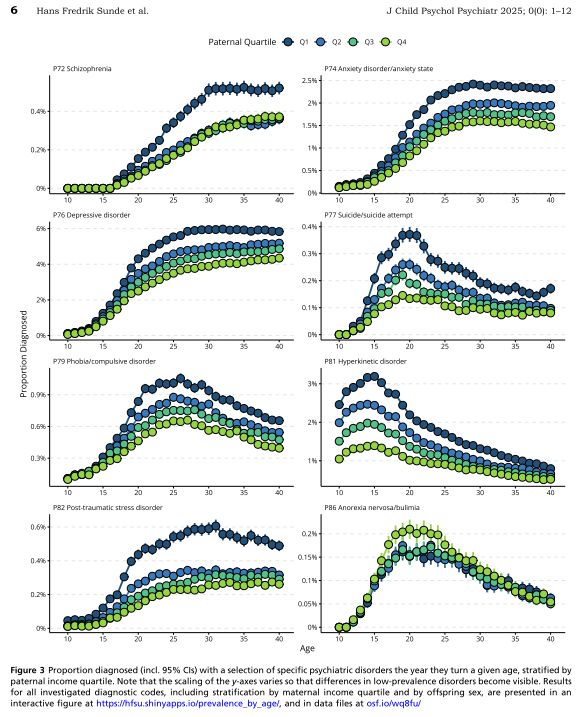
Our new paper is out today! 🎉 In it, we use administrative register data to document how psychiatric disorders are strongly linked to parental income, from childhood far into adulthood. Furthermore, we attempt to separate causation and selection using kinship-based models.
doi.org/10.1111/jcpp...
doi.org/10.1111/jcpp...
August 4, 2025 at 8:45 PM
Our new paper is out today! 🎉 In it, we use administrative register data to document how psychiatric disorders are strongly linked to parental income, from childhood far into adulthood. Furthermore, we attempt to separate causation and selection using kinship-based models.
doi.org/10.1111/jcpp...
doi.org/10.1111/jcpp...
Reposted by Varun Warrier

Psychiatric Genetics Beyond Heritability: Q&A with Michel Nivard ( @michelnivard.bsky.social )
“We look for genes as a means to an end—biology, epidemiology, and etiology of complex human outcomes.”
www.psychiatrymargins.com/p/psychiatri...
“We look for genes as a means to an end—biology, epidemiology, and etiology of complex human outcomes.”
www.psychiatrymargins.com/p/psychiatri...
Psychiatric Genetics Beyond Heritability: Q&A with Michel Nivard
We look for genes as a means to an end—biology, epidemiology, and etiology of complex human outcomes.
www.psychiatrymargins.com
July 19, 2025 at 1:14 PM
Psychiatric Genetics Beyond Heritability: Q&A with Michel Nivard ( @michelnivard.bsky.social )
“We look for genes as a means to an end—biology, epidemiology, and etiology of complex human outcomes.”
www.psychiatrymargins.com/p/psychiatri...
“We look for genes as a means to an end—biology, epidemiology, and etiology of complex human outcomes.”
www.psychiatrymargins.com/p/psychiatri...
Reposted by Varun Warrier
🚨New preprint is out!
How do genetic effects on complex traits change with age? In this work, we compare different approaches to obtain age-varying genetic effects, and show how design and modeling choices can impact the conclusions we draw.
shorturl.at/17snd
A thread 🧵👇
How do genetic effects on complex traits change with age? In this work, we compare different approaches to obtain age-varying genetic effects, and show how design and modeling choices can impact the conclusions we draw.
shorturl.at/17snd
A thread 🧵👇

Design and model choices shape inference of age-varying genetic effects on complex traits
Understanding how genetic influences on complex traits change with age is a fundamental question in genetic epidemiology. Both cross-sectional (between-subject) and longitudinal (within-subject) appro...
shorturl.at
July 8, 2025 at 12:47 PM
🚨New preprint is out!
How do genetic effects on complex traits change with age? In this work, we compare different approaches to obtain age-varying genetic effects, and show how design and modeling choices can impact the conclusions we draw.
shorturl.at/17snd
A thread 🧵👇
How do genetic effects on complex traits change with age? In this work, we compare different approaches to obtain age-varying genetic effects, and show how design and modeling choices can impact the conclusions we draw.
shorturl.at/17snd
A thread 🧵👇
Reposted by Varun Warrier
New pre-print! ✨ Antecedents and outcomes of a late ADHD diagnosis in females: www.medrxiv.org/content/10.1...
TLDR: This study finds evidence that a delay in ADHD diagnosis has profound and clear consequences by adolescence and this disproportionately disadvantages females (people who are AFAB).
TLDR: This study finds evidence that a delay in ADHD diagnosis has profound and clear consequences by adolescence and this disproportionately disadvantages females (people who are AFAB).

Antecedents and outcomes of a late attention deficit hyperactivity disorder (ADHD) diagnosis in females
Females receive an attention deficit hyperactivity disorder (ADHD) diagnosis at an older age than males. We examined the antecedents and outcomes of later (age 12+) diagnosis in females using data fro...
www.medrxiv.org
July 8, 2025 at 8:22 AM
New pre-print! ✨ Antecedents and outcomes of a late ADHD diagnosis in females: www.medrxiv.org/content/10.1...
TLDR: This study finds evidence that a delay in ADHD diagnosis has profound and clear consequences by adolescence and this disproportionately disadvantages females (people who are AFAB).
TLDR: This study finds evidence that a delay in ADHD diagnosis has profound and clear consequences by adolescence and this disproportionately disadvantages females (people who are AFAB).
Reposted by Varun Warrier

New preprint!🚨
"“The Contribution of Common and Rare Genetic Variation to Emotional and Behavioural Symptoms in Childhood and Adolescence” is out on medRxiv.
www.medrxiv.org/content/10.1...
Thread 👇
"“The Contribution of Common and Rare Genetic Variation to Emotional and Behavioural Symptoms in Childhood and Adolescence” is out on medRxiv.
www.medrxiv.org/content/10.1...
Thread 👇

The Contribution of Common and Rare Genetic Variation to Emotional and Behavioural Symptoms in Childhood and Adolescence
Genetic factors influence vulnerability to common mental health conditions, but their role in early-life mental health remains understudied. We analysed genotype array and exome sequence data from two...
www.medrxiv.org
July 3, 2025 at 8:23 AM
New preprint!🚨
"“The Contribution of Common and Rare Genetic Variation to Emotional and Behavioural Symptoms in Childhood and Adolescence” is out on medRxiv.
www.medrxiv.org/content/10.1...
Thread 👇
"“The Contribution of Common and Rare Genetic Variation to Emotional and Behavioural Symptoms in Childhood and Adolescence” is out on medRxiv.
www.medrxiv.org/content/10.1...
Thread 👇
Reposted by Varun Warrier
Studying the genetics of intelligence measures can help us understand the neurobiology of cognition and neurodevelopmental conditions 🧬🧠
We estimated missing intelligence test scores in @ukbiobank.bsky.social to reduce bias and boost power.
Preprint: www.medrxiv.org/content/10.1...
Thread 👇
We estimated missing intelligence test scores in @ukbiobank.bsky.social to reduce bias and boost power.
Preprint: www.medrxiv.org/content/10.1...
Thread 👇

June 21, 2025 at 4:08 AM
Studying the genetics of intelligence measures can help us understand the neurobiology of cognition and neurodevelopmental conditions 🧬🧠
We estimated missing intelligence test scores in @ukbiobank.bsky.social to reduce bias and boost power.
Preprint: www.medrxiv.org/content/10.1...
Thread 👇
We estimated missing intelligence test scores in @ukbiobank.bsky.social to reduce bias and boost power.
Preprint: www.medrxiv.org/content/10.1...
Thread 👇
Reposted by Varun Warrier

I am proud to have led and contributes to the experts in evidence advisory group- alot of hard work went into this www.england.nhs.uk/2025/06/nhs-...

NHS England » NHS England responds to ADHD Taskforce interim report
An independent taskforce set up to tackle challenges in attention deficit hyperactivity disorder (ADHD) care has published its interim report and recommendations today (Friday 20 June 2025). The repor...
www.england.nhs.uk
June 20, 2025 at 1:19 PM
I am proud to have led and contributes to the experts in evidence advisory group- alot of hard work went into this www.england.nhs.uk/2025/06/nhs-...
Reposted by Varun Warrier
📢 Just posted: Our preprint introducing SPC — Spectral Components — is now live on medRxiv!
Led by Dr. Ruhollah Shemirani and years in the making, this method offers a robust, scalable way to adjust for recent population structure in genomic analyses.
🔗 www.medrxiv.org/content/10.1...
1/9
Led by Dr. Ruhollah Shemirani and years in the making, this method offers a robust, scalable way to adjust for recent population structure in genomic analyses.
🔗 www.medrxiv.org/content/10.1...
1/9

SPC: a SPectral Component approach to address recent population structure in genomic analysis
Population structure is a well-known confounder in statistical genetics, particularly in genome-wide association studies (GWAS), where it can lead to inflated test statistics and spurious associations...
www.medrxiv.org
June 17, 2025 at 4:26 PM
📢 Just posted: Our preprint introducing SPC — Spectral Components — is now live on medRxiv!
Led by Dr. Ruhollah Shemirani and years in the making, this method offers a robust, scalable way to adjust for recent population structure in genomic analyses.
🔗 www.medrxiv.org/content/10.1...
1/9
Led by Dr. Ruhollah Shemirani and years in the making, this method offers a robust, scalable way to adjust for recent population structure in genomic analyses.
🔗 www.medrxiv.org/content/10.1...
1/9
Reposted by Varun Warrier

New preprint out! We mapped brain vulnerability in Alzheimer’s using MIND networks + population modelling.
Put this together with a brilliant team @raibethlehem.bsky.social @sarahmorganuk.bsky.social and many more still making their way to Bluesky
🧠 doi.org/10.1101/2025.06.10.25328978
Put this together with a brilliant team @raibethlehem.bsky.social @sarahmorganuk.bsky.social and many more still making their way to Bluesky
🧠 doi.org/10.1101/2025.06.10.25328978

Another great team effort, spearheaded and driven by @mmontagnese.bsky.social
doi.org/10.1101/2025...
doi.org/10.1101/2025...

Structural Similarity Networks Reveal Brain Vulnerability in Dementia
INTRODUCTION: Alzheimer's disease (AD) is characterised by inter-individual heterogeneity in brain degeneration, limiting diagnostic and prognostic precision. We present a novel framework integrating ...
doi.org
June 17, 2025 at 10:55 AM
New preprint out! We mapped brain vulnerability in Alzheimer’s using MIND networks + population modelling.
Put this together with a brilliant team @raibethlehem.bsky.social @sarahmorganuk.bsky.social and many more still making their way to Bluesky
🧠 doi.org/10.1101/2025.06.10.25328978
Put this together with a brilliant team @raibethlehem.bsky.social @sarahmorganuk.bsky.social and many more still making their way to Bluesky
🧠 doi.org/10.1101/2025.06.10.25328978
Reposted by Varun Warrier

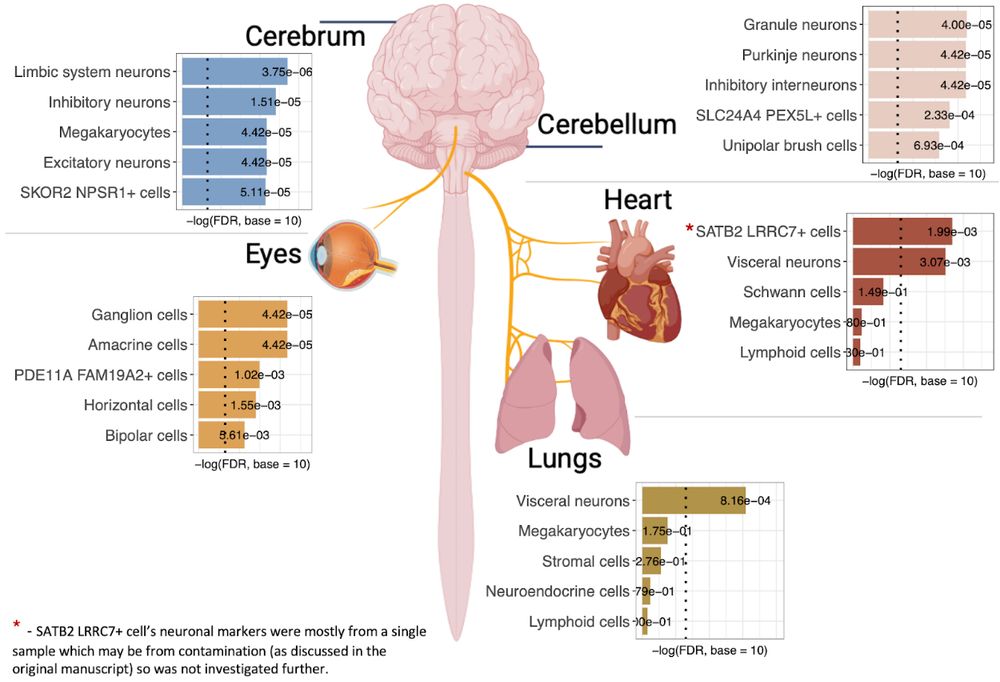
Excited about our new preprint: 1st successful genome-wide study of >61,000 panic attack and 29,000 panic disorder cases. www.medrxiv.org/content/10.1... We find 17 associations & evidence that peripheral neurons in eye, lungs and heart are involved in panic & other psychiatric disorders 1/n
June 17, 2025 at 10:50 AM
Excited about our new preprint: 1st successful genome-wide study of >61,000 panic attack and 29,000 panic disorder cases. www.medrxiv.org/content/10.1... We find 17 associations & evidence that peripheral neurons in eye, lungs and heart are involved in panic & other psychiatric disorders 1/n