



2Tie
@2tie.bsky.social
reverse engineer, computer historian, bionicle brain
play la mulana
play la mulana
The albums present on Sega's promo photo come from the later half of the 60s (Mina Aoe's Sapporo Blues on the left, pressed in '68). Sega tweeted a pic containing a catalogue with the Sega 1000 in it in 2014, which also contained Jupiter models from '67.

December 4, 2025 at 5:37 PM
The albums present on Sega's promo photo come from the later half of the 60s (Mina Aoe's Sapporo Blues on the left, pressed in '68). Sega tweeted a pic containing a catalogue with the Sega 1000 in it in 2014, which also contained Jupiter models from '67.
A closing thought on Wulff: industry man Freddy Bailey claims that Sega founder Bromley helped broker sales of the Berlin company to Bally (becoming Bally-Wulff) for a hefty sack of cash. Gunter seemed to remain involved with Sega, becoming a director in its parent company at the time.

December 4, 2025 at 9:26 AM
A closing thought on Wulff: industry man Freddy Bailey claims that Sega founder Bromley helped broker sales of the Berlin company to Bally (becoming Bally-Wulff) for a hefty sack of cash. Gunter seemed to remain involved with Sega, becoming a director in its parent company at the time.
Being the first domestically assembled jukebox plus it being a budget design meant the Sega 1000 cost a fraction of all the competitor's jukes, even Sega's other offerings. The tradeoff was that it was cheap quality, with reportedly poor sound and would break down often.

December 4, 2025 at 9:26 AM
Being the first domestically assembled jukebox plus it being a budget design meant the Sega 1000 cost a fraction of all the competitor's jukes, even Sega's other offerings. The tradeoff was that it was cheap quality, with reportedly poor sound and would break down often.
In fact, the new factory built for Sega in mid 1961 was immediately put to use for assembling the jukeboxes. They had only 48 selections instead of 120, and had an optional stereo speaker that could be installed into the base of the unit.


December 4, 2025 at 9:26 AM
In fact, the new factory built for Sega in mid 1961 was immediately put to use for assembling the jukeboxes. They had only 48 selections instead of 120, and had an optional stereo speaker that could be installed into the base of the unit.
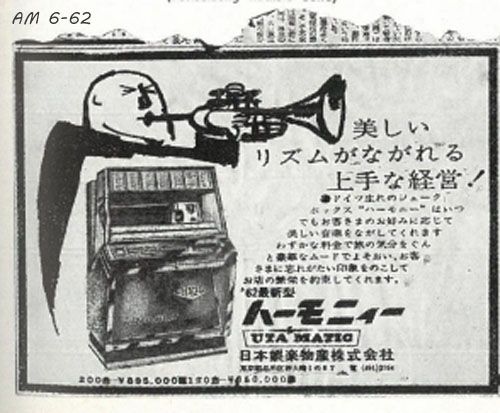
The Sega-1000 is part of the Harmonie line! This budget model never released in Germany, and was instead shipped to Japan for assembly and sales.


December 4, 2025 at 9:26 AM
The Sega-1000 is part of the Harmonie line! This budget model never released in Germany, and was instead shipped to Japan for assembly and sales.
In the late 50s, Sega had acquired use of some of Beromat's factory space for the assembly of their own slot machines, tailored for use in the German market as well as further markets like the U.K. This close association with Beromat is interesting because...


December 4, 2025 at 9:26 AM
In the late 50s, Sega had acquired use of some of Beromat's factory space for the assembly of their own slot machines, tailored for use in the German market as well as further markets like the U.K. This close association with Beromat is interesting because...
The Beromat Harmonie line was a series of 120-selection jukes introduced in 1959, and seemingly only produced domestically for a couple years. Beromat was the brand name for Gunter Wulff's manufacturing company's amusement machines, which also included slot machines.

December 4, 2025 at 9:26 AM
The Beromat Harmonie line was a series of 120-selection jukes introduced in 1959, and seemingly only produced domestically for a couple years. Beromat was the brand name for Gunter Wulff's manufacturing company's amusement machines, which also included slot machines.
Sega held the japanese rights to Rock-O-La, while Taito and V&V had Seeburg and Wurlitzer. Sega also had rights to smaller companies like Jupiter and, interestingly, german company Beromat.
December 4, 2025 at 9:26 AM
Sega held the japanese rights to Rock-O-La, while Taito and V&V had Seeburg and Wurlitzer. Sega also had rights to smaller companies like Jupiter and, interestingly, german company Beromat.
Indeed, no photos or mention of the unit actually being on location anywhere has been found, let alone any physical unit. Sega always reuses the same promo photo of it, likely the same unit that was recently on display in their visitor lobby.


December 4, 2025 at 9:26 AM
Indeed, no photos or mention of the unit actually being on location anywhere has been found, let alone any physical unit. Sega always reuses the same promo photo of it, likely the same unit that was recently on display in their visitor lobby.
In their official histories, Sega will often mention the SEGA 1000 Jukebox. The first domestically manufactured jukebox, it helped them overcome the three-way tie with taito and v&v to become the dominant jukebox distributor in japan. But is it even real? (a thread)

December 4, 2025 at 9:26 AM
In their official histories, Sega will often mention the SEGA 1000 Jukebox. The first domestically manufactured jukebox, it helped them overcome the three-way tie with taito and v&v to become the dominant jukebox distributor in japan. But is it even real? (a thread)
A photograph from "the Gotanda location". The Utamatic address points right beside the Gotanda train station (all sega offices were beside stations), but the Service Games on the cars suggests this was taken between '57 and '60.

December 4, 2025 at 12:19 AM
A photograph from "the Gotanda location". The Utamatic address points right beside the Gotanda train station (all sega offices were beside stations), but the Service Games on the cars suggests this was taken between '57 and '60.
And this advertisement in Automatenmarkt DE (german equivalent to Billboard) from june '62 gives an address for Utamatic in Shin Osaki 1-chome in Shinagawa, Tokyo, which is likely the two-story headquarters mentioned in the Cash Box article above.
December 4, 2025 at 12:12 AM
And this advertisement in Automatenmarkt DE (german equivalent to Billboard) from june '62 gives an address for Utamatic in Shin Osaki 1-chome in Shinagawa, Tokyo, which is likely the two-story headquarters mentioned in the Cash Box article above.
Okay assembly was for sure '61, june 24th '61 issue of Cash Box mentions it as their "new factory". the two-story headquarters doesn't match the Annex, unless that building was expanded between then and june '64 when the merger happened.

December 3, 2025 at 7:16 PM
Okay assembly was for sure '61, june 24th '61 issue of Cash Box mentions it as their "new factory". the two-story headquarters doesn't match the Annex, unless that building was expanded between then and june '64 when the merger happened.
Service Games "Complex"? I find it quite simple,

December 3, 2025 at 7:31 AM
Service Games "Complex"? I find it quite simple,