



Alejandro Lumbreras-Calle
@alumbrerasc.bsky.social
PhD in Astrophysics. UCM, IAC, and now a postdoc at CEFCA (Teruel, Spain). Star-forming galaxies and galaxy evolution.
And you can see the new version of the paper here: arxiv.org/abs/2412.08327 🔭
This may be of interest for @clarakm.bsky.social @zacksavitsky.bsky.social @monisharavis.bsky.social
@jtimmer.bsky.social @nebulousnikki.bsky.social @markzastrow.com @chrislintott.bsky.social
bsky.app/profile/alum...
This may be of interest for @clarakm.bsky.social @zacksavitsky.bsky.social @monisharavis.bsky.social
@jtimmer.bsky.social @nebulousnikki.bsky.social @markzastrow.com @chrislintott.bsky.social
bsky.app/profile/alum...
🔭 Now it's official, the nebula was never in Andromeda!
Our paper has been published and we show that the large 🧪 oxygen nebula is in the Milky Way.
This arc was discovered by amateurs photographing Andromeda with an [O III] filter, and now we have new things to say... ⚛️
Our paper has been published and we show that the large 🧪 oxygen nebula is in the Milky Way.
This arc was discovered by amateurs photographing Andromeda with an [O III] filter, and now we have new things to say... ⚛️
December 12, 2025 at 1:12 PM
And you can see the new version of the paper here: arxiv.org/abs/2412.08327 🔭
This may be of interest for @clarakm.bsky.social @zacksavitsky.bsky.social @monisharavis.bsky.social
@jtimmer.bsky.social @nebulousnikki.bsky.social @markzastrow.com @chrislintott.bsky.social
bsky.app/profile/alum...
This may be of interest for @clarakm.bsky.social @zacksavitsky.bsky.social @monisharavis.bsky.social
@jtimmer.bsky.social @nebulousnikki.bsky.social @markzastrow.com @chrislintott.bsky.social
bsky.app/profile/alum...
Regarding the Ghost Planetary Nebula hypothesis:
We don't think the velocities we measure in the gas agree with it. The turbulence (width of the emission lines) is also, we think, too low to be caused by shocks in the gas.
So...more research is needed to know for sure why is this nebula shining! 🔭
We don't think the velocities we measure in the gas agree with it. The turbulence (width of the emission lines) is also, we think, too low to be caused by shocks in the gas.
So...more research is needed to know for sure why is this nebula shining! 🔭
December 11, 2025 at 10:03 PM
Regarding the Ghost Planetary Nebula hypothesis:
We don't think the velocities we measure in the gas agree with it. The turbulence (width of the emission lines) is also, we think, too low to be caused by shocks in the gas.
So...more research is needed to know for sure why is this nebula shining! 🔭
We don't think the velocities we measure in the gas agree with it. The turbulence (width of the emission lines) is also, we think, too low to be caused by shocks in the gas.
So...more research is needed to know for sure why is this nebula shining! 🔭
In addition, with the @gtctelescope.bsky.social (largest optical telescope in the world!) we get spectra and measure the velocity of the nebula. It's moving at ~20 km/s toward us, while Andromeda is coming at ~300 km/s!
These two evidences show that the nebula is located within the Milky Way. 🔭
These two evidences show that the nebula is located within the Milky Way. 🔭

December 11, 2025 at 10:03 PM
In addition, with the @gtctelescope.bsky.social (largest optical telescope in the world!) we get spectra and measure the velocity of the nebula. It's moving at ~20 km/s toward us, while Andromeda is coming at ~300 km/s!
These two evidences show that the nebula is located within the Milky Way. 🔭
These two evidences show that the nebula is located within the Milky Way. 🔭
We used the JAST80 from @cefca-oaj.bsky.social in Teruel (Spain), with a large field of view, to observe less ionized oxygen ([OII], white contours).
We see it separated from [O III], in layers. These structures are too small to be resolved in distant nebula, but easy to see in Milky Way objects. 🔭
We see it separated from [O III], in layers. These structures are too small to be resolved in distant nebula, but easy to see in Milky Way objects. 🔭

December 11, 2025 at 10:03 PM
We used the JAST80 from @cefca-oaj.bsky.social in Teruel (Spain), with a large field of view, to observe less ionized oxygen ([OII], white contours).
We see it separated from [O III], in layers. These structures are too small to be resolved in distant nebula, but easy to see in Milky Way objects. 🔭
We see it separated from [O III], in layers. These structures are too small to be resolved in distant nebula, but easy to see in Milky Way objects. 🔭
Here is our press release: www.cefca.es/news/show/339
To sum up: Observing with two telescopes (GTC and JAST80) we confirm that SDSO-1 is in the Milky Way, but we don't think that its origin is clear yet.
We believe that the "Ghost Planetary Nebula" hypothesis doesn't agree with our data. 🔭
To sum up: Observing with two telescopes (GTC and JAST80) we confirm that SDSO-1 is in the Milky Way, but we don't think that its origin is clear yet.
We believe that the "Ghost Planetary Nebula" hypothesis doesn't agree with our data. 🔭


December 11, 2025 at 10:03 PM
Here is our press release: www.cefca.es/news/show/339
To sum up: Observing with two telescopes (GTC and JAST80) we confirm that SDSO-1 is in the Milky Way, but we don't think that its origin is clear yet.
We believe that the "Ghost Planetary Nebula" hypothesis doesn't agree with our data. 🔭
To sum up: Observing with two telescopes (GTC and JAST80) we confirm that SDSO-1 is in the Milky Way, but we don't think that its origin is clear yet.
We believe that the "Ghost Planetary Nebula" hypothesis doesn't agree with our data. 🔭
Hi! I am Alejandro Lumbreras-Calle, I am postdoctoral researcher in Astrophysics, and I would like to join the Science feed. Here is my ORCID orcid.org/0000-0002-66...
ORCID
orcid.org
December 11, 2025 at 12:21 AM
Hi! I am Alejandro Lumbreras-Calle, I am postdoctoral researcher in Astrophysics, and I would like to join the Science feed. Here is my ORCID orcid.org/0000-0002-66...
And, as @darksapiens.bsky.social points out, the velocity we measure doesn't quite match with the hypothesis presented in this new paper.
Even before us, others published different results (arxiv.org/abs/2303.09425 and arxiv.org/abs/2307.06308).
I think the nebula still remains (a bit) mysterious!
Even before us, others published different results (arxiv.org/abs/2303.09425 and arxiv.org/abs/2307.06308).
I think the nebula still remains (a bit) mysterious!
August 4, 2025 at 7:04 PM
And, as @darksapiens.bsky.social points out, the velocity we measure doesn't quite match with the hypothesis presented in this new paper.
Even before us, others published different results (arxiv.org/abs/2303.09425 and arxiv.org/abs/2307.06308).
I think the nebula still remains (a bit) mysterious!
Even before us, others published different results (arxiv.org/abs/2303.09425 and arxiv.org/abs/2307.06308).
I think the nebula still remains (a bit) mysterious!
We actually have more evidence supporting that the nebula lies within the Milky Way: For example, the separated [O II] emission we detect with our telescope 🔭 at @cefca-oaj.bsky.social.
You can read a bit more about it in the thread I wrote when we presented the paper: bsky.app/profile/alum...
You can read a bit more about it in the thread I wrote when we presented the paper: bsky.app/profile/alum...
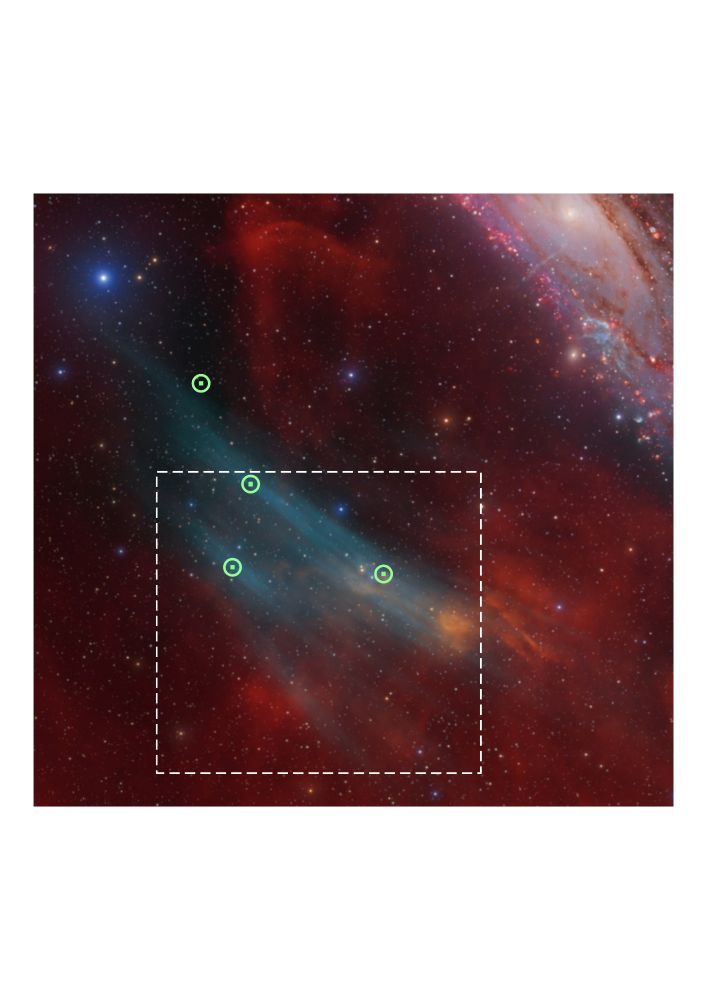
Remember the mysterious oxygen nebula discovered near the Andromeda galaxy #M31?
Today we try to decipher it! It's ✨Paper Day✨
arxiv.org/abs/2412.08327
With spectra from GTC (the largest 🔭) and OAJ large narrowband images we find the nebula is actually not related to M31!
But how?👇
#Astrophysics
Today we try to decipher it! It's ✨Paper Day✨
arxiv.org/abs/2412.08327
With spectra from GTC (the largest 🔭) and OAJ large narrowband images we find the nebula is actually not related to M31!
But how?👇
#Astrophysics
August 4, 2025 at 7:04 PM
We actually have more evidence supporting that the nebula lies within the Milky Way: For example, the separated [O II] emission we detect with our telescope 🔭 at @cefca-oaj.bsky.social.
You can read a bit more about it in the thread I wrote when we presented the paper: bsky.app/profile/alum...
You can read a bit more about it in the thread I wrote when we presented the paper: bsky.app/profile/alum...
Great picture! In fact, we already showed last December that this nebula was in the Milky Way, not in Andromeda. Here is the paper: arxiv.org/abs/2412.08327
And here is a thread explaining it:
bsky.app/profile/alum...
And here is a thread explaining it:
bsky.app/profile/alum...
Remember the mysterious oxygen nebula discovered near the Andromeda galaxy #M31?
Today we try to decipher it! It's ✨Paper Day✨
arxiv.org/abs/2412.08327
With spectra from GTC (the largest 🔭) and OAJ large narrowband images we find the nebula is actually not related to M31!
But how?👇
#Astrophysics
Today we try to decipher it! It's ✨Paper Day✨
arxiv.org/abs/2412.08327
With spectra from GTC (the largest 🔭) and OAJ large narrowband images we find the nebula is actually not related to M31!
But how?👇
#Astrophysics
August 4, 2025 at 1:28 PM
Great picture! In fact, we already showed last December that this nebula was in the Milky Way, not in Andromeda. Here is the paper: arxiv.org/abs/2412.08327
And here is a thread explaining it:
bsky.app/profile/alum...
And here is a thread explaining it:
bsky.app/profile/alum...
It is "slightly" sped up: Roughly one hour from the first to the last frame
July 23, 2025 at 10:55 AM
It is "slightly" sped up: Roughly one hour from the first to the last frame
Hi! I am the first author of the paper, thank you for sharing!
We used also a telescope from the OAJ (Teruel, Spain). And we are not sure of what it is exactly, but it does seem to be in the Milky Way.
For more info, the paper arxiv.org/abs/2412.08327 and my thread 👇
bsky.app/profile/alum...
We used also a telescope from the OAJ (Teruel, Spain). And we are not sure of what it is exactly, but it does seem to be in the Milky Way.
For more info, the paper arxiv.org/abs/2412.08327 and my thread 👇
bsky.app/profile/alum...
Remember the mysterious oxygen nebula discovered near the Andromeda galaxy #M31?
Today we try to decipher it! It's ✨Paper Day✨
arxiv.org/abs/2412.08327
With spectra from GTC (the largest 🔭) and OAJ large narrowband images we find the nebula is actually not related to M31!
But how?👇
#Astrophysics
Today we try to decipher it! It's ✨Paper Day✨
arxiv.org/abs/2412.08327
With spectra from GTC (the largest 🔭) and OAJ large narrowband images we find the nebula is actually not related to M31!
But how?👇
#Astrophysics
December 14, 2024 at 4:09 PM
Hi! I am the first author of the paper, thank you for sharing!
We used also a telescope from the OAJ (Teruel, Spain). And we are not sure of what it is exactly, but it does seem to be in the Milky Way.
For more info, the paper arxiv.org/abs/2412.08327 and my thread 👇
bsky.app/profile/alum...
We used also a telescope from the OAJ (Teruel, Spain). And we are not sure of what it is exactly, but it does seem to be in the Milky Way.
For more info, the paper arxiv.org/abs/2412.08327 and my thread 👇
bsky.app/profile/alum...
Finally, I want to thank all the co-authors and the telescope🔭 operators! Also, thanks to the discoverers of the nebula (Strottner, Dreschler, and Sainty), and thanks to Bray Falls, whose tweet about the discovery I saw and pushed me to start this project!
December 12, 2024 at 5:06 PM
Finally, I want to thank all the co-authors and the telescope🔭 operators! Also, thanks to the discoverers of the nebula (Strottner, Dreschler, and Sainty), and thanks to Bray Falls, whose tweet about the discovery I saw and pushed me to start this project!