


Amalia S. Levi, PhD
@amaliasl.bsky.social
Archives, life writing, history. Research focus: slavery & dependency; record-keeping & archives; Caribbean Jewish history; digital humanities. https://hcommons.org/members/amaliasl/ and https://heritedge.org/
🎉 Today I defended my dissertation and passed with summa cum laude.
The title is "Dependent Lives In and Beyond Archives: Enslaved People in Sephardic Jewish Households in Early Modern Bridgetown, Barbados (1654-1800)."
The abstract is below, and I hope to publish it soon.
The title is "Dependent Lives In and Beyond Archives: Enslaved People in Sephardic Jewish Households in Early Modern Bridgetown, Barbados (1654-1800)."
The abstract is below, and I hope to publish it soon.

December 16, 2025 at 3:02 PM
🎉 Today I defended my dissertation and passed with summa cum laude.
The title is "Dependent Lives In and Beyond Archives: Enslaved People in Sephardic Jewish Households in Early Modern Bridgetown, Barbados (1654-1800)."
The abstract is below, and I hope to publish it soon.
The title is "Dependent Lives In and Beyond Archives: Enslaved People in Sephardic Jewish Households in Early Modern Bridgetown, Barbados (1654-1800)."
The abstract is below, and I hope to publish it soon.
11/11 "...our understandings of history and ourselves rest on those invisible foundations. This book clarifies those foundations [labor and theory that upholds archives] while offering new possibilities for imagining archival futures in and outside of institutional holdings."
www.weherepress.org
www.weherepress.org

November 30, 2025 at 2:18 PM
11/11 "...our understandings of history and ourselves rest on those invisible foundations. This book clarifies those foundations [labor and theory that upholds archives] while offering new possibilities for imagining archival futures in and outside of institutional holdings."
www.weherepress.org
www.weherepress.org
7/ "This book reveals the profound importance of genealogy that was chronicled by family records, cultural artifacts, and court documents. These materials...demonstrate the culturally and historically specific nature of genealogical interest."
global.oup.com/academic/pro...
global.oup.com/academic/pro...

November 30, 2025 at 1:46 PM
7/ "This book reveals the profound importance of genealogy that was chronicled by family records, cultural artifacts, and court documents. These materials...demonstrate the culturally and historically specific nature of genealogical interest."
global.oup.com/academic/pro...
global.oup.com/academic/pro...
3/ Assessing selection biases in large digitized content such as Google Arts
academic.oup.com/dsh/article-...
academic.oup.com/dsh/article-...

November 18, 2025 at 5:08 PM
3/ Assessing selection biases in large digitized content such as Google Arts
academic.oup.com/dsh/article-...
academic.oup.com/dsh/article-...
1/ An analysis of the images of Early English Books Online (EEBO), and the texts of its hand-transcribed subset, EEBO-TCP.
academic.oup.com/dsh/advance-...
academic.oup.com/dsh/advance-...

November 18, 2025 at 5:08 PM
1/ An analysis of the images of Early English Books Online (EEBO), and the texts of its hand-transcribed subset, EEBO-TCP.
academic.oup.com/dsh/advance-...
academic.oup.com/dsh/advance-...
📣 Officially submitted--all 450 pages of it!
My PhD dissertation titled "Dependent Lives In and Beyond Archives: Enslaved People in Sephardic Jewish Households in Early Modern Bridgetown, Barbados (1654-1800)."
Defense is being scheduled for December!
My PhD dissertation titled "Dependent Lives In and Beyond Archives: Enslaved People in Sephardic Jewish Households in Early Modern Bridgetown, Barbados (1654-1800)."
Defense is being scheduled for December!

October 6, 2025 at 2:30 PM
📣 Officially submitted--all 450 pages of it!
My PhD dissertation titled "Dependent Lives In and Beyond Archives: Enslaved People in Sephardic Jewish Households in Early Modern Bridgetown, Barbados (1654-1800)."
Defense is being scheduled for December!
My PhD dissertation titled "Dependent Lives In and Beyond Archives: Enslaved People in Sephardic Jewish Households in Early Modern Bridgetown, Barbados (1654-1800)."
Defense is being scheduled for December!
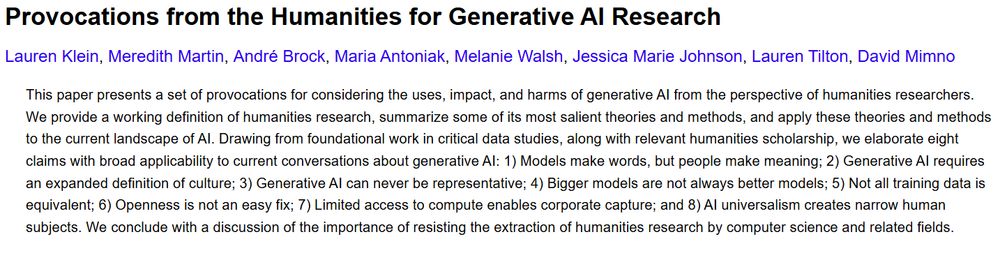
10/10 "Models make words, but people make meaning."
AI can never be representative because 95% of human wisdom and knowledge has not yet been digitized and is not accessible to LLMs.
arxiv.org/abs/2502.19190
AI can never be representative because 95% of human wisdom and knowledge has not yet been digitized and is not accessible to LLMs.
arxiv.org/abs/2502.19190
July 13, 2025 at 9:01 PM
10/10 "Models make words, but people make meaning."
AI can never be representative because 95% of human wisdom and knowledge has not yet been digitized and is not accessible to LLMs.
arxiv.org/abs/2502.19190
AI can never be representative because 95% of human wisdom and knowledge has not yet been digitized and is not accessible to LLMs.
arxiv.org/abs/2502.19190
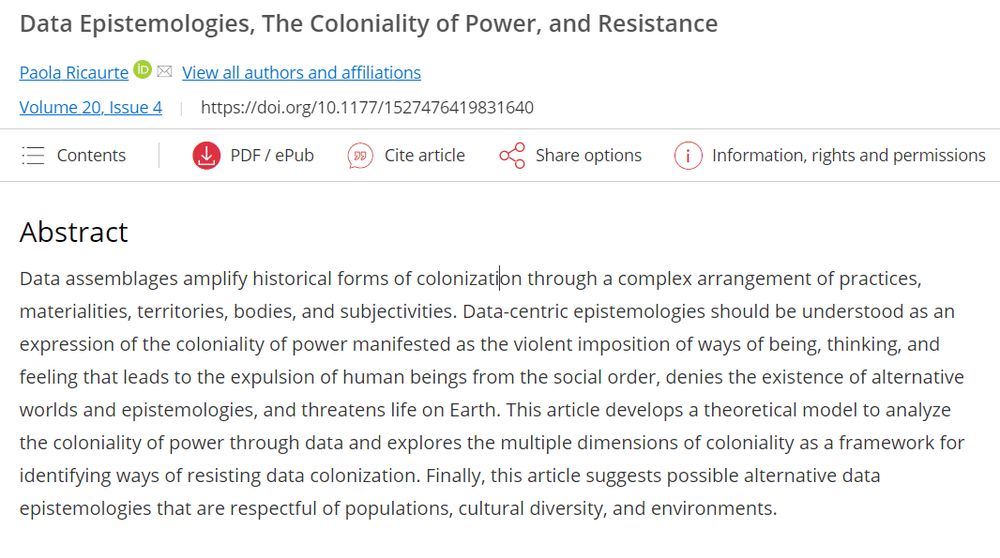
8/ To resist the coloniality of data, scholars suggest "possible alternative data epistemologies that are respectful of populations, cultural diversity, and environments."
journals.sagepub.com/doi/10.1177/...
journals.sagepub.com/doi/10.1177/...
July 13, 2025 at 9:01 PM
8/ To resist the coloniality of data, scholars suggest "possible alternative data epistemologies that are respectful of populations, cultural diversity, and environments."
journals.sagepub.com/doi/10.1177/...
journals.sagepub.com/doi/10.1177/...
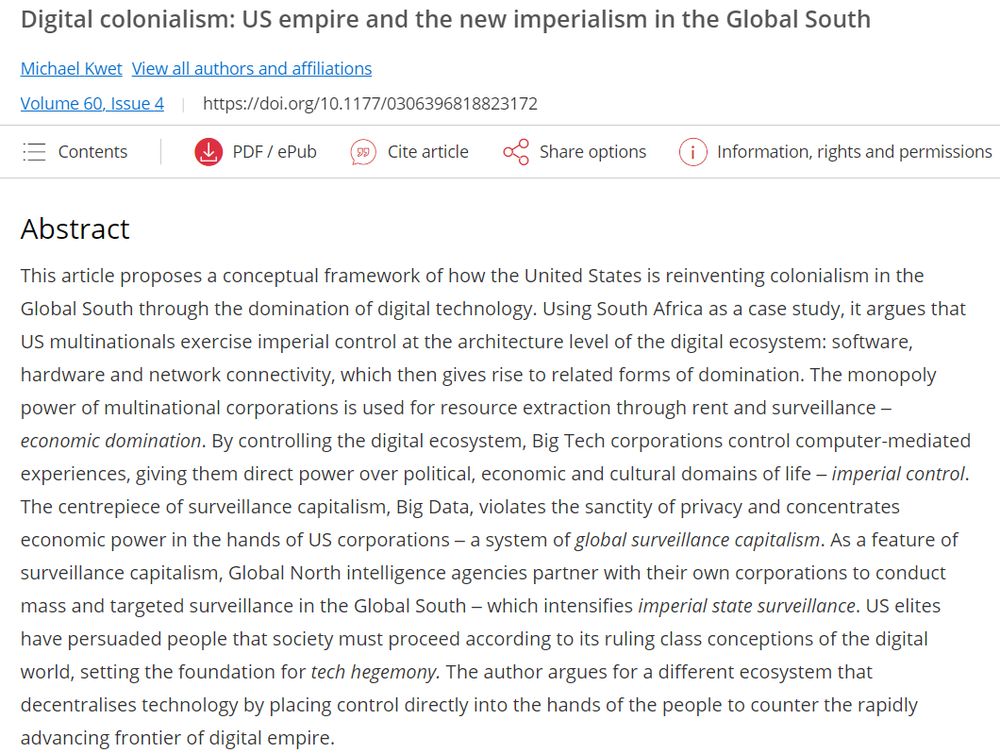
6/ In fact, "digital colonialism" means that today imperial control is translated into a system of global surveillance capitalism.
journals.sagepub.com/doi/10.1177/...
journals.sagepub.com/doi/10.1177/...
July 13, 2025 at 9:01 PM
6/ In fact, "digital colonialism" means that today imperial control is translated into a system of global surveillance capitalism.
journals.sagepub.com/doi/10.1177/...
journals.sagepub.com/doi/10.1177/...
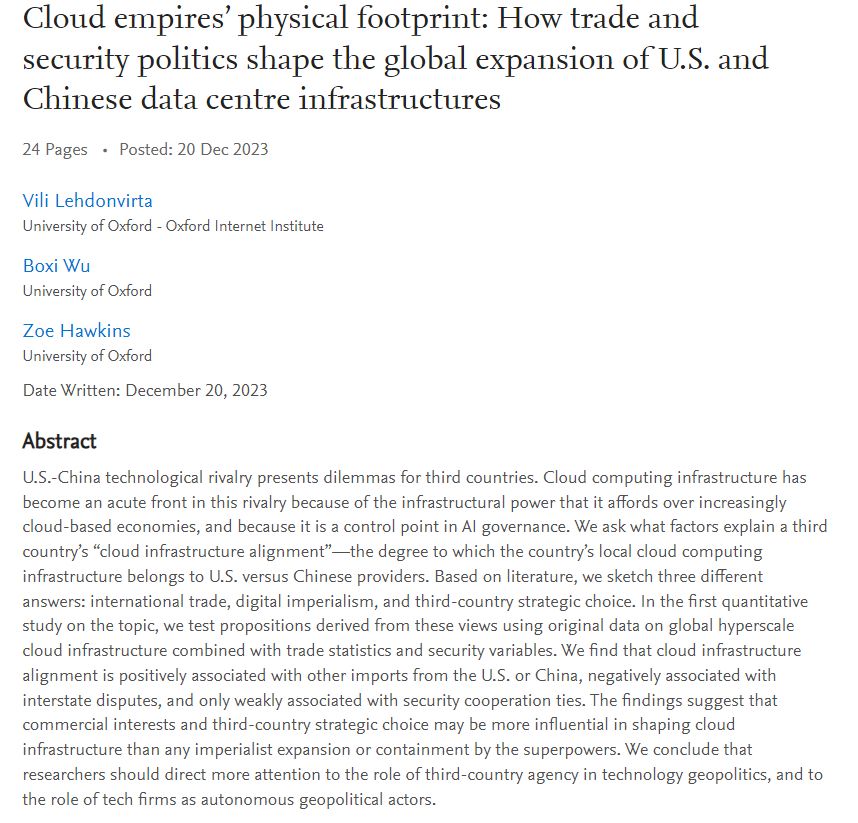
3/ Empires have not disappeared but are now in "the cloud," and data center infrastructures follow the global expansion of super powers.
dx.doi.org/10.2139/ssrn...
dx.doi.org/10.2139/ssrn...
July 13, 2025 at 9:01 PM
3/ Empires have not disappeared but are now in "the cloud," and data center infrastructures follow the global expansion of super powers.
dx.doi.org/10.2139/ssrn...
dx.doi.org/10.2139/ssrn...
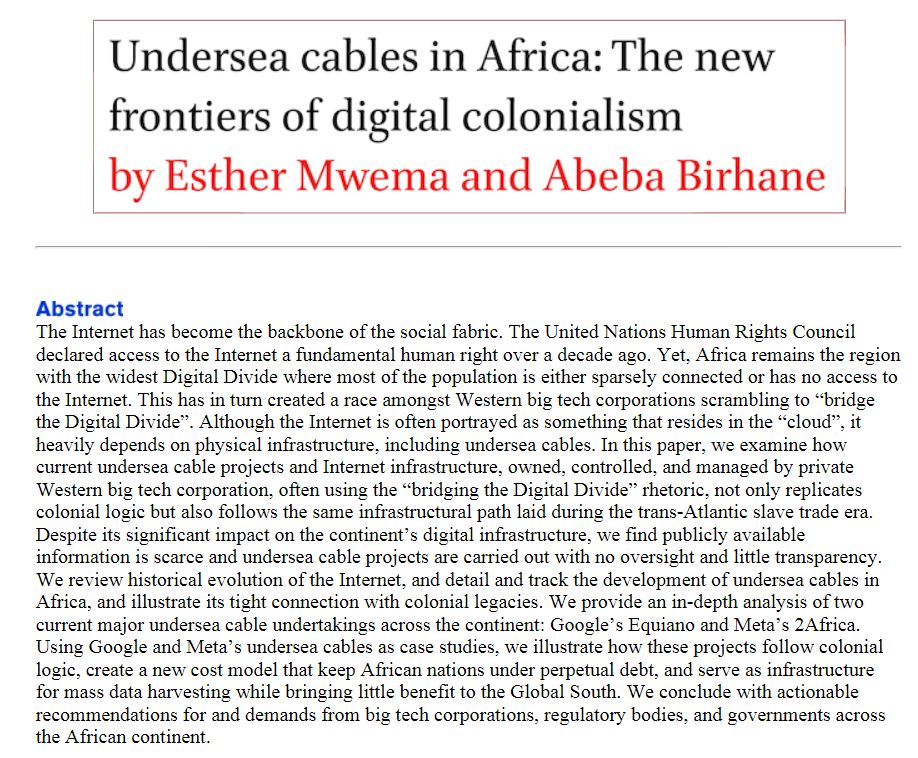
2/ In Africa, Internet infrastructure managed by private Western big tech corporations "not only replicates colonial logic but also follows the same infrastructural path laid during the trans-Atlantic slave trade.
firstmonday.org/ojs/index.ph...
firstmonday.org/ojs/index.ph...
July 13, 2025 at 9:01 PM
2/ In Africa, Internet infrastructure managed by private Western big tech corporations "not only replicates colonial logic but also follows the same infrastructural path laid during the trans-Atlantic slave trade.
firstmonday.org/ojs/index.ph...
firstmonday.org/ojs/index.ph...
Thankfully, nature blooms despite humankind.

April 3, 2025 at 12:18 PM
Thankfully, nature blooms despite humankind.
😍 Archival materialities!
"How do born-digital records transform our understanding of the materiality of the archive? How do digital techniques provide new insights into the materiality of older archives?"
Looking forward to seeing this--what a great ToC.
global.oup.com/academic/pro...
"How do born-digital records transform our understanding of the materiality of the archive? How do digital techniques provide new insights into the materiality of older archives?"
Looking forward to seeing this--what a great ToC.
global.oup.com/academic/pro...

February 9, 2025 at 3:21 PM
😍 Archival materialities!
"How do born-digital records transform our understanding of the materiality of the archive? How do digital techniques provide new insights into the materiality of older archives?"
Looking forward to seeing this--what a great ToC.
global.oup.com/academic/pro...
"How do born-digital records transform our understanding of the materiality of the archive? How do digital techniques provide new insights into the materiality of older archives?"
Looking forward to seeing this--what a great ToC.
global.oup.com/academic/pro...
First built by the 1660s, destroyed during the catastrophic 1831 hurricane, rebuilt in 1833, sold off after the end of the community in the 1920s, and restored in the 1980s, the historic "Nidhe Israel" (Outcasts of Israel) synagogue in Barbados.
As other early synagogues in the Americas,
1/
As other early synagogues in the Americas,
1/


January 12, 2025 at 6:37 PM
First built by the 1660s, destroyed during the catastrophic 1831 hurricane, rebuilt in 1833, sold off after the end of the community in the 1920s, and restored in the 1980s, the historic "Nidhe Israel" (Outcasts of Israel) synagogue in Barbados.
As other early synagogues in the Americas,
1/
As other early synagogues in the Americas,
1/
Dear publisher of academic books: why?

January 5, 2025 at 10:40 PM
Dear publisher of academic books: why?
"There is no bloodless data in slavery’s archive. Data is the evidence of terror, and the idea of data as fundamental and objective information...obscures rather than reveals the scene of the crime."
Jessica M. Johnson, "Markup Bodies," p. 70
read.dukeupress.edu/social-text/...

January 4, 2025 at 6:35 PM
"There is no bloodless data in slavery’s archive. Data is the evidence of terror, and the idea of data as fundamental and objective information...obscures rather than reveals the scene of the crime."
Jessica M. Johnson, "Markup Bodies," p. 70
read.dukeupress.edu/social-text/...
Here's to a whimsical 2025! 🙃

January 1, 2025 at 4:51 PM
Here's to a whimsical 2025! 🙃

Under each document we access in archives, there is a long, invisible, (un)intentional trail of fragmentation of information.
Recognizing these pivots in the path of documents can help us better contextualize why we find what we find.
Recognizing these pivots in the path of documents can help us better contextualize why we find what we find.

December 12, 2024 at 9:42 PM
Under each document we access in archives, there is a long, invisible, (un)intentional trail of fragmentation of information.
Recognizing these pivots in the path of documents can help us better contextualize why we find what we find.
Recognizing these pivots in the path of documents can help us better contextualize why we find what we find.
Last week, at @dependencybonn.de we held an insightful workshop on manumissions as process, leading not to freedom, but precariousness.
Case studies were as geographically dispersed as from S. Africa to the Crimea, and from the Ottoman Empire to Chile, and ranging from antiquity to late 19th c.
Case studies were as geographically dispersed as from S. Africa to the Crimea, and from the Ottoman Empire to Chile, and ranging from antiquity to late 19th c.

November 27, 2024 at 4:04 PM
Last week, at @dependencybonn.de we held an insightful workshop on manumissions as process, leading not to freedom, but precariousness.
Case studies were as geographically dispersed as from S. Africa to the Crimea, and from the Ottoman Empire to Chile, and ranging from antiquity to late 19th c.
Case studies were as geographically dispersed as from S. Africa to the Crimea, and from the Ottoman Empire to Chile, and ranging from antiquity to late 19th c.