



Amir Mitchell
@amitchell.bsky.social
Systems biologist trying to disentangle host-drug-microbiome interactions | PI at UMass medical school | hoping to keep the BS to a minimum (not always successful)
https://mitchell-lab.umassmed.edu
https://mitchell-lab.umassmed.edu
We then tested if this assosiation holds through our entire dataset. We used a functional assay for drug inactivation on all drugs and found the association holds up. A long-lag inhibition phenotype is a strong indicator of drug inactivation 7/9

December 22, 2025 at 3:25 PM
We then tested if this assosiation holds through our entire dataset. We used a functional assay for drug inactivation on all drugs and found the association holds up. A long-lag inhibition phenotype is a strong indicator of drug inactivation 7/9
That pushed us to ask whether cellular defenses might impact curve profiles. We cloned different resistance cassettes and measured how they altered the potency-matched growth curves. This strongly hinted that active drug inactivation underlies a long-lag inhibition profile 6/9

December 22, 2025 at 3:25 PM
That pushed us to ask whether cellular defenses might impact curve profiles. We cloned different resistance cassettes and measured how they altered the potency-matched growth curves. This strongly hinted that active drug inactivation underlies a long-lag inhibition profile 6/9
Overlaying the known mechanisms of action over the barycentric landscape ruled out this effect stem exclusively from how drug target bacteria (since drugs with the same mechanism can land in very different regions of the landscape) 5/9

December 22, 2025 at 3:25 PM
Overlaying the known mechanisms of action over the barycentric landscape ruled out this effect stem exclusively from how drug target bacteria (since drugs with the same mechanism can land in very different regions of the landscape) 5/9
Clustering drug by their impact on lag/rate/yield clearly revealed that they vary hugely in how they inhibited growth. In extreme cases, a drug solely affected only a single parameter 4/9

December 22, 2025 at 3:25 PM
Clustering drug by their impact on lag/rate/yield clearly revealed that they vary hugely in how they inhibited growth. In extreme cases, a drug solely affected only a single parameter 4/9
To compare drugs fairly, we didn’t use an arbitrary concentration. Instead, we interpolated each drug to a potency-matched condition (the concentration expected to produce the same overall level of inhibition) 3/9

December 22, 2025 at 3:25 PM
To compare drugs fairly, we didn’t use an arbitrary concentration. Instead, we interpolated each drug to a potency-matched condition (the concentration expected to produce the same overall level of inhibition) 3/9
So we assembled a new carefully curated dataset with growth curves across almost forty drugs, measured across multiple sub-inhibitory concentrations. For each curve, we quantified intuitive its key features: lag, growth rate, and yield 2/9

December 22, 2025 at 3:25 PM
So we assembled a new carefully curated dataset with growth curves across almost forty drugs, measured across multiple sub-inhibitory concentrations. For each curve, we quantified intuitive its key features: lag, growth rate, and yield 2/9
Beyond providing (to our knowledge) the first dynamical model for tumor colonization, our study matters given the fierce debate on the tumor microbiome. These statistical “fingerprints” may help distinguish genuine colonizers from technical artifacts/contamination (possibly even by microscopy) (6/7)

December 17, 2025 at 6:52 PM
Beyond providing (to our knowledge) the first dynamical model for tumor colonization, our study matters given the fierce debate on the tumor microbiome. These statistical “fingerprints” may help distinguish genuine colonizers from technical artifacts/contamination (possibly even by microscopy) (6/7)
The surprise: lineage sizes formed a scale-free power law that matches Zipf’s law (rank–frequency slope ~−1). This signature was robust across dozens of tumors and multiple collection days post bacteria intratumor injection (5/7)

December 17, 2025 at 6:52 PM
The surprise: lineage sizes formed a scale-free power law that matches Zipf’s law (rank–frequency slope ~−1). This signature was robust across dozens of tumors and multiple collection days post bacteria intratumor injection (5/7)
When we injected bacteria directly into the tumor (circumventing the bottleneck), we detected thousands of colonizing lineages, yet their sizes were still highly uneven (ruling out early tumor arrivers dominate) (4/7)

December 17, 2025 at 6:52 PM
When we injected bacteria directly into the tumor (circumventing the bottleneck), we detected thousands of colonizing lineages, yet their sizes were still highly uneven (ruling out early tumor arrivers dominate) (4/7)
Since we used genetically barcoded bacteria, we could also monitor growth of individual colonizers. We found that growth was extremely uneven with a handful of lineages becoming dominant (“winner-takes-most”) (3/7)

December 17, 2025 at 6:52 PM
Since we used genetically barcoded bacteria, we could also monitor growth of individual colonizers. We found that growth was extremely uneven with a handful of lineages becoming dominant (“winner-takes-most”) (3/7)
Main takeaways: Post systemic infection, there's a tight colonization bottleneck (per-cell colonization probability ~0.005%). Yet, once colonization happens, growth is remarkably fast (~50 min generation time) and bacterial load in tumors approaches saturation within a day (2/7)

December 17, 2025 at 6:52 PM
Main takeaways: Post systemic infection, there's a tight colonization bottleneck (per-cell colonization probability ~0.005%). Yet, once colonization happens, growth is remarkably fast (~50 min generation time) and bacterial load in tumors approaches saturation within a day (2/7)
We just published in @molsystbiol.org with the Mugler lab (UPitt) on bacterial population dynamics during tumor colonization (mouse model). Our study was guided by a Luria–Delbrück-style idea: infer mechanism from statistics (1/7) 🧪🦠
doi.org/10.1038/s443...
doi.org/10.1038/s443...

December 17, 2025 at 6:52 PM
We just published in @molsystbiol.org with the Mugler lab (UPitt) on bacterial population dynamics during tumor colonization (mouse model). Our study was guided by a Luria–Delbrück-style idea: infer mechanism from statistics (1/7) 🧪🦠
doi.org/10.1038/s443...
doi.org/10.1038/s443...
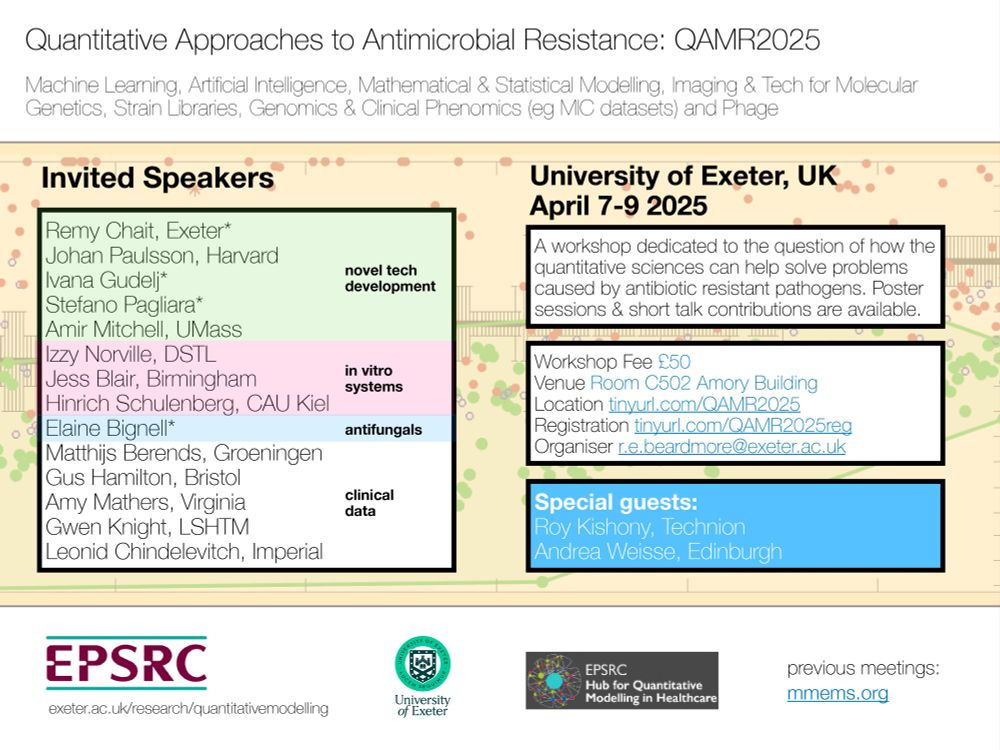
Interested in Antimicrobial Resistance & Quantitative Bio? Join a 3-day meeting+workshop with some of my favorite #AMR #QBio scientists this April (University of Exeter, UK). Register here: tinyurl.com/QAMR2025reg 🧪🦠
January 17, 2025 at 3:16 PM
Interested in Antimicrobial Resistance & Quantitative Bio? Join a 3-day meeting+workshop with some of my favorite #AMR #QBio scientists this April (University of Exeter, UK). Register here: tinyurl.com/QAMR2025reg 🧪🦠
My only complain is that I feel a bit like Cassandra, from the greek mythology, barely anyone listens 😞

December 7, 2024 at 11:23 PM
My only complain is that I feel a bit like Cassandra, from the greek mythology, barely anyone listens 😞
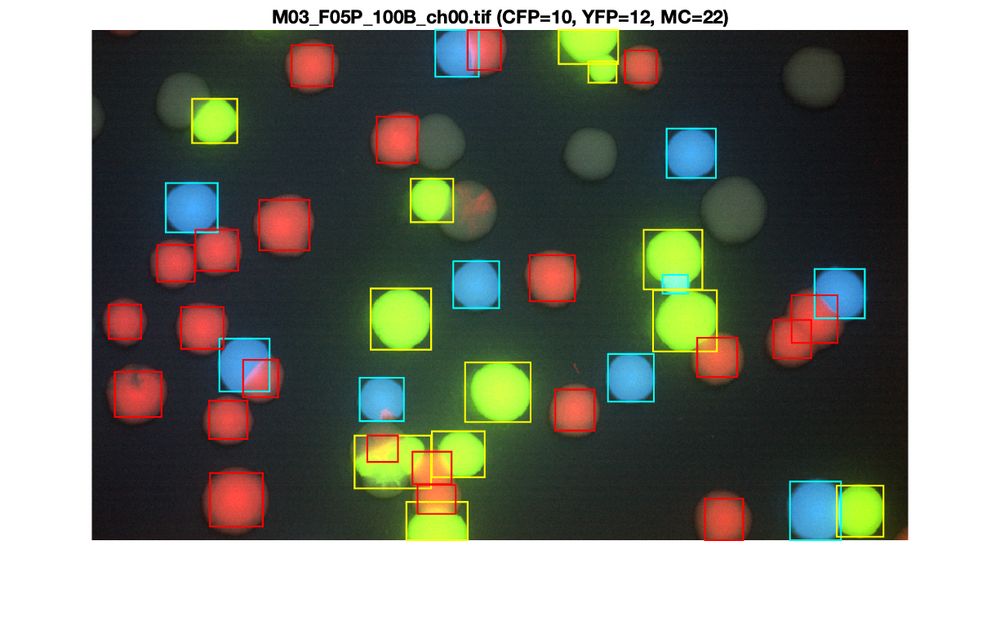
The ability of LMMs (chatGPT here) to *assist* in generating useful code for biologists a mind-blowing power multiplier 🤯! My advice to biologists at all career stages: Learn to code, its a superpower 🦸♀️🦹♂️ (simple example, counting fluorescent colonies isolated from mouse gut microbiome) 🧪🦠
December 7, 2024 at 11:04 PM
The ability of LMMs (chatGPT here) to *assist* in generating useful code for biologists a mind-blowing power multiplier 🤯! My advice to biologists at all career stages: Learn to code, its a superpower 🦸♀️🦹♂️ (simple example, counting fluorescent colonies isolated from mouse gut microbiome) 🧪🦠
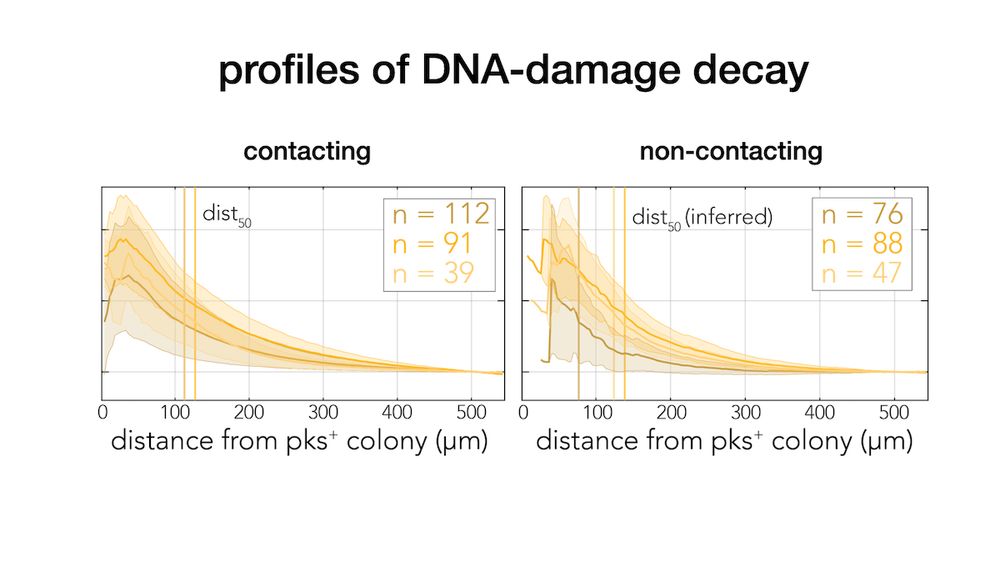
Careful quantification revealed that the damage decay curves are identical in contacting and non-contacting colonies. Therefore, direct contact is not only not required, but it doesn’t even increase the level of toxicity beyond what is expected by proximity (7/9)
December 2, 2024 at 4:44 PM
Careful quantification revealed that the damage decay curves are identical in contacting and non-contacting colonies. Therefore, direct contact is not only not required, but it doesn’t even increase the level of toxicity beyond what is expected by proximity (7/9)
Next, we monitored colibactin damage in separated colonies. This setup allowed us not only to validate contact independence, but also to accurately quantify how DNA-damage decays across distance (6/9)
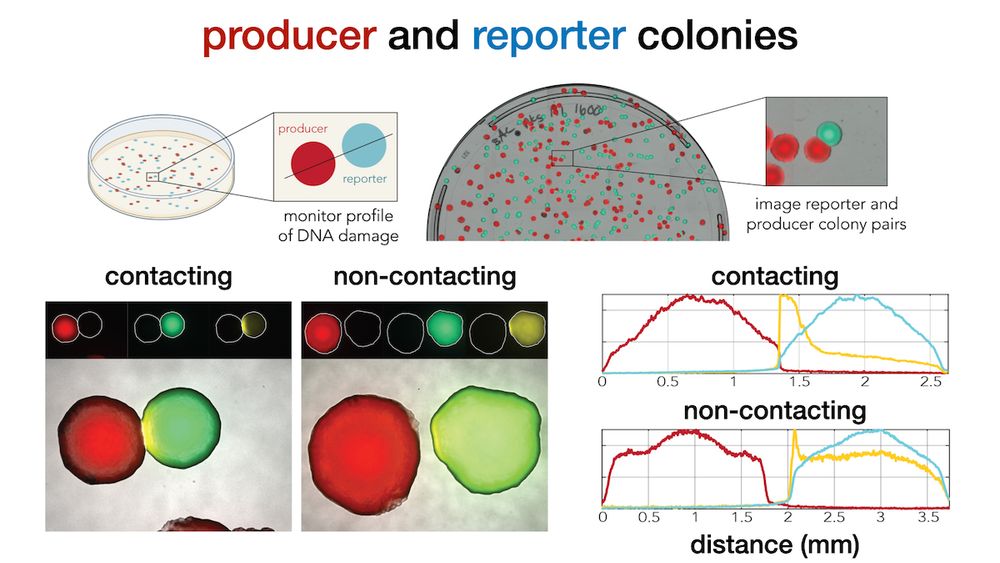
December 2, 2024 at 4:44 PM
Next, we monitored colibactin damage in separated colonies. This setup allowed us not only to validate contact independence, but also to accurately quantify how DNA-damage decays across distance (6/9)
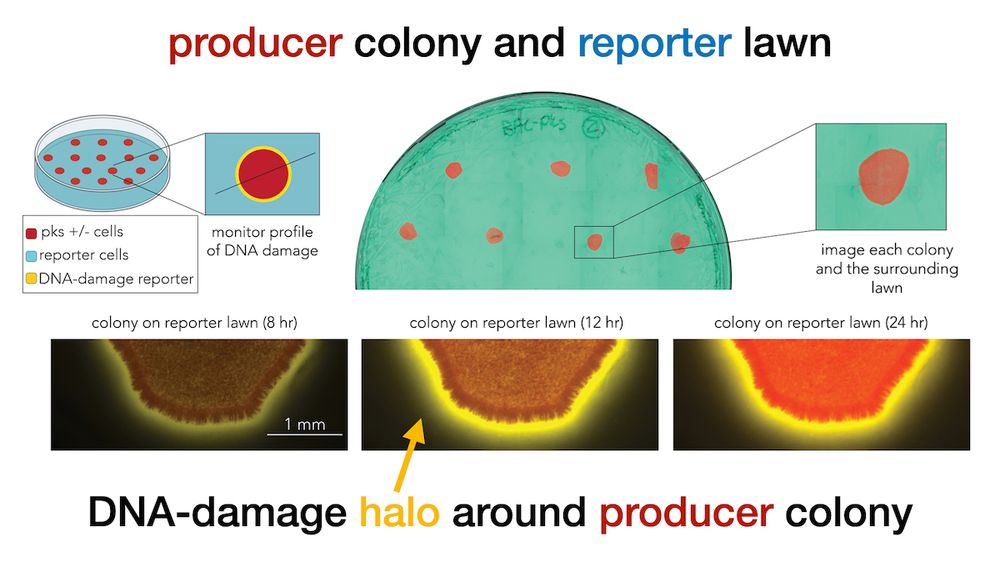
Microscopy imaging revealed that DNA damage is observed even hundreds of microns (YFP halo) away from the secreter front (mCherry) suggesting that direct cell-cell is not needed for toxicity (5/9)
December 2, 2024 at 4:44 PM
Microscopy imaging revealed that DNA damage is observed even hundreds of microns (YFP halo) away from the secreter front (mCherry) suggesting that direct cell-cell is not needed for toxicity (5/9)
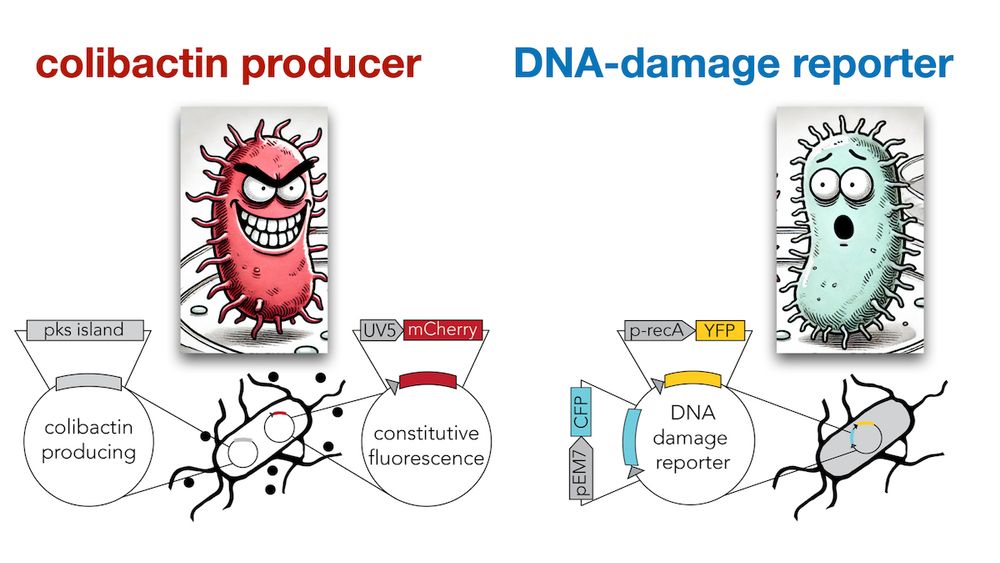
We cloned a YFP DNA-damage reporter in E. coli and tested how far colibactin induced damage “travels” across a lawn of cells (we tagged secreters and responders with constitutive mCherry and CFP to tell them apart) (4/9)
December 2, 2024 at 4:44 PM
We cloned a YFP DNA-damage reporter in E. coli and tested how far colibactin induced damage “travels” across a lawn of cells (we tagged secreters and responders with constitutive mCherry and CFP to tell them apart) (4/9)
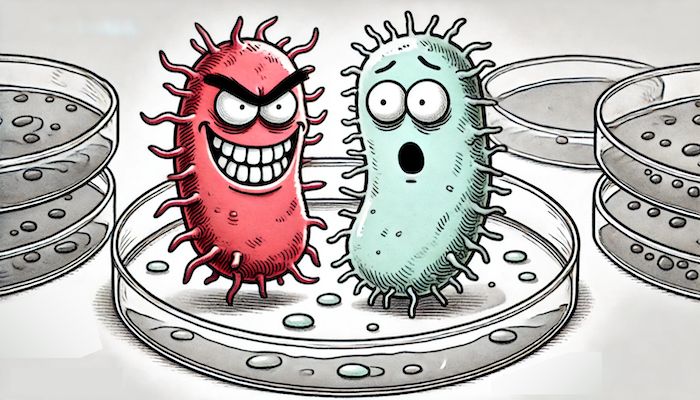
Our second paper on the bacterial toxin colibactin is now out on mBio, this time we critically evaluated the claim that colibactin toxicity necessitates cell-cell contact 🧪🦠🧵(1/9)
journals.asm.org/doi/10.1128/...
journals.asm.org/doi/10.1128/...
December 2, 2024 at 4:44 PM
Our second paper on the bacterial toxin colibactin is now out on mBio, this time we critically evaluated the claim that colibactin toxicity necessitates cell-cell contact 🧪🦠🧵(1/9)
journals.asm.org/doi/10.1128/...
journals.asm.org/doi/10.1128/...
Can’t believe we unlocked this level of the #AI hype - huge adds for @AnthropicAI in airports (Boston & Atlanta). Wonder what % of ppl even know what’s the product (<0.1% probably)

November 23, 2024 at 6:14 AM
Can’t believe we unlocked this level of the #AI hype - huge adds for @AnthropicAI in airports (Boston & Atlanta). Wonder what % of ppl even know what’s the product (<0.1% probably)
As a validation of our hypothesis on self-inflicted damage, we genetically engineered a fluorescent reporter of DNA damage and found its basal activity is indeed noticeably increased in colibactin producing cells (either engineered or natural strains)

November 23, 2024 at 7:06 AM
As a validation of our hypothesis on self-inflicted damage, we genetically engineered a fluorescent reporter of DNA damage and found its basal activity is indeed noticeably increased in colibactin producing cells (either engineered or natural strains)
Exploiting the mut signature we discovered, we scanned 10K E. coli genomes in search for compatible genomic scars. Surprisingly, we found that such scars are enriched in strains that produce colibactin. This indicates that producers cannot(!) avoid some self-inflicted damage

November 23, 2024 at 6:58 AM
Exploiting the mut signature we discovered, we scanned 10K E. coli genomes in search for compatible genomic scars. Surprisingly, we found that such scars are enriched in strains that produce colibactin. This indicates that producers cannot(!) avoid some self-inflicted damage
Yet, although in bacteria colibactin favored binding A/T rich oligos, just like in humans, colibactin damage led to to a bacteria-specific mutation profile – mostly T->A (rather than T->C)

November 23, 2024 at 6:50 AM
Yet, although in bacteria colibactin favored binding A/T rich oligos, just like in humans, colibactin damage led to to a bacteria-specific mutation profile – mostly T->A (rather than T->C)
We then tested the genomic changes colibactin induces with a mutation accumulation experiment (in a 100 parallel replicates). We repetitively exposed bacteria to colibactin producing cells and then sequenced their genomes (#WGS) to infer the mutational landscape

November 23, 2024 at 6:34 AM
We then tested the genomic changes colibactin induces with a mutation accumulation experiment (in a 100 parallel replicates). We repetitively exposed bacteria to colibactin producing cells and then sequenced their genomes (#WGS) to infer the mutational landscape