



Andrei Sourakov
@andreimoth.bsky.social
Entomologist, primary group of interest - Lepidoptera
Spinybacked Orbweaver, Gasteracantha cancriformis, from today's dog walk.

October 20, 2025 at 2:59 AM
Spinybacked Orbweaver, Gasteracantha cancriformis, from today's dog walk.
This morning, front yard. Pineapple Sage | Salvia elegans purchased @floridamuseum.bsky.social plant sale
October 20, 2025 at 2:44 AM
This morning, front yard. Pineapple Sage | Salvia elegans purchased @floridamuseum.bsky.social plant sale
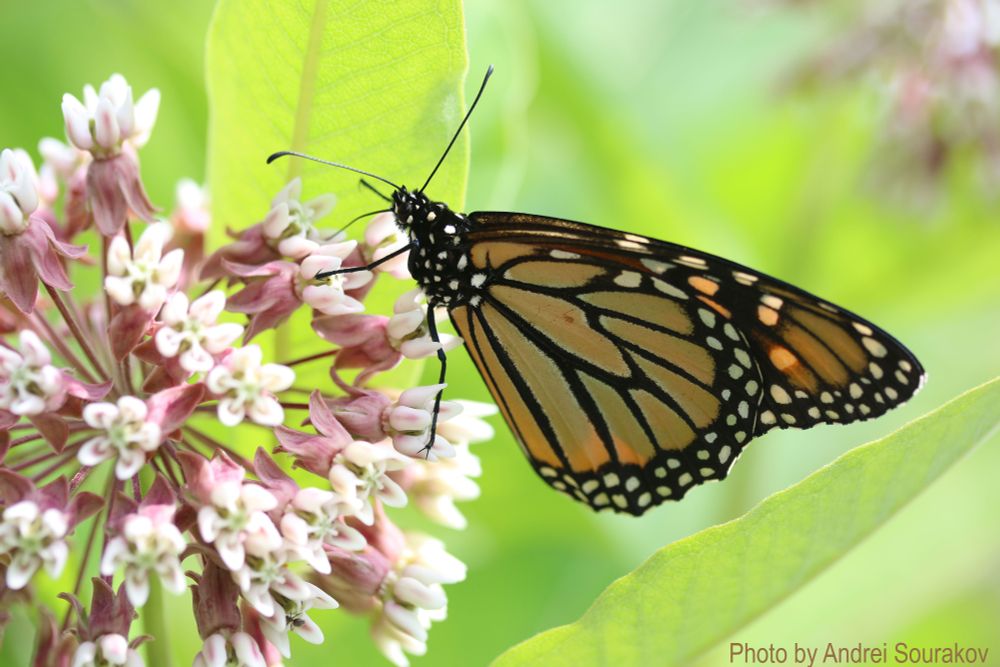
Asclepias must have evolved a 'heartfelt desire to be eaten' by the monarchs. Otherwise, why would they make flowers that are as attractive to these butterflies as their leaves?
August 28, 2025 at 10:08 AM
Asclepias must have evolved a 'heartfelt desire to be eaten' by the monarchs. Otherwise, why would they make flowers that are as attractive to these butterflies as their leaves?
Day 6 of the National Moth Week: The giant leopard moth (Hypercompe scribonia).
If parasitized, the caterpillars may alter their feeding behavior to increase their consumption of plants containing alkaloids in an effort to self-medicate. I find them sometimes on passion vines.
If parasitized, the caterpillars may alter their feeding behavior to increase their consumption of plants containing alkaloids in an effort to self-medicate. I find them sometimes on passion vines.

July 25, 2025 at 1:45 AM
Day 6 of the National Moth Week: The giant leopard moth (Hypercompe scribonia).
If parasitized, the caterpillars may alter their feeding behavior to increase their consumption of plants containing alkaloids in an effort to self-medicate. I find them sometimes on passion vines.
If parasitized, the caterpillars may alter their feeding behavior to increase their consumption of plants containing alkaloids in an effort to self-medicate. I find them sometimes on passion vines.
Day 5 of the National Moth Week: Chalcoela pegasalis; its wing margin scales resemble eyeshine from jumping spiders' eyes to (presumably) deflect their attacks.
This crambid's larvae are predators of immature paper wasps; hence it's commonly known as the Wasp Parasitizer Moth.
This crambid's larvae are predators of immature paper wasps; hence it's commonly known as the Wasp Parasitizer Moth.

July 24, 2025 at 10:13 AM
Day 5 of the National Moth Week: Chalcoela pegasalis; its wing margin scales resemble eyeshine from jumping spiders' eyes to (presumably) deflect their attacks.
This crambid's larvae are predators of immature paper wasps; hence it's commonly known as the Wasp Parasitizer Moth.
This crambid's larvae are predators of immature paper wasps; hence it's commonly known as the Wasp Parasitizer Moth.
Day 4 of the National Moth Week: the Imprerial Moth from Alachua, FL.
Not all butterflies and moths are symmetrical, and Eacles imperialis is one of the exceptions. Small black dots sprinkled on the wings are in different places on the right and on the left. How's this achieved?
Not all butterflies and moths are symmetrical, and Eacles imperialis is one of the exceptions. Small black dots sprinkled on the wings are in different places on the right and on the left. How's this achieved?

July 23, 2025 at 12:26 AM
Day 4 of the National Moth Week: the Imprerial Moth from Alachua, FL.
Not all butterflies and moths are symmetrical, and Eacles imperialis is one of the exceptions. Small black dots sprinkled on the wings are in different places on the right and on the left. How's this achieved?
Not all butterflies and moths are symmetrical, and Eacles imperialis is one of the exceptions. Small black dots sprinkled on the wings are in different places on the right and on the left. How's this achieved?
Day 3 of the National Moth Week: Idia litter moths inside a hollow tree. Yesterday, Alachua, FL.
July 21, 2025 at 11:15 AM
Day 3 of the National Moth Week: Idia litter moths inside a hollow tree. Yesterday, Alachua, FL.
Day 2 of the National Moth Week. Moth of the day: the fall webworm (Hyphantria cunea), family Erebidae, known for creating webbed nests.
Closeup of male's head (taken 3 June 2025, Gainesville, FL) gives a different perspective on this species.
Closeup of male's head (taken 3 June 2025, Gainesville, FL) gives a different perspective on this species.


July 20, 2025 at 2:38 PM
Day 2 of the National Moth Week. Moth of the day: the fall webworm (Hyphantria cunea), family Erebidae, known for creating webbed nests.
Closeup of male's head (taken 3 June 2025, Gainesville, FL) gives a different perspective on this species.
Closeup of male's head (taken 3 June 2025, Gainesville, FL) gives a different perspective on this species.
Another one from this evening

July 20, 2025 at 12:32 AM
Another one from this evening
Moth week begins with this sighting of the underwing moth in Blues Creek park in Gainesville, FL this morning.
July 19, 2025 at 7:59 PM
Moth week begins with this sighting of the underwing moth in Blues Creek park in Gainesville, FL this morning.
Wandering Hammerhead Worm on my window next to hammerhead shark. Convergence? It's been said that the wider head provides more surface area for sensory organs, which detect other animals, helping them locate prey.


June 5, 2025 at 12:13 AM
Wandering Hammerhead Worm on my window next to hammerhead shark. Convergence? It's been said that the wider head provides more surface area for sensory organs, which detect other animals, helping them locate prey.
Thanks for sharing! Possibly a lepidopteron, certainly not a butterfly. BTW, while all butterflies ARE moths, that doesn't mean that any possible moth can be referred to as a butterfly. But I suppose science.org carries a concealed poetic license.

June 3, 2025 at 10:21 PM
Thanks for sharing! Possibly a lepidopteron, certainly not a butterfly. BTW, while all butterflies ARE moths, that doesn't mean that any possible moth can be referred to as a butterfly. But I suppose science.org carries a concealed poetic license.
Would it make it easier to explain the bilateral gynandromorphs and their survival? It always seemed incredibly lucky that they are a byproduct of double fertilization of a binucleate oocyte as if they grow on trees these "binucleate oocytes"... @evolvwing.bsky.social

May 31, 2025 at 11:37 PM
Would it make it easier to explain the bilateral gynandromorphs and their survival? It always seemed incredibly lucky that they are a byproduct of double fertilization of a binucleate oocyte as if they grow on trees these "binucleate oocytes"... @evolvwing.bsky.social
Yes, on Raindrops on roses and kittens,
Bright copper kettles or warm woolen mittens.
But wing of cicada light up by the Spring
That is by far my most favorite thing.
Bright copper kettles or warm woolen mittens.
But wing of cicada light up by the Spring
That is by far my most favorite thing.

May 30, 2025 at 2:30 PM
Yes, on Raindrops on roses and kittens,
Bright copper kettles or warm woolen mittens.
But wing of cicada light up by the Spring
That is by far my most favorite thing.
Bright copper kettles or warm woolen mittens.
But wing of cicada light up by the Spring
That is by far my most favorite thing.
My first tweet 10 years ago was a robber fly photo on #worldrobberflyday. Saw this robber fly today, thought it'll be a good post to start with on my new BlueSky account. Eye-to-eye, a Fly is eating a Fly....
May 29, 2025 at 11:56 PM
My first tweet 10 years ago was a robber fly photo on #worldrobberflyday. Saw this robber fly today, thought it'll be a good post to start with on my new BlueSky account. Eye-to-eye, a Fly is eating a Fly....