



Anton Frisk Kockum
@antonfkockum.bsky.social
Quantum physicist (associate professor) at Chalmers University of Technology. Angel investor. Chess player and coach.
The many-body BICs we propose here should be accessible for state-of-the-art experiments using superconducting circuits.
(4/4)
(4/4)
November 25, 2025 at 8:31 PM
The many-body BICs we propose here should be accessible for state-of-the-art experiments using superconducting circuits.
(4/4)
(4/4)
Such spatially localised states in a continuum have previously mostly been studied for single photons/excitations.
(3/4)
(3/4)
November 25, 2025 at 8:31 PM
Such spatially localised states in a continuum have previously mostly been studied for single photons/excitations.
(3/4)
(3/4)
We show that bound states in the continuum (BICs) can form with strongly correlated two-photon states, so-called doublons, in setups with atoms coupling at multiple points to a waveguide.
(2/4)
(2/4)

November 25, 2025 at 8:31 PM
We show that bound states in the continuum (BICs) can form with strongly correlated two-photon states, so-called doublons, in setups with atoms coupling at multiple points to a waveguide.
(2/4)
(2/4)
Our Python libraries for quantum state, process, and measurement tomography are freely available to use:
github.com/mstorresh/GD...
github.com/quantshah/gd...
github.com/agtomo/SGD-QMT
(5/5)
github.com/mstorresh/GD...
github.com/quantshah/gd...
github.com/agtomo/SGD-QMT
(5/5)

GitHub - mstorresh/GD-QST: Gradient-descent for Quantum State Tomography
Gradient-descent for Quantum State Tomography. Contribute to mstorresh/GD-QST development by creating an account on GitHub.
github.com
November 23, 2025 at 12:39 PM
Our Python libraries for quantum state, process, and measurement tomography are freely available to use:
github.com/mstorresh/GD...
github.com/quantshah/gd...
github.com/agtomo/SGD-QMT
(5/5)
github.com/mstorresh/GD...
github.com/quantshah/gd...
github.com/agtomo/SGD-QMT
(5/5)
We now show how these data-processing methods also work well for extracting the POVM elements that characterise a measurement device.
(4/5)
(4/5)
November 23, 2025 at 12:39 PM
We now show how these data-processing methods also work well for extracting the POVM elements that characterise a measurement device.
(4/5)
(4/5)
We have previously developed and demonstrated such data-processing methods for quantum state and process tomography:
doi.org/10.1088/2058...
doi.org/10.1103/Phys...
(3/5)
doi.org/10.1103/Phys...
(3/5)
Gradient-descent methods for fast quantum state tomography - IOPscience
Gradient-descent methods for fast quantum state tomography, Gaikwad, Akshay, Torres, Manuel Sebastian, Ahmed, Shahnawaz, Kockum, Anton Frisk
doi.org
November 23, 2025 at 12:39 PM
We have previously developed and demonstrated such data-processing methods for quantum state and process tomography:
doi.org/10.1088/2058...
doi.org/10.1103/Phys...
(3/5)
doi.org/10.1103/Phys...
(3/5)
In this work, we complete the tomography trio (state, process, and measurement tomography) with gradient-descent-based data-processing methods.
(2/5)
(2/5)

November 23, 2025 at 12:39 PM
In this work, we complete the tomography trio (state, process, and measurement tomography) with gradient-descent-based data-processing methods.
(2/5)
(2/5)
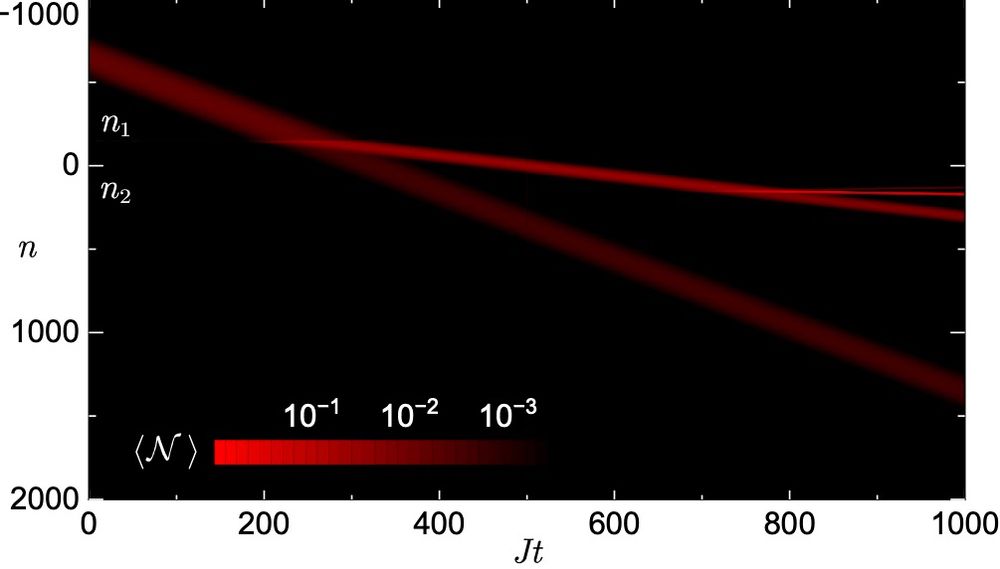
Adding more physical coupling point to create an actual giant atom, we can make the scattering unidirectional and the conversion into a desired multi-photon state perfect.
(5/5)
(5/5)

November 19, 2025 at 10:50 AM
Adding more physical coupling point to create an actual giant atom, we can make the scattering unidirectional and the conversion into a desired multi-photon state perfect.
(5/5)
(5/5)
The states with different numbers of photons naturally separate in space due to having different group velocities.
(4/5)
(4/5)

November 19, 2025 at 10:50 AM
The states with different numbers of photons naturally separate in space due to having different group velocities.
(4/5)
(4/5)
The scattering potential becomes nonlocal due to the spatial extension of the multi-photon states; we term this a pseudo-giant atom.
(3/5)
(3/5)

November 19, 2025 at 10:49 AM
The scattering potential becomes nonlocal due to the spatial extension of the multi-photon states; we term this a pseudo-giant atom.
(3/5)
(3/5)
We show how correlated two- and three-photon states (doublons and triplons) can be generated by scattering an incoming single photon off excited two-level emitters in a nonlinear waveguide.
(2/5)
(2/5)
November 19, 2025 at 10:49 AM
We show how correlated two- and three-photon states (doublons and triplons) can be generated by scattering an incoming single photon off excited two-level emitters in a nonlinear waveguide.
(2/5)
(2/5)
Overall, we see better logical error suppression per amount of entanglement (ebits) than for other protocols, although it comes at the cost of an increased number of physical qubits to achieve the same code distance.
(7/7)
(7/7)

October 16, 2025 at 6:34 PM
Overall, we see better logical error suppression per amount of entanglement (ebits) than for other protocols, although it comes at the cost of an increased number of physical qubits to achieve the same code distance.
(7/7)
(7/7)
To avoid propagation of errors from the interface, we use an alternating sequence of syndrome-measurement circuits, which may be of independent interest.
(6/7)
(6/7)


October 16, 2025 at 6:33 PM
To avoid propagation of errors from the interface, we use an alternating sequence of syndrome-measurement circuits, which may be of independent interest.
(6/7)
(6/7)
Our protocol is based on an equivalence between Bell measurements and Bell pairs, which can be seen through ZX calculus.
(5/7)
(5/7)

October 16, 2025 at 6:33 PM
Our protocol is based on an equivalence between Bell measurements and Bell pairs, which can be seen through ZX calculus.
(5/7)
(5/7)
In our work, we show how to perform lattice surgery (logical operations between encoded error-corrected qubits) across modules in a way that requires roughly half the amount of entanglement compared to previous protocols.
(4/7)
(4/7)
October 16, 2025 at 6:32 PM
In our work, we show how to perform lattice surgery (logical operations between encoded error-corrected qubits) across modules in a way that requires roughly half the amount of entanglement compared to previous protocols.
(4/7)
(4/7)
Thankfully, it has been shown that such an architecture can work even if the links between modules are more noisy than operations within modules. However, establishing entanglement between qubits on different modules is still a bottleneck.
(3/7)
(3/7)
October 16, 2025 at 6:32 PM
Thankfully, it has been shown that such an architecture can work even if the links between modules are more noisy than operations within modules. However, establishing entanglement between qubits on different modules is still a bottleneck.
(3/7)
(3/7)
Getting to well-functioning large-scale quantum computers will most likely require quantum error correction and a modular architecture, where several smaller processors are connected.
(2/7)
(2/7)
October 16, 2025 at 6:32 PM
Getting to well-functioning large-scale quantum computers will most likely require quantum error correction and a modular architecture, where several smaller processors are connected.
(2/7)
(2/7)
As an application, we show these three-qubit gates could rapidly generate high-fidelity highly entangled GHZ states among three and five giant atoms along a waveguide.
(6/6)
(6/6)

October 7, 2025 at 11:56 AM
As an application, we show these three-qubit gates could rapidly generate high-fidelity highly entangled GHZ states among three and five giant atoms along a waveguide.
(6/6)
(6/6)
This draws inspiration from our previous work with these three-qubit gates in superconducting qubits(theory: link.aps.org/doi/10.1103/..., experiment: www.nature.com/articles/s41...), but works without tunable coupler elements and allows greater connectivity.
(5/6)
(5/6)

Fast Multiqubit Gates through Simultaneous Two-Qubit Gates
A recipe to create multi-qubit gates that uses existing quantum hardware-- without any additional components, complicated pulse shapes, or changes in design--is proposed, promising a reduction in circ...
link.aps.org
October 7, 2025 at 11:55 AM
This draws inspiration from our previous work with these three-qubit gates in superconducting qubits(theory: link.aps.org/doi/10.1103/..., experiment: www.nature.com/articles/s41...), but works without tunable coupler elements and allows greater connectivity.
(5/6)
(5/6)
Here, we show that three giant atoms can be tuned to points where they don’t lose any energy into the waveguide, but exchange excitations through the waveguide to implement three-qubit CCZS and DIV gates.
(4/6)
(4/6)

October 7, 2025 at 11:55 AM
Here, we show that three giant atoms can be tuned to points where they don’t lose any energy into the waveguide, but exchange excitations through the waveguide to implement three-qubit CCZS and DIV gates.
(4/6)
(4/6)