



Antonio C Fuentes-Fayos
@antoniocafufa.bsky.social
PhD in Biomedical Science 🧠 Postdoctoral at Cedars-Sinai (USA) - @Breuniglab 🧬-EYRC Board Member-EANO youngster Committee Member-Future Leader (TBTC)
Reposted by Antonio C Fuentes-Fayos
🧠 Join the next #EANO Youngsters Journal Club! Upcoming session: “Lighting up PET imaging in IDH mutant glioma” [Mair, M., Werner, J. M., Weller, J., et al. (2025), doi.org/10.1093/neuo...
🗓 November 11, 2025 | 🕓 16:30–17:30 CET
👥 Open to all EANO members | Free of charge
🔗 Learn more: www.eano.eu
🗓 November 11, 2025 | 🕓 16:30–17:30 CET
👥 Open to all EANO members | Free of charge
🔗 Learn more: www.eano.eu

November 6, 2025 at 8:34 AM
🧠 Join the next #EANO Youngsters Journal Club! Upcoming session: “Lighting up PET imaging in IDH mutant glioma” [Mair, M., Werner, J. M., Weller, J., et al. (2025), doi.org/10.1093/neuo...
🗓 November 11, 2025 | 🕓 16:30–17:30 CET
👥 Open to all EANO members | Free of charge
🔗 Learn more: www.eano.eu
🗓 November 11, 2025 | 🕓 16:30–17:30 CET
👥 Open to all EANO members | Free of charge
🔗 Learn more: www.eano.eu
🎥 Missed it the first time? We’ve got you covered!
If you couldn’t attend our recent session — no worries. The full recording is now available on YouTube! 🙌
📺 Watch here ➡️ youtu.be/SD-5T-lCmiY?...
🧠 #JournalClub | #EANOYoungsters | #NeuroOncology
If you couldn’t attend our recent session — no worries. The full recording is now available on YouTube! 🙌
📺 Watch here ➡️ youtu.be/SD-5T-lCmiY?...
🧠 #JournalClub | #EANOYoungsters | #NeuroOncology
June 26, 2025 at 10:35 PM
🎥 Missed it the first time? We’ve got you covered!
If you couldn’t attend our recent session — no worries. The full recording is now available on YouTube! 🙌
📺 Watch here ➡️ youtu.be/SD-5T-lCmiY?...
🧠 #JournalClub | #EANOYoungsters | #NeuroOncology
If you couldn’t attend our recent session — no worries. The full recording is now available on YouTube! 🙌
📺 Watch here ➡️ youtu.be/SD-5T-lCmiY?...
🧠 #JournalClub | #EANOYoungsters | #NeuroOncology
Ready to share the results of one my projects at #SNOped2025 in San Diego!

May 15, 2025 at 9:41 PM
Ready to share the results of one my projects at #SNOped2025 in San Diego!
I hope to see you on June 5th at the next EANO Youngsters Journal Club session! 🧠
The Journal Club is open to all EANO members working in the diverse fields of neuro-oncology—there is no age limit, and participation is free of charge.
www.eano.eu/eanowebinar/
The Journal Club is open to all EANO members working in the diverse fields of neuro-oncology—there is no age limit, and participation is free of charge.
www.eano.eu/eanowebinar/

May 13, 2025 at 4:20 PM
I hope to see you on June 5th at the next EANO Youngsters Journal Club session! 🧠
The Journal Club is open to all EANO members working in the diverse fields of neuro-oncology—there is no age limit, and participation is free of charge.
www.eano.eu/eanowebinar/
The Journal Club is open to all EANO members working in the diverse fields of neuro-oncology—there is no age limit, and participation is free of charge.
www.eano.eu/eanowebinar/
Last Friday, I had the honor of meeting the family of Henrietta Lacks (her granddaughter, grandson, and great-granddaughter) at a wonderful symposium.
Grateful for HeLa cells and the countless scientific discoveries they have made possible 🧫🔬
Grateful for HeLa cells and the countless scientific discoveries they have made possible 🧫🔬


April 2, 2025 at 1:20 PM
Last Friday, I had the honor of meeting the family of Henrietta Lacks (her granddaughter, grandson, and great-granddaughter) at a wonderful symposium.
Grateful for HeLa cells and the countless scientific discoveries they have made possible 🧫🔬
Grateful for HeLa cells and the countless scientific discoveries they have made possible 🧫🔬
Reposted by Antonio C Fuentes-Fayos
📢 #EANOJournalClub update! Our #EANOYoungsters Committee has restructured the JC Working Group & welcomed new members! 🎉 Led by @antoniocafufa.bsky.social the Journal Club remains a great platform for discussion & knowledge exchange. Want to propose/present a paper? Drop us a message! #NeuroOncology

March 14, 2025 at 8:29 AM
📢 #EANOJournalClub update! Our #EANOYoungsters Committee has restructured the JC Working Group & welcomed new members! 🎉 Led by @antoniocafufa.bsky.social the Journal Club remains a great platform for discussion & knowledge exchange. Want to propose/present a paper? Drop us a message! #NeuroOncology
Reposted by Antonio C Fuentes-Fayos
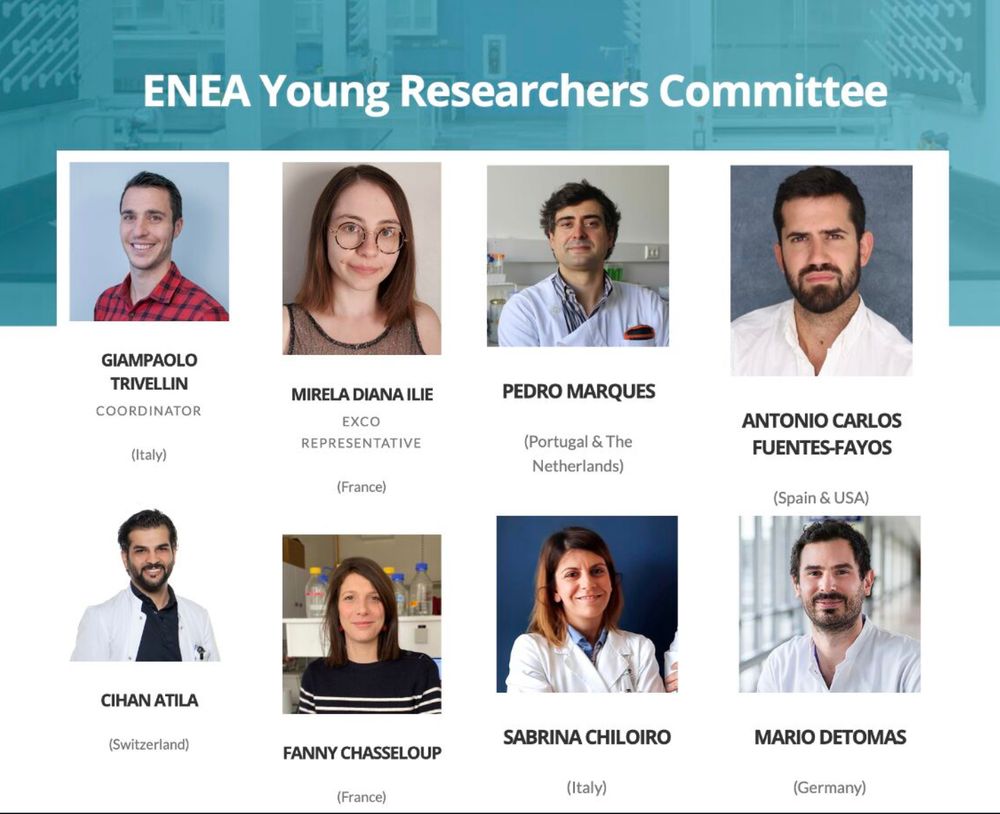
Welcome to the ENEA Young Researchers Committee (EYRC), a subcommittee of ENEA dedicated to supporting early career scientists in neuroendocrinology.
✨ Our Mission:
🔹 Strengthening ENEA’s visibility
🔹 Representing early career researchers
🔹 Organizing symposia & workshops
🔹 And much more ...
✨ Our Mission:
🔹 Strengthening ENEA’s visibility
🔹 Representing early career researchers
🔹 Organizing symposia & workshops
🔹 And much more ...
February 16, 2025 at 4:12 PM
Welcome to the ENEA Young Researchers Committee (EYRC), a subcommittee of ENEA dedicated to supporting early career scientists in neuroendocrinology.
✨ Our Mission:
🔹 Strengthening ENEA’s visibility
🔹 Representing early career researchers
🔹 Organizing symposia & workshops
🔹 And much more ...
✨ Our Mission:
🔹 Strengthening ENEA’s visibility
🔹 Representing early career researchers
🔹 Organizing symposia & workshops
🔹 And much more ...
🇪🇺🔵⚪️🧠 So glad to announce that I've been selected to be one of the member of ENEA Young Researchers Committee (EYRC) - @ENEA_Young.
Excited to jump off with new projects together with @GP_R101.
Excited to jump off with new projects together with @GP_R101.
March 12, 2025 at 6:15 AM
🇪🇺🔵⚪️🧠 So glad to announce that I've been selected to be one of the member of ENEA Young Researchers Committee (EYRC) - @ENEA_Young.
Excited to jump off with new projects together with @GP_R101.
Excited to jump off with new projects together with @GP_R101.
Also, I cannot wait to start working with TappAS developed by @aarzalluz_ #PacBio #splicing #SingleCell
March 12, 2025 at 6:15 AM
Also, I cannot wait to start working with TappAS developed by @aarzalluz_ #PacBio #splicing #SingleCell
Take a look to the session "Single-cell Iso-Seq applications in cancer and neurological disorders" at PacBio Iso-Seq Social Club Vol.3! Thank to @Magdoll @PacBio for taking me to this event. #longreadscSeq #PacBio

March 12, 2025 at 6:15 AM
Take a look to the session "Single-cell Iso-Seq applications in cancer and neurological disorders" at PacBio Iso-Seq Social Club Vol.3! Thank to @Magdoll @PacBio for taking me to this event. #longreadscSeq #PacBio
March 12, 2025 at 6:15 AM
Excited to start working at @breuniglab next Monday! A lot of things to learn and to do it🧬🔬🧫🥼💻 #postdoclife
March 12, 2025 at 6:15 AM
Excited to start working at @breuniglab next Monday! A lot of things to learn and to do it🧬🔬🧫🥼💻 #postdoclife
In two days, I’ll start my new PostDoc life. New place, new challenges, and very excited.
March 12, 2025 at 6:15 AM
In two days, I’ll start my new PostDoc life. New place, new challenges, and very excited.
🟣The effect of a spliceosome inhibitor is evaluated as a new way to fight against glioblastoma. See our work recently published in Journal of Experimental & Clinical Cancer Research
@OncMet27
jeccr.biomedcentral.com/articles/10.11…
@OncMet27
jeccr.biomedcentral.com/articles/10.11…
SF3B1 inhibition disrupts malignancy and prolongs survival in glioblastoma patients through BCL2L1 splicing and mTOR/ß-catenin pathways imbalances - Journal of Experimental & Clinical Cancer Research
Background Glioblastoma is one of the most devastating cancer worldwide based on its locally aggressive behavior and because it cannot be cured by current therapies. Defects in alternative splicing process are frequent in cancer. Recently, we demonstrated that dysregulation of the spliceosome is directly associated with glioma development, progression, and aggressiveness. Methods Different human cohorts and a dataset from different glioma mouse models were analyzed to determine the mutation frequency as well as the gene and protein expression levels between tumor and control samples of the splicing-factor-3B-subunit-1 (SF3B1), an essential and druggable spliceosome component. SF3B1 expression was also explored at the single-cell level across all cell subpopulations and transcriptomic programs. The association of SF3B1 expression with relevant clinical data (e.g., overall survival) in different human cohorts was also analyzed. Different functional (proliferation/migration/tumorspheres and colonies formation/VEGF secretion/apoptosis) and mechanistic (gene expression/signaling pathways) assays were performed in three different glioblastomas cell models (human primary cultures and cell lines) in response to SF3B1 blockade (using pladienolide B treatment). Moreover, tumor progression and formation were monitored in response to SF3B1 blockade in two preclinical xenograft glioblastoma mouse models. Results Our data provide novel evidence demonstrating that the splicing-factor-3B-subunit-1 (SF3B1, an essential and druggable spliceosome component) is low-frequency mutated in human gliomas (~ 1 %) but widely overexpressed in glioblastoma compared with control samples from the different human cohorts and mouse models included in the present study, wherein SF3B1 levels are associated with key molecular and clinical features (e.g., overall survival, poor prognosis and/or drug resistance). Remarkably, in vitro and in vivo blockade of SF3B1 activity with pladienolide B drastically altered multiple glioblastoma pathophysiological processes (i.e., reduction in proliferation, migration, tumorspheres formation, VEGF secretion, tumor initiation and increased apoptosis) likely by suppressing AKT/mTOR/ß-catenin pathways, and an imbalance of BCL2L1 splicing. Conclusions Together, we highlight SF3B1 as a potential diagnostic and prognostic biomarker and an efficient pharmacological target in glioblastoma, offering a clinically relevant opportunity worth to be explored in humans.
jeccr.biomedcentral.com
March 12, 2025 at 6:15 AM
🟣The effect of a spliceosome inhibitor is evaluated as a new way to fight against glioblastoma. See our work recently published in Journal of Experimental & Clinical Cancer Research
@OncMet27
jeccr.biomedcentral.com/articles/10.11…
@OncMet27
jeccr.biomedcentral.com/articles/10.11…
Two days to my PhD defense🎓, trying to maintain a balance between being nervous and being excited 💪🏼
March 12, 2025 at 6:15 AM
Two days to my PhD defense🎓, trying to maintain a balance between being nervous and being excited 💪🏼
🟡We are pleased to share that our work on the oncogenic role of the truncated sst5TMD4 splicing variant in glioblastoma is featured as a cover in the February issue of @IJMS_MDPI @OncMet27
doi.org/10.3390/ijms23…
doi.org/10.3390/ijms23…

Somatostatin Receptor Splicing Variant sst5TMD4 Overexpression in Glioblastoma Is Associated with Poor Survival, Increased Aggressiveness Features, and Somatostatin Analogs Resistance
Glioblastoma (GBM) is the most malignant and lethal brain tumor. Current standard treatment consists of surgery followed by radiotherapy/chemotherapy; however, this is only a palliative approach with a mean post-operative survival of scarcely ~12–15 months. Thus, the identification of novel therapeutic targets to treat this devastating pathology is urgently needed. In this context, the truncated splicing variant of the somatostatin receptor subtype 5 (sst5TMD4), which is produced by aberrant alternative splicing, has been demonstrated to be overexpressed and associated with increased aggressiveness features in several tumors. However, the presence, functional role, and associated molecular mechanisms of sst5TMD4 in GBM have not been yet explored. Therefore, we performed a comprehensive analysis to characterize the expression and pathophysiological role of sst5TMD4 in human GBM. sst5TMD4 was significantly overexpressed (at mRNA and protein levels) in human GBM tissue compared to non-tumor (control) brain tissue. Remarkably, sst5TMD4 expression was significantly associated with poor overall survival and recurrent tumors in GBM patients. Moreover, in vitro sst5TMD4 overexpression (by specific plasmid) increased, whereas sst5TMD4 silencing (by specific siRNA) decreased, key malignant features (i.e., proliferation and migration capacity) of GBM cells (U-87 MG/U-118 MG models). Furthermore, sst5TMD4 overexpression in GBM cells altered the activity of multiple key signaling pathways associated with tumor aggressiveness/progression (AKT/JAK-STAT/NF-κB/TGF-β), and its silencing sensitized GBM cells to the antitumor effect of pasireotide (a somatostatin analog). Altogether, these results demonstrate that sst5TMD4 is overexpressed and associated with enhanced malignancy features in human GBMs and reveal its potential utility as a novel diagnostic/prognostic biomarker and putative therapeutic target in GBMs.
doi.org
March 12, 2025 at 6:14 AM
🟡We are pleased to share that our work on the oncogenic role of the truncated sst5TMD4 splicing variant in glioblastoma is featured as a cover in the February issue of @IJMS_MDPI @OncMet27
doi.org/10.3390/ijms23…
doi.org/10.3390/ijms23…
March 12, 2025 at 6:14 AM

Amazing bunch of speakers at the XIII symposium of the Spanish neuroncological research group @GrupoGeino , I would like to highlight the talk by Dr. Parrinelo about Glioblastoma invasion hijacks brain development and regeneration @Parrinello_Lab 🧠💪🏼

March 12, 2025 at 6:14 AM
Amazing bunch of speakers at the XIII symposium of the Spanish neuroncological research group @GrupoGeino , I would like to highlight the talk by Dr. Parrinelo about Glioblastoma invasion hijacks brain development and regeneration @Parrinello_Lab 🧠💪🏼
Gracias a @GrupoGeino por permitirme atender a este XVI Curso de Neuro-Oncología Médica - GEINO! Aprendiendo desde un punto de vista más clínico los tumores cerebrales

March 12, 2025 at 6:14 AM
Gracias a @GrupoGeino por permitirme atender a este XVI Curso de Neuro-Oncología Médica - GEINO! Aprendiendo desde un punto de vista más clínico los tumores cerebrales
Uniros a esta #nochedelosinvestigadores #NIGHTspain para conocer más sobre tumores cerebrales!
x.com/IMIBIC/status/…
x.com/IMIBIC/status/…
March 12, 2025 at 6:14 AM
Uniros a esta #nochedelosinvestigadores #NIGHTspain para conocer más sobre tumores cerebrales!
x.com/IMIBIC/status/…
x.com/IMIBIC/status/…
🧩Gathering hobbies: Brain Science + @LEGO_Group ! Thanks to @10xGenomics #LEGO #singlecellgenomics #glioblastoma #research

March 12, 2025 at 6:14 AM
🧩Gathering hobbies: Brain Science + @LEGO_Group ! Thanks to @10xGenomics #LEGO #singlecellgenomics #glioblastoma #research
👏🏼🧠🗣 Amazing new era of single cell genomics, more cells, more resolution and better results #HT #singlecell #glioblastomaresearch
x.com/10xGenomics/st…
x.com/10xGenomics/st…
March 12, 2025 at 6:14 AM
👏🏼🧠🗣 Amazing new era of single cell genomics, more cells, more resolution and better results #HT #singlecell #glioblastomaresearch
x.com/10xGenomics/st…
x.com/10xGenomics/st…
Amazing @EANOassociation webinar on metabolic vulnerabilities in brain tumor colonization chaired by @valientelab 🟢Nice speakers in #braintumoresearch
March 12, 2025 at 6:14 AM
Amazing @EANOassociation webinar on metabolic vulnerabilities in brain tumor colonization chaired by @valientelab 🟢Nice speakers in #braintumoresearch
Be a team you will get huge things💪🏼! Thanks to @ESEndocrinology for awarding me and my colleagues for our scientific contribution to the neuro-oncology field! #drugrepurposing #braintumors #Glioblastoma #europeanyounginvestigatoraward
x.com/OncMet27/statu…
x.com/OncMet27/statu…
March 12, 2025 at 6:14 AM
Be a team you will get huge things💪🏼! Thanks to @ESEndocrinology for awarding me and my colleagues for our scientific contribution to the neuro-oncology field! #drugrepurposing #braintumors #Glioblastoma #europeanyounginvestigatoraward
x.com/OncMet27/statu…
x.com/OncMet27/statu…