


Arash Behboodi
@arashbehboodi.bsky.social
Director of Engineering @Qualcomm AI Research
information theory, machine learning, math and philosophy (will post more about it here)
information theory, machine learning, math and philosophy (will post more about it here)
Our internship hiring campaign has started! We have exciting opportunities at Qualcomm AI Research on various topics such as model efficiency, generative vision, agentic AI and reasoning, embodied AI, robustness and alignment.
Apply here:
careers.qualcomm.com/careers/job/...
Apply here:
careers.qualcomm.com/careers/job/...
FY26 Intern - Deep Learning Researcher Internship - 4 months, Amsterdam | Qualcomm Careers | Engineering Jobs and More | Qualcomm
Search open positions at Qualcomm. Learn more about how our culture of collaboration and robust benefits program allow our employees to live well and exceed their potential.
careers.qualcomm.com
November 24, 2025 at 8:46 AM
Our internship hiring campaign has started! We have exciting opportunities at Qualcomm AI Research on various topics such as model efficiency, generative vision, agentic AI and reasoning, embodied AI, robustness and alignment.
Apply here:
careers.qualcomm.com/careers/job/...
Apply here:
careers.qualcomm.com/careers/job/...
The credit is really for @sukjulian.bsky.social, Thomas and Gabriele! Congrats to them!

ICLR 2025 MLMP best poster award goes to "ViNE-GATr: scaling geometric algebra transformers with virtual nodes embeddings"! Congratulations @sukjulian.bsky.social, Thomas Hehn, @arashbehboodi.bsky.social, Gabriele Cesa!

May 5, 2025 at 3:35 PM
The credit is really for @sukjulian.bsky.social, Thomas and Gabriele! Congrats to them!
This is a great achievement. Kakeya conjectures have been one of my favorite open problems. And I encountered it when digging deeper in GMT while reading the paper of Wu and Verdú on Rényi information dimension (and the relation of information theoretic and geometrical notions of dimension)
I am happy to announce that the Kakeya set conjecture, one of the most sought after open problems in geometric measure theory, has now been proven (in three dimensions) by Hong Wang and Joshua Zahl! arxiv.org/abs/2502.17655 I discuss some ideas of the proof at terrytao.wordpress.com/2025/02/25/t...

Volume estimates for unions of convex sets, and the Kakeya set conjecture in three dimensions
We study sets of $δ$ tubes in $\mathbb{R}^3$, with the property that not too many tubes can be contained inside a common convex set $V$. We show that the union of tubes from such a set must have almos...
arxiv.org
February 26, 2025 at 8:38 AM
This is a great achievement. Kakeya conjectures have been one of my favorite open problems. And I encountered it when digging deeper in GMT while reading the paper of Wu and Verdú on Rényi information dimension (and the relation of information theoretic and geometrical notions of dimension)
Reposted by Arash Behboodi

In this new paper with Yifeng Chu, we are asking what happens when you take a Gaussian process and heat it up a bit: arxiv.org/abs/2502.06709

Talagrand Meets Talagrand: Upper and Lower Bounds on Expected Soft Maxima of Gaussian Processes with Finite Index Sets
Analysis of extremal behavior of stochastic processes is a key ingredient in a wide variety of applications, including probability, statistical physics, theoretical computer science, and learning theo...
arxiv.org
February 11, 2025 at 6:47 PM
In this new paper with Yifeng Chu, we are asking what happens when you take a Gaussian process and heat it up a bit: arxiv.org/abs/2502.06709
Reposted by Arash Behboodi
The "Lean for Mathematicians" workshop, aimed at training graduate students and postdocs in the use of the Lean proof assistant language for mathematics, runs June 16-27 2025 and is currently taking applications. sites.google.com/view/simonsl...

Lean for Mathematicians 2025
Workshop Information
Application Form
sites.google.com
February 5, 2025 at 1:58 AM
The "Lean for Mathematicians" workshop, aimed at training graduate students and postdocs in the use of the Lean proof assistant language for mathematics, runs June 16-27 2025 and is currently taking applications. sites.google.com/view/simonsl...
Definitely fascinating. There was a story about O1 that gave a compelling answer about Grassmannian packing problem but upon further investigation it turned out the answer was not correct (see Robert Heath post on Linkedin). This seems different though.
If it turns out that we now have LLMs that are capable of grasping the abstract ideas underlying a mathematical problem, that could be very useful for automatic theorem proving -- for example, it would greatly help with semantic search and premise selection.
February 4, 2025 at 7:58 PM
Definitely fascinating. There was a story about O1 that gave a compelling answer about Grassmannian packing problem but upon further investigation it turned out the answer was not correct (see Robert Heath post on Linkedin). This seems different though.
Reposted by Arash Behboodi

Initially it looked similar to o3-mini, spouting a whole lot of obviously irrelevant thoughts. Then it just stopped, so I assumed it had given up. But a few minutes later I returned to the page and found that it had given me a correct solution. At the end it wrote the following summary.
February 4, 2025 at 5:31 PM
Initially it looked similar to o3-mini, spouting a whole lot of obviously irrelevant thoughts. Then it just stopped, so I assumed it had given up. But a few minutes later I returned to the page and found that it had given me a correct solution. At the end it wrote the following summary.
Reposted by Arash Behboodi
I've just tried out o3-mini-high on the following question.
I'm wondering if you can help me with the following maths problem. I'd like to find a property of pairs of distinct primes such that if X is any infinite set of primes, then one can find a pair of distinct primes in X ... 🧵
I'm wondering if you can help me with the following maths problem. I'd like to find a property of pairs of distinct primes such that if X is any infinite set of primes, then one can find a pair of distinct primes in X ... 🧵
February 4, 2025 at 5:31 PM
I've just tried out o3-mini-high on the following question.
I'm wondering if you can help me with the following maths problem. I'd like to find a property of pairs of distinct primes such that if X is any infinite set of primes, then one can find a pair of distinct primes in X ... 🧵
I'm wondering if you can help me with the following maths problem. I'd like to find a property of pairs of distinct primes such that if X is any infinite set of primes, then one can find a pair of distinct primes in X ... 🧵
Reposted by Arash Behboodi

L'acquisition des fractions est une étape clé de l'éducation aux mathématiques.
Dans ce numéro du Passeur (toujours gratis!) la spécialiste Monica Neagoy explique comment rendre l'apprentissage des fractions facile et ludique.
t.co/x0UD8VzKbV
La vidéo est fantastique!
www.youtube.com/watch?v=SdZC...
Dans ce numéro du Passeur (toujours gratis!) la spécialiste Monica Neagoy explique comment rendre l'apprentissage des fractions facile et ludique.
t.co/x0UD8VzKbV
La vidéo est fantastique!
www.youtube.com/watch?v=SdZC...
https://www.reseau-canope.fr/conseil-scientifique-de-leducation-nationale-site-officiel/publications-et-ressources/lettre-le-passeur.html
t.co
January 13, 2025 at 3:13 PM
L'acquisition des fractions est une étape clé de l'éducation aux mathématiques.
Dans ce numéro du Passeur (toujours gratis!) la spécialiste Monica Neagoy explique comment rendre l'apprentissage des fractions facile et ludique.
t.co/x0UD8VzKbV
La vidéo est fantastique!
www.youtube.com/watch?v=SdZC...
Dans ce numéro du Passeur (toujours gratis!) la spécialiste Monica Neagoy explique comment rendre l'apprentissage des fractions facile et ludique.
t.co/x0UD8VzKbV
La vidéo est fantastique!
www.youtube.com/watch?v=SdZC...
Reposted by Arash Behboodi

#Science #Psychologie
« Les fondements cognitifs des #mathématiques : des intuitions universelles et précoces »
📌 Conférence d'Elizabeth Spelke (Harvard University)
⏰ Mercredi 22 janvier 2025, à 17 h 30
En direct 👉 lnkd.in/ehM3F2Tt
« Les fondements cognitifs des #mathématiques : des intuitions universelles et précoces »
📌 Conférence d'Elizabeth Spelke (Harvard University)
⏰ Mercredi 22 janvier 2025, à 17 h 30
En direct 👉 lnkd.in/ehM3F2Tt

January 14, 2025 at 8:50 AM
#Science #Psychologie
« Les fondements cognitifs des #mathématiques : des intuitions universelles et précoces »
📌 Conférence d'Elizabeth Spelke (Harvard University)
⏰ Mercredi 22 janvier 2025, à 17 h 30
En direct 👉 lnkd.in/ehM3F2Tt
« Les fondements cognitifs des #mathématiques : des intuitions universelles et précoces »
📌 Conférence d'Elizabeth Spelke (Harvard University)
⏰ Mercredi 22 janvier 2025, à 17 h 30
En direct 👉 lnkd.in/ehM3F2Tt
Indeed, this is a very nice piece. It is always interesting to see the nod to the relation of phyiscs and information theory. Let me mention some of the works I personally liked. First of course is Information Theory and Statistical Mechanics by Jaynes himself.

January 13, 2025 at 2:23 PM
Indeed, this is a very nice piece. It is always interesting to see the nod to the relation of phyiscs and information theory. Let me mention some of the works I personally liked. First of course is Information Theory and Statistical Mechanics by Jaynes himself.
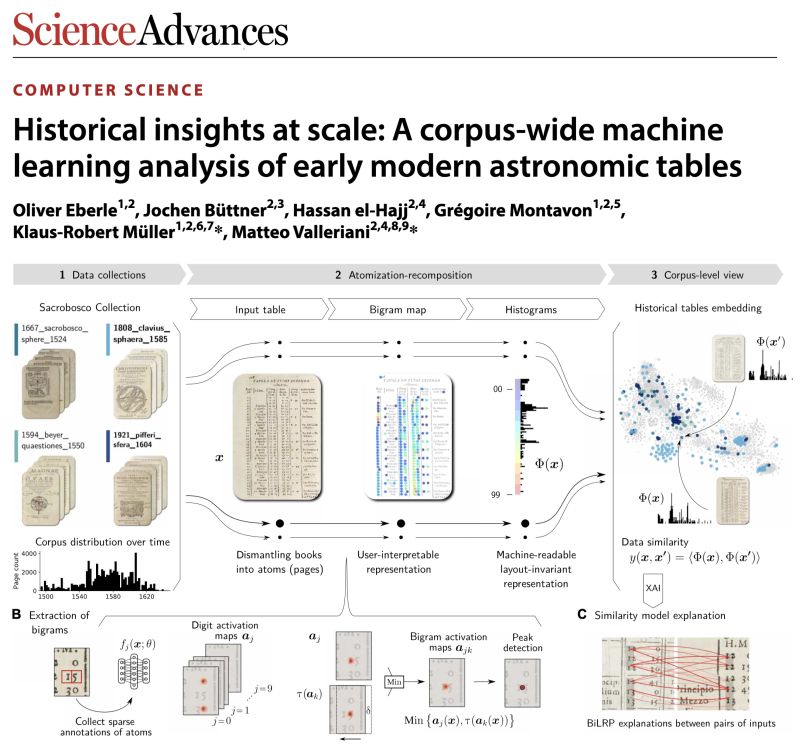
Very interesting. I hope such interactions grow between machine learning folks and those working on historical archives. I think some one like Lévi-Strauss or Barthes would have loved it.

📜 History repeats itself: We investigated how early modern communities have embraced scholarly advancements, reshaping scientific views and exploring scientific roots amidst a changing world.
www.science.org/doi/10.1126/...
@mpiwg.bsky.social @tuberlin.bsky.social @bifold.berlin @science.org
www.science.org/doi/10.1126/...
@mpiwg.bsky.social @tuberlin.bsky.social @bifold.berlin @science.org
January 7, 2025 at 9:56 PM
Very interesting. I hope such interactions grow between machine learning folks and those working on historical archives. I think some one like Lévi-Strauss or Barthes would have loved it.
Lorraine Daston is one the greatest minds in historical epistemology. Highly recommended to anyone interested in history of science.
Lorraine Daston was recently awarded the #Balzan Prize. @faznet.bsky.social takes this occasion to highlight her work on the history of objectivity and its value in light of the recent pandemic. 🗞️ (paywall, in German)
🔗 bit.ly/3OCcJHU
#HistSci #Daston #PoliticalEpistemology
🔗 bit.ly/3OCcJHU
#HistSci #Daston #PoliticalEpistemology

Verleihung des Balzan-Preises an Lorraine Daston
Ehrenhalber in Rom: Unter dem Eindruck der Pandemie spitzt die frisch gekürte Balzan-Preisträgerin Lorraine Daston ihre Theorie der Objektivität medienkritisch zu.
bit.ly
December 27, 2024 at 2:34 PM
Lorraine Daston is one the greatest minds in historical epistemology. Highly recommended to anyone interested in history of science.