



Vivian Poulin
@astroviv.bsky.social
Cosmologist working for CNRS/IN2P3 based at Laboratoire Univers et Particules de Montpellier.
Making a new measurement of Hubble's constant ?
October 23, 2025 at 10:50 AM
Making a new measurement of Hubble's constant ?
Let me wrap up by saying that we it was great to use the public tools developed by the ACT collaboration, such as the EDE emulator from Qu et al 2404.16805. Long live open science! Happy to share our chains and tools as well.
May 14, 2025 at 11:14 AM
Let me wrap up by saying that we it was great to use the public tools developed by the ACT collaboration, such as the EDE emulator from Qu et al 2404.16805. Long live open science! Happy to share our chains and tools as well.
Also, from our analyses, there remains a `Omega_m tension’ with the determination from SN1a data. This suggests including EDE cannot fully remove the preference for dynamical dark energy, but it may affect the reconstructed equation of state parameters. This should be further investigated as well.
May 14, 2025 at 11:14 AM
Also, from our analyses, there remains a `Omega_m tension’ with the determination from SN1a data. This suggests including EDE cannot fully remove the preference for dynamical dark energy, but it may affect the reconstructed equation of state parameters. This should be further investigated as well.
The remaining question is the origin of the difference between NPIPE+SDSS and ACT+DESI analyses. Is this compatible with statistical fluke? The ACT+DESI analysis is closer to what is obtained with Plik, but NPIPE is supposedly better. This deserves further investigation.
May 14, 2025 at 11:14 AM
The remaining question is the origin of the difference between NPIPE+SDSS and ACT+DESI analyses. Is this compatible with statistical fluke? The ACT+DESI analysis is closer to what is obtained with Plik, but NPIPE is supposedly better. This deserves further investigation.
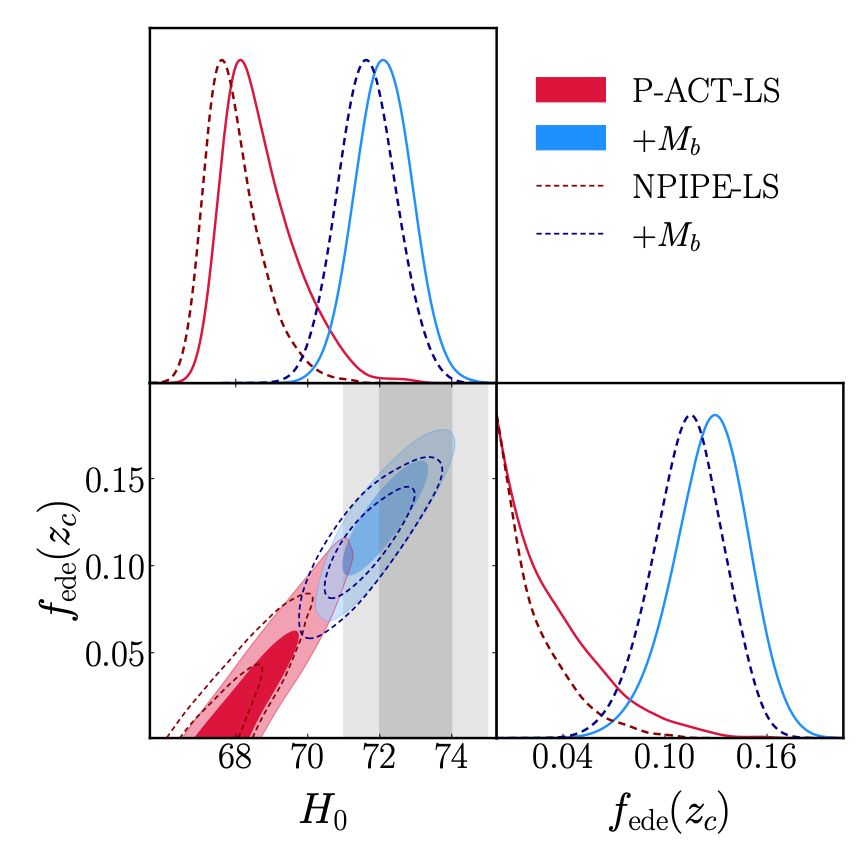
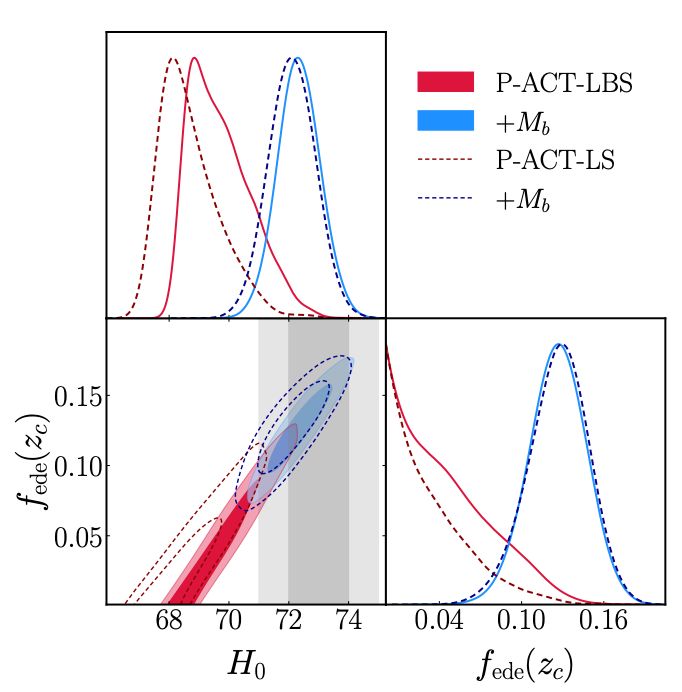
This plot demonstrates that Bayesian analyses are prior-dependent, and one should be careful in claiming that EDE is excluded from those. This was already seen with Planck `Plik' data (the previous Planck release), e.g. Herold et al. 2112.12140 but was much weaker with NPIPE.
May 14, 2025 at 11:14 AM
This plot demonstrates that Bayesian analyses are prior-dependent, and one should be careful in claiming that EDE is excluded from those. This was already seen with Planck `Plik' data (the previous Planck release), e.g. Herold et al. 2112.12140 but was much weaker with NPIPE.
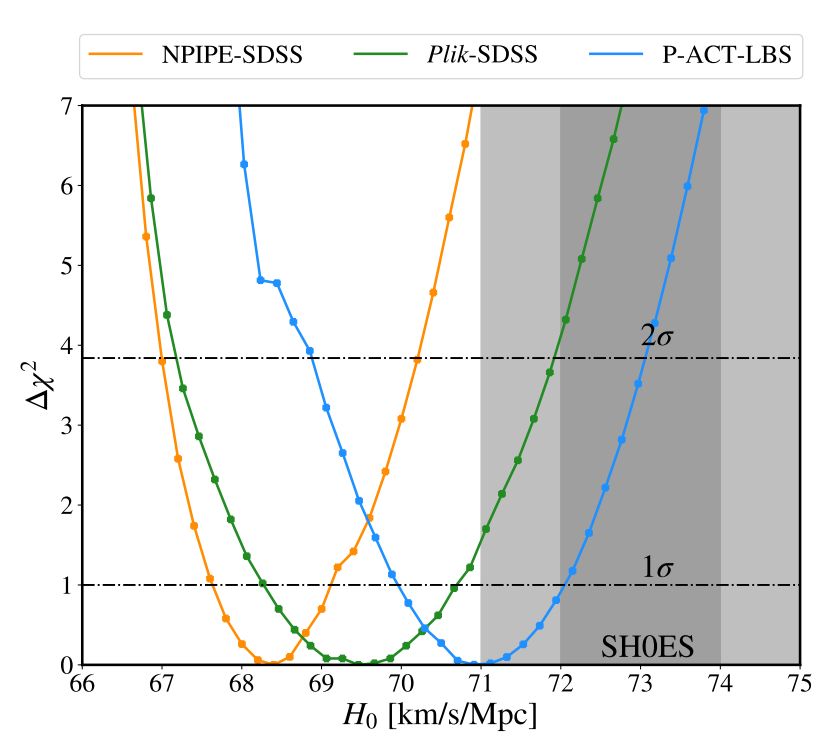
The most striking difference between NPIPE+SDSS and ACT+DESI is seen when computing the profile likelihood of H0 and fEDE. In the ACT+DESI case `PACTLBS' the frequentist CI at 68% are fEDE ~0.09+-0.03 and H0 ~ 71 +- 1. The fit with H0=73 (SH0ES value) is better than with H0 = 68.4 (LCDM value)!
May 14, 2025 at 11:14 AM
The most striking difference between NPIPE+SDSS and ACT+DESI is seen when computing the profile likelihood of H0 and fEDE. In the ACT+DESI case `PACTLBS' the frequentist CI at 68% are fEDE ~0.09+-0.03 and H0 ~ 71 +- 1. The fit with H0=73 (SH0ES value) is better than with H0 = 68.4 (LCDM value)!
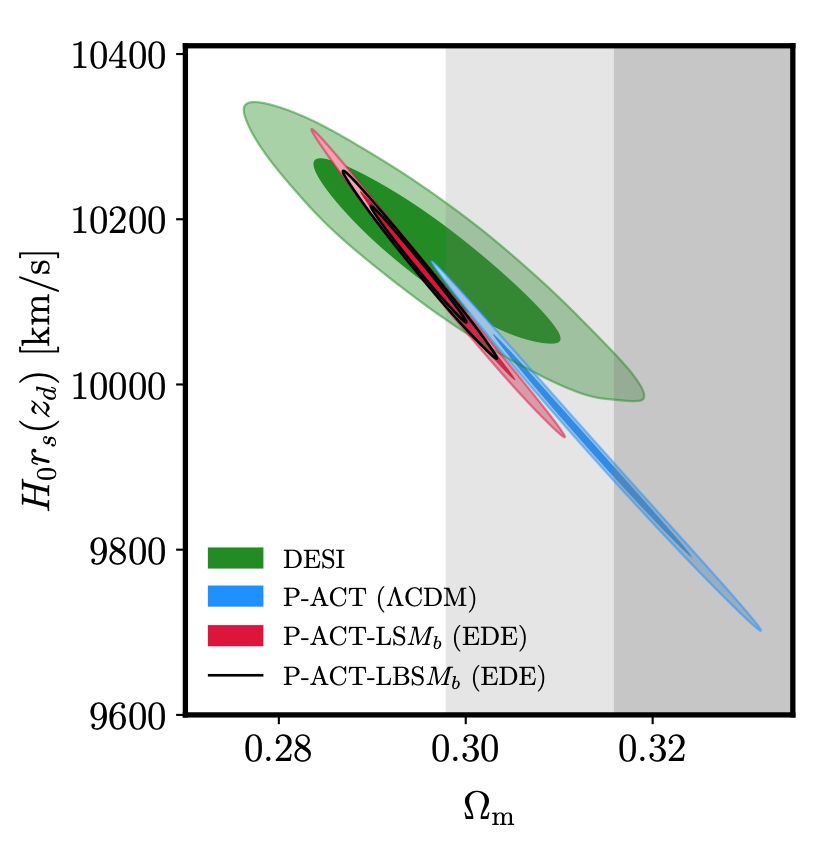
Moreover, we show that EDE rises the value of H0rs and decreases slightly Omega_m, improving consistency between CMB and DESI DR2 data. Including DESI DR2 thus further relaxes the constraints to the EDE contribution (fEDE) and the value of H0. See also Chaussidon++ 2503.24343
May 14, 2025 at 11:14 AM
Moreover, we show that EDE rises the value of H0rs and decreases slightly Omega_m, improving consistency between CMB and DESI DR2 data. Including DESI DR2 thus further relaxes the constraints to the EDE contribution (fEDE) and the value of H0. See also Chaussidon++ 2503.24343
Yet, ACT DR6 and DESI DR2 data are significantly less constraining than Planck NPIPE and SDSS (see Efstathiou et al. 2311.00524) despite increase precision at small angular scales. The residual tension with SH0ES *decreases* from 3.7 sigma to 2sigma (under LCDM, the tension is around 6-6.5sigma).
May 14, 2025 at 11:14 AM
Yet, ACT DR6 and DESI DR2 data are significantly less constraining than Planck NPIPE and SDSS (see Efstathiou et al. 2311.00524) despite increase precision at small angular scales. The residual tension with SH0ES *decreases* from 3.7 sigma to 2sigma (under LCDM, the tension is around 6-6.5sigma).
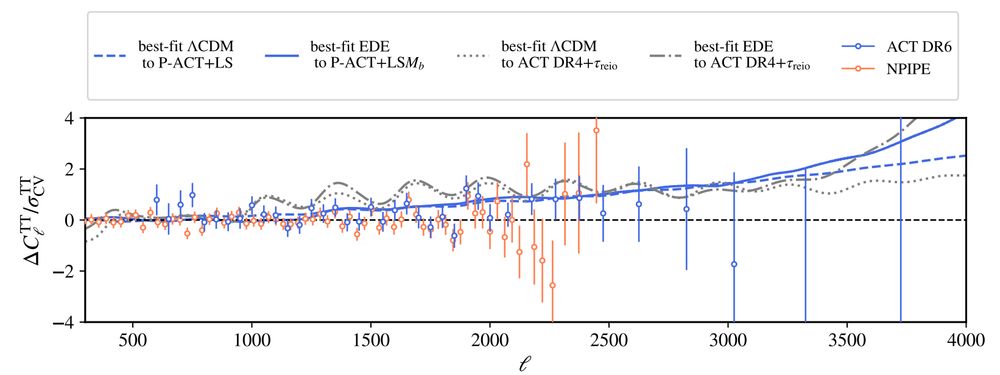
First, we point out that it is not so surprising that the preference for the ACT DR4 favored model did not increase, because the parameters of the model (fEDE of ~25% and H0 ~ 78) were in strong tension with Planck NPIPE. If they had confirm such numbers, it would have led to a large `CMB tension’!
May 14, 2025 at 11:14 AM
First, we point out that it is not so surprising that the preference for the ACT DR4 favored model did not increase, because the parameters of the model (fEDE of ~25% and H0 ~ 78) were in strong tension with Planck NPIPE. If they had confirm such numbers, it would have led to a large `CMB tension’!
TLDR; contrarily to previous analysis of ACT DR4, the new data do not favor EDE in the Bayesian analysis, only leading to upper limits to the max EDE contribution (fEDE), unless SH0ES is included. However, there are some intriguing aspects that we point out in our paper.
May 14, 2025 at 11:14 AM
TLDR; contrarily to previous analysis of ACT DR4, the new data do not favor EDE in the Bayesian analysis, only leading to upper limits to the max EDE contribution (fEDE), unless SH0ES is included. However, there are some intriguing aspects that we point out in our paper.
First of all, our results are in good agreement with those presented by the ACT collaboration in Calabrese et al 2503.14454. The main difference is i) the use of the new DESI BAO DR2 data ii) The comparison of Bayesian and Frequentist constraints on the model iii) the combination with SH0ES data.
May 14, 2025 at 11:14 AM
First of all, our results are in good agreement with those presented by the ACT collaboration in Calabrese et al 2503.14454. The main difference is i) the use of the new DESI BAO DR2 data ii) The comparison of Bayesian and Frequentist constraints on the model iii) the combination with SH0ES data.
Regarding CCHP I did see a post from Dan scolnic on the platform-whose-name-we-dont-pronounce saying it actually goes in the direction of sh0es because their data gives good agreement on distances with cepheids. combine everything and panplus you would get high h0. But don't quote me on this xD
March 19, 2025 at 10:16 PM
Regarding CCHP I did see a post from Dan scolnic on the platform-whose-name-we-dont-pronounce saying it actually goes in the direction of sh0es because their data gives good agreement on distances with cepheids. combine everything and panplus you would get high h0. But don't quote me on this xD
Haha no worries what you said makes sense ! ;) I just think that, had we not seen such a huge signal with DR4, we would think that going from planck to planck+actdr6 the situation is better. But that's not what happened and the signal did go down from dr4 to dr6 so it is what it is. Just annoying!
March 19, 2025 at 10:12 PM
Haha no worries what you said makes sense ! ;) I just think that, had we not seen such a huge signal with DR4, we would think that going from planck to planck+actdr6 the situation is better. But that's not what happened and the signal did go down from dr4 to dr6 so it is what it is. Just annoying!
Now the most statistically constraining dataset they presented, planck+act, yields significantly weaker constraints and close to no tension with sh0es under EDE, me etc. I think that's encouraging, though I understand your view point of course. It would have been great to see a > signal w/ new data
March 19, 2025 at 10:05 PM
Now the most statistically constraining dataset they presented, planck+act, yields significantly weaker constraints and close to no tension with sh0es under EDE, me etc. I think that's encouraging, though I understand your view point of course. It would have been great to see a > signal w/ new data
You're right of course! I think its just that given Planck+ SPT results it would have been really weird that their data yield a preference for such large fraction of EDE as they had seen before. It would likely have created big tensions with other cmb data.
March 19, 2025 at 10:03 PM
You're right of course! I think its just that given Planck+ SPT results it would have been really weird that their data yield a preference for such large fraction of EDE as they had seen before. It would likely have created big tensions with other cmb data.
We're all just super excited 😄
March 19, 2025 at 9:59 PM
We're all just super excited 😄
I think that's DES (dark energy survey) not DESI (dark energy spectroscopic instrument). DESI data are about to come out on the arxiv! Literally tonight. Should confirm what DES suggests too. And also that humans are maximally boring at choosing names of experiment!
March 19, 2025 at 9:45 PM
I think that's DES (dark energy survey) not DESI (dark energy spectroscopic instrument). DESI data are about to come out on the arxiv! Literally tonight. Should confirm what DES suggests too. And also that humans are maximally boring at choosing names of experiment!
The optimistic view is that we are trending towards one of those early time solutions when adding more accurate highell data. But not sensitive enough yet. The pessimistic one is everything was a fluke, constraints are weaker because its a fluke, and they will get stronger in the future. Could be...
March 18, 2025 at 10:00 PM
The optimistic view is that we are trending towards one of those early time solutions when adding more accurate highell data. But not sensitive enough yet. The pessimistic one is everything was a fluke, constraints are weaker because its a fluke, and they will get stronger in the future. Could be...
I dont think that's fully true. The constraints they get combining with planck are significantly *weaker* than those from planck alone. By like 50%. And their bestfit (not the mean) is H0~71.2.
Also they removed their data at ell ~500 that was pulling EDE up in DR4... not sure why likely systematic.
Also they removed their data at ell ~500 that was pulling EDE up in DR4... not sure why likely systematic.
March 18, 2025 at 9:54 PM
I dont think that's fully true. The constraints they get combining with planck are significantly *weaker* than those from planck alone. By like 50%. And their bestfit (not the mean) is H0~71.2.
Also they removed their data at ell ~500 that was pulling EDE up in DR4... not sure why likely systematic.
Also they removed their data at ell ~500 that was pulling EDE up in DR4... not sure why likely systematic.