



Bence Szalai
@benceszalai.bsky.social
Computational systems biology - research team lead at Turbine. Previously post-doc at RWTH Aachen and Semmelweis.
Using an IO dataset of #nivolumab-treated renal cancer patients, we found that:
- #PD1 or #PDL1 expression didn't predict survival
- PD1 activity (from RIDDEN) did associate with survival.
Showing that receptor activity could be a more effective biomarker than expression. 5/n
- #PD1 or #PDL1 expression didn't predict survival
- PD1 activity (from RIDDEN) did associate with survival.
Showing that receptor activity could be a more effective biomarker than expression. 5/n

July 15, 2025 at 10:25 PM
Using an IO dataset of #nivolumab-treated renal cancer patients, we found that:
- #PD1 or #PDL1 expression didn't predict survival
- PD1 activity (from RIDDEN) did associate with survival.
Showing that receptor activity could be a more effective biomarker than expression. 5/n
- #PD1 or #PDL1 expression didn't predict survival
- PD1 activity (from RIDDEN) did associate with survival.
Showing that receptor activity could be a more effective biomarker than expression. 5/n
RIDDEN’s receptor-specific signatures align with regulons of transcription factors downstream of receptors. 4/n

July 15, 2025 at 10:25 PM
RIDDEN’s receptor-specific signatures align with regulons of transcription factors downstream of receptors. 4/n
We benchmarked RIDDEN on various receptor perturbation datasets, including the recent in vivo Immune Dictionary data www.nature.com/articles/s41..., and found good predictive performance. 3/n

July 15, 2025 at 10:25 PM
We benchmarked RIDDEN on various receptor perturbation datasets, including the recent in vivo Immune Dictionary data www.nature.com/articles/s41..., and found good predictive performance. 3/n
We used prior knowledge from omnipathdb.org & perturbation data from clue.io to build models for receptor activity inference. Instead of focusing on receptor expression, we predicted activity from the expression of receptor-regulated genes. 2/n

July 15, 2025 at 10:25 PM
We used prior knowledge from omnipathdb.org & perturbation data from clue.io to build models for receptor activity inference. Instead of focusing on receptor expression, we predicted activity from the expression of receptor-regulated genes. 2/n
Our tool, RIDDEN (Receptor actIvity Data Driven inferENce) for predicting #receptor activity from #transcriptomics data is published in
PLOS Computational Biology journals.plos.org/ploscompbiol... 1/n
PLOS Computational Biology journals.plos.org/ploscompbiol... 1/n

July 15, 2025 at 10:25 PM
Our tool, RIDDEN (Receptor actIvity Data Driven inferENce) for predicting #receptor activity from #transcriptomics data is published in
PLOS Computational Biology journals.plos.org/ploscompbiol... 1/n
PLOS Computational Biology journals.plos.org/ploscompbiol... 1/n
Several popular Perturb-seq based benchmark datasets lack heterogeneity, making it difficult to distinguish between strong and weak models. 4/5

April 25, 2025 at 9:49 PM
Several popular Perturb-seq based benchmark datasets lack heterogeneity, making it difficult to distinguish between strong and weak models. 4/5
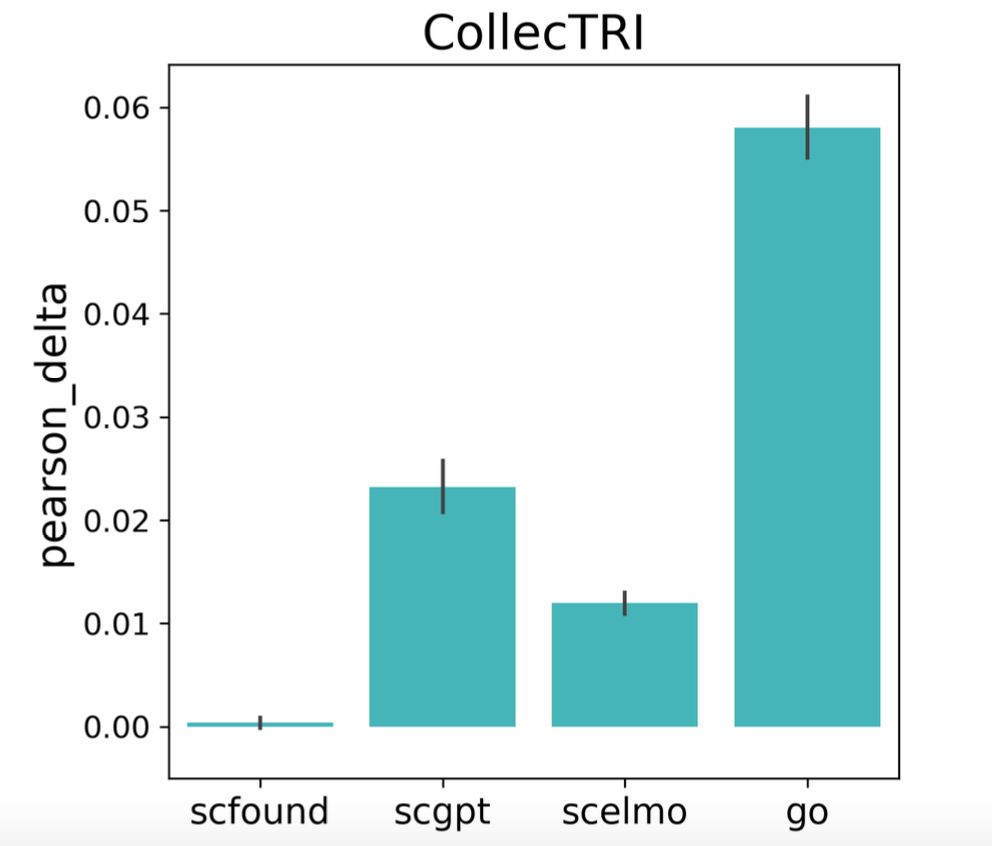
Gene embeddings from foundation models align more closely with gene regulatory networks than with signaling networks, which may underlie their weaker performance in perturbation tasks. 3/5
April 25, 2025 at 9:49 PM
Gene embeddings from foundation models align more closely with gene regulatory networks than with signaling networks, which may underlie their weaker performance in perturbation tasks. 3/5
Even the most trivial baseline (mean of train samples) outperformed recent foundation models, while basic ML models using biologically meaningful features won by a large margin. 2/5

April 25, 2025 at 9:49 PM
Even the most trivial baseline (mean of train samples) outperformed recent foundation models, while basic ML models using biologically meaningful features won by a large margin. 2/5
Single-cell foundation models, trained on large-scale scRNA-seq datasets, are increasingly used for post-perturbation RNA-seq prediction.
But how do they actually perform?
Our new paper from @turbine-ai.bsky.social is now out in BMC Genomics. bmcgenomics.biomedcentral.com/articles/10....
1/5
But how do they actually perform?
Our new paper from @turbine-ai.bsky.social is now out in BMC Genomics. bmcgenomics.biomedcentral.com/articles/10....
1/5

April 25, 2025 at 9:49 PM
Single-cell foundation models, trained on large-scale scRNA-seq datasets, are increasingly used for post-perturbation RNA-seq prediction.
But how do they actually perform?
Our new paper from @turbine-ai.bsky.social is now out in BMC Genomics. bmcgenomics.biomedcentral.com/articles/10....
1/5
But how do they actually perform?
Our new paper from @turbine-ai.bsky.social is now out in BMC Genomics. bmcgenomics.biomedcentral.com/articles/10....
1/5

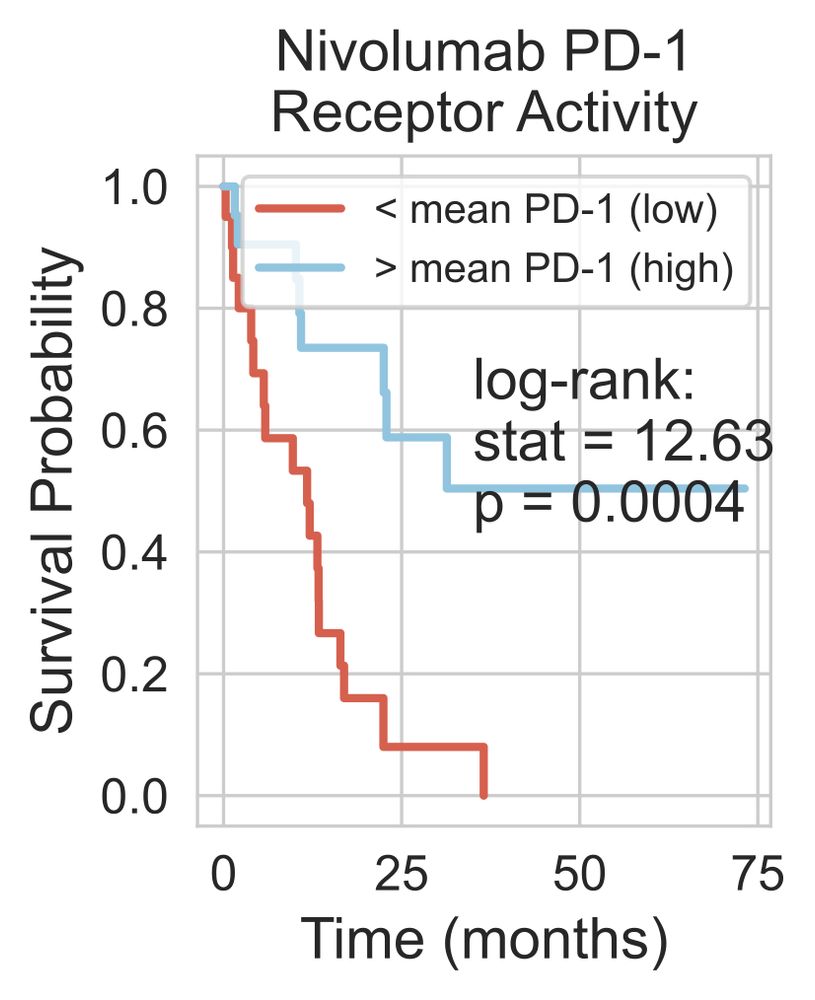
Using an IO dataset of nivolumab-treated renal cancer patients, we found that:
- PD1 or PDL1 expression didn't predict survival
- PD1 activity (from RIDDEN) did associate with survival.
This shows that receptor activity could be a more effective biomarker than expression. 5/n
- PD1 or PDL1 expression didn't predict survival
- PD1 activity (from RIDDEN) did associate with survival.
This shows that receptor activity could be a more effective biomarker than expression. 5/n
December 9, 2024 at 9:39 PM
Using an IO dataset of nivolumab-treated renal cancer patients, we found that:
- PD1 or PDL1 expression didn't predict survival
- PD1 activity (from RIDDEN) did associate with survival.
This shows that receptor activity could be a more effective biomarker than expression. 5/n
- PD1 or PDL1 expression didn't predict survival
- PD1 activity (from RIDDEN) did associate with survival.
This shows that receptor activity could be a more effective biomarker than expression. 5/n
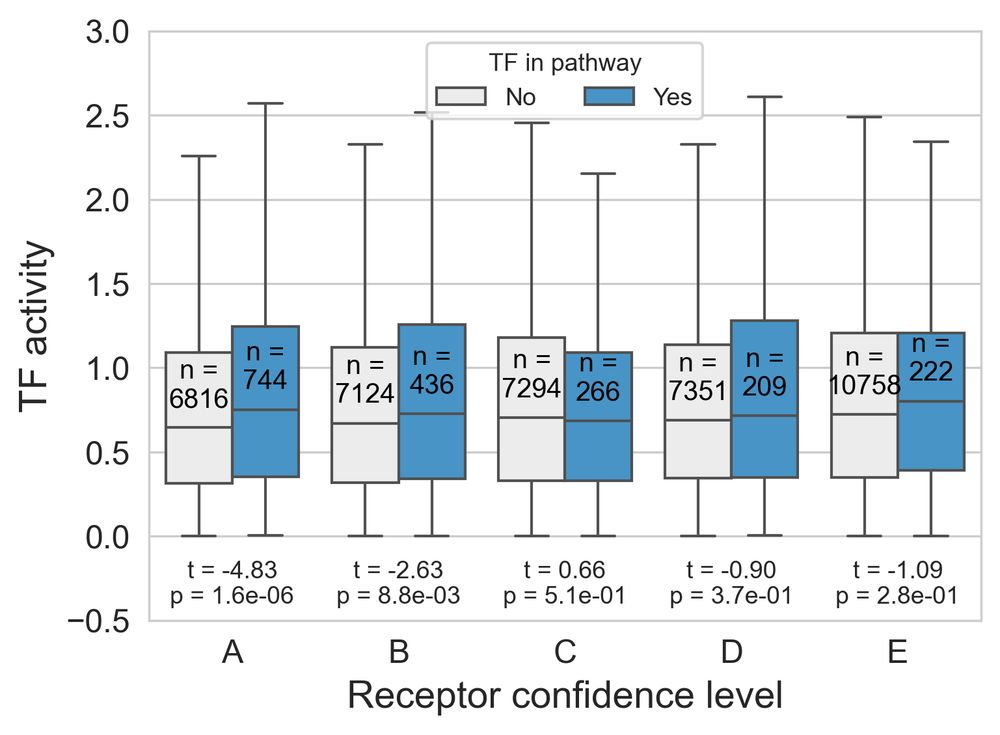
RIDDEN’s receptor-specific signatures align with regulons of transcription factors downstream of receptors. 4/n
December 9, 2024 at 9:39 PM
RIDDEN’s receptor-specific signatures align with regulons of transcription factors downstream of receptors. 4/n
We benchmarked RIDDEN on various receptor perturbation datasets, including the recent in vivo Immune Dictionary data nature.com/articles/s41..., and found good predictive performance. 3/n

December 9, 2024 at 9:39 PM
We benchmarked RIDDEN on various receptor perturbation datasets, including the recent in vivo Immune Dictionary data nature.com/articles/s41..., and found good predictive performance. 3/n
We combined prior knowledge from OmniPath omnipathdb.org with LINCS L1000 perturbation transcriptomics clue.io to build models that infer receptor activity. Instead of focusing on receptor expression, we predict activity using the expression of receptor-regulated genes. 2/n

December 9, 2024 at 9:39 PM
We combined prior knowledge from OmniPath omnipathdb.org with LINCS L1000 perturbation transcriptomics clue.io to build models that infer receptor activity. Instead of focusing on receptor expression, we predict activity using the expression of receptor-regulated genes. 2/n
[first 🦋] Receptors are essential for cell-cell communication, yet most comp CCC tools focus on ligand/receptor expression, not receptor activity. To address this, we developed RIDDEN, a model that infers activity for 229 receptors from transcriptomics data. 1/n www.biorxiv.org/content/10.1...

December 9, 2024 at 9:39 PM
[first 🦋] Receptors are essential for cell-cell communication, yet most comp CCC tools focus on ligand/receptor expression, not receptor activity. To address this, we developed RIDDEN, a model that infers activity for 229 receptors from transcriptomics data. 1/n www.biorxiv.org/content/10.1...