



Binglan Li
@binglan.bsky.social
Computational biologist. ML/AI for biomedical research. Alzheimer's Diseases and knowledge graph. Complex diseases genetics. Pharmacogenomics.
I have mixed feelings about this work. While it's interesting to visualize the impact of scientific works, metrics like patents and funding don't necessarily reflect social and ethical impacts, like cultural shifts.
www.nature.com/articles/d41...
www.nature.com/articles/d41...

Will your study change the world? This AI tool predicts the impact of your research
A tool called Funding the Frontier visualizes all the downstream impacts of funding — and predicts which studies will have the biggest societal impact.
www.nature.com
October 16, 2025 at 7:41 PM
I have mixed feelings about this work. While it's interesting to visualize the impact of scientific works, metrics like patents and funding don't necessarily reflect social and ethical impacts, like cultural shifts.
www.nature.com/articles/d41...
www.nature.com/articles/d41...
A pleasant read on how Deep Learning models can facilitate the prediction of gene expression levels from DNA sequences. This question led me into the field of computational biology almost 15 years ago.
Our featured article: Predicting gene expression from DNA sequence using deep learning models go.nature.com/3VXGCG9
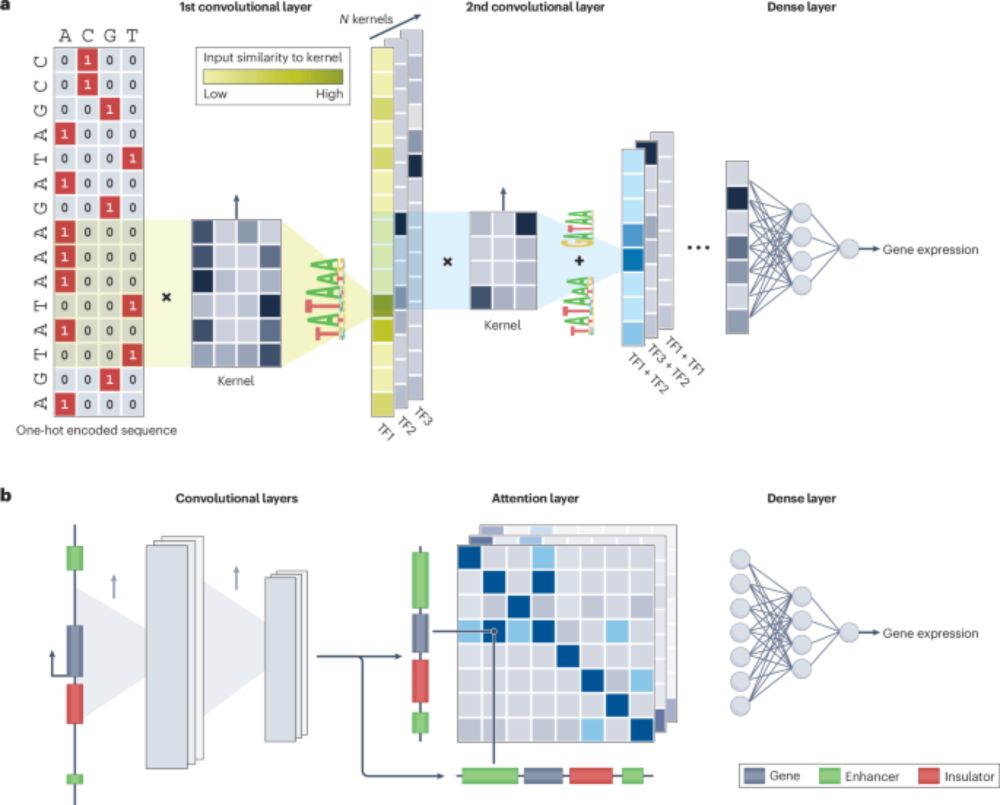
Predicting gene expression from DNA sequence using deep learning models - Nature Reviews Genetics
Barbadilla-Martínez et al. review recent progress in deep-learning-based sequence-to-expression models, which predict gene expression levels solely from DNA sequence. These models are providing new in...
go.nature.com
September 17, 2025 at 8:15 PM
A pleasant read on how Deep Learning models can facilitate the prediction of gene expression levels from DNA sequences. This question led me into the field of computational biology almost 15 years ago.
Can't wait to try out the new features of Biomni. I wonder how these will help democratize scientific data for the whole biomedical community.
biomni.stanford.edu/blog/sage-bi...
biomni.stanford.edu/blog/consens...
biomni.stanford.edu/blog/sage-bi...
biomni.stanford.edu/blog/consens...
biomni.stanford.edu
September 15, 2025 at 6:19 PM
Can't wait to try out the new features of Biomni. I wonder how these will help democratize scientific data for the whole biomedical community.
biomni.stanford.edu/blog/sage-bi...
biomni.stanford.edu/blog/consens...
biomni.stanford.edu/blog/sage-bi...
biomni.stanford.edu/blog/consens...
Love how OpenAI's new paper demystifies the origin of LLM hallucination as a result of training and testing. LLMs are rewarded for making confident guesses rather than reporting uncertainty, hence returning guesses (hallucinated responses) in production.
openai.com/index/why-la...
openai.com/index/why-la...

Why language models hallucinate
OpenAI’s new research explains why language models hallucinate. The findings show how improved evaluations can enhance AI reliability, honesty, and safety.
openai.com
September 10, 2025 at 8:00 PM
Love how OpenAI's new paper demystifies the origin of LLM hallucination as a result of training and testing. LLMs are rewarded for making confident guesses rather than reporting uncertainty, hence returning guesses (hallucinated responses) in production.
openai.com/index/why-la...
openai.com/index/why-la...

Projects in ChatGPT | OpenAI Help Center
Organize, revisit, and continue your work—all in one place
help.openai.com
September 8, 2025 at 6:43 PM
TransferTWAS: A transfer learning framework for cross-tissue transcriptome-wide association study: The American Journal of Human Genetics www.cell.com/ajhg/fulltex...

TransferTWAS: A transfer learning framework for cross-tissue transcriptome-wide association study
TransferTWAS is a TWAS method that adaptively borrows information from multiple external
tissues to boost gene-expression prediction in tissues with small sample sizes. It
outperforms competing approa...
www.cell.com
September 4, 2025 at 9:25 PM
TransferTWAS: A transfer learning framework for cross-tissue transcriptome-wide association study: The American Journal of Human Genetics www.cell.com/ajhg/fulltex...
Genomics-informed drug-repurposing strategy identifies two therapeutic targets for preventing liver disease associated with metabolic dysfunction: The American Journal of Human Genetics www.cell.com/ajhg/fulltex...

Genomics-informed drug-repurposing strategy identifies two therapeutic targets for preventing liver disease associated with metabolic dysfunction
We prioritized 57 druggable targets from 212 putative causal genes of metabolic-dysfunction-associated
steatotic liver disease (MASLD). Using a drug-repurposing analysis that integrated
protein struct...
www.cell.com
September 4, 2025 at 9:20 PM
Genomics-informed drug-repurposing strategy identifies two therapeutic targets for preventing liver disease associated with metabolic dysfunction: The American Journal of Human Genetics www.cell.com/ajhg/fulltex...
It makes sense that parallel agents can improve performance, much like a team of experts can lead to better results. The study also discusses the relationship between costs and the number of agents.
scalingintelligence.stanford.edu/pubs/codemon...
scalingintelligence.stanford.edu/pubs/codemon...

CodeMonkeys: Scaling Test-Time Compute for Software Engineering
Scaling test-time compute is a promising axis for improving LLM capabilities. However, test-time compute can be scaled in a variety of ways, and effectively combining different approaches remains an a...
scalingintelligence.stanford.edu
August 30, 2025 at 12:22 AM
It makes sense that parallel agents can improve performance, much like a team of experts can lead to better results. The study also discusses the relationship between costs and the number of agents.
scalingintelligence.stanford.edu/pubs/codemon...
scalingintelligence.stanford.edu/pubs/codemon...
What it looks like when an agent gets stuck for no reason.
It was tasked with creating a .gitignore file, following the GitHub template. It ended up reading a phantom .gitignore file.
Any suggestions on how to better prompt the agent? Do I need to break down the task?
It was tasked with creating a .gitignore file, following the GitHub template. It ended up reading a phantom .gitignore file.
Any suggestions on how to better prompt the agent? Do I need to break down the task?

August 29, 2025 at 7:27 PM
What it looks like when an agent gets stuck for no reason.
It was tasked with creating a .gitignore file, following the GitHub template. It ended up reading a phantom .gitignore file.
Any suggestions on how to better prompt the agent? Do I need to break down the task?
It was tasked with creating a .gitignore file, following the GitHub template. It ended up reading a phantom .gitignore file.
Any suggestions on how to better prompt the agent? Do I need to break down the task?
Reposted by Binglan Li

My new piece on The Paradox of Trust and Transparency in AI www.extremetech.com/science/the-... #artificialintelligence #trust #transparency

The Paradox of Trust and Transparency in AI
An AI is useless if you can't trust it—so how do we get there, and in a way that benefits and protects all parties involved?
www.extremetech.com
March 6, 2025 at 2:57 PM
My new piece on The Paradox of Trust and Transparency in AI www.extremetech.com/science/the-... #artificialintelligence #trust #transparency