


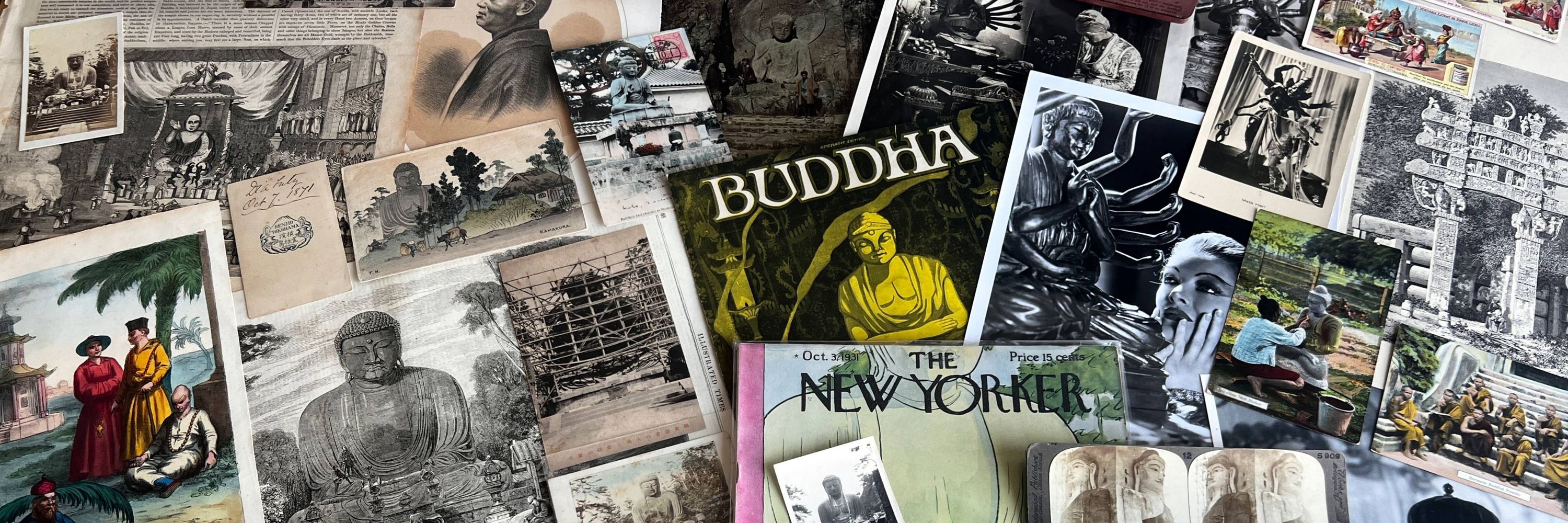

Buddhas in the West Material Archive
@buddhasinthewest.bsky.social
Exploring the circulation of Buddhist material culture in Western historical media, including prints, photos, ephemera, &c. Digital public scholarship project curated by @peterromaskiewicz.bsky.social.
📜 #buddhasinthewest
🌟 New Posts: On hiatus thru Jan. 🙏🏼
📜 #buddhasinthewest
🌟 New Posts: On hiatus thru Jan. 🙏🏼
A great online resource for 19th century political cartoons re: Chinese Exclusion can be found at thomasnastcartoons.com. It's worth noting Nast was more sympathetic to Chinese immigrants than other cartoonists of his time, such as George Frederick Keller.

Illustrating Chinese Exclusion
Thomas Nast's cartoons of Chinese Americans
thomasnastcartoons.com
December 29, 2025 at 4:06 PM
A great online resource for 19th century political cartoons re: Chinese Exclusion can be found at thomasnastcartoons.com. It's worth noting Nast was more sympathetic to Chinese immigrants than other cartoonists of his time, such as George Frederick Keller.
The idol is a distorted version of a sitting buddha, portrayed with horns and performing a "Chinese dance."
For more on the visual language of trade cards, see Lenore Metrick-chen "The Chinese of the American Imagination: 19th Century Trade Card Images" (2007).
#Buddhasinthewest
For more on the visual language of trade cards, see Lenore Metrick-chen "The Chinese of the American Imagination: 19th Century Trade Card Images" (2007).
#Buddhasinthewest

December 19, 2025 at 4:08 PM
The idol is a distorted version of a sitting buddha, portrayed with horns and performing a "Chinese dance."
For more on the visual language of trade cards, see Lenore Metrick-chen "The Chinese of the American Imagination: 19th Century Trade Card Images" (2007).
#Buddhasinthewest
For more on the visual language of trade cards, see Lenore Metrick-chen "The Chinese of the American Imagination: 19th Century Trade Card Images" (2007).
#Buddhasinthewest
The Chinese children in the background, clearly identified by their long queues and flowing garments, represent idolators practicing foreign idolatry. 4/5

December 19, 2025 at 4:08 PM
The Chinese children in the background, clearly identified by their long queues and flowing garments, represent idolators practicing foreign idolatry. 4/5
The moralizing tone of the images is apparent. In the foreground we see a child lying on the floor clutching a bottle, representing inebriation or intoxication. 3/5

December 19, 2025 at 4:08 PM
The moralizing tone of the images is apparent. In the foreground we see a child lying on the floor clutching a bottle, representing inebriation or intoxication. 3/5
This stock card was from an alphabet primer series, appealing to one of the primary audiences for trade cards, children.
The letter "I" can be spotted on the pedestal in the rear, thus asking viewers to interpret the scenes through the lens of words beginning with "I." 2/5
The letter "I" can be spotted on the pedestal in the rear, thus asking viewers to interpret the scenes through the lens of words beginning with "I." 2/5

December 19, 2025 at 4:08 PM
This stock card was from an alphabet primer series, appealing to one of the primary audiences for trade cards, children.
The letter "I" can be spotted on the pedestal in the rear, thus asking viewers to interpret the scenes through the lens of words beginning with "I." 2/5
The letter "I" can be spotted on the pedestal in the rear, thus asking viewers to interpret the scenes through the lens of words beginning with "I." 2/5
While some replicated scenes were decorated with authentic religious imagery, Japan's icon appears to be recreated with wood or plaster.
For more about missionary exhibits, see April Makgoeng's "Visualizing Missions: The Power of the Image in Promoting Foreign Missions" (2021).
#Buddhasinthewest
For more about missionary exhibits, see April Makgoeng's "Visualizing Missions: The Power of the Image in Promoting Foreign Missions" (2021).
#Buddhasinthewest

December 17, 2025 at 2:25 PM
While some replicated scenes were decorated with authentic religious imagery, Japan's icon appears to be recreated with wood or plaster.
For more about missionary exhibits, see April Makgoeng's "Visualizing Missions: The Power of the Image in Promoting Foreign Missions" (2021).
#Buddhasinthewest
For more about missionary exhibits, see April Makgoeng's "Visualizing Missions: The Power of the Image in Promoting Foreign Missions" (2021).
#Buddhasinthewest
In Cincinnati, the replicated foreign lands were populated by more than 5000 stewards from more than 200 local churches portraying native peoples. 4/5

December 17, 2025 at 2:25 PM
In Cincinnati, the replicated foreign lands were populated by more than 5000 stewards from more than 200 local churches portraying native peoples. 4/5
A variety of print ephemera, such as maps, posters, and postcards, were sold as souvenirs and visual learning aids to visitors.
The superimposed label printed on front of this real photo post card helps identify it as from the "World in Cincinnati," similar to other known postcard examples. 3/5
The superimposed label printed on front of this real photo post card helps identify it as from the "World in Cincinnati," similar to other known postcard examples. 3/5

December 17, 2025 at 2:25 PM
A variety of print ephemera, such as maps, posters, and postcards, were sold as souvenirs and visual learning aids to visitors.
The superimposed label printed on front of this real photo post card helps identify it as from the "World in Cincinnati," similar to other known postcard examples. 3/5
The superimposed label printed on front of this real photo post card helps identify it as from the "World in Cincinnati," similar to other known postcard examples. 3/5
Flanked by shops and scenes of everyday Japanese life, the exhibit was considered an exercise in immersive visual educational.
Partition walls were painted with panoramic views of distant locales such as Mt. Fuji and lotus ponds to further create a sense of virtual travel. 2/5
Partition walls were painted with panoramic views of distant locales such as Mt. Fuji and lotus ponds to further create a sense of virtual travel. 2/5

December 17, 2025 at 2:25 PM
Flanked by shops and scenes of everyday Japanese life, the exhibit was considered an exercise in immersive visual educational.
Partition walls were painted with panoramic views of distant locales such as Mt. Fuji and lotus ponds to further create a sense of virtual travel. 2/5
Partition walls were painted with panoramic views of distant locales such as Mt. Fuji and lotus ponds to further create a sense of virtual travel. 2/5
Landor's six card set was the only set of Tibet Tuck published before it stopped operation during WWII.
For a comprehensive digitized catalogue of Tuck Oilette cards, see www.tuckdbpostcards.org
#Buddhasinthewest
For a comprehensive digitized catalogue of Tuck Oilette cards, see www.tuckdbpostcards.org
#Buddhasinthewest

December 15, 2025 at 5:16 PM
Landor's six card set was the only set of Tibet Tuck published before it stopped operation during WWII.
For a comprehensive digitized catalogue of Tuck Oilette cards, see www.tuckdbpostcards.org
#Buddhasinthewest
For a comprehensive digitized catalogue of Tuck Oilette cards, see www.tuckdbpostcards.org
#Buddhasinthewest
The visual focus of Landor's painting is the monk's use of the prayer wheel, noted as containing the Buddhist "book of prayers."
As with others of his time, Landor was fascinated by the ritual object, describing its use in his published work on Tibet. 4/5
As with others of his time, Landor was fascinated by the ritual object, describing its use in his published work on Tibet. 4/5

December 15, 2025 at 5:16 PM
The visual focus of Landor's painting is the monk's use of the prayer wheel, noted as containing the Buddhist "book of prayers."
As with others of his time, Landor was fascinated by the ritual object, describing its use in his published work on Tibet. 4/5
As with others of his time, Landor was fascinated by the ritual object, describing its use in his published work on Tibet. 4/5
While a majority of Tuck's pictorial stock focused on the English countryside, the Wide Wide World series introduced colonial lands and other foreign cultures.
Here the caption notes the use of "Om mani padme hum," a six-syllable Sanskrit mantra common among Tibetan Buddhists. 3/5
Here the caption notes the use of "Om mani padme hum," a six-syllable Sanskrit mantra common among Tibetan Buddhists. 3/5

December 15, 2025 at 5:16 PM
While a majority of Tuck's pictorial stock focused on the English countryside, the Wide Wide World series introduced colonial lands and other foreign cultures.
Here the caption notes the use of "Om mani padme hum," a six-syllable Sanskrit mantra common among Tibetan Buddhists. 3/5
Here the caption notes the use of "Om mani padme hum," a six-syllable Sanskrit mantra common among Tibetan Buddhists. 3/5
Six paintings were prepared by the explorer and artist Henry Savage Landor who wrote about his travels to the region in his 1898 book, In the Forbidden Land.
Tuck printed Landor's paintings as lithograph postcards at a time when photos of Tibet were only first starting to circulate. 2/5
Tuck printed Landor's paintings as lithograph postcards at a time when photos of Tibet were only first starting to circulate. 2/5

December 15, 2025 at 5:16 PM
Six paintings were prepared by the explorer and artist Henry Savage Landor who wrote about his travels to the region in his 1898 book, In the Forbidden Land.
Tuck printed Landor's paintings as lithograph postcards at a time when photos of Tibet were only first starting to circulate. 2/5
Tuck printed Landor's paintings as lithograph postcards at a time when photos of Tibet were only first starting to circulate. 2/5
Obscured by flower offerings, the Buddhist icon sits at just above eye level in the shrine.
For more on this topic, see Chan's "Portable Faith: Toward a Non-Site-Specific History of Buddhist Art in Japan,” viewable here: tinyurl.com/3tde394d
#Buddhasinthewest
For more on this topic, see Chan's "Portable Faith: Toward a Non-Site-Specific History of Buddhist Art in Japan,” viewable here: tinyurl.com/3tde394d
#Buddhasinthewest

December 12, 2025 at 3:39 PM
Obscured by flower offerings, the Buddhist icon sits at just above eye level in the shrine.
For more on this topic, see Chan's "Portable Faith: Toward a Non-Site-Specific History of Buddhist Art in Japan,” viewable here: tinyurl.com/3tde394d
#Buddhasinthewest
For more on this topic, see Chan's "Portable Faith: Toward a Non-Site-Specific History of Buddhist Art in Japan,” viewable here: tinyurl.com/3tde394d
#Buddhasinthewest
Pilgrims would carry the frame on their backs as they moved from one location to the next.
A large bell rests in a basket hung off the side, ready to be struck by a mallet held in the pilgrim's hand on the left. His other hand holds a long string of mala beads. 4/5
A large bell rests in a basket hung off the side, ready to be struck by a mallet held in the pilgrim's hand on the left. His other hand holds a long string of mala beads. 4/5

December 12, 2025 at 3:39 PM
Pilgrims would carry the frame on their backs as they moved from one location to the next.
A large bell rests in a basket hung off the side, ready to be struck by a mallet held in the pilgrim's hand on the left. His other hand holds a long string of mala beads. 4/5
A large bell rests in a basket hung off the side, ready to be struck by a mallet held in the pilgrim's hand on the left. His other hand holds a long string of mala beads. 4/5
As described by Chun-Wa Chan, portable Buddhist shrines were already in use by the 5th century in the region of Gandhara and were introduced into Japan a few centuries later.
Portable Japanese shrines (zushi) were often ornately decorated and fitted with doors to conceal the icon inside. 3/5
#厨子
Portable Japanese shrines (zushi) were often ornately decorated and fitted with doors to conceal the icon inside. 3/5
#厨子

December 12, 2025 at 3:39 PM
As described by Chun-Wa Chan, portable Buddhist shrines were already in use by the 5th century in the region of Gandhara and were introduced into Japan a few centuries later.
Portable Japanese shrines (zushi) were often ornately decorated and fitted with doors to conceal the icon inside. 3/5
#厨子
Portable Japanese shrines (zushi) were often ornately decorated and fitted with doors to conceal the icon inside. 3/5
#厨子
The studio stock number (362) is currently unattributed, but fits within a sequence of numbers for photos taken in Nikko by Esaki Reiji, likely in the late 1880s or 1890s.
Esaki was a prominent souvenir album photographer in Asakusa, a tourist-friendly area of Tokyo. 2/5
#江崎礼二
Esaki was a prominent souvenir album photographer in Asakusa, a tourist-friendly area of Tokyo. 2/5
#江崎礼二

December 12, 2025 at 3:39 PM
The studio stock number (362) is currently unattributed, but fits within a sequence of numbers for photos taken in Nikko by Esaki Reiji, likely in the late 1880s or 1890s.
Esaki was a prominent souvenir album photographer in Asakusa, a tourist-friendly area of Tokyo. 2/5
#江崎礼二
Esaki was a prominent souvenir album photographer in Asakusa, a tourist-friendly area of Tokyo. 2/5
#江崎礼二