




Na Cai
@caina89.bsky.social
Assistant Prof at D-BSSE, ETH Zurich, studying genetics of psychiatric disorders
www.nacailab.com
www.nacailab.com
And www.nature.com/articles/s41... in a more cross disorder setting - this one discusses the impact of phenotyping on cross disorder analyses
Assessment and ascertainment in psychiatric molecular genetics: challenges and opportunities for cross-disorder research - Molecular Psychiatry
Molecular Psychiatry - Assessment and ascertainment in psychiatric molecular genetics: challenges and opportunities for cross-disorder research
www.nature.com
December 20, 2025 at 3:46 PM
And www.nature.com/articles/s41... in a more cross disorder setting - this one discusses the impact of phenotyping on cross disorder analyses
We have two more commentary/review like papers on this www.nature.com/articles/s41...

The genetic basis of major depressive disorder - Molecular Psychiatry
Molecular Psychiatry - The genetic basis of major depressive disorder
www.nature.com
December 20, 2025 at 3:45 PM
We have two more commentary/review like papers on this www.nature.com/articles/s41...
Importantly in this paper we derive a new metric PRS pleiotropy which we use to show shallow phenotypes indeed give non specific gwas signal that leads to non specific PRS predictions
December 20, 2025 at 3:44 PM
Importantly in this paper we derive a new metric PRS pleiotropy which we use to show shallow phenotypes indeed give non specific gwas signal that leads to non specific PRS predictions
We then worked out we can improve shallow phenotypes in biobank settings where there’s a small subset of individuals with high quality phenotypes through imputation www.nature.com/articles/s41...

Phenotype integration improves power and preserves specificity in biobank-based genetic studies of major depressive disorder - Nature Genetics
Phenotype imputation increases the effective sample size of major depressive disorder cases in UK Biobank, enhancing study power and polygenic risk score (PRS) accuracy. A new pleiotropy metric enable...
www.nature.com
December 20, 2025 at 3:43 PM
We then worked out we can improve shallow phenotypes in biobank settings where there’s a small subset of individuals with high quality phenotypes through imputation www.nature.com/articles/s41...
Hi @michelnivard.bsky.social we have written quite a lot on sample size vs phenotyping quality. The earliest was www.nature.com/articles/s41... on depression where we show shallow phenotyping, despite giving higher gwas power, gives non specific gwas signal

Minimal phenotyping yields genome-wide association signals of low specificity for major depression - Nature Genetics
Genetic analyses of depression based on minimal phenotyping identify nonspecific genetic risk factors shared between major depressive disorder (MDD) and other psychiatric conditions, suggesting that t...
www.nature.com
December 20, 2025 at 3:41 PM
Hi @michelnivard.bsky.social we have written quite a lot on sample size vs phenotyping quality. The earliest was www.nature.com/articles/s41... on depression where we show shallow phenotyping, despite giving higher gwas power, gives non specific gwas signal
Congratulations, very exciting! 🎉
July 26, 2025 at 5:54 AM
Congratulations, very exciting! 🎉
Link to GitHub page: github.com/caina89/psyc...
GitHub - caina89/psychCE: Code used to implement coordinated epistasis on psychiatric disorders
Code used to implement coordinated epistasis on psychiatric disorders - caina89/psychCE
github.com
July 24, 2025 at 5:24 AM
Link to GitHub page: github.com/caina89/psyc...
Link to the preprint: www.medrxiv.org/lookup/conte...

Genetic risk effects on psychiatric disorders act in sets
Genetic studies of psychiatric disorders have typically assumed that all genetic effects contribute additively to disease liability. However, it is likely that psychiatric disorders have unrecognized ...
www.medrxiv.org
July 24, 2025 at 5:24 AM
Link to the preprint: www.medrxiv.org/lookup/conte...
This work would not have been possible if not for the persistent efforts of @jolienrietkerk.bsky.social Andy Dahl, Jonathan Flint, Andrew Schork and many others, as well as the data from participants in @ukbiobank.bsky.social and IPSYCH. We hope it will be informative to the field. 12/n
July 24, 2025 at 5:24 AM
This work would not have been possible if not for the persistent efforts of @jolienrietkerk.bsky.social Andy Dahl, Jonathan Flint, Andrew Schork and many others, as well as the data from participants in @ukbiobank.bsky.social and IPSYCH. We hope it will be informative to the field. 12/n
Though our investigations and findings are centered on psychiatric disorders, the implications are generalizable to all complex traits and diseases, especially those with heterogeneous architectures and unclear diagnostic boundaries. 11/n
July 24, 2025 at 5:24 AM
Though our investigations and findings are centered on psychiatric disorders, the implications are generalizable to all complex traits and diseases, especially those with heterogeneous architectures and unclear diagnostic boundaries. 11/n
Overall, our work provides a novel metric, the CE test, for informing diagnostic boundaries. Our results show that genetic effects on psych disorders act in sets, and calls for a re-evaluation of current approaches and assumptions. 10/n
July 24, 2025 at 5:24 AM
Overall, our work provides a novel metric, the CE test, for informing diagnostic boundaries. Our results show that genetic effects on psych disorders act in sets, and calls for a re-evaluation of current approaches and assumptions. 10/n
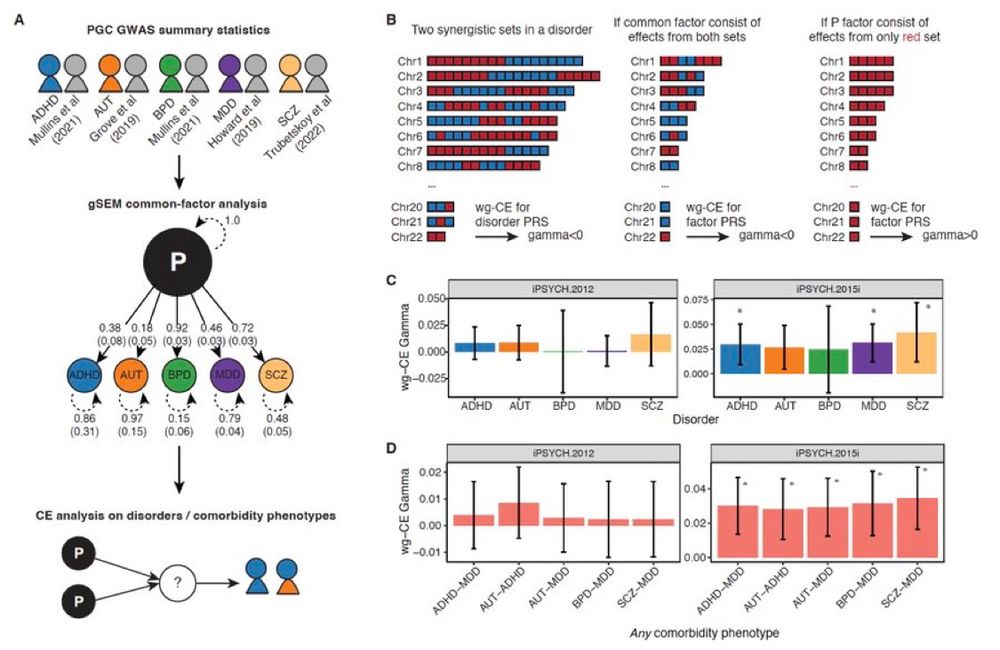
Finally, we find that common genetic effects across all five psych disorders, expected to capture common etiological axes among them, forms a cross-order set most plausibly explained by common confounders external to each disorder’s etiology. 9/n
July 24, 2025 at 5:24 AM
Finally, we find that common genetic effects across all five psych disorders, expected to capture common etiological axes among them, forms a cross-order set most plausibly explained by common confounders external to each disorder’s etiology. 9/n
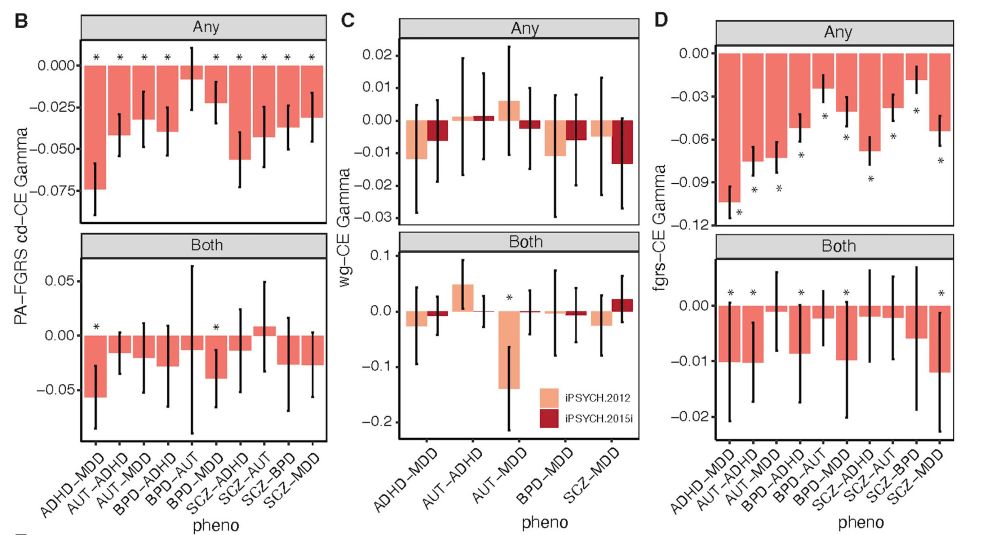
We further show that disorder-specific sets lead to comorbidity between two disorders, refuting the assumption that comorbidity is the result of additive effects of genetic effects on both, exemplified by the expectation that high rGs would lead to high comorbidity. 8/n
July 24, 2025 at 5:24 AM
We further show that disorder-specific sets lead to comorbidity between two disorders, refuting the assumption that comorbidity is the result of additive effects of genetic effects on both, exemplified by the expectation that high rGs would lead to high comorbidity. 8/n
These findings imply that rGs are insufficient to inform nosology, and that the CE test provides a way to determine whether putative disorders or subtypes should be merged or remain separate diagnostically. 7/n
July 24, 2025 at 5:24 AM
These findings imply that rGs are insufficient to inform nosology, and that the CE test provides a way to determine whether putative disorders or subtypes should be merged or remain separate diagnostically. 7/n
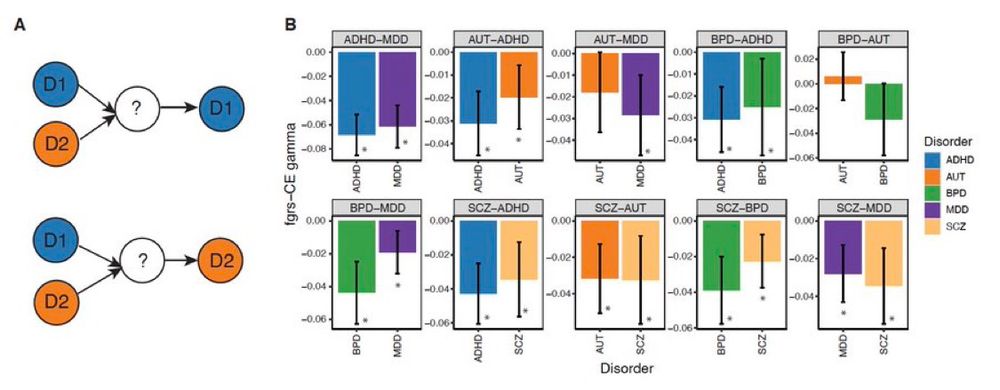
We also show that sets of genetic effects are disorder-specific, despite high genetic correlations (rG) between them. This opposes a well-established conjecture, based on high rG, that clinical boundaries do not reflect their pathogenic processes. 6/n
July 24, 2025 at 5:24 AM
We also show that sets of genetic effects are disorder-specific, despite high genetic correlations (rG) between them. This opposes a well-established conjecture, based on high rG, that clinical boundaries do not reflect their pathogenic processes. 6/n
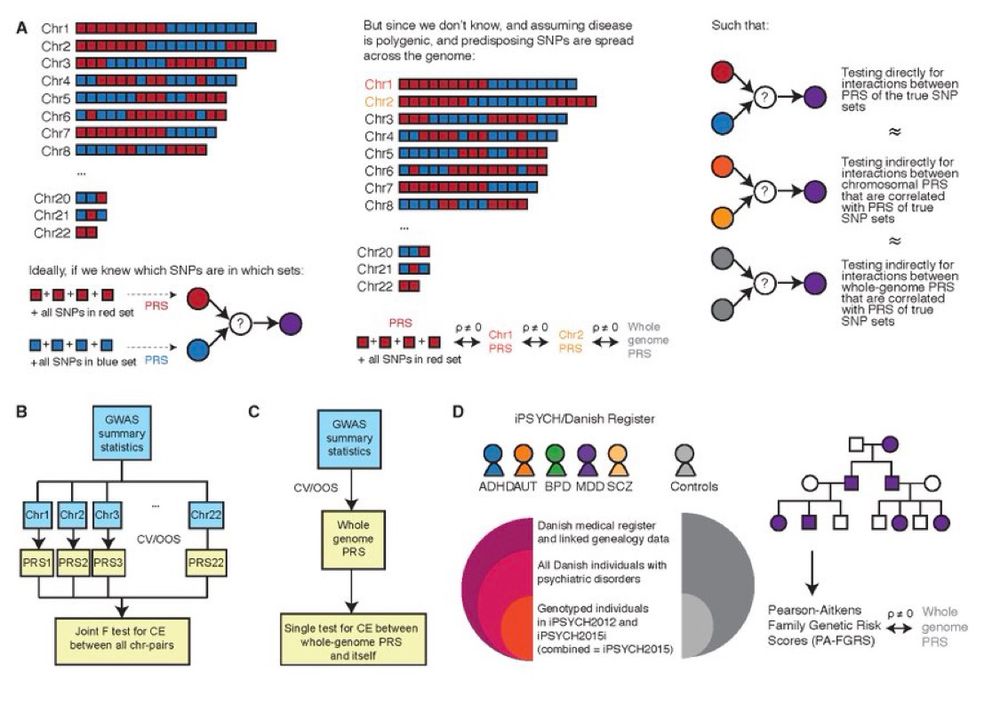
In our paper, we test for CE in five psychiatric disorders in the @ukbiobank.bsky.social and the iPSYCH dataset using both polygenic risk scores (PRS) and family-based genetic risk scores (FGRS). We find negative CE for 3 out of 5 disorders, demonstrating there are unrecognized subtypes. 5/n
July 24, 2025 at 5:24 AM
In our paper, we test for CE in five psychiatric disorders in the @ukbiobank.bsky.social and the iPSYCH dataset using both polygenic risk scores (PRS) and family-based genetic risk scores (FGRS). We find negative CE for 3 out of 5 disorders, demonstrating there are unrecognized subtypes. 5/n
The existence of these sets induces a structured form of statistical interactions called coordinated epistasis (CE), detailed in previous publications by Andy Dahl, Noah Zaitlen www.pnas.org/doi/10.1073/...; negative CE is seen when there are different sets of genetic effects. 4/n

A model and test for coordinated polygenic epistasis in complex traits | PNAS
Interactions between genetic variants—epistasis—is pervasive in model systems and
can profoundly impact evolutionary adaption, population disease d...
www.pnas.org
July 24, 2025 at 5:24 AM
The existence of these sets induces a structured form of statistical interactions called coordinated epistasis (CE), detailed in previous publications by Andy Dahl, Noah Zaitlen www.pnas.org/doi/10.1073/...; negative CE is seen when there are different sets of genetic effects. 4/n