



Charlie Fulco
@charlesfulco.bsky.social
Functional genomics for drug discovery
Reposted by Charlie Fulco

Had a lot of fun writing this “tools of the trade” highlight for our Variant-EFFECTS technology. Check it out! 🛠️

New online! Measuring the effects of regulatory variants in an endogenous context
Measuring the effects of regulatory variants in an endogenous context
Nature Reviews Genetics, Published online: 11 June 2025; doi:10.1038/s41576-025-00863-wIn this Tools of the Trade article, Michael Montgomery presents Variant-EFFECTS, a high-throughput and generalizable approach that combines prime editing, flow cytometry, sequencing, and computational analysis to quantify the effects of regulatory variants.
www.nature.com
June 11, 2025 at 2:01 PM
Had a lot of fun writing this “tools of the trade” highlight for our Variant-EFFECTS technology. Check it out! 🛠️
Reposted by Charlie Fulco
I am elated to share that our manuscript describing Variant-EFFECTS, a high-throughput technology we developed to precisely and quantitatively measure the effects of CRISPR-mediated edits on gene expression, is now published at @cellpress.bsky.social: authors.elsevier.com/c/1kxgiL7PXu...
authors.elsevier.com
April 17, 2025 at 6:20 PM
I am elated to share that our manuscript describing Variant-EFFECTS, a high-throughput technology we developed to precisely and quantitatively measure the effects of CRISPR-mediated edits on gene expression, is now published at @cellpress.bsky.social: authors.elsevier.com/c/1kxgiL7PXu...
Reposted by Charlie Fulco

🔷 📰 BLUETORIAL time! 📰 🔷
Excited to share recent work from our lab on noncoding genomics 🔎🧬: High-resolution CRISPR perturbations of the MYC TAD (~3 Mb) in 6 different human cancer cell lines
www.nature.com/articles/s41...
Excited to share recent work from our lab on noncoding genomics 🔎🧬: High-resolution CRISPR perturbations of the MYC TAD (~3 Mb) in 6 different human cancer cell lines
www.nature.com/articles/s41...

Comprehensive dissection of cis-regulatory elements in a 2.8 Mb topologically associated domain in six human cancers - Nature Communications
The oncogene MYC plays a key role in cancer initiation and progression. Using thousands of CRISPR perturbations, the authors investigate regulators of MYC in six different cancers. These tumor-specifi...
www.nature.com
March 3, 2025 at 2:40 AM
🔷 📰 BLUETORIAL time! 📰 🔷
Excited to share recent work from our lab on noncoding genomics 🔎🧬: High-resolution CRISPR perturbations of the MYC TAD (~3 Mb) in 6 different human cancer cell lines
www.nature.com/articles/s41...
Excited to share recent work from our lab on noncoding genomics 🔎🧬: High-resolution CRISPR perturbations of the MYC TAD (~3 Mb) in 6 different human cancer cell lines
www.nature.com/articles/s41...
Reposted by Charlie Fulco

I posted a couple days ago about our new paper on building causal graphs from genetic associations + Perturb-seq.
Here I want to expand on the value of using DIRECTIONAL information contained in LoF burden tests.🧵
[work led by @minetoota.bsky.social ]
bsky.app/profile/jkpr...
Here I want to expand on the value of using DIRECTIONAL information contained in LoF burden tests.🧵
[work led by @minetoota.bsky.social ]
bsky.app/profile/jkpr...
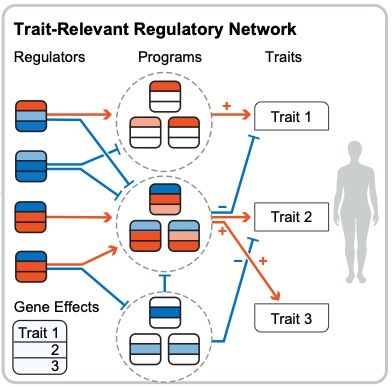
GWAS provides a unique tool in human biology as it can establish causal links from variants to trait.
But interpretation is difficult as most effects flow through (unobserved) gene regulatory networks. Can we gain insight by linking to modern Perturb-seq data?
www.biorxiv.org/content/10.1...
But interpretation is difficult as most effects flow through (unobserved) gene regulatory networks. Can we gain insight by linking to modern Perturb-seq data?
www.biorxiv.org/content/10.1...

Causal modeling of gene effects from regulators to programs to traits: integration of genetic associations and Perturb-seq
Genetic association studies provide a unique tool for identifying causal links from genes to human traits and diseases. However, it is challenging to determine the biological mechanisms underlying mos...
www.biorxiv.org
January 27, 2025 at 7:19 PM
I posted a couple days ago about our new paper on building causal graphs from genetic associations + Perturb-seq.
Here I want to expand on the value of using DIRECTIONAL information contained in LoF burden tests.🧵
[work led by @minetoota.bsky.social ]
bsky.app/profile/jkpr...
Here I want to expand on the value of using DIRECTIONAL information contained in LoF burden tests.🧵
[work led by @minetoota.bsky.social ]
bsky.app/profile/jkpr...
Reposted by Charlie Fulco
Modern GWAS can identify 1000s of significant hits but it can be hard to turn this into biological insight. What key cellular functions link genetic variation to disease?
I'm very excited to present our new work combining associations and Perturb-seq to build interpretable causal graphs! A 🧵
I'm very excited to present our new work combining associations and Perturb-seq to build interpretable causal graphs! A 🧵
January 26, 2025 at 12:13 AM
Modern GWAS can identify 1000s of significant hits but it can be hard to turn this into biological insight. What key cellular functions link genetic variation to disease?
I'm very excited to present our new work combining associations and Perturb-seq to build interpretable causal graphs! A 🧵
I'm very excited to present our new work combining associations and Perturb-seq to build interpretable causal graphs! A 🧵
Reposted by Charlie Fulco

Super excited to announce our latest work. On a personal note, it's not an exaggeration to say that blood, sweat, and tears got us to the finish line on this: working w/ an outstanding global team of scientists in Germany, Japan, Russia, and USA responding in >100 pages of complex reviewer comments.
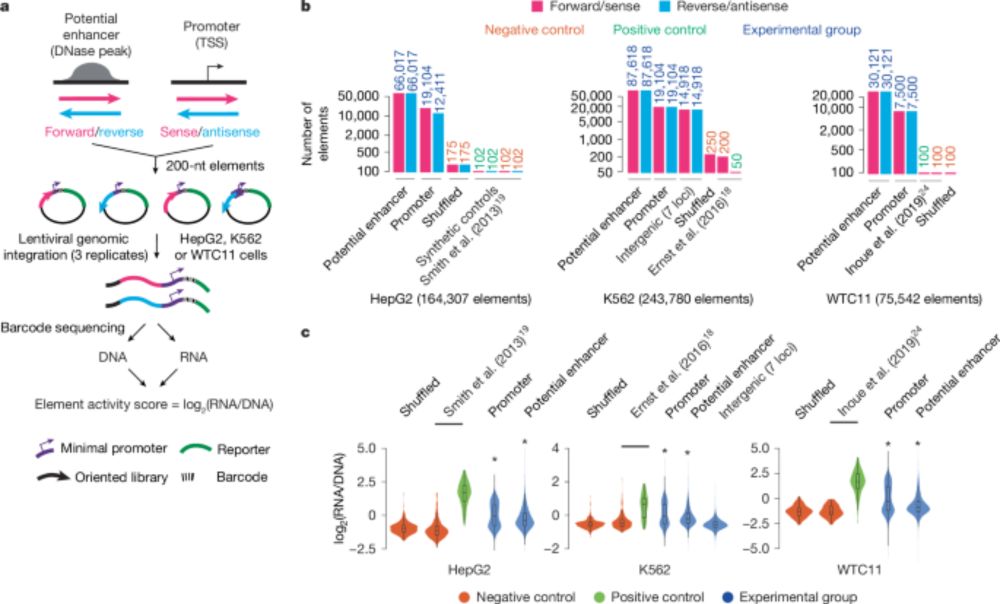
Massively parallel characterization of transcriptional regulatory elements - Nature
Lentivirus-based reporter assays for 680,000 regulatory sequences from three cell lines coupled to machine-learning models lead to insights into the grammar of cis-regulatory elements.
www.nature.com
January 15, 2025 at 5:39 PM
Super excited to announce our latest work. On a personal note, it's not an exaggeration to say that blood, sweat, and tears got us to the finish line on this: working w/ an outstanding global team of scientists in Germany, Japan, Russia, and USA responding in >100 pages of complex reviewer comments.
Reposted by Charlie Fulco
Super excited to announce our latest flagship model Borzoi: major props to Johannes & David Kelley et al for advancing it. It's been a long journey from our prior Enformer model into this one. A few innovations: i) longer DNA context, ii) adaptation to predict RNA-seq abundance and splice isoforms,
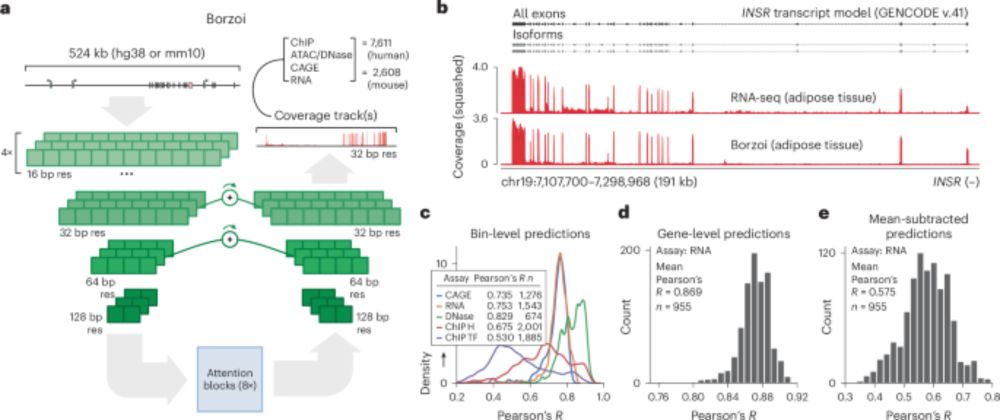
Predicting RNA-seq coverage from DNA sequence as a unifying model of gene regulation - Nature Genetics
Borzoi adapts the Enformer sequence-to-expression model to directly predict RNA-seq coverage, enabling the in-silico analysis of variant effects across multiple layers of gene regulation.
www.nature.com
January 9, 2025 at 3:08 AM
Super excited to announce our latest flagship model Borzoi: major props to Johannes & David Kelley et al for advancing it. It's been a long journey from our prior Enformer model into this one. A few innovations: i) longer DNA context, ii) adaptation to predict RNA-seq abundance and splice isoforms,
Reposted by Charlie Fulco

Our ChromBPNet preprint out!
www.biorxiv.org/content/10.1...
Huge congrats to Anusri! This was quite a slog (for both of us) but we r very proud of this one! It is a long read but worth it IMHO. Methods r in the supp. materials. Bluetorial coming soon below 1/
www.biorxiv.org/content/10.1...
Huge congrats to Anusri! This was quite a slog (for both of us) but we r very proud of this one! It is a long read but worth it IMHO. Methods r in the supp. materials. Bluetorial coming soon below 1/
December 25, 2024 at 11:48 PM
Our ChromBPNet preprint out!
www.biorxiv.org/content/10.1...
Huge congrats to Anusri! This was quite a slog (for both of us) but we r very proud of this one! It is a long read but worth it IMHO. Methods r in the supp. materials. Bluetorial coming soon below 1/
www.biorxiv.org/content/10.1...
Huge congrats to Anusri! This was quite a slog (for both of us) but we r very proud of this one! It is a long read but worth it IMHO. Methods r in the supp. materials. Bluetorial coming soon below 1/
Reposted by Charlie Fulco

What do GWAS and rare variant burden tests discover, and why?
Do these studies find the most IMPORTANT genes? If not, how DO they rank genes?
Here we present a surprising result: these studies actually test for SPECIFICITY! A 🧵on what this means... (🧪🧬)
www.biorxiv.org/content/10.1...
Do these studies find the most IMPORTANT genes? If not, how DO they rank genes?
Here we present a surprising result: these studies actually test for SPECIFICITY! A 🧵on what this means... (🧪🧬)
www.biorxiv.org/content/10.1...

Specificity, length, and luck: How genes are prioritized by rare and common variant association studies
Standard genome-wide association studies (GWAS) and rare variant burden tests are essential tools for identifying trait-relevant genes. Although these methods are conceptually similar, we show by anal...
www.biorxiv.org
December 17, 2024 at 7:05 AM
What do GWAS and rare variant burden tests discover, and why?
Do these studies find the most IMPORTANT genes? If not, how DO they rank genes?
Here we present a surprising result: these studies actually test for SPECIFICITY! A 🧵on what this means... (🧪🧬)
www.biorxiv.org/content/10.1...
Do these studies find the most IMPORTANT genes? If not, how DO they rank genes?
Here we present a surprising result: these studies actually test for SPECIFICITY! A 🧵on what this means... (🧪🧬)
www.biorxiv.org/content/10.1...
Reposted by Charlie Fulco
Beautiful work led by Maya Arce from Marson lab reveals a fascinating story about rewiring of a critical gene regulatory circuit in different T cell types: T effectors and Tregs
www.nature.com/articles/s41...
www.nature.com/articles/s41...
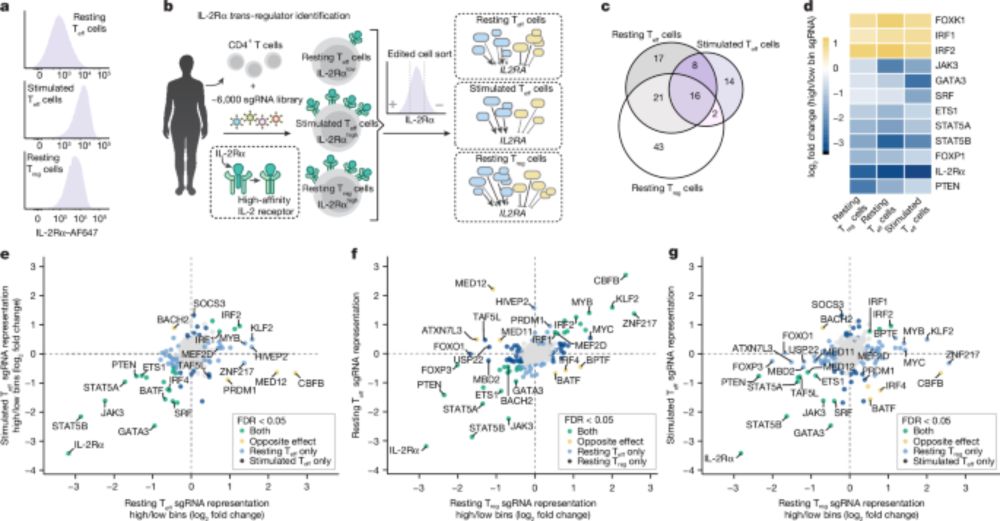
Central control of dynamic gene circuits governs T cell rest and activation - Nature
Resting and activated T cell states are established by context-specific regulators and dynamic gene circuits.
www.nature.com
December 11, 2024 at 8:46 PM
Beautiful work led by Maya Arce from Marson lab reveals a fascinating story about rewiring of a critical gene regulatory circuit in different T cell types: T effectors and Tregs
www.nature.com/articles/s41...
www.nature.com/articles/s41...