




Christina Hicks
@christinahicks.bsky.social
Professor. Environmental social scientist at Lancaster Environment Centre. Trying to return to a fell runner
It’s hard to discuss fully here, plus I’m not the best person to do so. Do send me a DM & I will put you in touch with the modelling group who can do a much better job of explaining the nuances & details.
October 19, 2025 at 9:17 PM
It’s hard to discuss fully here, plus I’m not the best person to do so. Do send me a DM & I will put you in touch with the modelling group who can do a much better job of explaining the nuances & details.
Because many of the places where population is expected to grow is a) where income is expected to grow & b) where consumption is currently lowest, we project a greater growth in demand for fish production that would be expected from global averages based on population alone.
October 19, 2025 at 9:17 PM
Because many of the places where population is expected to grow is a) where income is expected to grow & b) where consumption is currently lowest, we project a greater growth in demand for fish production that would be expected from global averages based on population alone.
Of course, people could meet the recommendations with much lower levels of fish consumption, as the bottom range is 0, but this is less likely. + The aim was to establish how feasible a realistic shift is, how much change is required & explore if that’s possible within safe & just boundaries.
October 19, 2025 at 9:16 PM
Of course, people could meet the recommendations with much lower levels of fish consumption, as the bottom range is 0, but this is less likely. + The aim was to establish how feasible a realistic shift is, how much change is required & explore if that’s possible within safe & just boundaries.
All the EAT-Lancet recommendations have a range-e.g. dairy is 0-500g/d, fish 0-100g/d, beef 0-30g/d. The scenarios make assumptions about where different populations are likely to fall in that range, based on preferences, wealth, etc.

October 19, 2025 at 9:16 PM
All the EAT-Lancet recommendations have a range-e.g. dairy is 0-500g/d, fish 0-100g/d, beef 0-30g/d. The scenarios make assumptions about where different populations are likely to fall in that range, based on preferences, wealth, etc.
& the opposite is true (eg Europe). Plus the diet is flexible (ie fish recommendations from 0-100g/day) & the areas where population is expected to grow are where increases in income are expected. The expectation is that with increases in income demand for higher value goods increases.
October 14, 2025 at 8:03 PM
& the opposite is true (eg Europe). Plus the diet is flexible (ie fish recommendations from 0-100g/day) & the areas where population is expected to grow are where increases in income are expected. The expectation is that with increases in income demand for higher value goods increases.
Sorry just seen this (+ caveat I was most involved in the justice part). A number of factors go into the models including population, income, & preferences. The main factor driving increases is the areas with most catch up are where population growth is also to be greatest (eg parts of S Asia & SSA)
October 14, 2025 at 8:02 PM
Sorry just seen this (+ caveat I was most involved in the justice part). A number of factors go into the models including population, income, & preferences. The main factor driving increases is the areas with most catch up are where population growth is also to be greatest (eg parts of S Asia & SSA)
Reposted by Christina Hicks

I'm also helping out with this exciting session on *Pedagogies of Hope*
nomadit.co.uk/conference/p...
nomadit.co.uk/conference/p...
P124: Pedagogies of hope: Ideas and practices for teaching and learning in a time of crisis
An interactive, round table format, for the sharing insights, experiences and practices. 5 short talks (5 minutes each) invited to frame discussion.
nomadit.co.uk
October 9, 2025 at 4:01 AM
I'm also helping out with this exciting session on *Pedagogies of Hope*
nomadit.co.uk/conference/p...
nomadit.co.uk/conference/p...
Reposted by Christina Hicks

The study was published in @plosbiology.org - you can find out more by following the link below
Follow @lec-reefs.bsky.social to stay updated on our researchers’ work
www.lancaster.ac.uk/news/seychel...
Follow @lec-reefs.bsky.social to stay updated on our researchers’ work
www.lancaster.ac.uk/news/seychel...
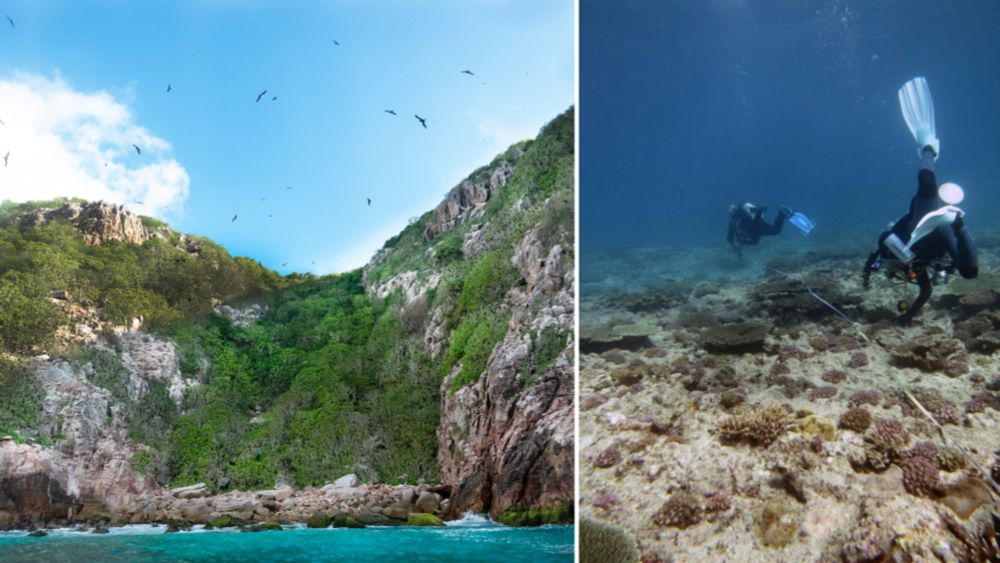
Seychelles study shows seabird nutrients boost marine ecosystems around rat-free islands - Lancaster University
A newly published study shows that nutrients from seabird droppings boost the growth of algae in coral reefs in the Seychelles – helping to feed and sustain populations of herbivorous fish that feed o...
www.lancaster.ac.uk
July 9, 2025 at 8:03 AM
The study was published in @plosbiology.org - you can find out more by following the link below
Follow @lec-reefs.bsky.social to stay updated on our researchers’ work
www.lancaster.ac.uk/news/seychel...
Follow @lec-reefs.bsky.social to stay updated on our researchers’ work
www.lancaster.ac.uk/news/seychel...
Looking forward to it!
June 14, 2025 at 1:52 PM
Looking forward to it!
Brilliant Bryce, and super clear!
June 10, 2025 at 5:44 AM
Brilliant Bryce, and super clear!
I don’t think so, Science now asks that “authors of Letters also make readers aware of financial and advisory competing interests.” After a contentious trophy hunting letter in 2019 raised complaints of conflict of interest
www.thecanary.co/discovery/an...
www.thecanary.co/discovery/an...

Renowned Science mag changes policy after complaints about pro-trophy hunting letter
Commendable
www.thecanary.co
May 12, 2025 at 10:18 PM
I don’t think so, Science now asks that “authors of Letters also make readers aware of financial and advisory competing interests.” After a contentious trophy hunting letter in 2019 raised complaints of conflict of interest
www.thecanary.co/discovery/an...
www.thecanary.co/discovery/an...
Always happy to discuss where this is necessary and possible
April 29, 2025 at 6:33 AM
Always happy to discuss where this is necessary and possible