



Christian Mott
@cjmott.bsky.social
Moral psychology & experimental jurisprudence. Interested in mental state attributions, risk, punishment, personal identity, criminal law & procedure, constitutional & statutory interpretation, statistics, etc., etc., etc. christianmott.com
This reporting is quite disturbing. If it's true, it is easy to imagine how any strikes could spiral into a boots-on-the-ground invasion.

January 30, 2026 at 9:38 PM
This reporting is quite disturbing. If it's true, it is easy to imagine how any strikes could spiral into a boots-on-the-ground invasion.
There's also a statute that allows civil actions against any person for violations of rights secured by the federal constitution, "whether or not acting under color of law."
Could be a test case for the view that the FTCA exception for constitutional violations isn't limited to Bivens actions.
Could be a test case for the view that the FTCA exception for constitutional violations isn't limited to Bivens actions.
![Text of sec. 4682 of the Maine Civil Rights Act:
Interference with rights; private actions. A person whose exercise or enjoyment of the rights secured by the United States Constitution or the laws of the United States or of the rights secured by the Constitution of Maine or the laws of the State has been interfered with, or attempted to be interfered with, may institute and prosecute in that person's own name and on that person's own behalf a civil action for legal or equitable relief whenever any person, whether or not acting under color of law:
A. Violates section 4684‑B; or [PL 2023, c. 287, §2 (NEW).]
B. Intentionally interferes or attempts to intentionally interfere with the exercise or enjoyment by any other person of those secured rights by:
(1) Physical force or violence against a person;
(2) Damage or destruction of property or trespass on property;
(3) Threatening physical force or violence against a person;
(4) Threatening damage or destruction of property or trespass on property; or
(5) Engaging in any conduct that would cause a reasonable person to suffer emotional distress or to fear death or bodily injury to that person or to a close relation. For purposes of this subparagraph, "close relation" and "emotional distress" have the same meanings as in Title 17‑A, section 210‑A, subsection 2, paragraph B and paragraph D, respectively.](https://cdn.bsky.app/img/feed_thumbnail/plain/did:plc:cn54gi4w3anugyfn4czrrdw3/bafkreifyznke6ryk6ivtqfxibivoqoxqinh3qrpyhujbcslzoadnhk2kue@jpeg)
January 27, 2026 at 3:58 PM
There's also a statute that allows civil actions against any person for violations of rights secured by the federal constitution, "whether or not acting under color of law."
Could be a test case for the view that the FTCA exception for constitutional violations isn't limited to Bivens actions.
Could be a test case for the view that the FTCA exception for constitutional violations isn't limited to Bivens actions.
Would be interested to read some more reporting about this part of the declaration.
![Paragraphs 15-17 of a declaration by an unnamed witness to the murder of Alex Pretti:
15. The video I recorded of what happened accurately depicts the events leading up to the agents shooting [Pretti] and several minutes afterwards. The video is attached as Exhibit I.
16. I have read the statement from DHS about what happened and it is wrong. The man did not approach the agents with a gun. He approached them with a camera. He was just trying to help a woman get up and they took him to the ground.
17. I feel afraid. Only hours have passed since they shot a man right in front [of] me and I don't feel like I can go home because I heard agents were looking for me. I don't know what the agents will do when they find me. I do know that they're not telling the truth about what happened. I've heard that other witnesses might have been arrested and taken to the Whipple Building.](https://cdn.bsky.app/img/feed_thumbnail/plain/did:plc:cn54gi4w3anugyfn4czrrdw3/bafkreic2a6abhsrlyicl6lxzorsmkomnolkkrqouk23rdmgxv4bggwxf7e@jpeg)
January 25, 2026 at 1:19 AM
Would be interested to read some more reporting about this part of the declaration.
Created the below in ggplot2, just using geom_line and geom_point, after reshaping long using pivot_longer, so each row is id on person#-stint#. Happy to send code if helpful.

January 14, 2026 at 11:51 PM
Created the below in ggplot2, just using geom_line and geom_point, after reshaping long using pivot_longer, so each row is id on person#-stint#. Happy to send code if helpful.
Directly violates Epstein Files Transparency Act, Section 2(b).

December 19, 2025 at 10:06 PM
Directly violates Epstein Files Transparency Act, Section 2(b).
Going back to 2017 in that data, here are some graphs. First is the number of 1Ls who identify as Black by school by year. In this data, there is a clear drop at two schools (Harvard and Georgetown) in 2024. Second is overall percentage of Black 1Ls at all 14 schools over this time frame.


December 18, 2025 at 10:07 PM
Going back to 2017 in that data, here are some graphs. First is the number of 1Ls who identify as Black by school by year. In this data, there is a clear drop at two schools (Harvard and Georgetown) in 2024. Second is overall percentage of Black 1Ls at all 14 schools over this time frame.
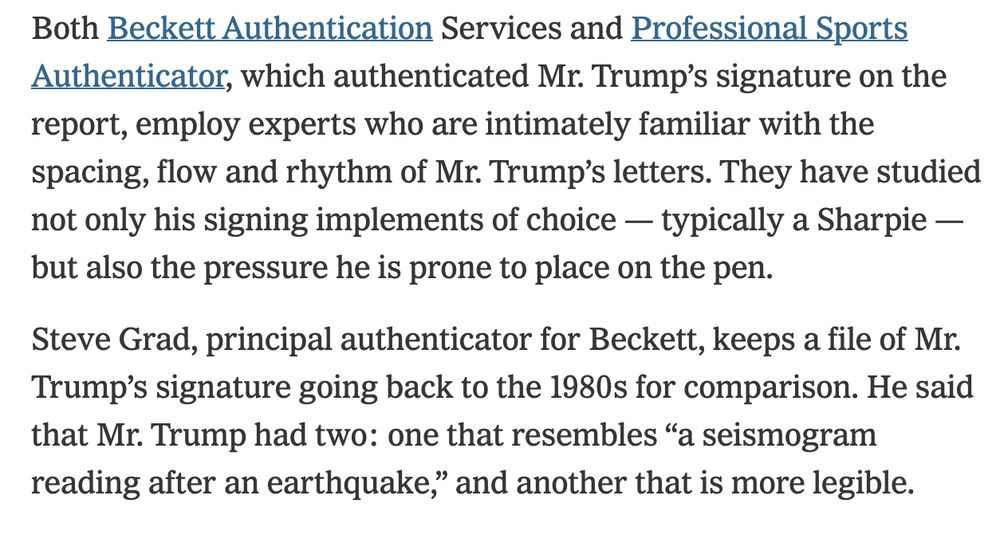
Per this February 2020 NYT story on signed Trump memorabilia, Trump has two different signatures.
September 8, 2025 at 7:49 PM
Per this February 2020 NYT story on signed Trump memorabilia, Trump has two different signatures.
Probably the guidance in the image, which appears at the linked BOP document at p. 51 of the pdf: www.bop.gov/policy/progs...
Maxwell's offenses of conviction fall into category (6), per this: www.bop.gov/policy/progs...
Maxwell is now in a Minimum security facility, which is lower than Low.
Maxwell's offenses of conviction fall into category (6), per this: www.bop.gov/policy/progs...
Maxwell is now in a Minimum security facility, which is lower than Low.

August 6, 2025 at 2:30 AM
Probably the guidance in the image, which appears at the linked BOP document at p. 51 of the pdf: www.bop.gov/policy/progs...
Maxwell's offenses of conviction fall into category (6), per this: www.bop.gov/policy/progs...
Maxwell is now in a Minimum security facility, which is lower than Low.
Maxwell's offenses of conviction fall into category (6), per this: www.bop.gov/policy/progs...
Maxwell is now in a Minimum security facility, which is lower than Low.
Seems like JD Vance should have some words with John Roberts.

July 30, 2025 at 4:40 PM
Seems like JD Vance should have some words with John Roberts.
Couldn't this fall into the the newly passed double jeopardy exception at CPL 40.51(4) or (5)? (Seems like it would depend on whether there's potential civil or criminal liability for anything Maxwell knows, which seems possible given the possibility of future statute of limitations extension laws.)

July 26, 2025 at 2:45 AM
Couldn't this fall into the the newly passed double jeopardy exception at CPL 40.51(4) or (5)? (Seems like it would depend on whether there's potential civil or criminal liability for anything Maxwell knows, which seems possible given the possibility of future statute of limitations extension laws.)
Take also this argument. SCOTUS only feels "forced" to resolve those "significant and difficult" questions of law on the shadow docket because it refuses to apply its normal stay factors to government stay petitions. If they did, they wouldn't always need to reach the merits.

June 27, 2025 at 3:31 PM
Take also this argument. SCOTUS only feels "forced" to resolve those "significant and difficult" questions of law on the shadow docket because it refuses to apply its normal stay factors to government stay petitions. If they did, they wouldn't always need to reach the merits.
First, the court says the "through the governor" language could not require the governor's consent because another section of title 10 requires the governor's consent more explicitly. The problem? 10 USC 12301 was enacted in 1952. The "through to governor" language was enacted in 1908.

June 20, 2025 at 3:34 AM
First, the court says the "through the governor" language could not require the governor's consent because another section of title 10 requires the governor's consent more explicitly. The problem? 10 USC 12301 was enacted in 1952. The "through to governor" language was enacted in 1908.
The opinion ends with this puzzling paragraph, which appears to argue that religious discrimination falls outside Title VI entirely... and infers that the President must therefore have some unspecified other authority, outside Title VI, to withdraw funding from schools for religious discrimination.
![Passage from AAUP v. DOJ, ECF 148 at 29-30.
"[A]ll of Plaintiffs' arguments that Defendants violated the APA (and the separation of powers) by failing to comply with procedural requirements for cutting funding pursuant to Title VI simply presuppose that Title VI is the exclusive vehicle by which the Executive Branch may withdraw financial support for an institution that allows religious discrimination.
"The Court urges Plaintiffs, and the amici who decry Defendants' alleged failure to follow Title VI to the letter, to review the text of that statute. Title VI does not mention religion. As such, it strikes the Court as unlikely that Title VI is the sole and exclusive 'legal tool[]' available to a President who instructs executive agencies to prioritize 'combat[ting] anti-Semitism . . . on university and college campuses.'" (citations omitted)](https://cdn.bsky.app/img/feed_thumbnail/plain/did:plc:cn54gi4w3anugyfn4czrrdw3/bafkreicos7vr4ojcnv47kcxzfx2l3oy7njd3dmfojjflrqko72t3kcy3my@jpeg)
June 16, 2025 at 10:52 PM
The opinion ends with this puzzling paragraph, which appears to argue that religious discrimination falls outside Title VI entirely... and infers that the President must therefore have some unspecified other authority, outside Title VI, to withdraw funding from schools for religious discrimination.
Surprisingly, the injury-in-fact analysis is even worse.
This paragraph finds that all the grant terminations at Columbia can be fully covered by Columbia's endowment, private donations, and tuition payments, despite there being no evidence that's true and plenty of evidence to the contrary.
This paragraph finds that all the grant terminations at Columbia can be fully covered by Columbia's endowment, private donations, and tuition payments, despite there being no evidence that's true and plenty of evidence to the contrary.
![Passage from p. 24 of AAUP v. DOJ, ECF 148 at 24-25:
"Turning to representational standing, Plaintiffs fail to establish that any injuries their members may have suffered are fairly traceable to Defendants. As noted above, the Court does find that some of Plaintiffs [sic] members used federal grants to Columbia for their academic work. The loss of professional opportunities or income may certainly constitute an injury in some cases. However, here, Plaintiffs have not demonstrated that it makes a difference to their members whether the funding for their research and salaries comes from American taxpayers, non-party Columbia's multi-billion-dollar endowment, the largess of Columbia's donors, or the eye-popping tuition bills paid by Columbia students, including the Jewish students who apparently paid for the privilege of being threatened with violence on their way to class." (citations omitted)](https://cdn.bsky.app/img/feed_thumbnail/plain/did:plc:cn54gi4w3anugyfn4czrrdw3/bafkreiaurfmqf2wmgj7bgjzj7eiif5ox666cxb3g6dkkeunioioqse45ta@jpeg)
June 16, 2025 at 9:40 PM
Surprisingly, the injury-in-fact analysis is even worse.
This paragraph finds that all the grant terminations at Columbia can be fully covered by Columbia's endowment, private donations, and tuition payments, despite there being no evidence that's true and plenty of evidence to the contrary.
This paragraph finds that all the grant terminations at Columbia can be fully covered by Columbia's endowment, private donations, and tuition payments, despite there being no evidence that's true and plenty of evidence to the contrary.
Unfortunately, now I can't think about it without also thinking about Justice Gorsuch's considerably less elegant rewrite in 303 Creative.
![Passage from Justice Gorsuch's opinion for the Court in 303 Creative LLC v. Elenis, 21-476, slip op. at 7 (June 30, 2023):
"For all these reasons '[i]f there is any fixed star in our constitutional constellation,' West Virginia Bd. of Ed. v. Barnette, 319 U.S. 624, 642 (1943), it is the principle that the government may not interfere with 'an uninhibited marketplace of ideas,' McCullen v. Coakley, 573 U.S. 464, 476 (2014)."](https://cdn.bsky.app/img/feed_thumbnail/plain/did:plc:cn54gi4w3anugyfn4czrrdw3/bafkreigzaev6vindsuprfotjgqdwgxd4bnqx4biq2vwlfpvlsty33qilgy@jpeg)
June 14, 2025 at 7:02 PM
Unfortunately, now I can't think about it without also thinking about Justice Gorsuch's considerably less elegant rewrite in 303 Creative.
Instead, DOJ argues that its position follows from the plain meaning of "though." DOJ also makes a policy argument: It would have been bad if 10 USC 12406 allowed a governor to veto a President's order because then Governor Faubus could have vetoed President Eisenhower's order during Little Rock.

June 11, 2025 at 7:07 PM
Instead, DOJ argues that its position follows from the plain meaning of "though." DOJ also makes a policy argument: It would have been bad if 10 USC 12406 allowed a governor to veto a President's order because then Governor Faubus could have vetoed President Eisenhower's order during Little Rock.
In 1911, the Army Chief of Staff, Maj. Gen. Wood, made the same point, arguing that the 1903 and 1908 Militia Acts had restricted the President's power over the militia (which he thought was bad).
There may be arguments why this historical interpretation was wrong; DOJ doesn't offer any.
There may be arguments why this historical interpretation was wrong; DOJ doesn't offer any.


June 11, 2025 at 7:07 PM
In 1911, the Army Chief of Staff, Maj. Gen. Wood, made the same point, arguing that the 1903 and 1908 Militia Acts had restricted the President's power over the militia (which he thought was bad).
There may be arguments why this historical interpretation was wrong; DOJ doesn't offer any.
There may be arguments why this historical interpretation was wrong; DOJ doesn't offer any.
During the House debate over the 1908 Militia Act, an opponent of the bill, Rep. Parker, argued against the bill, in part, on the grounds that the "through the governor" language *would* give the governor a veto over a presidential order to a state militia.

June 11, 2025 at 7:07 PM
During the House debate over the 1908 Militia Act, an opponent of the bill, Rep. Parker, argued against the bill, in part, on the grounds that the "through the governor" language *would* give the governor a veto over a presidential order to a state militia.
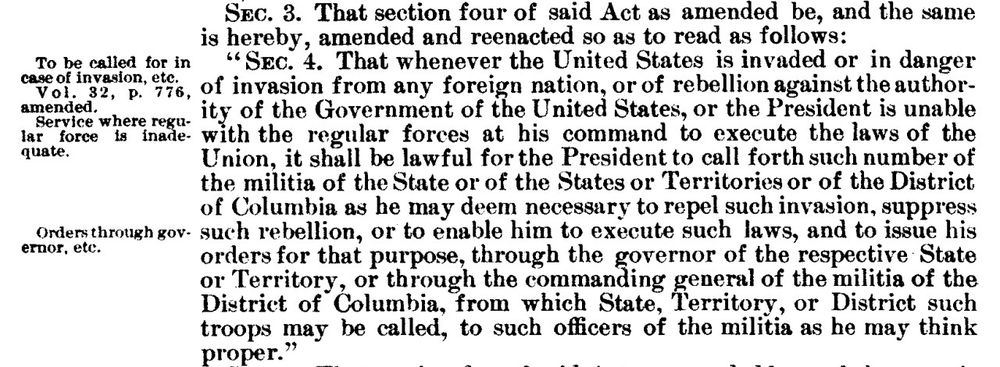
10 USC 12406 is a recodification of 10 USC secs. 3500 (Army NG) and 8500 (Air NG), which were themselves codifications of the 1903 Militia Act (the "Dick Act"), as amended by the 1908 Militia Act. The 1908 Militia Act added the "through the governor" language to this statute.
June 11, 2025 at 7:07 PM
10 USC 12406 is a recodification of 10 USC secs. 3500 (Army NG) and 8500 (Air NG), which were themselves codifications of the 1903 Militia Act (the "Dick Act"), as amended by the 1908 Militia Act. The 1908 Militia Act added the "through the governor" language to this statute.
DOJ has filed its opposition to Newsom's motion for a TRO in the National Guard case. They argue that the "through the governor" language in 10 USC 12406 does not allow the governor to veto a President's order to a state NG.
Historical evidence about the law's original meaning trends the other way.
Historical evidence about the law's original meaning trends the other way.
![Passage from p. 17 of DOJ's opposition to the motion for a TRO in Newsom v. Trump.
3. Section 12406 does not require a governor's consent or input.
Defendants also acted lawfully in the processes they used to federalize Guardsmen. Section 12406's first sentence establishes the President's unilateral authority to federalize Guardsmen. Again, it reads: "[T]he President may call into Federal service members and units of the National Guard of any State . . . ." The next sentence adds that "[o]rders for these purposes shall be issued through the governors of the States." 10 U.S.C. sec. 12406. The statute is thus clear that the orders are issued by the President, and they are conveyed through State officials. Nothing in the statute entitles a Governor to veto or impede a valid presidential order.](https://cdn.bsky.app/img/feed_thumbnail/plain/did:plc:cn54gi4w3anugyfn4czrrdw3/bafkreig2g3fr4wv2zfungthqzkv64kr5mgp6k7ktdqopfhnyprcnhr7554@jpeg)
June 11, 2025 at 7:07 PM
DOJ has filed its opposition to Newsom's motion for a TRO in the National Guard case. They argue that the "through the governor" language in 10 USC 12406 does not allow the governor to veto a President's order to a state NG.
Historical evidence about the law's original meaning trends the other way.
Historical evidence about the law's original meaning trends the other way.
Maj. Gen. Wood submitted a memo, in connection with debate over a 1911 bill, that made similar points about his understanding of the role of the governor under the Dick law (that is, the 1903 Militia Act as amended by the 1908 Militia Act).
Suggests the governor's role is not merely "ministerial."
Suggests the governor's role is not merely "ministerial."

June 11, 2025 at 3:57 AM
Maj. Gen. Wood submitted a memo, in connection with debate over a 1911 bill, that made similar points about his understanding of the role of the governor under the Dick law (that is, the 1903 Militia Act as amended by the 1908 Militia Act).
Suggests the governor's role is not merely "ministerial."
Suggests the governor's role is not merely "ministerial."
Here's some interesting subsequent history, from a 1911 hearing by the House Committee on Militia, in which Maj. Gen. Leonard Wood, at the time the Chief of Staff of the Army, agreed with the interpretation that the 1908 Act required the cooperation of the governor to call up the militia.


June 11, 2025 at 3:29 AM
Here's some interesting subsequent history, from a 1911 hearing by the House Committee on Militia, in which Maj. Gen. Leonard Wood, at the time the Chief of Staff of the Army, agreed with the interpretation that the 1908 Act required the cooperation of the governor to call up the militia.
One person (after Rep. Parker) who read this statute to require that presidential orders to a state NG go via the governor, who could veto, is Sen. Herman Talmadge, who in 1958 relied on this understanding to argue that this statute could not have allowed Eisenhower's use of the NG in Little Rock.
![Excerpt from the Congressional Record, August 18, 1958, p. 18230:
"Even in cases where the President is within his authority to call forth the militia to enforce the 'laws of the United States,' the law expressly provides that orders federalizing National Guard units 'shall be issued through the governors of the States.'
"This is made plain in section 3500 of title 10 of the United States Code [the prior codification of 10 USC 12406], from which I quote: [Quoting the language of 10 USC 3500, which is materially identical to 10 USC 12406].
"None of the three conditions set forth in this section was met in the Little Rock case. There was no danger of invasion, there was no rebellion or danger of rebellion."](https://cdn.bsky.app/img/feed_thumbnail/plain/did:plc:cn54gi4w3anugyfn4czrrdw3/bafkreigeem332xodjrkp7rz7veyyc4cu6bzrfpegjgcqilvxmrqyqubdw4@jpeg)

June 9, 2025 at 2:14 PM
One person (after Rep. Parker) who read this statute to require that presidential orders to a state NG go via the governor, who could veto, is Sen. Herman Talmadge, who in 1958 relied on this understanding to argue that this statute could not have allowed Eisenhower's use of the NG in Little Rock.
Though one of the bill's opponents, Mr. Parker, opposed it on the grounds it was taking away the President's power to command the militia directly. He assumed this new law would require the cooperation of a state's governor.

June 8, 2025 at 9:29 PM
Though one of the bill's opponents, Mr. Parker, opposed it on the grounds it was taking away the President's power to command the militia directly. He assumed this new law would require the cooperation of a state's governor.