


Cordero-Vásquez Lab
@cvlab.bsky.social
A great opportunity to bring trainees, exchange ideas, and connect across disciplines. Registration is open: www.grc.org/ion-channels...
3/3
3/3
2026 Ion Channels Conference GRC
The 2026 Gordon Research Conference on Ion Channels will be held in South Hadley, Massachusetts. Apply today to reserve your spot.
www.grc.org
January 27, 2026 at 10:40 PM
A great opportunity to bring trainees, exchange ideas, and connect across disciplines. Registration is open: www.grc.org/ion-channels...
3/3
3/3
We have an outstanding speaker lineup, including Keynote Talks by Kenton Swartz, Nancy Carrasco, Miriam B. Goodman (@wormsense.bsky.social), and Francisco Bezanilla. Trailblazer Spotlights presented by Ed Twomey (@cryoet.bsky.social)and Theanne Griffith (@doctheagrif.bsky.social).
2/3
2/3
January 27, 2026 at 10:40 PM
We have an outstanding speaker lineup, including Keynote Talks by Kenton Swartz, Nancy Carrasco, Miriam B. Goodman (@wormsense.bsky.social), and Francisco Bezanilla. Trailblazer Spotlights presented by Ed Twomey (@cryoet.bsky.social)and Theanne Griffith (@doctheagrif.bsky.social).
2/3
2/3
This work was a collaboration with Mat Baker (UTHealth Houston), the Chesler Lab @alexchesler.bsky.social (NIH), and the Sotomayor Lab (University of Chicago).
5/5
5/5

January 2, 2026 at 6:00 PM
This work was a collaboration with Mat Baker (UTHealth Houston), the Chesler Lab @alexchesler.bsky.social (NIH), and the Sotomayor Lab (University of Chicago).
5/5
5/5
4. The pore-distal, N-terminal blade is dispensable for mechanoactivation: the intermediate isoform is not only functional, but also inactivates more slowly than the long isoform.
5. The intermediate isoform induces larger membrane deformation than the long isoform.
4/5
5. The intermediate isoform induces larger membrane deformation than the long isoform.
4/5
January 2, 2026 at 6:00 PM
4. The pore-distal, N-terminal blade is dispensable for mechanoactivation: the intermediate isoform is not only functional, but also inactivates more slowly than the long isoform.
5. The intermediate isoform induces larger membrane deformation than the long isoform.
4/5
5. The intermediate isoform induces larger membrane deformation than the long isoform.
4/5
1. The longest isoform resembles a Mercedes-Benz steering wheel in top view.
2. The long and intermediate isoforms are semi-flattened and differ from the mammalian domes.
3. Multiple blade–cap contacts stabilize a “toggle-down” conformation.
3/5
2. The long and intermediate isoforms are semi-flattened and differ from the mammalian domes.
3. Multiple blade–cap contacts stabilize a “toggle-down” conformation.
3/5
January 2, 2026 at 6:00 PM
1. The longest isoform resembles a Mercedes-Benz steering wheel in top view.
2. The long and intermediate isoforms are semi-flattened and differ from the mammalian domes.
3. Multiple blade–cap contacts stabilize a “toggle-down” conformation.
3/5
2. The long and intermediate isoforms are semi-flattened and differ from the mammalian domes.
3. Multiple blade–cap contacts stabilize a “toggle-down” conformation.
3/5
Briar and Angela (CV Lab) solved three structures from heavily spliced worm isoforms. Along the way —while solving the structures, characterizing their function, and evaluating effects on membrane curvature— we ran into several surprises:
2/5
2/5
January 2, 2026 at 6:00 PM
Briar and Angela (CV Lab) solved three structures from heavily spliced worm isoforms. Along the way —while solving the structures, characterizing their function, and evaluating effects on membrane curvature— we ran into several surprises:
2/5
2/5
Thanks to our team members (Luis Romero, Manisha Bade, Sonia Paz-López) and collaborators (Elisa Carrillo, Vasanthi Jayaraman @frettinglab.bsky.social , Syed Hasan, William James Antonisamy, and Zahoor Shah) 6/6
November 6, 2025 at 8:03 PM
Thanks to our team members (Luis Romero, Manisha Bade, Sonia Paz-López) and collaborators (Elisa Carrillo, Vasanthi Jayaraman @frettinglab.bsky.social , Syed Hasan, William James Antonisamy, and Zahoor Shah) 6/6
Our results highlight cytoskeletal dysregulation as a key driver of ion channel and behavioral deficits, and suggest that actin-binding proteins may be targets to enhance motor coordination and spatial learning in AS. 5/6
November 6, 2025 at 8:03 PM
Our results highlight cytoskeletal dysregulation as a key driver of ion channel and behavioral deficits, and suggest that actin-binding proteins may be targets to enhance motor coordination and spatial learning in AS. 5/6
currents in hippocampal neurons, and improves rotarod and T-maze performance in AS mice. 4/6
November 6, 2025 at 8:03 PM
currents in hippocampal neurons, and improves rotarod and T-maze performance in AS mice. 4/6
In Angelman syndrome (AS), disrupted F-actin affects mechanosensitive and glutamatergic signaling. We show that a first-in-class, selective cofilin inhibitor (SZ-3) stabilizes the actin cytoskeleton, increases cellular stiffness, restores PIEZO2 function in DRG neurons and glutamate-evoked 3/6
November 6, 2025 at 8:03 PM
In Angelman syndrome (AS), disrupted F-actin affects mechanosensitive and glutamatergic signaling. We show that a first-in-class, selective cofilin inhibitor (SZ-3) stabilizes the actin cytoskeleton, increases cellular stiffness, restores PIEZO2 function in DRG neurons and glutamate-evoked 3/6
It was nicely highlighted by Paige McKeon in “This Week in The Journal: www.jneurosci.org/content/45/4... 2/6

This Week in The Journal
Mechanistic Insight into Angelman Syndrome Treatments
Luis O. Romero, Manisha Bade, Elisa Carrillo, Sonia Paz-López, Syed A. M. Hasan et al.
(see article e0965252025)
People with Angelman syndrome...
www.jneurosci.org
November 6, 2025 at 8:03 PM
It was nicely highlighted by Paige McKeon in “This Week in The Journal: www.jneurosci.org/content/45/4... 2/6
(TMC, the world’s largest medical complex). 2/2
October 21, 2025 at 9:47 PM
(TMC, the world’s largest medical complex). 2/2
This study was a collaborative effort across multiple groups, led by our first graduate student, Dr.
Luis Octavio Romero, in partnership with graduate student Manisha Bade. 3/3
Luis Octavio Romero, in partnership with graduate student Manisha Bade. 3/3
October 3, 2025 at 4:53 PM
This study was a collaborative effort across multiple groups, led by our first graduate student, Dr.
Luis Octavio Romero, in partnership with graduate student Manisha Bade. 3/3
Luis Octavio Romero, in partnership with graduate student Manisha Bade. 3/3
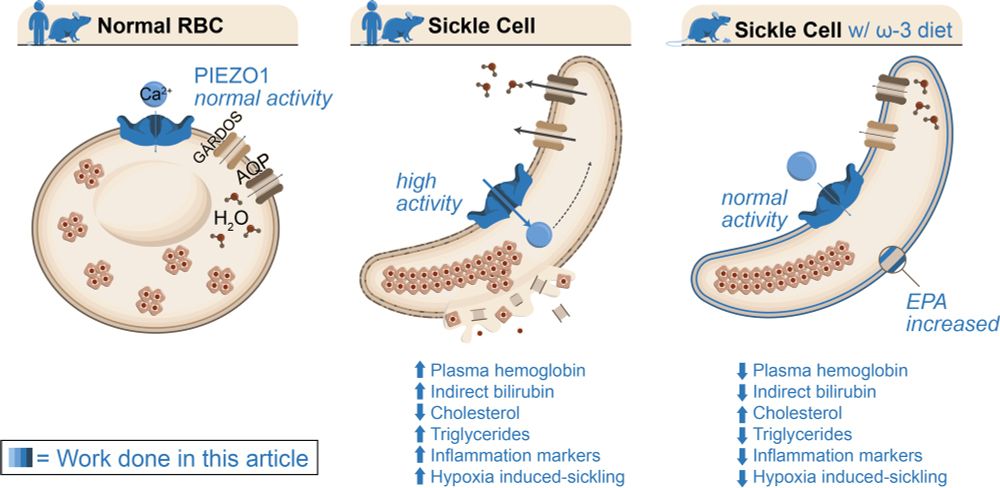
PIEZO1 is abnormally overactive in sickle red blood cells (humans and mice). In mice, an EPA-enriched diet normalized PIEZO1 and reduced hemolysis, hypoxia-induced sickling, and downstream inflammation, suggesting a potential dietary strategy to support people living with sickle cell disease. 2/3
October 3, 2025 at 4:53 PM
PIEZO1 is abnormally overactive in sickle red blood cells (humans and mice). In mice, an EPA-enriched diet normalized PIEZO1 and reduced hemolysis, hypoxia-induced sickling, and downstream inflammation, suggesting a potential dietary strategy to support people living with sickle cell disease. 2/3