


David Mauduit
@davidmauduit.bsky.social
Research manager at VIB.AI
Gene regulation and enhancer design 🧬
Gene regulation and enhancer design 🧬
Reposted by David Mauduit

Such a treat to host @gioelelamanno.bsky.social (EPFL) today and be the first to hear more about his lab's latest work, posted just two days ago on bioRxiv.
Missed the talk?
Here's the preprint: https://www.biorxiv.org/content/10.1101/2025.10.13.682018v1
Missed the talk?
Here's the preprint: https://www.biorxiv.org/content/10.1101/2025.10.13.682018v1


October 16, 2025 at 3:52 PM
Such a treat to host @gioelelamanno.bsky.social (EPFL) today and be the first to hear more about his lab's latest work, posted just two days ago on bioRxiv.
Missed the talk?
Here's the preprint: https://www.biorxiv.org/content/10.1101/2025.10.13.682018v1
Missed the talk?
Here's the preprint: https://www.biorxiv.org/content/10.1101/2025.10.13.682018v1
Reposted by David Mauduit

1/ First preprint from @jdemeul.bsky.social lab 🥳! We present our new multi-modal single-cell long-read method SPLONGGET (Single-cell Profiling of LONG-read Genome, Epigenome, and Transcriptome)! www.biorxiv.org/content/10.1...

September 10, 2025 at 3:48 PM
1/ First preprint from @jdemeul.bsky.social lab 🥳! We present our new multi-modal single-cell long-read method SPLONGGET (Single-cell Profiling of LONG-read Genome, Epigenome, and Transcriptome)! www.biorxiv.org/content/10.1...
Reposted by David Mauduit

Check out our work on evaluating methods for predicting in vivo cell enhancer activity in the mouse cortex! Combined, scATAC peak specificity and sequence-based CREsted predictions gave the best predictive performance, aiming to advance genetic tool design for cell targeting in the brain.
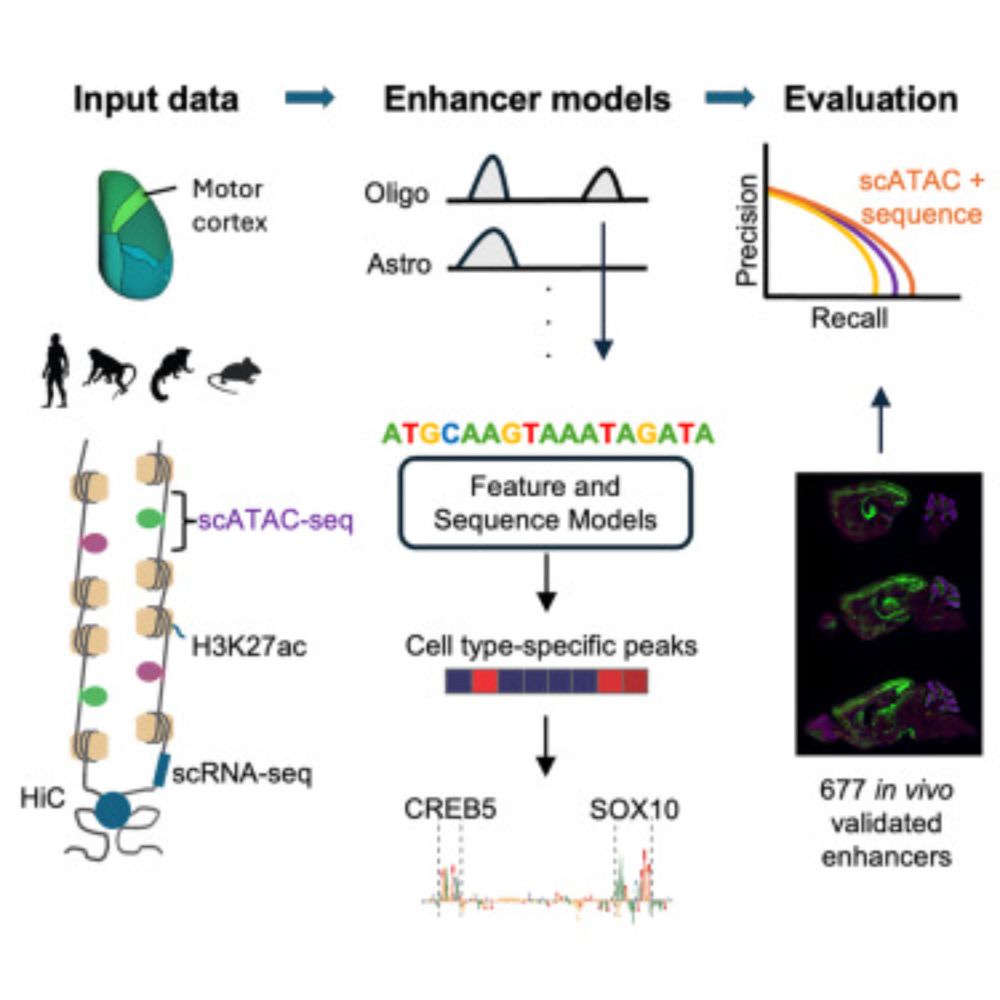
Evaluating methods for the prediction of cell-type-specific enhancers in the mammalian cortex
Johansen et al. report the results of a community challenge to predict functional
enhancers targeting specific brain cell types. By comparing multi-omics machine learning
approaches using in vivo data...
www.cell.com
May 21, 2025 at 4:45 PM
Check out our work on evaluating methods for predicting in vivo cell enhancer activity in the mouse cortex! Combined, scATAC peak specificity and sequence-based CREsted predictions gave the best predictive performance, aiming to advance genetic tool design for cell targeting in the brain.
Reposted by David Mauduit
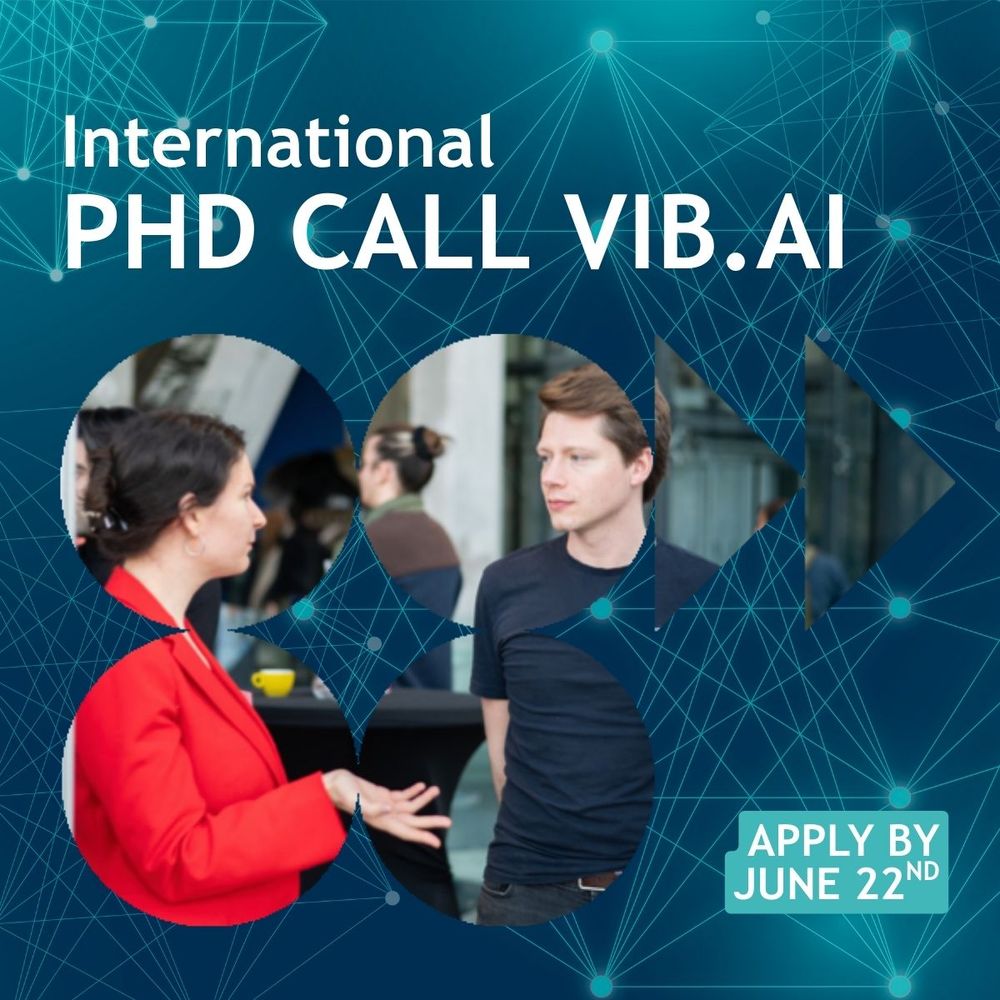
VIB.AI's International PhD call is now open!
https://tinyurl.com/53nc9vnd
If you're interested in applying AI to biology, take a look at the PhD projects across our labs.
🗓️ Deadline: June 22nd
https://tinyurl.com/53nc9vnd
If you're interested in applying AI to biology, take a look at the PhD projects across our labs.
🗓️ Deadline: June 22nd
May 6, 2025 at 12:48 PM
VIB.AI's International PhD call is now open!
https://tinyurl.com/53nc9vnd
If you're interested in applying AI to biology, take a look at the PhD projects across our labs.
🗓️ Deadline: June 22nd
https://tinyurl.com/53nc9vnd
If you're interested in applying AI to biology, take a look at the PhD projects across our labs.
🗓️ Deadline: June 22nd
Reposted by David Mauduit
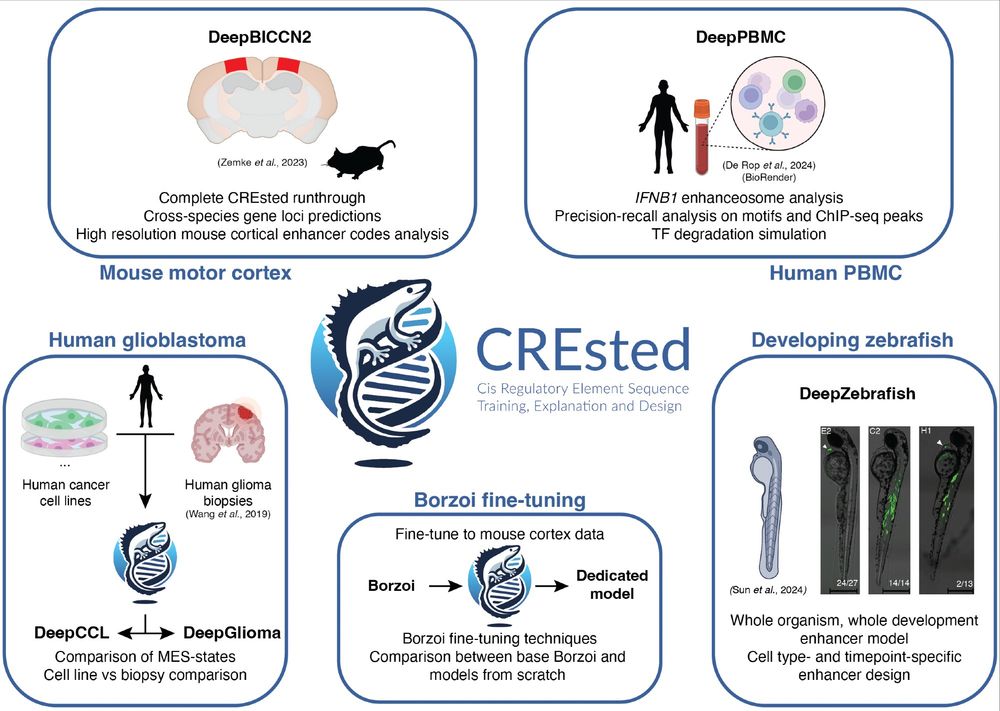
We released our preprint on the CREsted package. CREsted allows for complete modeling of cell type-specific enhancer codes from scATAC-seq data. We demonstrate CREsted’s robust functionality in various species and tissues, and in vivo validate our findings: www.biorxiv.org/content/10.1...
April 3, 2025 at 2:30 PM
We released our preprint on the CREsted package. CREsted allows for complete modeling of cell type-specific enhancer codes from scATAC-seq data. We demonstrate CREsted’s robust functionality in various species and tissues, and in vivo validate our findings: www.biorxiv.org/content/10.1...
Reposted by David Mauduit
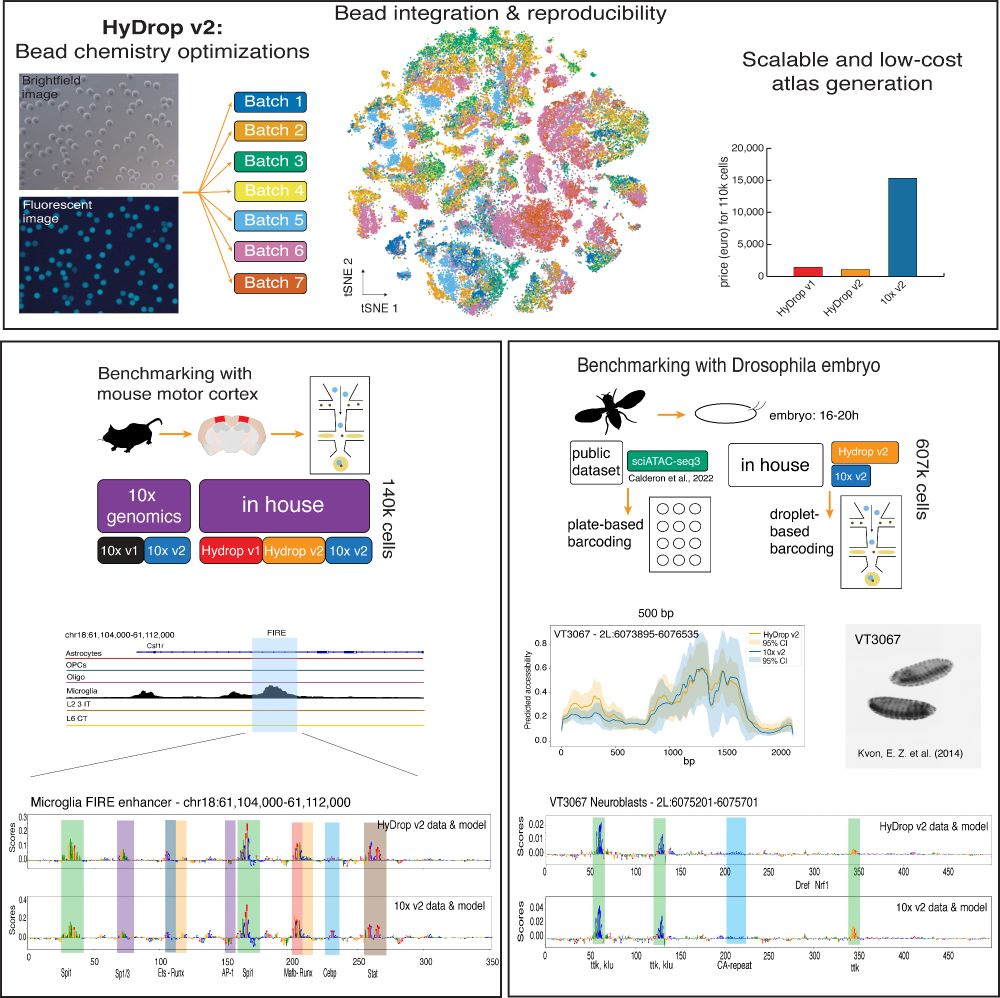
Our new preprint is out! We optimized our open-source platform, HyDrop (v2), for scATAC sequencing and generated new atlases for the mouse cortex and Drosophila embryo with 607k cells. Now, we can train sequence-to-function models on data generated with HyDrop v2!
www.biorxiv.org/content/10.1...
www.biorxiv.org/content/10.1...
April 4, 2025 at 8:52 AM
Our new preprint is out! We optimized our open-source platform, HyDrop (v2), for scATAC sequencing and generated new atlases for the mouse cortex and Drosophila embryo with 607k cells. Now, we can train sequence-to-function models on data generated with HyDrop v2!
www.biorxiv.org/content/10.1...
www.biorxiv.org/content/10.1...
Reposted by David Mauduit
2) HyDrop-v2: with a new bead design it provides scalable and cost-effective generation of scATAC-seq atlases. With HyDrop atlases of the fly embryo and mouse cortex we show that CREsted models trained on HyDrop data are equivalent to models trained 10x atlases. www.biorxiv.org/content/10.1...
HyDrop v2: Scalable atlas construction for training sequence-to-function models
Deciphering cis-regulatory logic underlying cell type identity is a fundamental question in biology. Single-cell chromatin accessibility (scATAC-seq) data has enabled training of sequence-to-function ...
www.biorxiv.org
April 4, 2025 at 9:04 AM
2) HyDrop-v2: with a new bead design it provides scalable and cost-effective generation of scATAC-seq atlases. With HyDrop atlases of the fly embryo and mouse cortex we show that CREsted models trained on HyDrop data are equivalent to models trained 10x atlases. www.biorxiv.org/content/10.1...
Reposted by David Mauduit
Very proud of two new preprints from the lab:
1) CREsted: to train sequence-to-function deep learning models on scATAC-seq atlases, and use them to decipher enhancer logic and design synthetic enhancers. This has been a wonderful lab-wide collaborative effort. www.biorxiv.org/content/10.1...
1) CREsted: to train sequence-to-function deep learning models on scATAC-seq atlases, and use them to decipher enhancer logic and design synthetic enhancers. This has been a wonderful lab-wide collaborative effort. www.biorxiv.org/content/10.1...
CREsted: modeling genomic and synthetic cell type-specific enhancers across tissues and species
Sequence-based deep learning models have become the state of the art for the analysis of the genomic regulatory code. Particularly for transcriptional enhancers, deep learning models excel at decipher...
www.biorxiv.org
April 4, 2025 at 9:04 AM
Very proud of two new preprints from the lab:
1) CREsted: to train sequence-to-function deep learning models on scATAC-seq atlases, and use them to decipher enhancer logic and design synthetic enhancers. This has been a wonderful lab-wide collaborative effort. www.biorxiv.org/content/10.1...
1) CREsted: to train sequence-to-function deep learning models on scATAC-seq atlases, and use them to decipher enhancer logic and design synthetic enhancers. This has been a wonderful lab-wide collaborative effort. www.biorxiv.org/content/10.1...
Reposted by David Mauduit
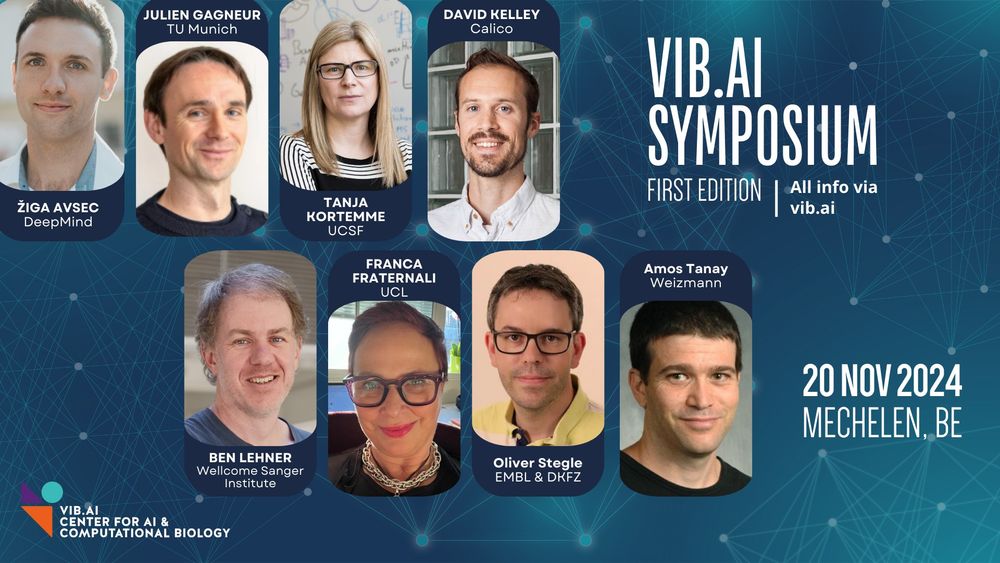
Looking forward to the Inaugural Symposium of the Center for AI & Computational Biology vib.ai with a great line-up of speakers at the interface of AI & biology: D. Kelley, J. Gagneur, Z. Avsec, T. Kortemme, B. Lehner, F. Fraternali, A. Tanay & O. Stegle (20Nov) www.vibconferences.be/events/vibai...
November 12, 2024 at 11:26 AM
Looking forward to the Inaugural Symposium of the Center for AI & Computational Biology vib.ai with a great line-up of speakers at the interface of AI & biology: D. Kelley, J. Gagneur, Z. Avsec, T. Kortemme, B. Lehner, F. Fraternali, A. Tanay & O. Stegle (20Nov) www.vibconferences.be/events/vibai...