



Dan Björkegren
@dbjork.bsky.social
Digital data/machine learning/economics, focused on developing economies. Faculty at Columbia. dan.bjorkegren.com
What could it mean? Perhaps open-weight AI models:
- Shift who benefits
- Induce different investments
- Are more likely to lead to extreme outcomes
- Or something else
I’m trying to make sense of it, so thoughts are very welcome!
Paper here:
arxiv.org/abs/2512.14969
(3/3)
- Shift who benefits
- Induce different investments
- Are more likely to lead to extreme outcomes
- Or something else
I’m trying to make sense of it, so thoughts are very welcome!
Paper here:
arxiv.org/abs/2512.14969
(3/3)

Market Beliefs about Open vs. Closed AI
Market expectations about AI's economic impact may influence interest rates. Previous work has shown that US bond yields decline around the release of a sample of mostly proprietary AI models (Andrews...
arxiv.org
January 6, 2026 at 3:26 PM
What could it mean? Perhaps open-weight AI models:
- Shift who benefits
- Induce different investments
- Are more likely to lead to extreme outcomes
- Or something else
I’m trying to make sense of it, so thoughts are very welcome!
Paper here:
arxiv.org/abs/2512.14969
(3/3)
- Shift who benefits
- Induce different investments
- Are more likely to lead to extreme outcomes
- Or something else
I’m trying to make sense of it, so thoughts are very welcome!
Paper here:
arxiv.org/abs/2512.14969
(3/3)
Isaiah Andrews and Maryam Farboodi documented the yield decline around mostly proprietary AI model releases in a thought provoking paper. Following closely, I find evidence that markets react differently to open weight model releases–possibly in the opposite direction. (2/3)
January 6, 2026 at 3:26 PM
Isaiah Andrews and Maryam Farboodi documented the yield decline around mostly proprietary AI model releases in a thought provoking paper. Following closely, I find evidence that markets react differently to open weight model releases–possibly in the opposite direction. (2/3)
Also, search results are low quality. Only 2% of results were from in-country. We asked teachers to rate responses, without telling them how the response was generated. Teachers rate AI responses as more helpful, relevant, and correct than web search results.
April 2, 2025 at 5:06 PM
The research conducted with my students at Columbia Jun Ho Choi, Divya Budihal, Dominic Sobhani, and chatbot creators Oliver Garrod and Paul Atherton
February 25, 2025 at 8:01 PM
The research conducted with my students at Columbia Jun Ho Choi, Divya Budihal, Dominic Sobhani, and chatbot creators Oliver Garrod and Paul Atherton
This is together with the excellent folks at Fab Inc who created the chatbot and are coordinating work at AI-for-Education.org. Also @educaid.bsky.social in Sierra Leone
February 25, 2025 at 8:01 PM
This is together with the excellent folks at Fab Inc who created the chatbot and are coordinating work at AI-for-Education.org. Also @educaid.bsky.social in Sierra Leone
We’re working on the question: how can we build information services for the 2.6 billion people underserved by the web? If you’re interested, reach out.
Working paper here: arxiv.org/abs/2502.12397
Working paper here: arxiv.org/abs/2502.12397
Could AI Leapfrog the Web? Evidence from Teachers in Sierra Leone
Access to digital information is a driver of economic development. But although 85% of sub-Saharan Africa's population is covered by mobile broadband signal, only 37% use the internet, and those who d...
arxiv.org
February 25, 2025 at 8:01 PM
We’re working on the question: how can we build information services for the 2.6 billion people underserved by the web? If you’re interested, reach out.
Working paper here: arxiv.org/abs/2502.12397
Working paper here: arxiv.org/abs/2502.12397
AI can reformat knowledge to work better on small screens and costly, intermittent connections. Can it help catch up remote, low-income communities to the revolution of information?
February 25, 2025 at 8:01 PM
AI can reformat knowledge to work better on small screens and costly, intermittent connections. Can it help catch up remote, low-income communities to the revolution of information?
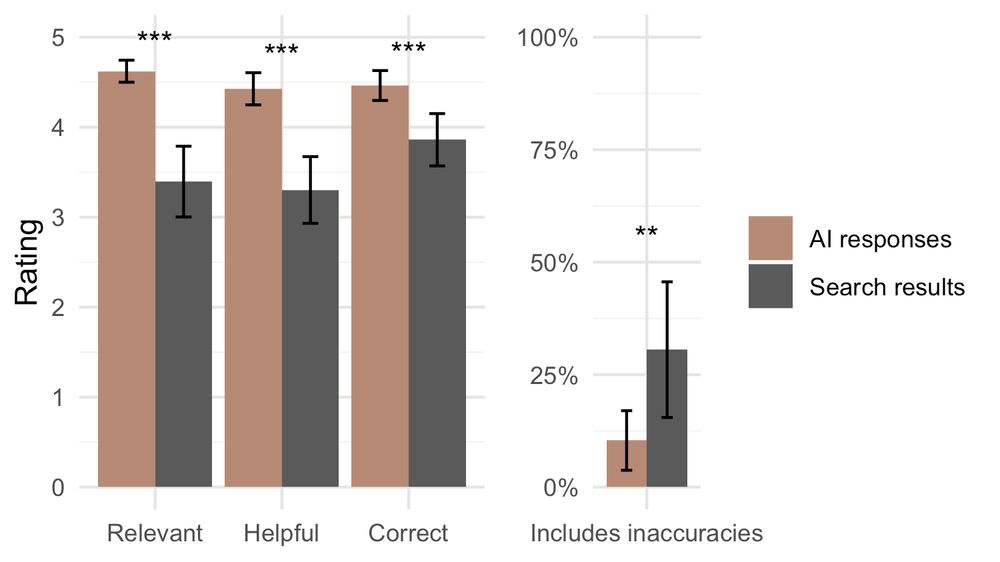
Also, search results are low quality. Only 2% of results were from in-country. We asked teachers to rate responses, without telling them how the response was generated. Teachers rate AI responses as more helpful, relevant, and correct than web search results.
February 25, 2025 at 8:01 PM
Also, search results are low quality. Only 2% of results were from in-country. We asked teachers to rate responses, without telling them how the response was generated. Teachers rate AI responses as more helpful, relevant, and correct than web search results.
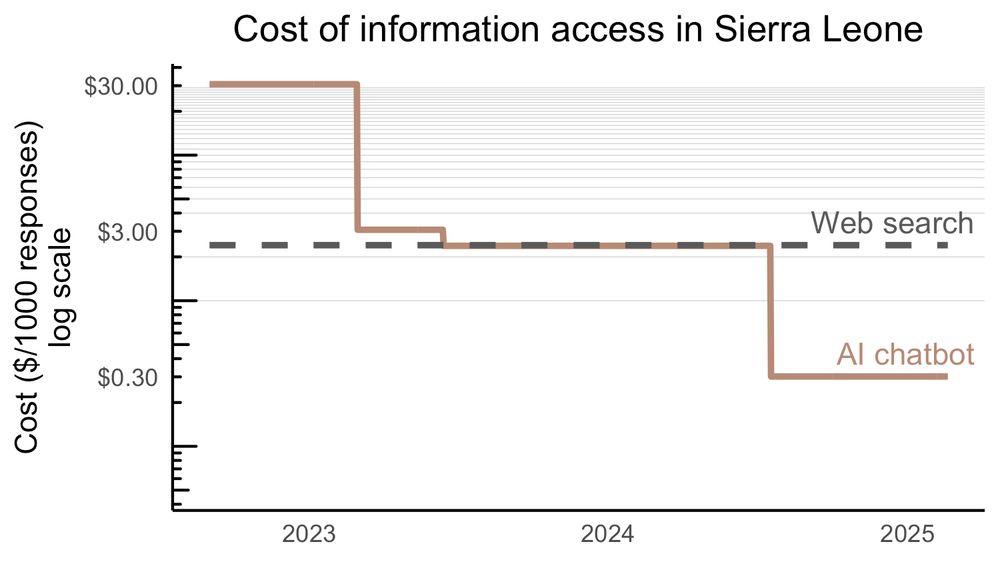
Because querying an AI is 3,107x more data efficient, AI is already 87% cheaper than loading a web page for our teachers in Sierra Leone.
February 25, 2025 at 8:01 PM
Because querying an AI is 3,107x more data efficient, AI is already 87% cheaper than loading a web page for our teachers in Sierra Leone.
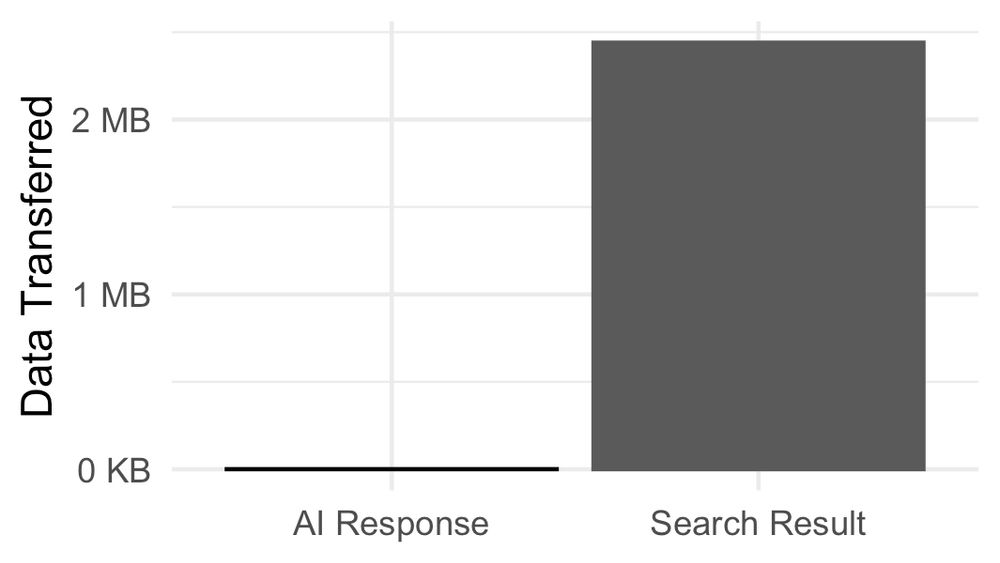
Why don’t teachers use web search? First, because search is slow and expensive. The average web page uses 3,107x more data than the corresponding AI response (!)
February 25, 2025 at 8:01 PM
Why don’t teachers use web search? First, because search is slow and expensive. The average web page uses 3,107x more data than the corresponding AI response (!)
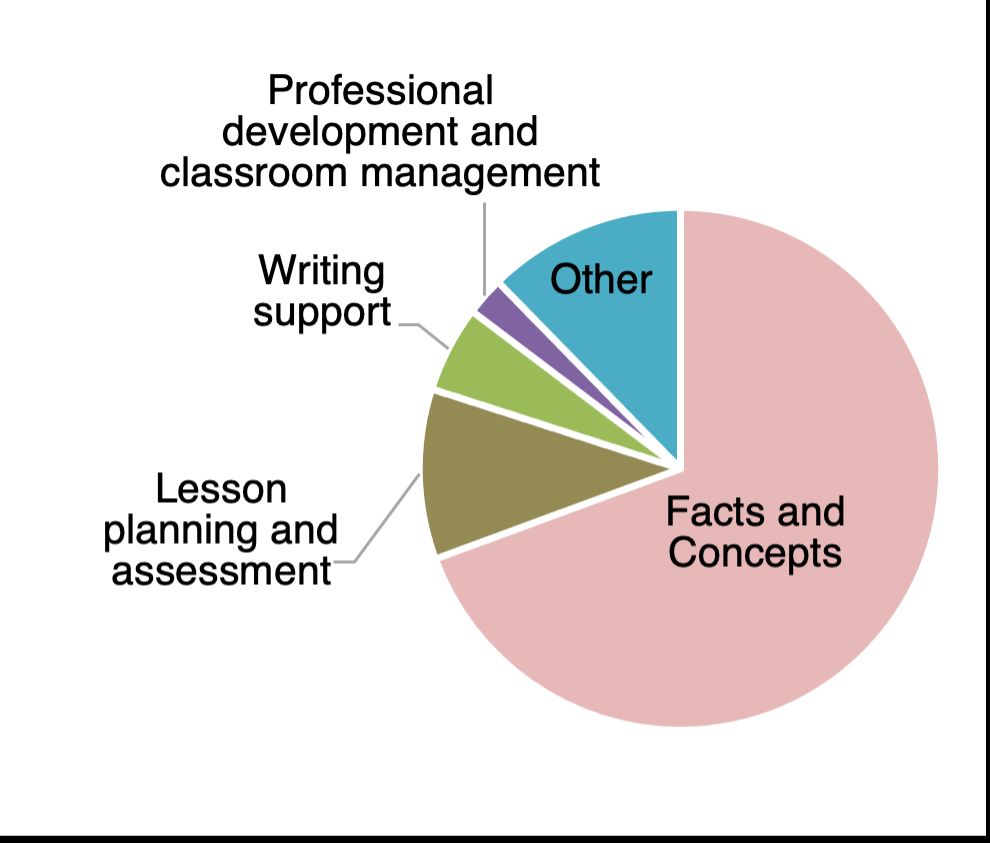
What do teachers use AI for? Mostly for facts and conceptual questions.
February 25, 2025 at 8:01 PM
What do teachers use AI for? Mostly for facts and conceptual questions.
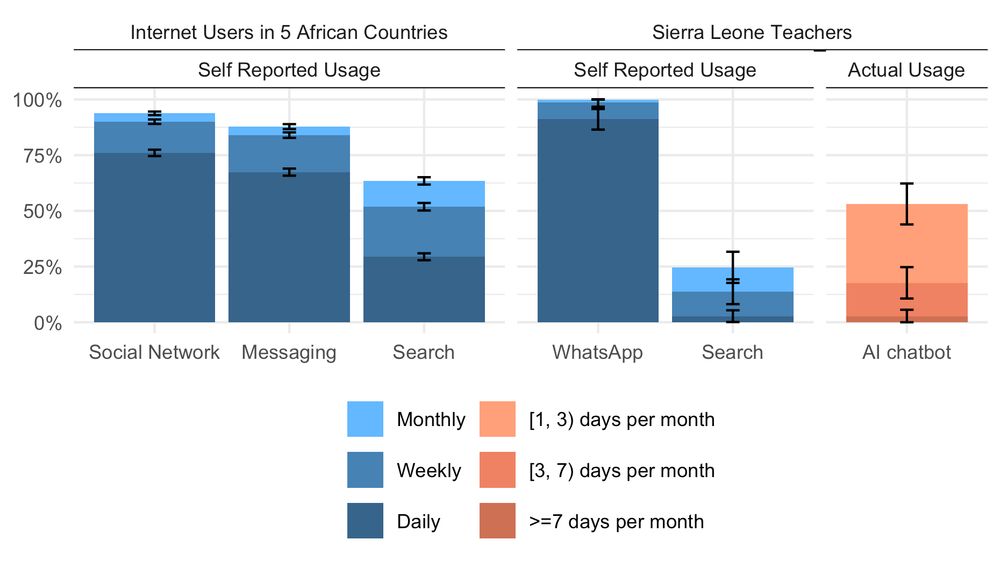
85% of sub-Saharan Africans have mobile broadband signal, but few use the internet. Internet users use WhatsApp—but seldom web search (see plot).
We study a GPT-based chatbot accessible through WhatsApp. Sierra Leonean teachers use AI more than web search (leapfrog!)
We study a GPT-based chatbot accessible through WhatsApp. Sierra Leonean teachers use AI more than web search (leapfrog!)
February 25, 2025 at 8:01 PM
85% of sub-Saharan Africans have mobile broadband signal, but few use the internet. Internet users use WhatsApp—but seldom web search (see plot).
We study a GPT-based chatbot accessible through WhatsApp. Sierra Leonean teachers use AI more than web search (leapfrog!)
We study a GPT-based chatbot accessible through WhatsApp. Sierra Leonean teachers use AI more than web search (leapfrog!)
I haven't read their quantum book but I love the Fourier book so I expect it's also good www.amazon.com/What-Quantum...

What Is Quantum Mechanics?: A Physics Adventure
Buy What Is Quantum Mechanics?: A Physics Adventure on Amazon.com ✓ FREE SHIPPING on qualified orders
www.amazon.com
December 9, 2024 at 2:02 PM
I haven't read their quantum book but I love the Fourier book so I expect it's also good www.amazon.com/What-Quantum...
PhD students: there is a tutorial on AI + digital economics Feb 12 too; apply here www.nber.org/calls-papers...

Digital Economics and AI Tutorial
www.nber.org
December 2, 2024 at 7:25 PM
PhD students: there is a tutorial on AI + digital economics Feb 12 too; apply here www.nber.org/calls-papers...