




Deepak Premkumar
@deepakpremkumar.bsky.social
Economist. Researches the criminal justice system at Public Policy Institute of California. PhD from UC Berkeley. Undergrad at Iowa State. Thoughts are my own. #EconSky
https://sites.google.com/view/deepakpremkumar
https://sites.google.com/view/deepakpremkumar
CA example of emergency bail orders were unique in that it resulted in automatic release (because of "zero dollar" bail) for many offenses and was not generally paired with monitoring or case mgmt because of COVID pandemic.
August 26, 2025 at 7:41 PM
CA example of emergency bail orders were unique in that it resulted in automatic release (because of "zero dollar" bail) for many offenses and was not generally paired with monitoring or case mgmt because of COVID pandemic.
Some research highlights that crime reduction benefits of pretrial detention from those channels are offset against longer-term crime increases. Those are because of disruptions to jobs and public benefits, family and social strain, criminogenic nature of jails, and stress in general.
August 26, 2025 at 7:41 PM
Some research highlights that crime reduction benefits of pretrial detention from those channels are offset against longer-term crime increases. Those are because of disruptions to jobs and public benefits, family and social strain, criminogenic nature of jails, and stress in general.
Good q. Crime could go down as incapacitation from being in jail, as you said. That's likely biggest channel. Also, deterrence knowing that there is some financial penalty or detention (if cannot pay) when they commit crime, especially for cases of automatic release. But there are costs (see below).
August 26, 2025 at 7:41 PM
Good q. Crime could go down as incapacitation from being in jail, as you said. That's likely biggest channel. Also, deterrence knowing that there is some financial penalty or detention (if cannot pay) when they commit crime, especially for cases of automatic release. But there are costs (see below).
Some short-term risk of CA emer bail orders, and arresting offense—on its own—may not always be an accurate indicator of future risk, esp for felonies. Pretrial risk assessments based on crim history could be promising. Studies are mixed but some CA studies seem promising. n/n
August 18, 2025 at 10:04 PM
Some short-term risk of CA emer bail orders, and arresting offense—on its own—may not always be an accurate indicator of future risk, esp for felonies. Pretrial risk assessments based on crim history could be promising. Studies are mixed but some CA studies seem promising. n/n
Future research needed on: (1) pub health benefits of bail policy wrt COVID transmission in courts and jails, (2) longer-term impacts on rearrests—pretrial detention has potential crime costs too that are less likely to materialize early on. 14/n
August 18, 2025 at 10:04 PM
Future research needed on: (1) pub health benefits of bail policy wrt COVID transmission in courts and jails, (2) longer-term impacts on rearrests—pretrial detention has potential crime costs too that are less likely to materialize early on. 14/n
Focus on settings w/ automatic release: Albright (2022) studies a KY release of low-level offenses---no effect on rearrests but small rise in court appearance. Heaton (2022) studies TX case that results in release of misdemeanors, but no impact on future felony offending. 13/n
August 18, 2025 at 10:04 PM
Focus on settings w/ automatic release: Albright (2022) studies a KY release of low-level offenses---no effect on rearrests but small rise in court appearance. Heaton (2022) studies TX case that results in release of misdemeanors, but no impact on future felony offending. 13/n
CA setting shows a rare statewide natural experiment where cash bail is being taken away (w/ lots of COVID disruption) and then put back into place (less COVID disruption) for a wide variety of offenses. What do other studies on bail show w/o COVID impact? 12/n
August 18, 2025 at 10:04 PM
CA setting shows a rare statewide natural experiment where cash bail is being taken away (w/ lots of COVID disruption) and then put back into place (less COVID disruption) for a wide variety of offenses. What do other studies on bail show w/o COVID impact? 12/n
Arrest, booking, and jail pop stayed below pre-pandemic levels during this period, suggesting some pandemic-era practices may have persisted. That could have contributed to felony rearrest rates not quickly returning to pre-pandemic levels after these orders ended. 11/n
August 18, 2025 at 10:04 PM
Arrest, booking, and jail pop stayed below pre-pandemic levels during this period, suggesting some pandemic-era practices may have persisted. That could have contributed to felony rearrest rates not quickly returning to pre-pandemic levels after these orders ended. 11/n
Both may explain why impact subsides 4 months after implementation. Also possible that counties and law enforcement learned and adapted, modifying the offenses considered eligible for zero bail. 10/n
August 18, 2025 at 10:04 PM
Both may explain why impact subsides 4 months after implementation. Also possible that counties and law enforcement learned and adapted, modifying the offenses considered eligible for zero bail. 10/n
Why do we see this asymmetry btwn implementation and revocation? Difficulty connecting people in jail with pretrial services and case mgmt early in COVID. Reoffending risk when released during height of the pandemic may be different than when society functioning normally. 9/n
August 18, 2025 at 10:04 PM
Why do we see this asymmetry btwn implementation and revocation? Difficulty connecting people in jail with pretrial services and case mgmt early in COVID. Reoffending risk when released during height of the pandemic may be different than when society functioning normally. 9/n
What happened when cash bail was reinstated? No change in rearrests, regardless of offense type. Can rule out relatively small effects. Because felony rearrests did not subside while orders were in place or when revoked, they remained slightly elevated until late 2023. 8/n
August 18, 2025 at 10:04 PM
What happened when cash bail was reinstated? No change in rearrests, regardless of offense type. Can rule out relatively small effects. Because felony rearrests did not subside while orders were in place or when revoked, they remained slightly elevated until late 2023. 8/n
For counties w/ orders past 2020, rearrests reduce over time. Initial stat sig increase on rearrests starts to decrease after 4 months (Aug 2020). Over 1st year of order, avg effect was not stat sig (see Figure 6a). However, notably, rise in felony rearrests does not subside. 7/n

August 18, 2025 at 10:04 PM
For counties w/ orders past 2020, rearrests reduce over time. Initial stat sig increase on rearrests starts to decrease after 4 months (Aug 2020). Over 1st year of order, avg effect was not stat sig (see Figure 6a). However, notably, rise in felony rearrests does not subside. 7/n
The increase in rearrests is driven by felony offenses, but we do not find any evidence that there is an increase for violent felonies, a concern regularly raised during this period by some (see Figure 5a). 6/n

August 18, 2025 at 10:04 PM
The increase in rearrests is driven by felony offenses, but we do not find any evidence that there is an increase for violent felonies, a concern regularly raised during this period by some (see Figure 5a). 6/n
Use a triple diff regression using staggered timing of county adoption and revocation and comparing offenses eligible for these orders vs not. Implementation of these orders (Mar-Apr 2020) sig increased prob and the number of rearrests within 30 days of an initial arrest. 5/n

August 18, 2025 at 10:04 PM
Use a triple diff regression using staggered timing of county adoption and revocation and comparing offenses eligible for these orders vs not. Implementation of these orders (Mar-Apr 2020) sig increased prob and the number of rearrests within 30 days of an initial arrest. 5/n
Statewide mandate was Apr-June 2020, but counties could implement early and keep after. Majority of CA had an order until July 2022. Unlike most "bail reform" measures, no shift to electronic monitoring or intensive case mgmt b/c it occurred in a pandemic emergency setting. 4/n

August 18, 2025 at 10:04 PM
Statewide mandate was Apr-June 2020, but counties could implement early and keep after. Majority of CA had an order until July 2022. Unlike most "bail reform" measures, no shift to electronic monitoring or intensive case mgmt b/c it occurred in a pandemic emergency setting. 4/n
Academic version #chooseyourownadventure. Impetus = to reduce COVID transmission in courts and jails by reducing pretrial jail pop through suspension of cash bail for most misdemeanors and felonies (excluding most serious, sexual, and violent crimes) 3/n papers.ssrn.com/sol3/papers....
What Happened When California Suspended Bail During Covid?
The efficacy and fairness of cash bail in promoting public safety has been a prominent policy question in recent years, but it is difficult to rigorously estima
papers.ssrn.com
August 18, 2025 at 10:04 PM
Academic version #chooseyourownadventure. Impetus = to reduce COVID transmission in courts and jails by reducing pretrial jail pop through suspension of cash bail for most misdemeanors and felonies (excluding most serious, sexual, and violent crimes) 3/n papers.ssrn.com/sol3/papers....
These emergency bail orders raised concerns within the state, as people speculated that they may be contributing to crime increases. The results are nuanced and somewhat complicated, so let’s walk through them in a thread. Policy report from Nov 2024. 2/n
www.ppic.org/publication/...
www.ppic.org/publication/...

What Happened When California Suspended Bail during COVID?
To reduce viral transmission in courts and jails during the pandemic, a statewide emergency policy set bail at zero dollars for most misdemeanors and felonies. This report examines whether those relea...
www.ppic.org
August 18, 2025 at 10:04 PM
These emergency bail orders raised concerns within the state, as people speculated that they may be contributing to crime increases. The results are nuanced and somewhat complicated, so let’s walk through them in a thread. Policy report from Nov 2024. 2/n
www.ppic.org/publication/...
www.ppic.org/publication/...
Thanks to @byjustinfox.bsky.social for citing this study a few times, but most recently in this great data-driven piece about the murder decline in the US. (And thanks to the other people who've covered it as well @noahpinion.blogsky.venki.dev @jerusalem.bsky.social @charlesflehman.bsky.social) n/n
What’s Behind the Great American Murder Decline?
Homicides are plummeting in many places. The explanation may be the sheer volume of different efforts to reduce violence.
www.bloomberg.com
July 31, 2025 at 8:28 PM
Thanks to @byjustinfox.bsky.social for citing this study a few times, but most recently in this great data-driven piece about the murder decline in the US. (And thanks to the other people who've covered it as well @noahpinion.blogsky.venki.dev @jerusalem.bsky.social @charlesflehman.bsky.social) n/n
B/c of the crime impact seems to a response to the incident itself, need to reduce these high incidents from occurring, likely through interventions that reduce use of force in general. Happy to answer questions, but feel free to check out the paper (ungated link here) if you want to know more. 9/n
Public Scrutiny, Police Behavior, and Crime Consequences: Evidence from High-Profile Police Killings
This paper provides the first national analysis of how public scrutiny from high-profile police killings affect local policing and crime. These killings reduce
papers.ssrn.com
July 31, 2025 at 8:21 PM
B/c of the crime impact seems to a response to the incident itself, need to reduce these high incidents from occurring, likely through interventions that reduce use of force in general. Happy to answer questions, but feel free to check out the paper (ungated link here) if you want to know more. 9/n
Recent declines in murders have renewed discussions of what caused the increases during COVID. It’s likely that the murder of George Floyd contributed. The analysis in this paper is from 2005-2016, but arrest and crime patterns seem to occur in Minneapolis (and perhaps the rest of the country). 8/n
July 31, 2025 at 8:20 PM
Recent declines in murders have renewed discussions of what caused the increases during COVID. It’s likely that the murder of George Floyd contributed. The analysis in this paper is from 2005-2016, but arrest and crime patterns seem to occur in Minneapolis (and perhaps the rest of the country). 8/n
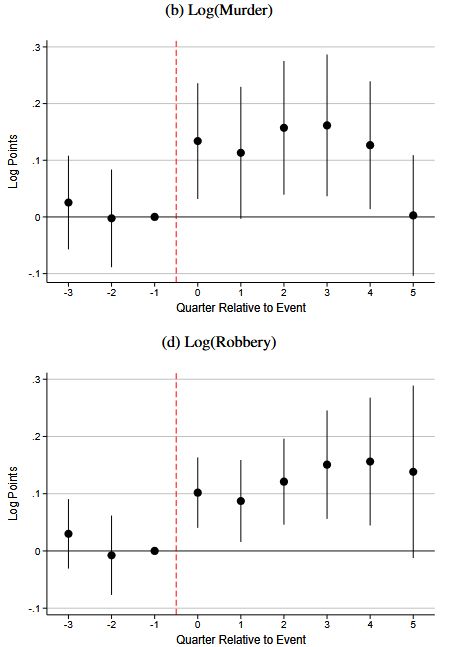
There’s also a sharp increase in robberies and murders. Nearby cities experience declines in arrest with no change in crime, suggesting that the increase may be a response to the incident itself. I rule out other potential explanations, including investigations into the law enforcement agency. 7/n
July 31, 2025 at 8:20 PM
There’s also a sharp increase in robberies and murders. Nearby cities experience declines in arrest with no change in crime, suggesting that the increase may be a response to the incident itself. I rule out other potential explanations, including investigations into the law enforcement agency. 7/n
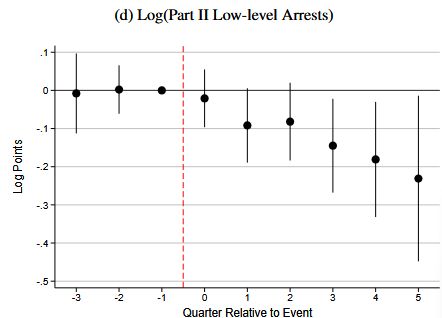
After a high-profile police killing, arrests for low-level offenses continually plummet in the community where the death occurred for at least 1.5 years while arrests for more serious offenses do not change. Public scrutiny of police seems to be a driving factor in the reduction in arrests. 6/n
July 31, 2025 at 8:19 PM
After a high-profile police killing, arrests for low-level offenses continually plummet in the community where the death occurred for at least 1.5 years while arrests for more serious offenses do not change. Public scrutiny of police seems to be a driving factor in the reduction in arrests. 6/n