



Endre Borbáth
@eborbath.bsky.social
💼 Assistant Prof. for Participation Research @uniheidelberg.bsky.social
🧐 PI, The New Climate Divide (Emmy Noether)
🧳 Guest @wzb.bsky.social
🔬 Parties • Movements • Participation • Climate Politics
📈 Quant Methods
🇪🇺 Western, Central & Eastern EU
⛰️🚴♀️🏃
🧐 PI, The New Climate Divide (Emmy Noether)
🧳 Guest @wzb.bsky.social
🔬 Parties • Movements • Participation • Climate Politics
📈 Quant Methods
🇪🇺 Western, Central & Eastern EU
⛰️🚴♀️🏃
❓What structures competition?
Economic and cultural conflicts matter across the region, but cultural conflicts gain importance, especially where democratic backsliding intensifies (notably 🇭🇺🇵🇱). Romania looks different: cultural issues are least salient there, and its overall structuration is weaker
Economic and cultural conflicts matter across the region, but cultural conflicts gain importance, especially where democratic backsliding intensifies (notably 🇭🇺🇵🇱). Romania looks different: cultural issues are least salient there, and its overall structuration is weaker


January 16, 2026 at 1:02 PM
❓What structures competition?
Economic and cultural conflicts matter across the region, but cultural conflicts gain importance, especially where democratic backsliding intensifies (notably 🇭🇺🇵🇱). Romania looks different: cultural issues are least salient there, and its overall structuration is weaker
Economic and cultural conflicts matter across the region, but cultural conflicts gain importance, especially where democratic backsliding intensifies (notably 🇭🇺🇵🇱). Romania looks different: cultural issues are least salient there, and its overall structuration is weaker
Main finding: programmatic competition is substantial and (mostly) stable over time, but it varies across countries.
Latvia comes out as the most programmatic system, Hungary and Poland remain fairly programmatic even under erosion, while Romania is the clear laggard.
Latvia comes out as the most programmatic system, Hungary and Poland remain fairly programmatic even under erosion, while Romania is the clear laggard.

January 16, 2026 at 1:02 PM
Main finding: programmatic competition is substantial and (mostly) stable over time, but it varies across countries.
Latvia comes out as the most programmatic system, Hungary and Poland remain fairly programmatic even under erosion, while Romania is the clear laggard.
Latvia comes out as the most programmatic system, Hungary and Poland remain fairly programmatic even under erosion, while Romania is the clear laggard.
🚨New publication on cleavages in party competition in Central and Eastern Europe 🚨
CEE party systems are famously volatile, but does that mean that they are unstructured?
❓I ask whether competition has become programmatically organized around enduring cleavages
🔗 doi.org/10.1177/1354...
Thread 👇
CEE party systems are famously volatile, but does that mean that they are unstructured?
❓I ask whether competition has become programmatically organized around enduring cleavages
🔗 doi.org/10.1177/1354...
Thread 👇


January 16, 2026 at 1:02 PM
🚨New publication on cleavages in party competition in Central and Eastern Europe 🚨
CEE party systems are famously volatile, but does that mean that they are unstructured?
❓I ask whether competition has become programmatically organized around enduring cleavages
🔗 doi.org/10.1177/1354...
Thread 👇
CEE party systems are famously volatile, but does that mean that they are unstructured?
❓I ask whether competition has become programmatically organized around enduring cleavages
🔗 doi.org/10.1177/1354...
Thread 👇
The paradox: name changes don’t buy much. In the experiments, party-name labels have tiny effects (a “movement” label is only ~+1pp vs no label). Voters react more to signals about how parties organize (e.g., ties to civil society) and they tend to punish established parties that rebrand.

January 6, 2026 at 10:39 AM
The paradox: name changes don’t buy much. In the experiments, party-name labels have tiny effects (a “movement” label is only ~+1pp vs no label). Voters react more to signals about how parties organize (e.g., ties to civil society) and they tend to punish established parties that rebrand.
Who drives this change? Mostly newer parties, parties on the right, and often parties in opposition, with the radical right especially prone to adopting “movement”-like branding. The shift is also stronger where party systems are more unstable (higher electoral volatility).


January 6, 2026 at 10:39 AM
Who drives this change? Mostly newer parties, parties on the right, and often parties in opposition, with the radical right especially prone to adopting “movement”-like branding. The shift is also stronger where party systems are more unstable (higher electoral volatility).
Big supply-side takeaway: since the 1960s, parties increasingly drop “party” and classic ideology words. By the early 2020s, nearly 2/3 of parties no longer identify as “parties” in their official name; “movement” references rise in waves (e.g., post-2008).

January 6, 2026 at 10:39 AM
Big supply-side takeaway: since the 1960s, parties increasingly drop “party” and classic ideology words. By the early 2020s, nearly 2/3 of parties no longer identify as “parties” in their official name; “movement” references rise in waves (e.g., post-2008).
Demand side: we ran two conjoint survey experiments (2023) in Austria, Germany, Italy, and Hungary, one on branding of a new party, one on rebranding an existing party, to see whether “nonclassical” labels actually help.

January 6, 2026 at 10:39 AM
Demand side: we ran two conjoint survey experiments (2023) in Austria, Germany, Italy, and Hungary, one on branding of a new party, one on rebranding an existing party, to see whether “nonclassical” labels actually help.
Supply side: we built a ballot-paper party-name dataset by manually coding name changes across 616 parties, 28 European countries, between 1945-2023 (or from the first competitive election). This lets us track how party labels evolve across decades and party systems.

January 6, 2026 at 10:39 AM
Supply side: we built a ballot-paper party-name dataset by manually coding name changes across 616 parties, 28 European countries, between 1945-2023 (or from the first competitive election). This lets us track how party labels evolve across decades and party systems.
🔔 New paper on party brands with @swenhutter.bsky.social in @poppublicsphere.bsky.social
We study the supply (how parties call themselves) and demand (what voters reward) sides. We pair a new European dataset of party names with conjoint experiments on voter reactions
OA 👉 doi.org/10.1017/S153...
We study the supply (how parties call themselves) and demand (what voters reward) sides. We pair a new European dataset of party names with conjoint experiments on voter reactions
OA 👉 doi.org/10.1017/S153...

January 6, 2026 at 10:39 AM
🔔 New paper on party brands with @swenhutter.bsky.social in @poppublicsphere.bsky.social
We study the supply (how parties call themselves) and demand (what voters reward) sides. We pair a new European dataset of party names with conjoint experiments on voter reactions
OA 👉 doi.org/10.1017/S153...
We study the supply (how parties call themselves) and demand (what voters reward) sides. We pair a new European dataset of party names with conjoint experiments on voter reactions
OA 👉 doi.org/10.1017/S153...
Why? 🤔
🔎 We examine this question with a causal mediation model.
⛔ It is not because people feel much riskier joining.
➡️ The demobilizing path runs mainly through lower perceived efficacy, especially identity-building/solidarity efficacy, and lower expected public support.
🔎 We examine this question with a causal mediation model.
⛔ It is not because people feel much riskier joining.
➡️ The demobilizing path runs mainly through lower perceived efficacy, especially identity-building/solidarity efficacy, and lower expected public support.

October 23, 2025 at 8:07 AM
Why? 🤔
🔎 We examine this question with a causal mediation model.
⛔ It is not because people feel much riskier joining.
➡️ The demobilizing path runs mainly through lower perceived efficacy, especially identity-building/solidarity efficacy, and lower expected public support.
🔎 We examine this question with a causal mediation model.
⛔ It is not because people feel much riskier joining.
➡️ The demobilizing path runs mainly through lower perceived efficacy, especially identity-building/solidarity efficacy, and lower expected public support.
We find that more politicization 𝐥𝐨𝐰𝐞𝐫𝐬 the willingness to protest.
👉 In the “highly politicized” condition, 48.0% were above the participation midpoint vs 57.8% under moderate politicization (−9.8 pp).
So, ramping up party cues and conflict can demobilize. 
👉 In the “highly politicized” condition, 48.0% were above the participation midpoint vs 57.8% under moderate politicization (−9.8 pp).
So, ramping up party cues and conflict can demobilize. 

October 23, 2025 at 8:07 AM
We find that more politicization 𝐥𝐨𝐰𝐞𝐫𝐬 the willingness to protest.
👉 In the “highly politicized” condition, 48.0% were above the participation midpoint vs 57.8% under moderate politicization (−9.8 pp).
So, ramping up party cues and conflict can demobilize. 
👉 In the “highly politicized” condition, 48.0% were above the participation midpoint vs 57.8% under moderate politicization (−9.8 pp).
So, ramping up party cues and conflict can demobilize. 
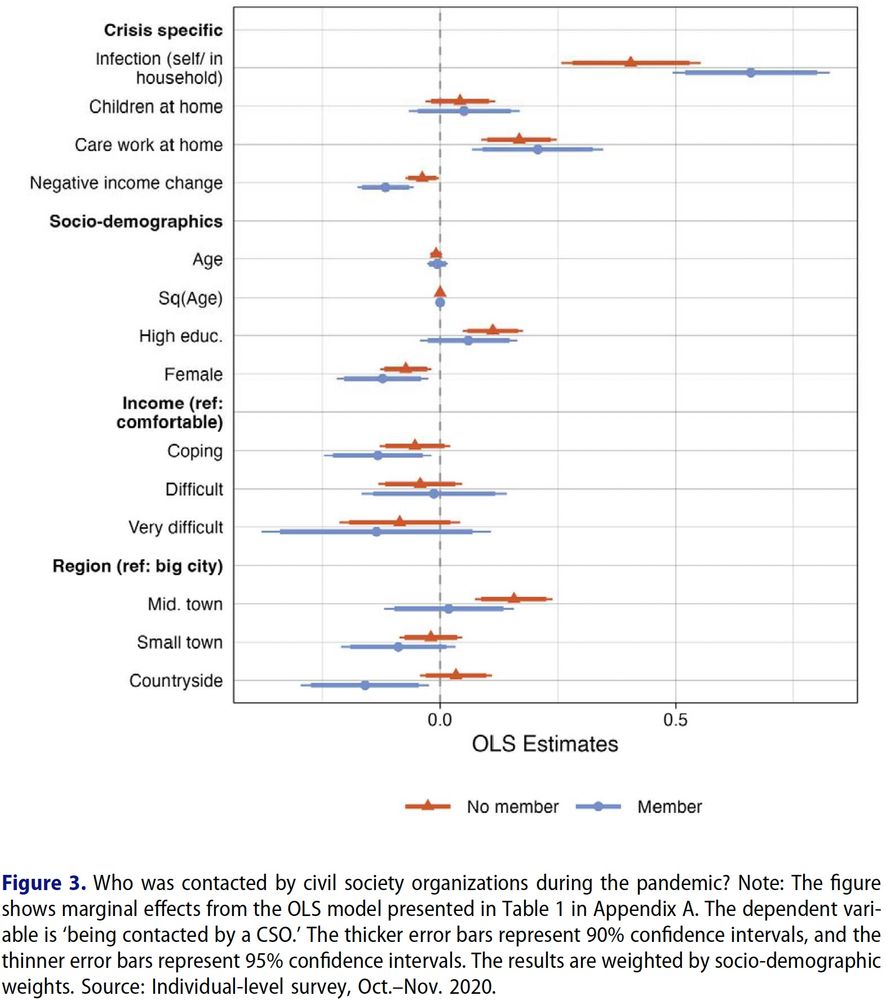
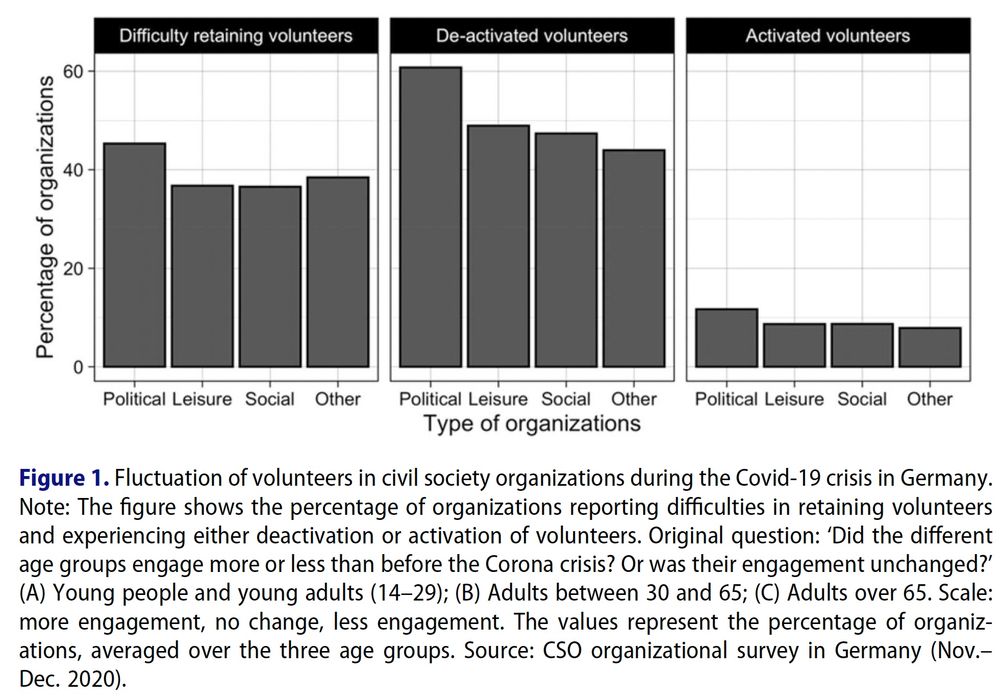
Who gets asked? Mostly the “usual suspects”: men, highly educated, better-off.
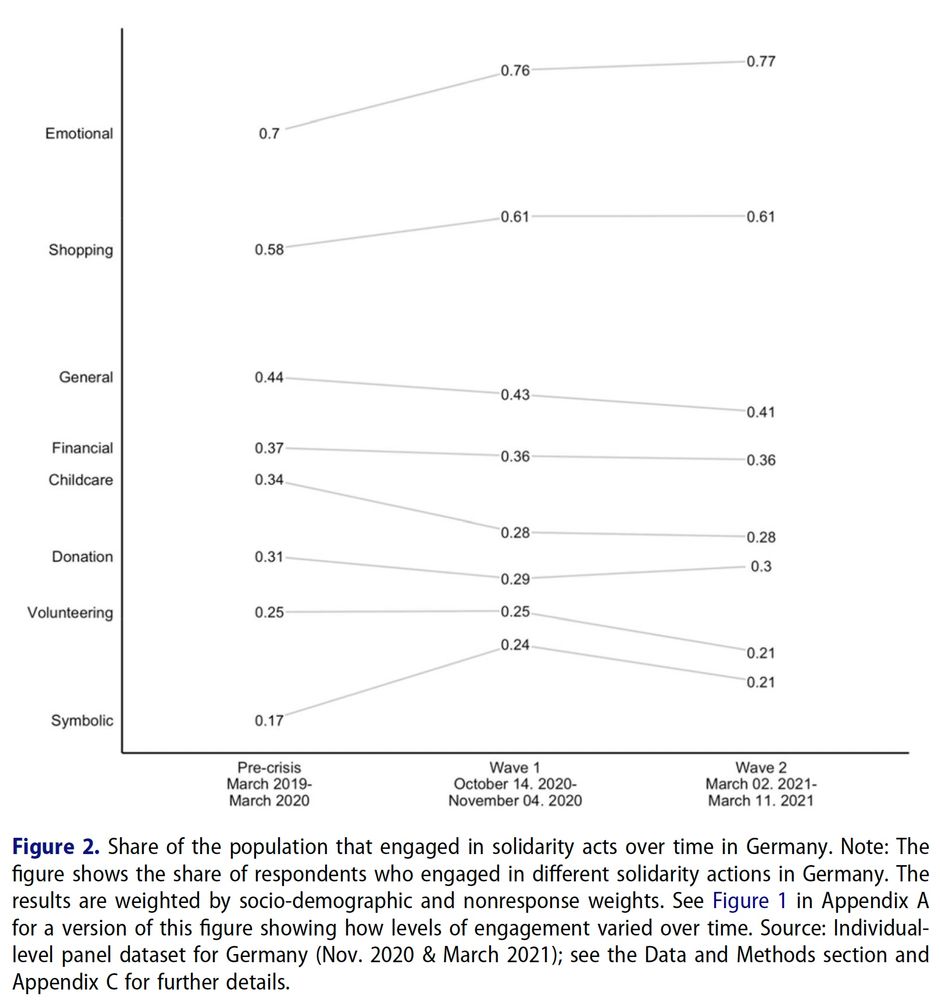
Even during a crisis, CSO outreach often reinforced inequalities rather than reducing them. Spontaneous, informal help grew, but formal volunteering stayed tied to social advantage.
Even during a crisis, CSO outreach often reinforced inequalities rather than reducing them. Spontaneous, informal help grew, but formal volunteering stayed tied to social advantage.
July 13, 2025 at 3:40 PM
Who gets asked? Mostly the “usual suspects”: men, highly educated, better-off.
Even during a crisis, CSO outreach often reinforced inequalities rather than reducing them. Spontaneous, informal help grew, but formal volunteering stayed tied to social advantage.
Even during a crisis, CSO outreach often reinforced inequalities rather than reducing them. Spontaneous, informal help grew, but formal volunteering stayed tied to social advantage.
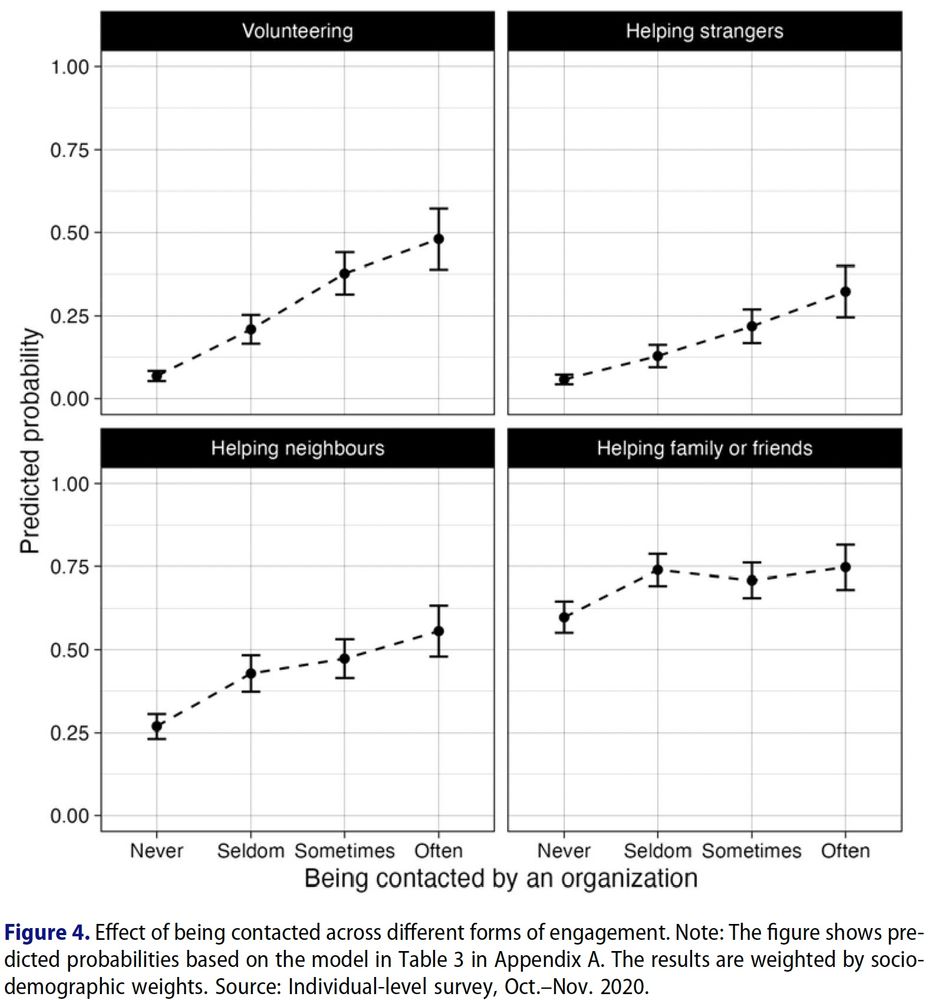
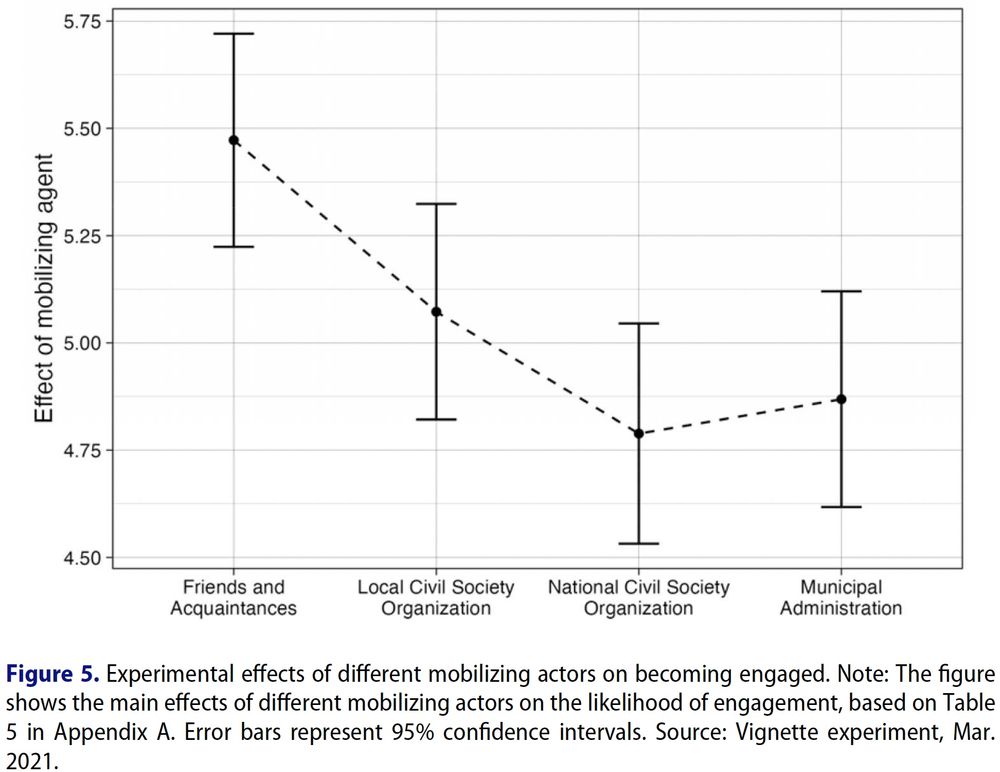
Our findings: Outreach by CSOs matters a lot.
People who were contacted were far more likely to volunteer, both formally and informally. But only ~1/3 of the population was ever asked, highlighting missed opportunities to engage willing citizens.
People who were contacted were far more likely to volunteer, both formally and informally. But only ~1/3 of the population was ever asked, highlighting missed opportunities to engage willing citizens.
July 13, 2025 at 3:40 PM
Our findings: Outreach by CSOs matters a lot.
People who were contacted were far more likely to volunteer, both formally and informally. But only ~1/3 of the population was ever asked, highlighting missed opportunities to engage willing citizens.
People who were contacted were far more likely to volunteer, both formally and informally. But only ~1/3 of the population was ever asked, highlighting missed opportunities to engage willing citizens.
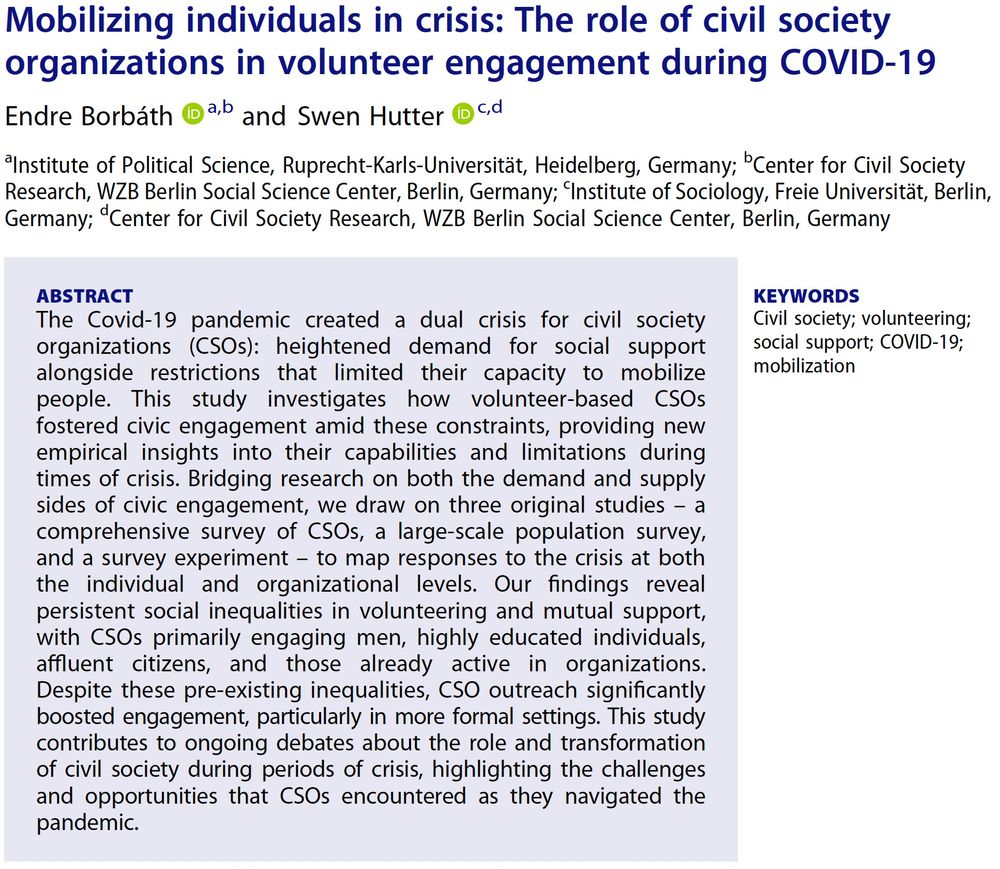
🚨 New article out in Journal of Civil Society with Swen Hutter!
We explore how civil society organizations (CSOs) mobilized volunteers during the COVID-19 pandemic, a moment of both rising need and shrinking organizational capacity.
📖 Open access link: doi.org/10.1080/1744...
We explore how civil society organizations (CSOs) mobilized volunteers during the COVID-19 pandemic, a moment of both rising need and shrinking organizational capacity.
📖 Open access link: doi.org/10.1080/1744...
July 13, 2025 at 3:40 PM
🚨 New article out in Journal of Civil Society with Swen Hutter!
We explore how civil society organizations (CSOs) mobilized volunteers during the COVID-19 pandemic, a moment of both rising need and shrinking organizational capacity.
📖 Open access link: doi.org/10.1080/1744...
We explore how civil society organizations (CSOs) mobilized volunteers during the COVID-19 pandemic, a moment of both rising need and shrinking organizational capacity.
📖 Open access link: doi.org/10.1080/1744...
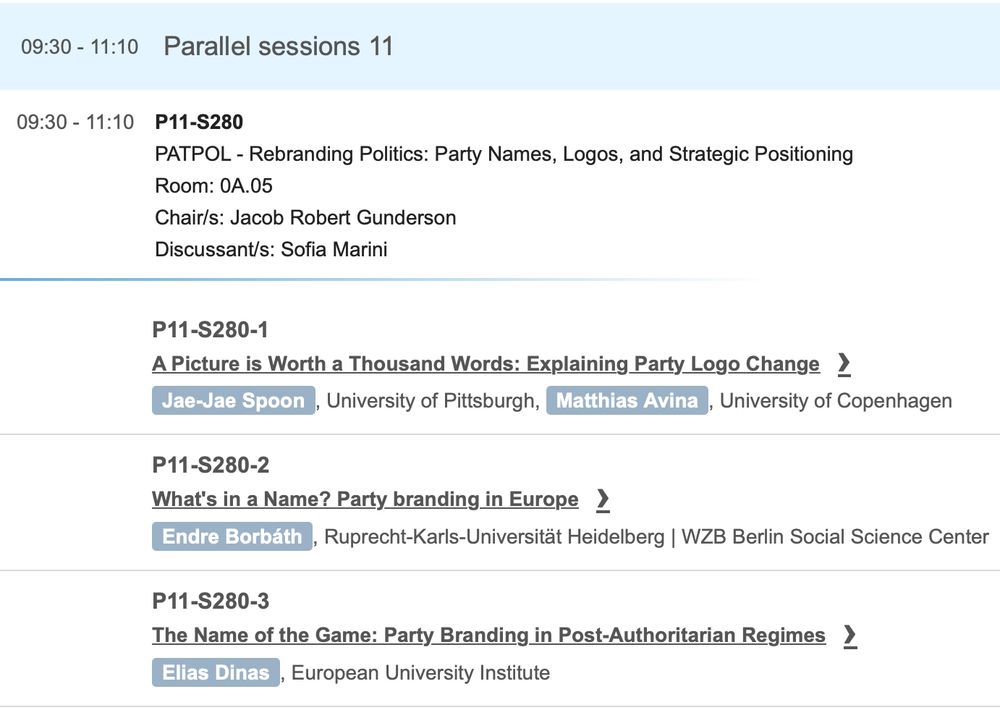
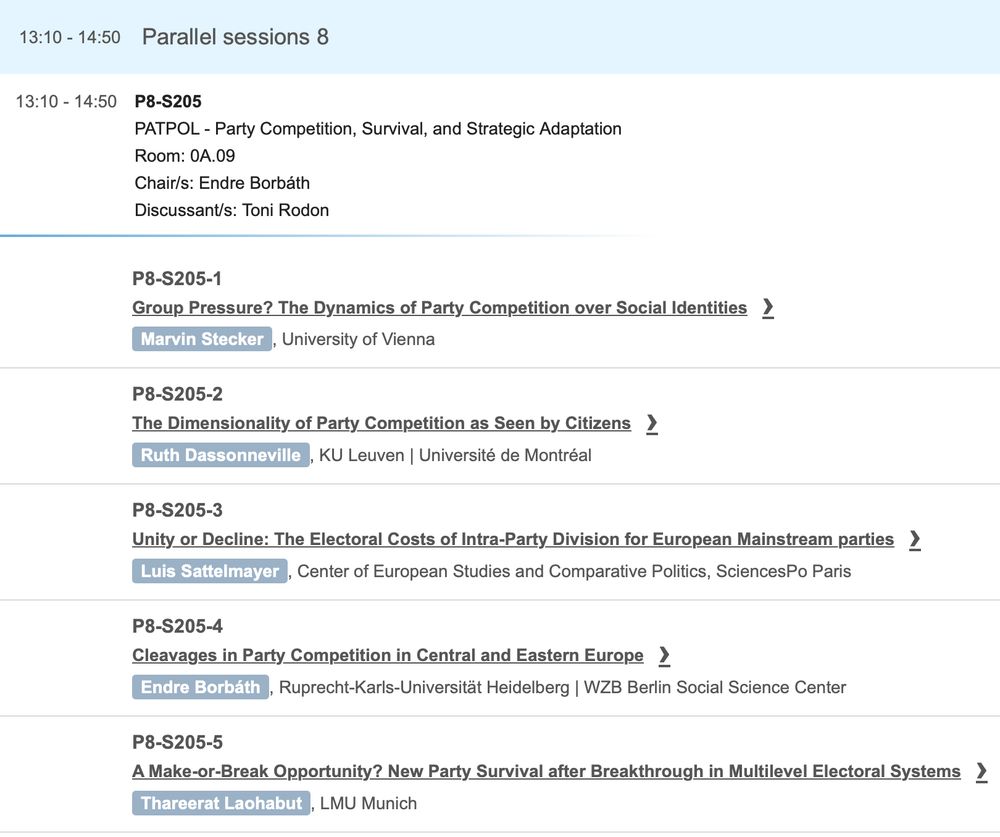
Off to Madrid for #EPSA2025
Assuming I survive the heat, I'll be presenting two papers and joining a roundtable on protests and social movements in Central and Eastern Europe.
Looking forward to catching up with many of you there!
Assuming I survive the heat, I'll be presenting two papers and joining a roundtable on protests and social movements in Central and Eastern Europe.
Looking forward to catching up with many of you there!

June 25, 2025 at 5:49 PM
Off to Madrid for #EPSA2025
Assuming I survive the heat, I'll be presenting two papers and joining a roundtable on protests and social movements in Central and Eastern Europe.
Looking forward to catching up with many of you there!
Assuming I survive the heat, I'll be presenting two papers and joining a roundtable on protests and social movements in Central and Eastern Europe.
Looking forward to catching up with many of you there!
These are the latest polls, aggregated by Mircea Comșa, presented here: doarungraficsatimaispun.wordpress.com/2024/11/22/a...


November 23, 2024 at 1:00 PM
These are the latest polls, aggregated by Mircea Comșa, presented here: doarungraficsatimaispun.wordpress.com/2024/11/22/a...
📢 I’m over the moon to share that my Emmy Noether project, The New Climate Divide will be supported by
@dfgpublic.bsky.social
!✨
It includes a 6-year postdoc position and two 4-year PhD positions, which I’ll be advertising soon. If ClimateDivide sounds intriguing, stay tuned! 👀
Short 🧵👇
@dfgpublic.bsky.social
!✨
It includes a 6-year postdoc position and two 4-year PhD positions, which I’ll be advertising soon. If ClimateDivide sounds intriguing, stay tuned! 👀
Short 🧵👇

November 10, 2024 at 2:12 PM
📢 I’m over the moon to share that my Emmy Noether project, The New Climate Divide will be supported by
@dfgpublic.bsky.social
!✨
It includes a 6-year postdoc position and two 4-year PhD positions, which I’ll be advertising soon. If ClimateDivide sounds intriguing, stay tuned! 👀
Short 🧵👇
@dfgpublic.bsky.social
!✨
It includes a 6-year postdoc position and two 4-year PhD positions, which I’ll be advertising soon. If ClimateDivide sounds intriguing, stay tuned! 👀
Short 🧵👇
3) The over-time analysis shows that resources are crucial for explaining the absolute number of environmental issues and their relative share in the protest arena. In contrast, political opportunities are associated with a higher protest turnout.


August 29, 2024 at 7:27 AM
3) The over-time analysis shows that resources are crucial for explaining the absolute number of environmental issues and their relative share in the protest arena. In contrast, political opportunities are associated with a higher protest turnout.
2) Compared to other protests, environmental events are better attended, more associated with NGOs (as opposed to parties and unions). They are both less contentious (e.g., petitions and symbolic forms ) and more confrontational (blockades and civil disobedience), but not violent.

August 29, 2024 at 7:26 AM
2) Compared to other protests, environmental events are better attended, more associated with NGOs (as opposed to parties and unions). They are both less contentious (e.g., petitions and symbolic forms ) and more confrontational (blockades and civil disobedience), but not violent.
1) 2019 represents a peak, particularly in terms of the number of protesters and the relative importance of environmental issues in the protest arena.
This is observed not only in Northwestern Europe but also in Central and Eastern Europe.
This is observed not only in Northwestern Europe but also in Central and Eastern Europe.

August 29, 2024 at 7:25 AM
1) 2019 represents a peak, particularly in terms of the number of protesters and the relative importance of environmental issues in the protest arena.
This is observed not only in Northwestern Europe but also in Central and Eastern Europe.
This is observed not only in Northwestern Europe but also in Central and Eastern Europe.
❓How widespread is the new wave of environmental protests, and how do the profile and drivers of these events differ from others?
🔥 New paper with Swen Hutter in the @jeppjournal.bsky.social on Environmental Protests in Europe
See the paper 👉 tandfonline.com/doi/full/10....
Three key findings 🧵
🔥 New paper with Swen Hutter in the @jeppjournal.bsky.social on Environmental Protests in Europe
See the paper 👉 tandfonline.com/doi/full/10....
Three key findings 🧵

August 29, 2024 at 7:23 AM
❓How widespread is the new wave of environmental protests, and how do the profile and drivers of these events differ from others?
🔥 New paper with Swen Hutter in the @jeppjournal.bsky.social on Environmental Protests in Europe
See the paper 👉 tandfonline.com/doi/full/10....
Three key findings 🧵
🔥 New paper with Swen Hutter in the @jeppjournal.bsky.social on Environmental Protests in Europe
See the paper 👉 tandfonline.com/doi/full/10....
Three key findings 🧵
I am grateful to all my wonderful colleagues at @wzb.bsky.social and @socfub.bsky.social for making the last five years in Berlin such a great experience!
I am happy to remain a guest at @wzb.bsky.social and to continue our ongoing work with Swen Hutter.
Stay tuned! :)
I am happy to remain a guest at @wzb.bsky.social and to continue our ongoing work with Swen Hutter.
Stay tuned! :)

January 25, 2024 at 11:57 AM
I am grateful to all my wonderful colleagues at @wzb.bsky.social and @socfub.bsky.social for making the last five years in Berlin such a great experience!
I am happy to remain a guest at @wzb.bsky.social and to continue our ongoing work with Swen Hutter.
Stay tuned! :)
I am happy to remain a guest at @wzb.bsky.social and to continue our ongoing work with Swen Hutter.
Stay tuned! :)
I am happy to share that I will be joining the University of Heidelberg as Junior Professor for Political Participation Research from February. 👨🎓🧐
I am really looking forward to meeting my new colleagues, new students, and being in such a green city surrounded by mountains!
I am really looking forward to meeting my new colleagues, new students, and being in such a green city surrounded by mountains!

January 25, 2024 at 11:56 AM
I am happy to share that I will be joining the University of Heidelberg as Junior Professor for Political Participation Research from February. 👨🎓🧐
I am really looking forward to meeting my new colleagues, new students, and being in such a green city surrounded by mountains!
I am really looking forward to meeting my new colleagues, new students, and being in such a green city surrounded by mountains!
📣 If you are studying in Berlin at the MA level, come and join us as a student assistant at the FU Berlin! 📣
We are excited to work together with you! 👋
🔎 We expect interest in social movements & parties, quant skills (R and/or Stata), English (German is not a must)
👉 Link shorturl.at/sALQ1
We are excited to work together with you! 👋
🔎 We expect interest in social movements & parties, quant skills (R and/or Stata), English (German is not a must)
👉 Link shorturl.at/sALQ1

October 11, 2023 at 1:57 PM
📣 If you are studying in Berlin at the MA level, come and join us as a student assistant at the FU Berlin! 📣
We are excited to work together with you! 👋
🔎 We expect interest in social movements & parties, quant skills (R and/or Stata), English (German is not a must)
👉 Link shorturl.at/sALQ1
We are excited to work together with you! 👋
🔎 We expect interest in social movements & parties, quant skills (R and/or Stata), English (German is not a must)
👉 Link shorturl.at/sALQ1