


Graham Ward
@edintone.mastodon.green.ap.brid.gy
Historian, Genealogist, Occasional writer
#Genealogy #Nonconformists #LocalHistory #TiddlyWiki #AncestryHour #Scrivener #Maps #Cycling #Geneadons #Genchat #Fedi22
🌉 bridged from ⁂ https://mastodon.green/@edintone, follow @ap.brid.gy to interact
#Genealogy #Nonconformists #LocalHistory #TiddlyWiki #AncestryHour #Scrivener #Maps #Cycling #Geneadons #Genchat #Fedi22
🌉 bridged from ⁂ https://mastodon.green/@edintone, follow @ap.brid.gy to interact
Sunken Medieval Cargo Ship Found–The Largest Vessel of Its Kind Ever Found https://www.goodnewsnetwork.org/sunken-medieval-cargo-ship-found-the-largest-vessel-of-its-kind-ever-found/

Sunken Medieval Cargo Ship Found–The Largest Vessel of Its Kind Ever Found
For 600 years, the waters off Copenhagen have hidden an exceptional secret. Now, maritime archaeologists from the Viking Ship Museum in Denmark reveal the discovery of the world’s largest “cog,” a medieval cargo ship whose size and previously unknown construction details offer new insight into the maritime technology and trade networks of the Middle Ages. […]
The post Sunken Medieval Cargo Ship Found–The Largest Vessel of Its Kind Ever Found appeared first on Good News Network.
www.goodnewsnetwork.org
January 15, 2026 at 7:56 AM
Sunken Medieval Cargo Ship Found–The Largest Vessel of Its Kind Ever Found https://www.goodnewsnetwork.org/sunken-medieval-cargo-ship-found-the-largest-vessel-of-its-kind-ever-found/
Reposted by Graham Ward

🇳🇴 **The Government of Norway allocates nine million NOK to save the Viking sleds**
"_In order to save the unique wooden sleds from Oseberg, they must be conserved using a method that does not exist yet._"
🔗 https://www.vikingtidsmuseet.no/english/news/norwegian-gov-funding.html
#conservation […]
"_In order to save the unique wooden sleds from Oseberg, they must be conserved using a method that does not exist yet._"
🔗 https://www.vikingtidsmuseet.no/english/news/norwegian-gov-funding.html
#conservation […]
Original post on qoto.org
qoto.org
January 14, 2026 at 7:43 PM
🇳🇴 **The Government of Norway allocates nine million NOK to save the Viking sleds**
"_In order to save the unique wooden sleds from Oseberg, they must be conserved using a method that does not exist yet._"
🔗 https://www.vikingtidsmuseet.no/english/news/norwegian-gov-funding.html
#conservation […]
"_In order to save the unique wooden sleds from Oseberg, they must be conserved using a method that does not exist yet._"
🔗 https://www.vikingtidsmuseet.no/english/news/norwegian-gov-funding.html
#conservation […]
The National Archives and RIBA to partner https://www.nationalarchives.gov.uk/about/news/the-national-archives-and-riba-to-partner/

The National Archives and RIBA to partner
The National Archives and the Royal Institute of British Architects (RIBA) are pleased to announce a partnership that will ensure the accessibility and preservation of its world-class Drawings and Archives Collections during the interim period between the conclusion of the V&A+RIBA Architecture Partnership in 2027 and the creation of a new permanent home for RIBA Collections. […]
www.nationalarchives.gov.uk
January 14, 2026 at 8:03 AM
The National Archives and RIBA to partner https://www.nationalarchives.gov.uk/about/news/the-national-archives-and-riba-to-partner/
How to eliminate 'corridor care' in hospitals? Remove the corridors! Too much hospital floor space is lost to rooms - storage, staff, admin and unnecessary partitions. Yes, some are needed and some patients do require isolation, but it's not an efficient use of space. #nhs #a&E #ed #corridorcare
January 13, 2026 at 1:11 PM
How to eliminate 'corridor care' in hospitals? Remove the corridors! Too much hospital floor space is lost to rooms - storage, staff, admin and unnecessary partitions. Yes, some are needed and some patients do require isolation, but it's not an efficient use of space. #nhs #a&E #ed #corridorcare
World’s Oldest Poisoned Arrowheads Date Back 60,000 Years, Show Hunters’ Knowledge of Toxins https://www.goodnewsnetwork.org/worlds-oldest-poisoned-arrowheads-date-back-60000-years-show-hunters-knowledge-of-toxins/

World’s Oldest Poisoned Arrowheads Date Back 60,000 Years, Show Hunters’ Knowledge of Toxins
The research team identified chemical residues of poison from gifbol, a poisonous plant still used by traditional hunters in the region.
www.goodnewsnetwork.org
January 13, 2026 at 8:03 AM
World’s Oldest Poisoned Arrowheads Date Back 60,000 Years, Show Hunters’ Knowledge of Toxins https://www.goodnewsnetwork.org/worlds-oldest-poisoned-arrowheads-date-back-60000-years-show-hunters-knowledge-of-toxins/
William Packwood was a tailor and #baptist preacher in #Northamptonshire and #bedfordshire. In 1848, he took his family to #newyork to start a new life, but sadly died on arrival. Read the full story here https://www.amazon.co.uk/William-Packwood-Tailor-Baptist-Preacher-ebook/dp/B0CNSC6MYT/

January 12, 2026 at 4:20 PM
William Packwood was a tailor and #baptist preacher in #Northamptonshire and #bedfordshire. In 1848, he took his family to #newyork to start a new life, but sadly died on arrival. Read the full story here https://www.amazon.co.uk/William-Packwood-Tailor-Baptist-Preacher-ebook/dp/B0CNSC6MYT/
Paul’s Address Book app updated! https://edintone.com/pauls-address-book-app-updated/ My 'address book' inspired by the Apostle Paul's letters and the book of Acts, has had a r

Paul’s Address Book app updated!
My ‘address book’ inspired by the Apostle Paul’s letters and the book of Acts, has had a refresh. More details here and you can try it and download it for free!
© Copyright : Graham Ward. All rights reserved.
edintone.com
January 11, 2026 at 8:25 PM
Paul’s Address Book app updated! https://edintone.com/pauls-address-book-app-updated/ My 'address book' inspired by the Apostle Paul's letters and the book of Acts, has had a r
Bartle, a family of watchmakers https://edintone.com/bartle-watchmaker/ The life and family of Walter G Bartle, Northampton watchmaker (1848-1910).

Bartle, a family of watchmakers
William N Terry was the curator of the Northampton Museum and Art Gallery from the 1960s until 1986. He had a wide range of interests and subject matter expertise – shoemaking and shoemakers, coins, watch and clockmaking, all associated with Northamptonshire. In 1966, his watch and clockmaking expertise was demonstrated in an extensive exhibition that he curated from the museum’s collection, supplemented from many private sources. For many years, the exhibition catalogue was the definitive listing of known makers in the county. It was the starting point of my own much extended online Clock and Watchmakers Index. This has continued to grow as more documentary sources have become accessible. The index is also added to from time to time as items come to light in private hands or appear in auction sales.
## Walter George Bartle
One such item was a silver pocket watch appearing recently for sale1
It was probably manufactured in the 1880s at Bartle’s premises in St Giles Street, Northampton.
Bartle family: Brigg & Kirton in Lindsey, Lincs. and Northampton & Wellingborough, Northants.
Walter G Bartle was born in Kirton in Lindsey, Lincolnshire in October 1847. His parents were William and Mary Bartle (nee White). William, also was a watchmaker in Kirton, as was his father, George. Mary’s father John White was another watchmaker in Kirton. Sadly, Mary died in 1850 aged just 21. Mary’s younger sister, Maria White, joined the family as housekeeper, whilst her brother Charles White was apprenticed to William.
White family: Kirton in Lindsey, Lincs.
William and Maria married in 1851. Subsequently, two more children arrived, Charles and Leonora. However, Maria also died in 1855 aged 23. Charles also followed his father’s occupation as a watchmaker. However, both young men, after serving their apprenticeships with their father, eventually settled in Northamptonshire. Charles to Silver Street, Wellingborough and Walter to 9 St Giles Street, Northampton.
Walter married Louisa Fanny Robinson in Derby in 1873, where Walter had been working since at least 1871. Walter and Louisa had four children: Reginald (1874), Edith (1876), Maud (1880) and Maria (1881). About 1875, they moved from Derby to Northampton. Walter seems to have originally worked with John A Hill a jeweller and silversmith in Bridge Street. By early 1878, he opened his own business at 9 St Giles Street.
In April 1879, Walter’s brother was married in St Giles, Northampton to Catherine Augusta Atkin; both gave their address as St Giles Street. It is reasonable to assume Charles was working with Walter at the time. By 1881, Charles had moved to 16 Midland Road, Wellingborough and was working independently in Silver Street, Wellingborough. Charles died in 1907.
Walter moved to larger premises two doors away at 13 St Giles Street in 18802.
Notice of move to 13 St Giles Street. Northampton Mercury – Saturday, 8 May 1880
Subsequently, in about 1893, Walter moved his shop to The Drapery, one of the more prominent streets in the town, where he should have enjoyed greater footfall. However, this seems not to have been a commercial success, since in July the same year, his whole stock is put up for sale for the benefit of his creditors.3 Walter seems to have picked himself up and re-established his business at 173 Kettering Road, at the time know as Brockhall Parade4 by 1901.
Watchmaking was not the only dimension of Walter and Louisa’s life. In politics, Walter was a Liberal and a member of the Northampton Reform Club. However, during the Bradlaugh crisis in 1884, Walter resigned his membership.
Both Walter and Louisa were accomplished musicians and members of the Northampton Choral Society. Walter was a frequent soloist, including popular songs like _The Village Blacksmith_ in his repertoire. In later life, Walter and Louisa lived at 5 Adams Avenue, Northampton.
Walter died in July 1910, and Louisa in 1922.
1. Sutton Hill Farm Country Auctions, Coventry Road, Broughton Astley, Leicester LE9 6EY. 14 November, 2025
2. Both these premises had been demolished by 1992 for the extension to the Guildhall.
3. “Peremptory Notice of the sale of the whole stock of Walter G. Bartle”, Northampton Chronicle and Echo – Tuesday, 10 July 1894
4. On the north side of the Kettering Road, between Cowper Street and Hood Street.
© Copyright : Graham Ward. All rights reserved.
edintone.com
January 11, 2026 at 8:22 PM
Bartle, a family of watchmakers https://edintone.com/bartle-watchmaker/ The life and family of Walter G Bartle, Northampton watchmaker (1848-1910).
The mission that began in a Circus: Ned Weeks and Abington Square https://edintone.com/ned-weeks-mission/ For more than twenty years, Ned Weeks preached to packed halls of working men and women, s

The mission that began in a Circus: Ned Weeks and Abington Square
Edwin “Ned” Weeks
In the late nineteenth century, on a modest plot near Abington Square in Northampton, an unlikely religious movement took root. What began in a wooden riding circus became one of the town’s most enduring centres of evangelistic work. At its heart stood a man as unconventional as the mission itself: Edwin “Ned” Weeks—illiterate, rough-edged, fearless, and widely loved.
For more than twenty years, Weeks preached to packed halls of working men and women, shaping a chapter of Northampton’s religious life that would be remembered long after his death.
## From Riding Circus to Revival
The story begins in the summer of 1875, when revival meetings were held in a temporary wooden circus near Abington Square. These services, led by visiting evangelists including J. Manton Smith and Ned Weeks, attracted large and enthusiastic crowds. Contemporary reporting noted that Weeks’ preaching was “especially attractive”, combining humour, blunt honesty, and emotional power.1
The circus proved an ideal venue. It was informal and welcoming, and—crucially—free from the social barriers that often discouraged the working poor from attending established churches. Anyone could enter without paying for a seat or fearing unwanted scrutiny.
The popularity of these meetings continued well beyond the initial revival. When the wooden structure was eventually demolished, supporters feared the work might falter. Instead, they resolved to secure the site permanently and erect a mission hall dedicated to evangelistic preaching.
Abington Square (c.1910). The former People’s Cafe on the left, fronted by the statue of Charles Bradlaugh, MP. On the right, the Abington Square Mission.
**Building a Mission for the People**
On 15 July 1878, the memorial stone of the new Abington Square Mission Hall was laid in a public ceremony marked by a striking spirit of unity. Clergymen of the Established Church stood alongside Nonconformist ministers, all emphasising that the building was to serve no single denomination, but the Gospel itself.2
The hall was designed to be plain but substantial. Measuring 96 feet by 50 feet and seating around 1,000 people, it was built for usefulness rather than ornament. Speakers repeatedly stressed that its purpose was to reach those often neglected by conventional religious institutions. One address recalled Christ’s own words as the ultimate test of authentic faith:_“The poor have the Gospel preached to them.”_ 2
The hall opened for worship in November 1878, with services conducted by prominent visiting preachers. It was even announced that Charles Haddon Spurgeon had promised to preach there in due course.3
Yet it was not a famous name that defined the hall’s character, but the steady presence of its missioner—Ned Weeks.
## The Making of “Ned” Weeks
Edwin Weeks’ early life was far removed from religious respectability. Born in Darenth, Kent about 1824 and raised near Dartford in Kent, he received no formal education and never learned to read or write. His childhood was harsh and undisciplined, shaped by hard labour and encouraged fighting. As a young man, he worked variously as a farm labourer, horse driver, foundry worker, and docker. After moving to London, he frequented boxing saloons, penny theatres, and other rough amusements, later describing himself as a committed infidel.4
His conversion came unexpectedly. A City missionary left a religious tract at his home. Unable to read it himself, Weeks asked his son to do so. To his astonishment, the tract appeared to describe his own life and character in precise detail. Curiosity replaced hostility, and he soon began attending mission services.4
The decisive turning point came at a meeting in Spitalfields, where a converted chimney sweep preached. There, Weeks committed himself to Christ. The change was immediate and dramatic.
## An Evangelist Without a Script
Despite his illiteracy, Weeks possessed an extraordinary natural gift for speech. He preached without notes, relying entirely on memory, improvisation, and force of personality. His sermons were vivid, humorous, and direct, often tailored instinctively to his audience.
Invitations to preach arrived from across London and beyond. While still working full-time, he spoke at meetings almost every night. He once addressed a congregation of some 2,000 people beneath Spurgeon’s Metropolitan Tabernacle.4
In 1876, on the recommendation of fellow evangelists, Weeks was invited to Northampton to conduct a one-week mission in the Abington Square circus. The response was overwhelming. One week became three, and the success was such that the committee retained him for a year at a salary of 30 shillings per week. In accepting the post, Weeks lost his engineering job in London—but gained a calling that would define the rest of his life.4
## Twenty-One Years of Tireless Labour
For more than two decades, Ned Weeks laboured with astonishing intensity. He visited homes during the day, preached multiple times on Sundays, and conducted weekday meetings, open-air services, and village missions whenever invited.
His jovial manner and fearless honesty attracted vast crowds. At its peak, the Mission Hall could accommodate between 1,000 and 1,700 people, comprising almost entirely of working men and women.5
He was renowned for his quick wit. On one occasion, a drunken heckler threatened to throw beer at him during an open-air meeting. Weeks calmly replied, “Oh no you won’t—you think too much of it,” neatly disarming the situation.6
Under his leadership, the mission became self-supporting. Debts on the hall were steadily reduced, and a rich social life developed around bazaars, children’s entertainments, musical evenings, and lectures. Weeks himself often entertained crowds with demonstrations using an electric battery, blending education and amusement.7
## Retirement, Death, and Memorial
In 1897, failing health forced Weeks to retire after twenty-one years of service. He was then believed to be about 73 years old. The decision was deeply painful for both him and the congregation. In recognition of his life’s work, supporters established an annuity of £1 per week for the remainder of his life.4[ efn_note]_Northampton Mercury_ , 9 April 1897 – Retirement and annuity for Ned Weeks.[/efn_note]
He died on 8 April 1899 at his home in Whitworth Road, aged 74.8
His funeral drew immense crowds. The Mission Hall was filled to capacity before the cortege arrived, and large numbers of working people left their employment to attend. Clergy from multiple denominations took part, reflecting the broad respect in which he was held.8
A memorial service followed shortly afterwards, again filling the hall.9
In 1901, a marble tablet was unveiled in the Mission Hall by the Mayor of Northampton, permanently commemorating Weeks’ work.1011
Renamed The Central Hall
## A Legacy That Endured
Rev. Frederick Martyn
The Abington Square Mission continued long after Ned Weeks’ death. Ned’s immediate successor was Rev. Frederick Martyn, who, since 1893, had been the minister of Kingsley Park Wesleyan Church, Northampton. Further missioners maintained the tradition over the years that followed, although changing social patterns gradually reduced the congregations. The mission continued to be the focus of evangelical mission, although through the mid-20th century, it was renamed The Central Hall and managed by trustees. From the 1940s, the building was also the home of the Northampton Mens’ Own, and choir from 1946.
In 1967, the Elim Pentecostal Church revitalised the hall, restoring and adapting it for continued worship.12
Finally, in August 1974—nearly a century after the first revival meetings in the old circus—the Mission closed with a service of thanksgiving, marking the end of a unique chapter in Northampton’s religious history.13
The building’s original name reappears after conversion to Urban Tiger. [Credit: “Abington Square Mission, Northampton” by Steven Collis, CC BY-NC-ND 2.0]
Unlike many other historic buildings in Northampton, this one was to find a new life, and from 1974 it was the Irish Centre. Subsequently, in 2002, it was refurbished and transitioned into Urban Tiger.
Yet the legacy of Ned Weeks endured. As later writers observed, he so deeply impressed his character upon the town that his name became a legend.13
He could not read. He never wrote a sermon. But through conviction, courage, and compassion, Edwin “Ned” Weeks helped build not merely a hall of bricks and mortar, but a living community—one of which it could truly be said, _“This man and that man was born there.”_ 14
A biography _Ned Weeks of Northampton. Story of his life_ was published in 1902.15
1. _Northampton Mercury_ , 21 August 1875 – Revival meetings in the Abington Square circus.
2. _Northampton Mercury_ , 20 July 1878 – Laying of the memorial stone of Abington Square Mission Hall.
3. _Northampton Mercury_ , 2 November 1878 – Opening of the Mission Hall.
4. _Northampton Chronicle and Echo_ , 5 April 1897 – “A Remarkable Career” (retirement of Ned Weeks).
5. _Northampton Chronicle and Echo_ , 21 August 1974 – Closing of the Abington Square Mission.
6. _Northampton Chronicle and Echo_ , 10 June 1927 – Anecdote of Ned Weeks’ open-air preaching.
7. _Northampton Mercury_ , 9 October 1880 – Bazaar and financial progress of the Mission.
8. _Northampton Mercury_ , 14 April 1899 – Death and funeral of Ned Weeks.
9. _Northampton Mercury_ , 21 April 1899 – Memorial service at the Mission Hall.
10. _Northampton Chronicle and Echo_ , 22 October 1901 – Unveiling of marble tablet.
11. _Northampton Mercury_ , 25 October 1901 – Memorial tablet to Ned Weeks.
12. _Northampton Chronicle and Echo_ , 3 August 1974 – Elim Pentecostal Church farewell
13. _Northampton Chronicle and Echo_ , 21 August 1974 – Retrospective history of the Mission.
14. Psalm 87:5
15. WAKE, B. Barry, and Edwin WEEKS. _Ned Weeks of Northampton. Story of His Life._ Passmore & Alabaster, 1902.
© Copyright : Graham Ward. All rights reserved.
edintone.com
January 11, 2026 at 8:22 PM
The mission that began in a Circus: Ned Weeks and Abington Square https://edintone.com/ned-weeks-mission/ For more than twenty years, Ned Weeks preached to packed halls of working men and women, s
Veteran Becomes First Double-Amputee to Climb Highest Peak on Every Continent: Conquering the 7 Summits https://www.goodnewsnetwork.org/veteran-is-first-double-amputee-to-climb-highest-peak-on-every-continent-conquering-a-7-summit-challenge/

Veteran Becomes First Double-Amputee to Climb Highest Peak on Every Continent: Conquering the 7 Summits
A veteran who lost both his legs became the first double amputee to reach the summit of the highest peaks on every continent in the world.
www.goodnewsnetwork.org
January 11, 2026 at 7:56 AM
Veteran Becomes First Double-Amputee to Climb Highest Peak on Every Continent: Conquering the 7 Summits https://www.goodnewsnetwork.org/veteran-is-first-double-amputee-to-climb-highest-peak-on-every-continent-conquering-a-7-summit-challenge/
Ambush at Wallbank https://edintone.com/ambush-at-wallbank/ On a dark Wednesday night in September 1769, the quiet road between Northampton and Kingst

Ambush at Wallbank
**A Brutal Highway Robbery in Georgian Northamptonshire**
The attack upon William Walker by Anthony Horner and William Craddock [Image by OpenAI]
On a dark Wednesday night in September 1769, the quiet road between Northampton and Kingsthorpe became the scene of a shocking act of violence that would end on the gallows.
Between nine and ten o’clock, William Walker the Younger, a farmer of Kingsthorpe, was walking home from Northampton when he reached a place known as Wallbank, or Welbeck1,
the place where the Kingsthorpe Road crosses the Welbeck stream in Kingsthorpe Hollow, about one mile north of the town. There, in what contemporary reports described as a “little three-cornered close in the footway,” his journey was suddenly and violently interrupted.
Without a word spoken, a footpad2 emerged and fired a large horse regimental pistol at Walker at point-blank range. The shot missed. Acting instinctively, Walker struck his attacker in the head or face, knocking him down and attempting to seize him. But the struggle was far from over.
Believing himself overpowered, the assailant cried out for help. Almost immediately, one—possibly two—other men rushed from nearby concealment. They fell upon Walker with pistols and other weapons, beating him about the head and face “in a very inhuman manner.” After robbing him of a canvas purse containing three or four shillings, the attackers fled, leaving Walker unconscious on the ground, bleeding heavily.
Somehow, after a time, Walker regained enough strength to make his way—only with great difficulty—to the Cock Inn at Kingsthorpe. A surgeon was sent for at once to dress his wounds. Though he lay dangerously ill, early reports held out hope for his recovery.3
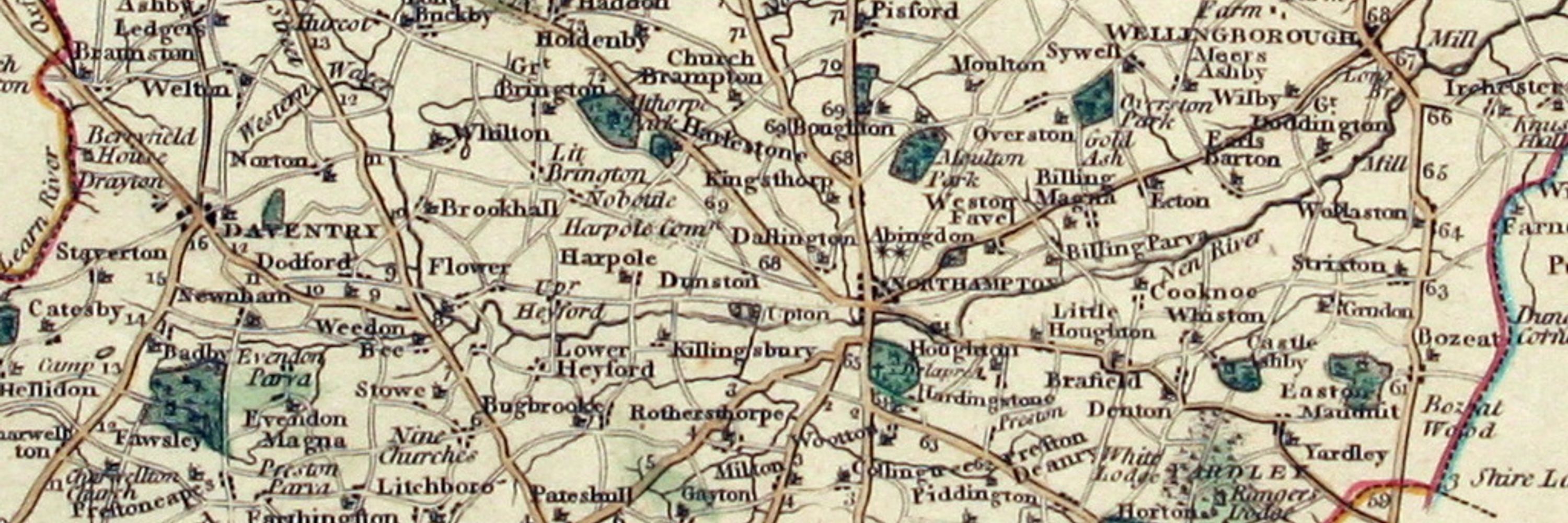
A section of Thomas Eyre and Thomas Jeffreys, engraved by William Faden, map, 1780. Showing the location of Wallbank and the Gallows.
**Suspects and Suspicion**
The attack caused immediate alarm. By Thursday morning, two men had been committed to Northampton Gaol on strong suspicion of carrying out the robbery and assault: William Craddock, a weaver of Northampton, and Anthony Harwood, a dragoon quartered in the town.4
Their names appeared among those listed to be tried at the forthcoming Lent Assizes of 1770. Craddock stood accused of most cruelly wounding William Walker the Younger. Harwood was charged with being concerned in the same attack—firing a pistol at Walker and robbing him of his purse. These were serious offences compared with some of the other cases scheduled for trial: theft, burglary, and killing a deer.5
**Trial and Sentence**
Both men appeared at the Lent Assizes before senior judges.6 The outcome was decisive. At the close of the proceedings in March 1770, William Craddock and Anthony Harwood were sentenced to death for cruelly wounding and robbing William Walker.
Less than a month later, their sentences were carried out. On Saturday in April 1770, the two men were executed at Northampton.
At the place of execution, both acknowledged their involvement in the wounding but denied the robbery itself. Craddock declared that he had been the man who so inhumanely attacked Walker, stating that Harwood stood ready to assist him if he were overpowered. By their own confession, they admitted that they intended to continue in such desperate acts and even to murder anyone who opposed them.
Harwood, aged 26, had spent ten years in the army and was born at Barnard Castle, County Durham. Craddock, only about 21 years old, was a native of Wellingborough and worked as a weaver.
**Gallows and Landscape**
At the time of their execution, Northampton’s gallows had already moved through several locations over the centuries. Earlier sites included the Abington Gallows and later the “new gallows” near Abington Grove. By the late 18th century, executions took place on publicly owned land near the Racecourse, a site that remained in use until 1818.
Sites of the gallows near the meeting point of the parish boundaries of Abington, Kingsthorpe and Northampton
At the time of their execution, the gallows were located at the “new” site near the junction of Abington Grove and Holly Road.
The history of Northampton’s executions is literally built into the modern town:
* 1612–1651: The Abington Gallows stood north of Abington Avenue in “Gallows Close”.
* 1651–1779: The site shifted to Abington Grove. When the Crescent Medical Centre was being extended, human bones were discovered at this very location.
* 1780–1818: The gallows moved one last time to the corner of the Racecourse, near where the White Elephant stands today.
The physical landscape of the crime also left echoes in later years. In the late 19th century, part of Semilong Road near its junction with Kingsthorpe Road became known as ‘Cut Throat Lane’78, a name that chillingly recalls the violence of earlier generations. It is possible that this junction corresponded with the ‘little three-cornered close’ mentioned in the original report of the ambush.9
**The Weaver Behind the Crime**
The story of William Craddock is particularly striking. Though the Craddock family had long-standing roots in Northamptonshire as millers and farmers across multiple villages, this William followed a different path. Born in Wellingborough in 1749 and working as a weaver, he appears in records as a young man living in Cow Lane, Northampton, in 1768.10 William would only have been 20 years of age and therefore ineligible to vote. At the time, this was a closely fought contest and significant numbers of votes were classed as invalid on grounds of age, or boarders and lodgers claiming to be householders.11
It was this same William Craddock who would, within a year, become the central figure in one of the most brutal highway robberies recorded in the county’s Georgian press.
**A Crime Remembered**
The ambush at Wallbank was more than a robbery gone wrong. It was a calculated and violent attack that shocked contemporaries, filled newspaper columns, and ended in public execution. The place, the people, and even the road itself carried the memory forward—long after the blood had been washed from the footway and the gallows dismantled.
It remains a stark reminder of the dangers of 18th-century travel, and of how swiftly a single night’s violence could seal a young man’s fate.
1. For more on the area known as Wallbank or Welbeck see https://edintone.com/semilong/#welbeck
2. A highwayman or robber on foot
3. Northampton Mercury of Monday 18 September 1769
4. Coventry Standard – Monday 18 September 1769 | p 3 col 3
5. Northampton Mercury – Monday 19 March 1770 | p 3 col 4
6. Either Mr Chief Baron Parker or Mr Justice Aston. Craddock
7. Northampton Mercury – Saturday 11 May 1889, page 6
8. For more on Cut Throat Lane see https://edintone.com/semilong/#cut-throat-lane
9. Northampton Mercury of Monday 18 September 1769
10. A state of the poll for Members of Parliament to represent the town and borough of Northampton; as it was taken … March, and … April, 1768; … addressed to the free and independent electors … in the interest of the Hon. Thomas Howe. 1795
11. Grenby, M.O. and Chalus, E. (2024), Elections in 18th-Century England: Polling, Politics and Participation. Parliamentary History, 43: 5-19. https://doi.org/10.1111/1750-0206.12719
© Copyright : Graham Ward. All rights reserved.
edintone.com
January 9, 2026 at 10:16 PM
Ambush at Wallbank https://edintone.com/ambush-at-wallbank/ On a dark Wednesday night in September 1769, the quiet road between Northampton and Kingst
William Craddock and his family https://edintone.com/william-craddock-family/ Three generations of the Craddock family of Kingsthorpe, Northamptonshire. (c1680-1770)

William Craddock and his family
This post provides some additional background on William Craddock, the main subject of Ambush at Wallbank
## A personal note and the Craddock family
William Craddock’s grandfather was this author’s 7xGreat Grandfather. In theory, everyone has 256 7xGreat Grandfathers, although this number can be slightly less as a consequence of intermarriage. Sadly, it would not be unusual to find some miscreants among their descendants.
William Craddock (1749-1770), his parents and grandparents
For over 200 years, members of the Craddock family were millers in several villages in central Northamptonshire: Maidwell, Tichmarsh, Earls Barton, Hardingstone, Harlestone, Overstone and Kingsthorpe. Notably in Kingsthorpe, the family operated two mills: the upper watermill, later known as Walker’s Mill and a windmill that stood opposite the Windmill public house on the Welford Road, Northampton. Our interest focuses on the Kingsthorpe branch descended from William Craddock and Christian Bailey. It is not certain where William was born but he may have been the son of Francis Craddock and Ann Wilson a husbandman (farmer) in Overstone.
William and Christian were married at St Giles, Northampton but lived in Kingsthorpe, where they had nine children who were all christened and St John the Baptist, Kingsthorpe. William was one of the Kingsthorpe millers and was succeeded by his eldest son also William. It was from William and Christian’s second son John that this author’s family is descended. John seems to have been a farmer and married Mary Dickenson, from another established Kingsthorpe family. The youngest son, Francis, moved to Wellingborough, where he married Susanna Chapman, the daughter of a baker. They had at least one son, William, born in 1749. He later worked as a weaver. His father may have died when he was young in 1755 at Wellingborough and subsequently moved to Northampton with his mother, Susanna, as she was the subject of a settlement examination initiated by St Peter’s Overseers of the Poor in 1795 against the Wellingborough parish overseers1. It appears she remained in Northampton as she was buried at St Peter’s, Northampton in 1801.
1. Examination of Susanna Craddock, 240P/073/41, Settlement papers; Northampton, St Peter, Overseers of the Poor, Northamptonshire Archives.
© Copyright : Graham Ward. All rights reserved.
edintone.com
January 9, 2026 at 9:39 PM
William Craddock and his family https://edintone.com/william-craddock-family/ Three generations of the Craddock family of Kingsthorpe, Northamptonshire. (c1680-1770)
Ambush at Wallbank https://edintone.com/ambush-at-wallbank/ On a dark Wednesday night in September 1769, the quiet road between Northampton and Kingst
Ambush at Wallbank
**A Brutal Highway Robbery in Georgian Northamptonshire**
The attack upon William Walker by Anthony Horner and William Craddock [Image by OpenAI]
On a dark Wednesday night in September 1769, the quiet road between Northampton and Kingsthorpe became the scene of a shocking act of violence that would end on the gallows.
Between nine and ten o’clock, William Walker the Younger, a farmer of Kingsthorpe, was walking home from Northampton when he reached a place known as Wallbank, or Welbeck1,
the place where the Kingsthorpe Road crosses the Welbeck stream in Kingsthorpe Hollow, about one mile north of the town. There, in what contemporary reports described as a “little three-cornered close in the footway,” his journey was suddenly and violently interrupted.
Without a word spoken, a footpad2 emerged and fired a large horse regimental pistol at Walker at point-blank range. The shot missed. Acting instinctively, Walker struck his attacker in the head or face, knocking him down and attempting to seize him. But the struggle was far from over.
Believing himself overpowered, the assailant cried out for help. Almost immediately, one—possibly two—other men rushed from nearby concealment. They fell upon Walker with pistols and other weapons, beating him about the head and face “in a very inhuman manner.” After robbing him of a canvas purse containing three or four shillings, the attackers fled, leaving Walker unconscious on the ground, bleeding heavily.
Somehow, after a time, Walker regained enough strength to make his way—only with great difficulty—to the Cock Inn at Kingsthorpe. A surgeon was sent for at once to dress his wounds. Though he lay dangerously ill, early reports held out hope for his recovery.3
A section of Thomas Eyre and Thomas Jeffreys, engraved by William Faden, map, 1780. Showing the location of Wallbank and the Gallows.
**Suspects and Suspicion**
The attack caused immediate alarm. By Thursday morning, two men had been committed to Northampton Gaol on strong suspicion of carrying out the robbery and assault: William Craddock, a weaver of Northampton, and Anthony Harwood, a dragoon quartered in the town.4
Their names appeared among those listed to be tried at the forthcoming Lent Assizes of 1770. Craddock stood accused of most cruelly wounding William Walker the Younger. Harwood was charged with being concerned in the same attack—firing a pistol at Walker and robbing him of his purse. These were serious offences compared with some of the other cases scheduled for trial: theft, burglary, and killing a deer.5
**Trial and Sentence**
Both men appeared at the Lent Assizes before senior judges.6 The outcome was decisive. At the close of the proceedings in March 1770, William Craddock and Anthony Harwood were sentenced to death for cruelly wounding and robbing William Walker.
Less than a month later, their sentences were carried out. On Saturday in April 1770, the two men were executed at Northampton.
At the place of execution, both acknowledged their involvement in the wounding but denied the robbery itself. Craddock declared that he had been the man who so inhumanely attacked Walker, stating that Harwood stood ready to assist him if he were overpowered. By their own confession, they admitted that they intended to continue in such desperate acts and even to murder anyone who opposed them.
Harwood, aged 26, had spent ten years in the army and was born at Barnard Castle, County Durham. Craddock, only about 21 years old, was a native of Wellingborough and worked as a weaver.
**Gallows and Landscape**
At the time of their execution, Northampton’s gallows had already moved through several locations over the centuries. Earlier sites included the Abington Gallows and later the “new gallows” near Abington Grove. By the late 18th century, executions took place on publicly owned land near the Racecourse, a site that remained in use until 1818.
Sites of the gallows near the meeting point of the parish boundaries of Abington, Kingsthorpe and Northampton
At the time of their execution, the gallows were located at the “new” site near the junction of Abington Grove and Holly Road.
The history of Northampton’s executions is literally built into the modern town:
* 1612–1651: The Abington Gallows stood north of Abington Avenue in “Gallows Close”.
* 1651–1779: The site shifted to Abington Grove. When the Crescent Medical Centre was being extended, human bones were discovered at this very location.
* 1780–1818: The gallows moved one last time to the corner of the Racecourse, near where the White Elephant stands today.
The physical landscape of the crime also left echoes in later years. In the late 19th century, part of Semilong Road near its junction with Kingsthorpe Road became known as ‘Cut Throat Lane’78, a name that chillingly recalls the violence of earlier generations. It is possible that this junction corresponded with the ‘little three-cornered close’ mentioned in the original report of the ambush.9
**The Weaver Behind the Crime**
The story of William Craddock is particularly striking. Though the Craddock family had long-standing roots in Northamptonshire as millers and farmers across multiple villages, this William followed a different path. Born in Wellingborough in 1749 and working as a weaver, he appears in records as a young man living in Cow Lane, Northampton, in 1768.10 William would only have been 20 years of age and therefore ineligible to vote. At the time, this was a closely fought contest and significant numbers of votes were classed as invalid on grounds of age, or boarders and lodgers claiming to be householders.11
It was this same William Craddock who would, within a year, become the central figure in one of the most brutal highway robberies recorded in the county’s Georgian press.
**A Crime Remembered**
The ambush at Wallbank was more than a robbery gone wrong. It was a calculated and violent attack that shocked contemporaries, filled newspaper columns, and ended in public execution. The place, the people, and even the road itself carried the memory forward—long after the blood had been washed from the footway and the gallows dismantled.
It remains a stark reminder of the dangers of 18th-century travel, and of how swiftly a single night’s violence could seal a young man’s fate.
1. For more on the area known as Wallbank or Welbeck see https://edintone.com/semilong/#welbeck
2. A highwayman or robber on foot
3. Northampton Mercury of Monday 18 September 1769
4. Coventry Standard – Monday 18 September 1769 | p 3 col 3
5. Northampton Mercury – Monday 19 March 1770 | p 3 col 4
6. Either Mr Chief Baron Parker or Mr Justice Aston. Craddock
7. Northampton Mercury – Saturday 11 May 1889, page 6
8. For more on Cut Throat Lane see https://edintone.com/semilong/#cut-throat-lane
9. Northampton Mercury of Monday 18 September 1769
10. A state of the poll for Members of Parliament to represent the town and borough of Northampton; as it was taken … March, and … April, 1768; … addressed to the free and independent electors … in the interest of the Hon. Thomas Howe. 1795
11. Grenby, M.O. and Chalus, E. (2024), Elections in 18th-Century England: Polling, Politics and Participation. Parliamentary History, 43: 5-19. https://doi.org/10.1111/1750-0206.12719
© Copyright : Graham Ward. All rights reserved.
edintone.com
January 9, 2026 at 9:38 PM
Ambush at Wallbank https://edintone.com/ambush-at-wallbank/ On a dark Wednesday night in September 1769, the quiet road between Northampton and Kingst
William Craddock and his family https://edintone.com/william-craddock-family/ Three generations of the Craddock family of Kingsthorpe, Northamptonshire. (c1680-1770)
William Craddock and his family
This post provides some additional background on William Craddock, the main subject of Ambush at Wallbank
## A personal note and the Craddock family
William Craddock’s grandfather was this author’s 7xGreat Grandfather. In theory, everyone has 256 7xGreat Grandfathers, although this number can be slightly less as a consequence of intermarriage. Sadly, it would not be unusual to find some miscreants among their descendants.
William Craddock (1749-1770), his parents and grandparents
For over 200 years, members of the Craddock family were millers in several villages in central Northamptonshire: Maidwell, Tichmarsh, Earls Barton, Hardingstone, Harlestone, Overstone and Kingsthorpe. Notably in Kingsthorpe, the family operated two mills: the upper watermill, later known as Walker’s Mill and a windmill that stood opposite the Windmill public house on the Welford Road, Northampton. Our interest focuses on the Kingsthorpe branch descended from William Craddock and Christian Bailey. It is not certain where William was born but he may have been the son of Francis Craddock and Ann Wilson a husbandman (farmer) in Overstone.
William and Christian were married at St Giles, Northampton but lived in Kingsthorpe, where they had nine children who were all christened and St John the Baptist, Kingsthorpe. William was one of the Kingsthorpe millers and was succeeded by his eldest son also William. It was from William and Christian’s second son John that this author’s family is descended. John seems to have been a farmer and married Mary Dickenson, from another established Kingsthorpe family. The youngest son, Francis, moved to Wellingborough, where he married Susanna Chapman, the daughter of a baker. They had at least one son, William, born in 1749. He later worked as a weaver. His father may have died when he was young in 1755 at Wellingborough and subsequently moved to Northampton with his mother, Susanna, as she was the subject of a settlement examination initiated by St Peter’s Overseers of the Poor in 1795 against the Wellingborough parish overseers1. It appears she remained in Northampton as she was buried at St Peter’s, Northampton in 1801.
1. Examination of Susanna Craddock, 240P/073/41, Settlement papers; Northampton, St Peter, Overseers of the Poor, Northamptonshire Archives.
© Copyright : Graham Ward. All rights reserved.
edintone.com
January 9, 2026 at 9:35 PM
William Craddock and his family https://edintone.com/william-craddock-family/ Three generations of the Craddock family of Kingsthorpe, Northamptonshire. (c1680-1770)
#068 One reason for optimism https://diagramclub.substack.com/p/068-one-reason-for-optimism

#068 One reason for optimism
Newsletter changes for 2026 / New hat reveal
diagramclub.substack.com
January 8, 2026 at 8:04 AM
#068 One reason for optimism https://diagramclub.substack.com/p/068-one-reason-for-optimism
Southmyllewong or Semilong? https://edintone.com/semilong/ Semilong is an area of Northampton that was developed in the late 19th and early 20th cent

Southmyllewong or Semilong?
Semilong is an area of Northampton that was developed in the late 19th and early 20th centuries. The regular pattern of streets heading in an east-west direction down from Semilong Road to St Andrews Road has added to the close community feel of the area. It might be assumed that before this area became part of expanding Northampton it was largely open fields. This however is only partially true and an oversimplification. In the past, the area was considerably different. Before the Medieval town of Northampton expanded its perimeter and built a new boundary wall, Semilong Road was the main road from Northampton towards Market Harborough and Leicester, rejoining the modern alignment of the Harborough Road at Kingsthorpe Hollow. This is well illustrated in Alderman Frank Lee’s conjectural map produced in 19531.
Conjectural map of early Northampton by Frank Lee
There is no mention of St Andrew’s Priory in the Domesday Survey (1086) and it is believed that the Saxon town of Northampton lay partially in ruins after the attacks and occupation by the Danes. Simon de Senlis I is credited with founding the Priory of St Andrew probably between 1093-1100 2. As the boundary of the priory is shared with the new extended town wall it seems likely they were planned if not built at the same time. It would have been near this date that the main route north from the town moved from the Semilong Road route to the new Kingsthorpe Road alignment from the North Gate located near what is today Regents Square.
There is no known surviving map but we can infer this from the archaeology of the early street pattern of the town. This is perhaps more clearly seen in Speed’s 1610 plan of the town.
Speed’s plan of Northampton, 1610
Site of Medieval features on Law’s map of 1847
Until Northampton itself expanded further in the late 19th century the area to the west of Semilong Road was in the parish of Kingsthorpe and the area to the east of Semilong Road terminating abruptly as Kingsthorpe Hollow was in Northampton. The name Semilong is itself interesting, and in this form probably unique. The 280,000 entries in the Gazetteer of British Place Names3 does not reveal any similar places in Britain and Google Maps only identifies the name with Northampton. However, if we turn to historical sources we can begin to understand its origins.
## Southmyllewong – the origins of the name
A Kingsthorpe deed cites a, now lost, will of Henry Coup of Northampton referring to 3 acres of arable land in the field of Kingsthorpe above the furlong called ‘Southmyllewonge’4.
Another early deed refers to a “Walter Delepert bought of John Pekke Bailiff in the town of Kingsthorpe half acre of land in the furlong he calls Sowthmylnewonge.”5
Unravelling “Southmyllewonge”, it can be read as “South-Mill-Wong”. Kingsthorpe had three watermills North or Far Mill (later known as Walker’s Mill), Nether Mill at the bottom of Mill Lane in the village and South Mill, also known as St Andrew’s Mill, adjacent to Miller’s Meadow (or Paddy’s Meadow) in St Andrews Road. Wong (which sometimes appears as Wang) is an Old English word meaning, a piece of meadowland, an open field’.
Taken together, “South-Mill-Wong” describes the area between St Andrews Road and Semilong Road as a meadow adjoining the Kingsthorpe South Mill.
## Cut Throat Lane
Not the most welcoming address, but one that was not uncommon in Victorian England, if not earlier. It is possible that some streets acquired this name by repute although more often the name is used to refer to a narrow lane or shortcut with no footpath and walls or hedges to either side. The last 150 metres of Semilong Road before it joined the Kingsthorpe Road at the Hollow was known by this appellation. The road was “made up” and rejoined Semilong Road with Kingsthorpe Hollow in 18896.
## Welbeck or Wallbank?
The area we now refer to as Kingsthorpe Hollow was until the late 19th century often referred to as Wallbank7 which took its name from the Welbeck stream that passes under the Kingsthorpe/Harborough Road at the lowest point. This stream will be familiar to the properties on Balfour Road today.
Kingsthorpe Hollow itself, a more modern name for the area, was the site of a minor battle in the English Civil, as I have written about previously. The area was previously known as Walbeck, Welbeck or Wallbank, named after a stream that now flows under the road at the lowest point in ‘the Hollow’.
The 1767 enclosure plan of the parish of Kingsthorpe shows the fields on either side of the Kingsthorpe Road as Wall Bank Close and Great Wall Bank Close. The Welbeck stream is also a clear feature and boundary on the map.
Part of the 1767 Enclosure plan of Kingsthorpe
Here the town of Northampton met the parish of Kingsthorpe, but that too was not a straightforward or even a straight boundary. The area we know as Semilong was part of Kingsthorpe as was the area to the east of the Kingsthorpe Road extending as far south as the Racecourse. Northampton extended only into the area between Semilong and Barrack Roads as far north as Kingsthorpe Hollow.
Ancient parish boundaries between Kingsthorpe, Dallington and Northampton
## Welbeck Leper Hospital
In Medieval times there existed in this area of Kingsthorpe Hollow a short-lived leper hospital known as Welbeck Hospital. To date, the existence of the hospital is only known from documents and no archaeological evidence to pinpoint its location has been found.
It seems likely that this building would have been within ‘greater’ Northampton rather than Kingsthorpe, outside the town walls and close to a water supply.
It was first noted by Dr Cox in the Victoria County History of Northampton, volume 2 published in 19068. Subsequently, Serjeantson wrote a short note for the Northamptonshire Natural History Society and Field Club on discovering an additional reference to the hospital. All date from the 14th century and no further evidence seems to exist. By the time of the Dissolution, there was no trace of the institution. The only surviving records are as follows:
> On November 21st, 1301, Bishop Dalderby, who was then at Gayton, granted an indulgence of fifteen days to all benefactors of the sick men in the Hospital of “Walebek” without Northampton. 9
> A few months later (March 28th,1303), Dalderby’s successor in the See of Lincoln, Bishop Burghersh, who was paying a visit to Abington, granted twenty days’ indulgence “to all who of the goods given to them by God, contributed to the sustentation of the _poor lepers of the house of Walbek without the North Gate Northampton_.” 10
Subsequently, Rev Serjeantson located this grim reference to the Welbeck hospital in the Northamptonshire Coroner’s records:11
> “It happened at Walbeck, in the parish of Kingsthorpe, on Thursday after the Feast of St. Mark the Evangelist, 21 Edward III. (March 26th 1347 ), that a certain Richard de Wynwyck, a leper, was found dead in the Leper Hospital of Walbeck and was viewed by Andrew de Landwhat, the coroner, and the four nearest townships, viz., Kingsthorpe, Abington, Weston, Moulton, Boughton and Pitsford; who say on their oath that on Tuesday night after the feast of St. George (April 23rd ) in the year aforesaid, a certain Henry of “Ashebourne in le Peke,” servant of the lepers of Walbeck, struck the aforesaid Richard on the head with a hatchet worth a penny, and feloniously slew him in Walbeck and immediately fled. He had no chattels. On the same day, an inquest was held on another leper of Walbeck, Roger of Aylesbury, also slain by the said Henry of Ashebourne.” 12
Despite these references, it does not enable us to identify the location of the hospital. The coroner’s inquest places it in the parish of Kingsthorpe which would mean it would be north of the Welbeck stream and therefore could have been located in one of the closes later known as Wall Bank. However, it is perhaps strange that the larger town of Northampton should place a hospital in a neighbouring parish.
However, one further piece of secondary evidence exists that suggests the hospital was located in Northampton on the narrow triangle of land between Semilong and Kingsthorpe Road in Kingsthorpe Hollow. A field name survey was conducted in 1932 by pupils of Kingsthorpe Grove schools and an accompanying map was produced. This shows the Leper hospital (Lazar House) in the area bounded by Arnold Road and the junction of Semilong Road and Kingsthorpe Road. There is no evidence supporting this claim in the paperwork with the map and project, so can only be assumed to be a conjectured location as 600 years had passed from the last documented record of the hospital and the school survey.
Part of Kingsthorpe Field Survey, 1932
I am indebted to Mary Pilkington for her help and local research in connection with this post.
1. Lee, “A New Theory of the Origins and Early Growth of Northampton.”
2. Adkins, The Victoria History of the County of Northampton, 1:293.
3. https://gazetteer.org.uk
4. ”Henry IV [1367-1413] – Quod Henrus Coup de Northn legavit in testamento suo tres acras terr’ arabil’ jac’ in campis de Kyngesthorpe super stadio vocat’ Sowthmyllewonge.” Glover, _Kingsthorpiana; or, Researches in a Church Chest…,_ 25.
5. ”Walterus Delepert emit de Johne Pekke Ballivo ville de Kyngesthorpe dim’ acra terr’ in stadio vocat Sowthmylnewonge” Glover, _Kingsthorpiana; or, Researches in a Church Chest…,_ 25.
6. Northampton Mercury – Saturday 11 May 1889, page 6
7. ”Lot 2 – All that substantially erected Messuage or Tenement, situate at or near Wall-Bank in the parish of Kingsthorpe” _Northampton Mercury_ – Saturday 01 May 1880, page 4
8. Adkins and Serjeantson, _The Victoria History of the County of Northampton_ , 2:162.
9. Linc. Epis. Reg. Bishop Dalderby’s Memoranda, f. 40. [, Lincolnshire Archives, Ref.: DIOC/REG/3]
10. Linc. Epis. Reg. Bishop Burghersh’s Memoranda,f. 78. [Lincolnshire Archives, Ref.: DIOC/REG/3]
11. Serjeantson, “The Leper Hospitals of Northampton.”
12. Coroner’s Roll (Northants.),No. 113, M.11
© Copyright : Graham Ward. All rights reserved.
edintone.com
January 7, 2026 at 11:41 AM
Southmyllewong or Semilong? https://edintone.com/semilong/ Semilong is an area of Northampton that was developed in the late 19th and early 20th cent
If You Can’t Beat ‘Em, Eat ‘Em: Ecologists Combat Invasive Lionfish with Local Cuisine https://www.goodnewsnetwork.org/if-you-cant-beat-em-eat-em-ecologists-combat-invasive-lionfish-with-local-cuisine/

If You Can’t Beat ‘Em, Eat ‘Em: Ecologists Combat Invasive Lionfish with Local Cuisine
In parts of the Mediterranean, invasive lionfish have devastated local marine biodiversity, but an allegiance between fishermen and chefs may mean the invader has met its match. On the island of Cyprus, the strategy is now clear: if we can’t beat it, let’s eat it. Native to the Indo-Pacific the lionfish has been introduced to […]
The post If You Can’t Beat ‘Em, Eat ‘Em: Ecologists Combat Invasive Lionfish with Local Cuisine appeared first on Good News Network.
www.goodnewsnetwork.org
January 7, 2026 at 7:57 AM
If You Can’t Beat ‘Em, Eat ‘Em: Ecologists Combat Invasive Lionfish with Local Cuisine https://www.goodnewsnetwork.org/if-you-cant-beat-em-eat-em-ecologists-combat-invasive-lionfish-with-local-cuisine/
Hungary’s Famous Thermal Baths Are Saving the Country’s Famous Grasslands from Desertification https://www.goodnewsnetwork.org/hungarys-famous-thermal-baths-are-saving-the-countrys-famous-grasslands-from-desertification/

Hungary’s Famous Thermal Baths Are Saving the Country’s Famous Grasslands from Desertification
Drought is affecting the Great Hungarian Plain like never before, but a team of concerned citizens have hatched a clever plan to address it in the short term. It’s arguable what the Eastern European country is more famous for, its grasslands and horse heritage, or its thermal baths. The capital of Budapest is filled with […]
The post Hungary’s Famous Thermal Baths Are Saving the Country’s Famous Grasslands from Desertification appeared first on Good News Network.
www.goodnewsnetwork.org
January 3, 2026 at 7:57 AM
Hungary’s Famous Thermal Baths Are Saving the Country’s Famous Grasslands from Desertification https://www.goodnewsnetwork.org/hungarys-famous-thermal-baths-are-saving-the-countrys-famous-grasslands-from-desertification/
Reposted by Graham Ward

When Projectkin first launched on Substack, #familyhistorians and #genealogists were rare finds. It's now time to stretch beyond our roots and build “Skybridges!”
Learn more in my new post for Projectkin: “Skybridges Connect Communities Across Platforms” open.substack.com/pub/projectk...
Learn more in my new post for Projectkin: “Skybridges Connect Communities Across Platforms” open.substack.com/pub/projectk...

Skybridges Connect Communities Across Platforms
When Projectkin first launched on Substack, family historians and genealogists were rare finds. Now that we’ve become a vibrant community, it’s time to stretch beyond our roots and build “Skybridges!”
open.substack.com
January 2, 2026 at 2:10 PM
When Projectkin first launched on Substack, #familyhistorians and #genealogists were rare finds. It's now time to stretch beyond our roots and build “Skybridges!”
Learn more in my new post for Projectkin: “Skybridges Connect Communities Across Platforms” open.substack.com/pub/projectk...
Learn more in my new post for Projectkin: “Skybridges Connect Communities Across Platforms” open.substack.com/pub/projectk...
Western Tatami Mat Mania Keeping Alive Japan’s Traditional Woven Grass Flooring Industry https://www.goodnewsnetwork.org/western-tatami-mat-mania-keeping-alive-japans-traditional-woven-grass-flooring-industry/

Western Tatami Mat Mania Keeping Alive Japan’s Traditional Woven Grass Flooring Industry
Western admirers of Japanese aesthetic are keeping afloat tatami craftsmen in Japan, where modernity and maintenance requirements are driving down interest in this artisanal form of flooring. From Europe to the US and even in the Middle East, eager importers of tatami mats now account for a sizable amount of orders from workshops like that […]
The post Western Tatami Mat Mania Keeping Alive Japan’s Traditional Woven Grass Flooring Industry appeared first on Good News Network.
www.goodnewsnetwork.org
January 2, 2026 at 7:57 AM
Western Tatami Mat Mania Keeping Alive Japan’s Traditional Woven Grass Flooring Industry https://www.goodnewsnetwork.org/western-tatami-mat-mania-keeping-alive-japans-traditional-woven-grass-flooring-industry/
4,500 years ago, Worship of the Sun Took Place in This Recently-Uncovered Temple in Egypt https://www.goodnewsnetwork.org/4500-years-ago-worship-of-the-sun-took-place-in-this-recently-uncovered-temple-in-egypt/

4,500 years ago, Worship of the Sun Took Place in This Recently-Uncovered Temple in Egypt
An Italian-Egyptian archaeological mission has finally excavated a temple for the worship of the sun after it was identified over 100 years ago. It’s only one of two sun temples that have been definitively identified, and dates to the reign of King Nyuserre, the sixth ruler of the Old Kingdom’s Fifth Dynasty. He is credited […]
The post 4,500 years ago, Worship of the Sun Took Place in This Recently-Uncovered Temple in Egypt appeared first on Good News Network.
www.goodnewsnetwork.org
January 2, 2026 at 7:56 AM
4,500 years ago, Worship of the Sun Took Place in This Recently-Uncovered Temple in Egypt https://www.goodnewsnetwork.org/4500-years-ago-worship-of-the-sun-took-place-in-this-recently-uncovered-temple-in-egypt/
This fragment of wood is of a letter from Hostilius Flavianus to Flavius Cerialis the Commanding Officer of the IX Cohort of Batavians who were stationed at Vindolanda in about AD 97-105. He wishes Cerialis "a fortunate and happy New Year" […]
[Original post on mastodon.green]
[Original post on mastodon.green]

January 1, 2026 at 8:27 PM
This fragment of wood is of a letter from Hostilius Flavianus to Flavius Cerialis the Commanding Officer of the IX Cohort of Batavians who were stationed at Vindolanda in about AD 97-105. He wishes Cerialis "a fortunate and happy New Year" […]
[Original post on mastodon.green]
[Original post on mastodon.green]
Reposted by Graham Ward

We’re proud to be Patrons of The Charles Rennie Mackintosh Society.
Established 53 years ago to promote, encourage awareness, save threatened buildings and protect the Mackintosh legacy for future generations.
Please join the Society and support this vital work.
Established 53 years ago to promote, encourage awareness, save threatened buildings and protect the Mackintosh legacy for future generations.
Please join the Society and support this vital work.

January 1, 2026 at 7:00 PM
We’re proud to be Patrons of The Charles Rennie Mackintosh Society.
Established 53 years ago to promote, encourage awareness, save threatened buildings and protect the Mackintosh legacy for future generations.
Please join the Society and support this vital work.
Established 53 years ago to promote, encourage awareness, save threatened buildings and protect the Mackintosh legacy for future generations.
Please join the Society and support this vital work.